ABB HV/EHV power transformer legacy class (69-765 kV)
Manufacturer: ABB
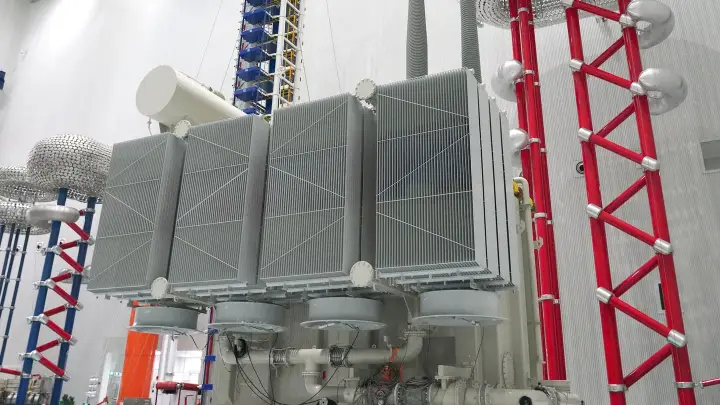
ABB-brand HV and EHV power transformers, 69-765 kV transmission class, a legacy fleet that trades brokered and off-market
This model is part of SecondWatt’s transformer research catalogue. Specifications and price observations are included where supported by sources. Equipment availability and commercial terms require confirmation.
ABB HV and EHV power transformer legacy class: 69-765 kV fleet history, 230 kV GSU priced at 650,000 USD, broker channels, inspection checklist, failures.
ABB's high-voltage power transformer line spanned 69 to 765 kV across generator step-up, autotransformer, and system intertie duties, built 1988-2020 on the TrafoStar design platform that Hitachi Energy still uses. The heritage reaches deeper: more than 500 units at 735-765 kV AC plus 800 kV UHVDC converter transformers trace to the ASEA, BBC, and Westinghouse lineages, including Pacific Intertie converter units at 620 MVA. Hitachi Energy counts more than 20,000 power transformers delivered at over 2,600 GVA.
US used-market ABB HV units cluster at 115-230 kV and 20-75 MVA. The priced anchor is a 42/56/70 MVA 230 kV GSU at 650,000 USD in Tampa; a 45/60/75 MVA 115 kV GSU and a 32/43/54 MVA 120 kV unit trade price-on-request. Above 345 kV no ABB unit carried an open asking price on any public venue in August 2026, because that tier moves through brokers against 144-week GSU lead times and demand up 274% since 2019. Dealers such as Transformer Exchange stock reconditioned 230 kV ABB autotransformers with warranty.
Why it matters
EHV transformers are the longest-lead item on the grid: GSU lead times averaged 144 weeks in Q2 2025 and high-capacity units quote up to 4 years. A legacy ABB unit already built, tested, and sitting domestic is one of the few paths to transmission-voltage capacity this decade, which is why 230 kV class units command 650,000 USD asks despite 1990s vintages.
Who buys it
Utilities replacing failed GSUs and autotransformers, independent power producers repowering plants, and hyperscale campuses taking transmission-voltage service buy this class. Data center projects above 100 MW increasingly need 230 kV yard transformers. Buyers accept brokered, price-on-request channels because a spare EHV unit can compress a 3-4 year outage to months.
Role in the data center
Transmission-interconnect yard transformer for campuses taking 115-230 kV service and stepping it to 34.5 kV distribution. This is transmission-class equipment, not data-hall gear: it sits in the utility interconnect yard and is typically the single longest-lead item on the project schedule, at a 144-week average for the GSU class.
Key specifications
| Voltage class range | 69-765 kV |
|---|---|
| US used-market cluster | 115-230 kV, 20-75 MVA |
| Priced anchor unit | 42/56/70 MVA 230 kV GSU at 650,000 USD |
| Heritage EHV fleet | 500+ units at 735-765 kV AC |
| HVDC heritage | 620 MVA Pacific Intertie converter units; 800 kV UHVDC |
| Delivered fleet (successor count) | 20,000+ units / 2,600+ GVA |
| GSU lead time (class) | 144 weeks average, Q2 2025 |
| GSU demand growth 2019-2025 | +274 % |
| Transport standard | IEEE C57.150-2023 (units >= 10 MVA) |
| Design platform | TrafoStar, continued under Hitachi Energy |
| Efficiency scope | Power class sits outside the 10 CFR 431 Subpart K distribution standards |
Technical summary
Class range: 69-765 kV; 20-620 MVA observed in heritage fleet. US used cluster: 115-230 kV primary, 20-75 MVA. Duties: GSU, autotransformer, system intertie, HVDC converter. Top of legacy range: 735-765 kV AC, 500+ units delivered. Design platform: TrafoStar (continued by Hitachi Energy). Test lineage: IEEE C57.12.00 / C57.12.90. Delivered fleet: 20,000+ power transformers, 2,600+ GVA. Transport rule: IEEE C57.150 applies to all moves at 10 MVA and above.
Major variations
GSUs (delta LV, wye HV, no LTC), transmission autotransformers (often 5-stage MVA ratings), and system intertie units differ in impedance and tap design. HVDC converter transformers are project-specific and rarely redeployable. Bushing vintage matters: OIP condenser bushings from the 1990s are a known fire risk and reprice units that lack recent bushing service.
Configurations and options
On a legacy HV or EHV unit the nameplate is the order sheet, and the items that set value are the MVA stages and cooling class (OA/FA/FA in US practice, ONAN/ONAF/ODAF in IEC), primary and secondary voltage and connection, impedance, BIL, and the tap arrangement. Tap control is the single largest cost and maintenance variable: de-energized tap changers are inexpensive and inert, while an on-load tap changer brings a motor drive, a control cabinet and the component that fleet surveys rank as a leading failure source. Bushing type and vintage are the second: oil-impregnated-paper condenser bushings are the legacy standard and a known tank-rupture fire path, and units with recent bushing service or dry RIP or RIS bushings reprice upward. Duty matters too, since GSUs run delta low voltage without an LTC while transmission autotransformers usually carry five-stage MVA ratings.
Compatibility and dependencies
This is transmission-yard equipment at 69-765 kV, not data-hall gear. High-voltage bushings land on overhead bus or a gas-insulated connection; the low-voltage side goes to bus duct or medium-voltage cable. Three coordination checks govern reuse. Impedance sets the fault current the downstream breakers have to interrupt, so a used unit with lower impedance than the design assumed raises the duty on gear already bought. BIL has to coordinate with the arrester scheme at the installed voltage class. A wye winding with a neutral bushing needs a defined grounding path. Cooling stages need station service, and an on-load tap changer needs control power. Every move at 10 MVA and above falls under IEEE C57.150-2023, so impact recorders, bracing and post-transport inspection are part of the purchase, and the site needs foundation, oil containment and fire separation per FM Global Data Sheet 5-4.
Pricing and availability
Trend: rising Electrical Trader's price history, published 2026-04-01, puts power transformer prices up 77% between 2019 and 2026 and generator step-up transformers up 45% since 2019, on copper up roughly 70% and grain-oriented electrical steel up 80-100% from 2020 to 2025. It records Q2 2025 lead times of 128 weeks for power transformers and 144 weeks for GSUs. PwC figures reported by pv magazine USA on 2026-05-11 put high-capacity units at up to four years, with GSU demand up 274% between 2019 and 2025. Lead time, new: 144 weeks average (GSU); up to 4 years high-capacity. Lead time, used or refurbished: 2-12 weeks. Warranty, used: 3-year typical from major US rebuilders.
Lifecycle and maintenance
Liquid-filled transformers routinely serve 30-40 years with annual oil screening, DGA on a 1-2 year cadence (or continuous online monitoring on critical units), and gasket or bushing service as tests dictate. Major US rebuilders remanufacture units to like-new condition with warranties up to 3 years (T&R Electric, Sunbelt Solomon), and reconditioned stock ships in days against 65-210 week new-build queues. Remaining paper life, estimated by furan testing, governs end-of-life valuation.
Thermal and emissions profile
Transformers produce no combustion emissions; the regulatory profile is efficiency and fluid. US distribution-class units fall under DOE 10 CFR 431 Subpart K efficiency standards, amended in 2024 with compliance from 2029 requiring 10-30% lower losses than 2016 levels. Fluid choice drives fire and environmental posture: mineral oil versus FR3 natural ester with a 360 C fire point and ready biodegradability. Legacy units require PCB screening, with clean units documented below 2 ppm.
Common failure points
- Windings — Dielectric failure; windings dominate major-failure statistics in CIGRE TB 642
- Bushings — Failure share rises with voltage class; OIP bushing faults can rupture tanks
- OLTC — Contact and mechanism wear; prominent failure source on substation units
- Winding deformation — Through-fault or transport damage shifting SFRA signature
- Cooling system — Pump, fan, and radiator degradation derating the unit
- Moisture and paper aging — Furans in oil and reduced degree of polymerization
Inspection checklist
DGA: dissolved gas analysis per IEEE C57.104; combustible-gas trend rise between 2 samples triggers investigation. Oil quality: dielectric breakdown, moisture, acidity, and furan tests; degree of polymerization below 200 marks end of paper life. Insulation resistance: megger HV/LV/ground; polarization index of 2.0 or higher passes. Power factor: insulation power factor testing; values above 1.0% on oil-filled windings warrant investigation. Turns ratio: TTR on all taps; deviation beyond 0.5% from nameplate fails. Winding resistance: three-phase balance within 2% between phases. Bushings: capacitance and power factor test; bushing failure share rises with voltage class per CIGRE TB 642. OLTC: inspect on-load tap changer diverter and selector; OLTCs are a leading failure component in CIGRE TB 642 fleet surveys.
Procurement channels
Brokered and dealer channels: Surplus Record listings (mostly price-on-request), Power Asset Recovery, J Turbines, and Transformer Exchange, which stocks reconditioned 230 kV ABB autotransformers with warranty. Above 345 kV, transactions run broker-to-utility without public listings.
Regional notes
US-built ABB units follow the IEEE C57.12.00 and C57.12.90 family at 60 Hz; European ABB production is IEC 60076 at 50 Hz and rarely suits US service, because a 50 Hz design energized at 60 Hz drops flux and secondary voltage roughly in proportion to the frequency ratio while a 60 Hz design at 50 Hz over-fluxes the core unless the applied voltage is cut in the same ratio. Power class sits outside the DOE distribution rules at 10 CFR 431 Subpart K. Imported replacements carry the Section 232 50% tariff on non-US steel and aluminum content, effective 2025-08-18, which is part of why domestic units hold value.