Howard Industries Three-phase pad-mounted transformers (45-10,000 kVA)
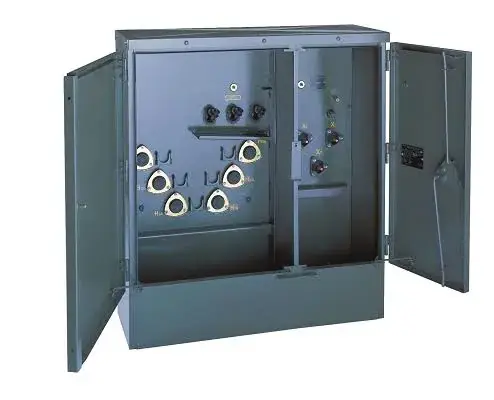
Howard Industries three-phase pad-mounts, 45 to 10,000 kVA in dead-front and live-front builds
This model is part of SecondWatt’s transformer research catalogue. Specifications and price observations are included where supported by sources. Equipment availability and commercial terms require confirmation.
Howard Industries pad-mount dossier: 45-10,000 kVA, BIL to 150 kV, dead-front and live-front builds, used pricing from 4,950 USD, inspection points.
Howard's three-phase pad-mount family spans 18 standard kVA sizes from 45 through 10,000, in dead-front and live-front compartment styles. High voltage runs 2,400-34,500 V delta or wye with BIL to 150 kV; low voltage covers 120-8,600 V or 14,400Y with BIL to 95 kV. Feeds are radial (3 bushing wells) or loop (6), enclosure integrity follows ANSI C57.12.28, and the design meets IEEE, NEMA, RUS, and DOE standards, with loadbreak bushings, current-limiting fuses, and arresters as options.
Howard is one of few US independents with a priced used listing as of August 2026: a 150 kVA live-front unit (4,800 V to 208Y/120) listed as-is untested at 4,950 USD, marked down from 15,000 USD, in California. That single point sits inside a well-priced class: eight pad-mount observations from 4,950 to 104,000 USD (roughly 10-42 $/kVA) in August 2026.
Company-level capacity investments (236 million USD in 2025, 100 million USD in 2026) cover this line's plants, and the same 40-65 week class lead time that drives buyers to used stock applies.
Why it matters
This is the volume class of the entire transformer shortage: 40-65 week leads, 10% supply deficit, demand up 34-41% since 2019. Howard's 10,000 kVA ceiling reaches sizes most pad-mount makers do not, covering the 3,750-5,000 kVA blocks hyperscale yards now specify, and its $4,950 as-is listing sits at the bottom of the class price range.
Who buys it
Utilities and co-ops (RUS builds), commercial developers, and data center site contractors buy the class; the live-front style serves legacy utility systems while dead-front loop-feed units dominate new campus work. As-is units like the 4,950 USD observation go to rebuilders and cost-driven industrial buyers with test capability.
Role in the data center
Campus pad-mount distribution at 1,000-5,000 kVA per unit, dead-front and loop-fed, stepping campus medium voltage to 480Y/277 at each hall or yard block. Eighteen published kVA sizes from 45 to 10,000 mean the same line covers both the small ancillary loads and the hall service, which simplifies spares and switching procedures across a site.
Key specifications
| kVA range | 45-10,000 kVA (18 sizes) |
|---|---|
| HV range | 2,400-34,500 V |
| HV BIL ceiling | 150 kV |
| LV BIL ceiling | 95 kV |
| Feed styles | radial (3 wells) / loop (6) |
| Enclosure standard | ANSI C57.12.28 |
| Class design standard | IEEE C57.12.34 |
| Priced used observation | 4,950 (150 kVA live-front, as-is) USD |
| Class comp, 2,500 kVA new | 104,000 USD |
| LV range | 120-8,600 V or 14,400Y |
| Compartment styles | dead-front (elbow) or live-front (exposed bushing) |
| Standards | IEEE, NEMA, RUS, DOE |
| Options | loadbreak bushings, current-limiting fuses, arresters |
| Class lead time, pad-mount 0-5 MVA | 40-65 weeks (2026) |
Technical summary
Sizes: 45, 75, 112.5, 150, 225, 300, 500, 750, 1000, 1500, 2000, 2500, 3000, 3750, 5000, 7000, 7500, 10000 kVA. HV: 2,400-34,500 V delta or wye; BIL to 150 kV. LV: 120-8,600 V or 14,400Y; BIL to 95 kV. Feeds: radial (3 wells) or loop (6). Compartments: dead-front or live-front. Enclosure integrity: ANSI C57.12.28. Standards: IEEE, NEMA, RUS, DOE. Fluid: mineral oil; 65 C rise class typical. Options: loadbreak bushings, CL fuses, arresters.
Major variations
Compartment style is the first choice: dead-front with elbow connections, or live-front with exposed bushings, which changes the switching procedure and the arc-flash study. Feed style follows, radial with three bushing wells or loop with six. The third axis is specification regime, RUS-compliant against commercial builds. Above 3,000 kVA the line overlaps unit substation duty and competes with close-coupled substation designs, so the top of the pad-mount range and the bottom of the substation range are quoted against each other.
Configurations and options
Eighteen standard kVA sizes run 45 through 10,000, with high voltage 2,400-34,500 V in delta or wye and BIL to 150 kV, and low voltage 120-8,600 V or 14,400Y with BIL to 95 kV. The first ordering choice is compartment style, dead-front with elbow connections or live-front with exposed bushings, because it changes the switching procedure and the arc-flash study for the life of the unit. The second is feed style: radial with three bushing wells or loop with six. The third is specification regime, RUS-compliant against a commercial build. Options are loadbreak bushings, current-limiting fuses and arresters. Enclosure integrity follows ANSI C57.12.28 and the designs are stated to meet IEEE, NEMA, RUS and DOE standards. Above 3,000 kVA the line overlaps unit substation duty, so the top of the pad-mount range and the bottom of the substation range get quoted against each other.
Compatibility and dependencies
The pad-mount interface is what a used buyer is really buying. A dead-front unit takes separable-connector elbow terminations on bushing wells, three for radial feed and six for loop; a live-front unit presents exposed bushings with different clearances and different personal protective equipment for switching. Low voltage at 120-8,600 V or 14,400Y lands on cable lugs or bus. High-voltage BIL to 150 kV and low-voltage BIL to 95 kV have to coordinate with the arrester scheme, and impedance has to be checked against the interrupting duty of the switchboard downstream. Enclosure integrity to ANSI C57.12.28 is the standard that governs tamper resistance and is what a siting in publicly accessible space depends on. The unit needs a concrete pad matched to its footprint, conduit stub-ups for the secondary, and a grounding connection, set by the serving utility's pad-mount standard.
Pricing and availability
Comparable secondary-market band: 10–42 $ per kVA. Trend: rising Electrical Trader's price history, published 2026-04-01, puts power transformer prices up 77% between 2019 and 2026, with distribution classes at the top of a 45-95% spread, on copper up roughly 70% and grain-oriented electrical steel up 80-100% from 2020 to 2025, together 50-55% of production cost. Annual increases have eased from 34.58% in 2022 to 8-10% in 2025, with 3-5% forecast for 2026. Terrapin Construction Group put pad-mount lead times at 0-5 MVA at 40-65 weeks on 2026-06-10. Lead time, new: 40-65 weeks (pad-mount class). Lead time, used or refurbished: 1-8 weeks. Warranty, used: 3-year typical from major US rebuilders.
Lifecycle and maintenance
Liquid-filled transformers routinely serve 30-40 years with annual oil screening, DGA on a 1-2 year cadence (or continuous online monitoring on critical units), and gasket or bushing service as tests dictate. Major US rebuilders remanufacture units to like-new condition with warranties up to 3 years (T&R Electric, Sunbelt Solomon), and reconditioned stock ships in days against 65-210 week new-build queues. Remaining paper life, estimated by furan testing, governs end-of-life valuation.
Thermal and emissions profile
Transformers produce no combustion emissions; the regulatory profile is efficiency and fluid. US distribution-class units fall under DOE 10 CFR 431 Subpart K efficiency standards, amended in 2024 with compliance from 2029 requiring 10-30% lower losses than 2016 levels. Fluid choice drives fire and environmental posture: mineral oil versus FR3 natural ester with a 360 C fire point and ready biodegradability. Legacy units require PCB screening, with clean units documented below 2 ppm.
Common failure points
- Bushings — Moisture ingress and partial discharge leading to flashover or tank rupture
- Gaskets and seals — Oil seepage at bushings, valves, and radiator headers
- Tap changer — Contact wear and mechanism faults; leading maintenance component in fleet surveys
- Winding insulation — Dielectric failure, the most common failure mode in CIGRE TB 642 data
- Tank corrosion — Base and cabinet rust on pad-mounted units
- Moisture in oil — Reduced dielectric strength and accelerated paper aging
Inspection checklist
Oil quality: dielectric breakdown, moisture, and acidity tests; verify PCB content documented below 2 ppm on older units. DGA: dissolved gas analysis per IEEE C57.104; investigate any combustible-gas trend rise between 2 consecutive samples. Insulation resistance: megger HV/LV/ground; polarization index of 2.0 or higher passes. Turns ratio: TTR on all tap positions; deviation beyond 0.5% from nameplate fails. Winding resistance: verify three-phase balance within 2% between phases. Bushings and wells: inspect for cracks, tracking, and oil weep; replace suspect bushing wells before energization. Gaskets and seals: inspect bushings, valves, and radiator headers; oil seepage is the top pad-mount defect. Tank and cabinet: corrosion survey at base and sills; enclosure integrity per IEEE C57.12.28 class requirements.
Procurement channels
Utility and rep channels for new; Surplus Record pad-mount category, Recycled Goods, and rebuilders for used. The 4,950 USD as-is observation shows the untested-unit discount: 67% below its own original ask.
Regional notes
This is a North American 60 Hz product built to the IEEE C57.12.34 pad-mount class standard with ANSI C57.12.28 enclosure integrity, and RUS-compliant builds are offered for rural electric cooperatives that cannot accept a non-compliant unit. US units in scope fall under the DOE distribution transformer rules at 10 CFR 431 Subpart K, amended by the final rule published 2024-04-22 with a 2029 compliance date, so a pre-2016 unit can be reused but may not meet a new-project specification. Imported content carries the Section 232 50% tariff on non-US steel and aluminum from 2025-08-18.