ABB 10-40 MVA power transformer class
Manufacturer: ABB
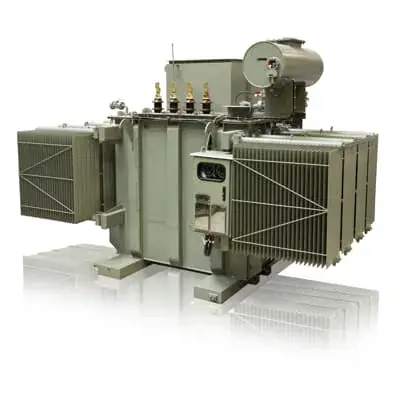
Legacy ABB 10-40 MVA oil-filled power transformers, the deepest-benched nameplate on the US secondary market
This model is part of SecondWatt’s transformer research catalogue. Specifications and price observations are included where supported by sources. Equipment availability and commercial terms require confirmation.
ABB 10-40 MVA power transformer class dossier: used-market pricing from six observations at 6-60 $/kVA, fleet history, inspection checklist, failure points.
ABB-brand power transformers in the 10-40 MVA class were built from 1988 to 2020 on a heritage that folds in ASEA, BBC, and the 1989 Westinghouse transmission and distribution acquisition. The fleet is enormous: roughly 400,000 ABB-heritage power transformers remain in service worldwide, with US small and medium power units built at South Boston, Virginia since 1968. Hitachi acquired 80.1% of ABB Power Grids on 2020-07-01 and renamed the business Hitachi Energy in October 2021, so ABB nameplates now identify legacy production.
That legacy status is exactly why the brand dominates the secondary market: 97 ABB-badged three-phase listings sat on Surplus Record in August 2026, more than any competing nameplate. With new power transformer lead times averaging 128 weeks and prices up 60-80% since 2020, tested ABB units with clean DGA histories reprice upward every quarter.
Why it matters
The 10-40 MVA class is the workhorse node between transmission and the data hall, and ABB is its most liquid used nameplate. Wood Mackenzie projects a 30% power transformer supply deficit for 2025, imports cover 80% of US demand, and Section 232 tariffs of 50% hit imported derivative content from 2025-08-18. Legacy ABB iron already inside the border carries scarcity value that did not exist five years ago.
Who buys it
Data center developers and EPCs buy 10-40 MVA ABB units for campus substations, alongside utilities covering failures, industrial plants, and renewable developers needing step-up capacity. Rebuilders such as Sunbelt Solomon and T&R Electric absorb cores for remanufacture. The trigger is delivery: a tested unit ships in weeks against a 128-week average new-build queue.
Role in the data center
Campus substation step-down transformer, taking 69-138 kV utility service down to 13.8 or 34.5 kV medium-voltage distribution, usually in 2N pairs feeding the switchgear lineup ahead of the unit substations. On a used purchase it is the item that sets the energization date, because a tested unit ships in weeks against a 128-week average new-build queue.
Key specifications
| Class MVA range | 10-40 MVA base |
|---|---|
| Typical primary voltage | 69-138 kV |
| Observed GSU example | 42/56/70 MVA, 230 kV wye / 13.8 kV delta |
| Observed type SL example | 32/43/54 MVA OA/FA/FA, 120 kV / 13.8 kV |
| ABB-heritage fleet in service | ~400,000 units |
| Heritage brands absorbed | ASEA, BBC, Westinghouse T&D (1989), Ansaldo, National Industri, Stromberg |
| US small/medium power plant | South Boston, VA, since 1968 |
| Brand transition dates | Hitachi 80.1% stake 2020-07-01; renamed Hitachi Energy Oct 2021 |
| Successor product line | Hitachi Energy power transformers (TrafoStar platform) |
| Efficiency regulation | Power class exempt from 10 CFR 431 Subpart K distribution rules |
Technical summary
Class range: 10-40 MVA base, multi-stage OA/FA/FA ratings. Primary voltage: 69-138 kV typical (230 kV on GSU units). Secondary voltage: 4.16-13.8 kV typical. Insulation: mineral oil, thermally upgraded kraft paper. Design lineage: IEEE C57.12.00 family, ASEA/BBC/Westinghouse heritage. Tap control: DETC standard; LTC on many substation units. Fleet: ~400,000 ABB-heritage power transformers in service. US plant: South Boston, VA, operating since 1968. Brand transition: ABB Power Grids to Hitachi (2020), Hitachi Energy (2021).
Major variations
The class splits by duty: substation step-down units (LTC common), generator step-up units (delta LV, no LTC), and dry-type unit substations at the bottom of the range. Nameplates read ABB (pre-2020), Hitachi ABB Power Grids (2020-2021), or Hitachi Energy (post-2021); all share the same design platform. Westinghouse-badged units from the pre-1989 fleet trade alongside.
Configurations and options
Options that move price and lead time on this class are the tap changer, the cooling stages and the fluid. De-energized tap changers are standard; an on-load tap changer adds cost and becomes the highest-maintenance component on the unit. Multi-stage OA/FA/FA cooling buys roughly a third more capacity on the same core through added radiators and fans. Bushing type matters on resale: oil-impregnated-paper condenser bushings are the legacy standard, while dry RIP or RIS bushings remove the leading tank-rupture fire path. Mineral oil is the installed-base default; less-flammable ester fill appears on units specified for indoor or fire-separated sites.
Compatibility and dependencies
In this class the transformer sits between a 69-138 kV utility source and a 4.16-13.8 kV medium-voltage system, with high-voltage bushings on overhead bus and the low-voltage side on bus duct or cable into switchgear. Three things decide whether a given used unit will actually mate. Impedance sets the fault current the downstream switchgear must interrupt, so it must be checked against the gear already specified. BIL has to coordinate with the surge arrester scheme at the installed voltage class. The tap arrangement has to suit the delivered voltage: de-energized taps can only be moved with the unit dead, while the on-load tap changers common on substation units need control power and a maintenance regime. Cooling stages need fan and pump supplies, transport at 10 MVA and above follows IEEE C57.150-2023, and the pad needs oil containment and fire separation per FM Global Data Sheet 5-4.
Pricing and availability
Published price range: $6,000 - $650,000. Trend: rising Mid-2019 baseline pricing for 1-25 MVA power transformers was 30-40 USD per MVA thousand (30-40 $/kVA new). Prices have since risen 60-80% on average per Wood Mackenzie, with GOES core steel up roughly 100%. Used ABB asks now span 6-60 $/kVA by condition, and multi-MVA used units at 9-16 $/kVA represent 15-45% of equivalent new cost. Lead time, new: 128-144 weeks (class average). Lead time, used or refurbished: 2-12 weeks. Warranty, used: 3-year typical from major US rebuilders.
Lifecycle and maintenance
Liquid-filled transformers routinely serve 30-40 years with annual oil screening, DGA on a 1-2 year cadence (or continuous online monitoring on critical units), and gasket or bushing service as tests dictate. Major US rebuilders remanufacture units to like-new condition with warranties up to 3 years (T&R Electric, Sunbelt Solomon), and reconditioned stock ships in days against 65-210 week new-build queues. Remaining paper life, estimated by furan testing, governs end-of-life valuation.
Thermal and emissions profile
Transformers produce no combustion emissions; the regulatory profile is efficiency and fluid. US distribution-class units fall under DOE 10 CFR 431 Subpart K efficiency standards, amended in 2024 with compliance from 2029 requiring 10-30% lower losses than 2016 levels. Fluid choice drives fire and environmental posture: mineral oil versus FR3 natural ester with a 360 C fire point and ready biodegradability. Legacy units require PCB screening, with clean units documented below 2 ppm.
Common failure points
- Bushings — Moisture ingress and partial discharge leading to flashover or tank rupture
- Gaskets and seals — Oil seepage at bushings, valves, and radiator headers
- Tap changer — Contact wear and mechanism faults; leading maintenance component in fleet surveys
- Winding insulation — Dielectric failure, the most common failure mode in CIGRE TB 642 data
- Tank corrosion — Base and cabinet rust on pad-mounted units
- Moisture in oil — Reduced dielectric strength and accelerated paper aging
Inspection checklist
DGA: dissolved gas analysis per IEEE C57.104; combustible-gas trend rise between 2 samples triggers investigation. Oil quality: dielectric breakdown, moisture, acidity, and furan tests; degree of polymerization below 200 marks end of paper life. Insulation resistance: megger HV/LV/ground; polarization index of 2.0 or higher passes. Power factor: insulation power factor testing; values above 1.0% on oil-filled windings warrant investigation. Turns ratio: TTR on all taps; deviation beyond 0.5% from nameplate fails. Winding resistance: three-phase balance within 2% between phases. Bushings: capacitance and power factor test; bushing failure share rises with voltage class per CIGRE TB 642. OLTC: inspect on-load tap changer diverter and selector; OLTCs are a leading failure component in CIGRE TB 642 fleet surveys.
Procurement channels
Surplus Record carries the deepest ABB bench (97 three-phase listings); dealers include Belyea, Power Asset Recovery, J Turbines, RAAR Group, and Transformer Exchange, with rebuilders Sunbelt Solomon and T&R Electric selling remanufactured units with warranties to 3 years.
Regional notes
US 60 Hz units dominate domestic supply; European 50 Hz ABB units rarely suit US service. Section 232 tariffs of 50% on imported transformer content, effective 2025-08-18, advantage units already in the US.