Hitachi Energy HiDry dry-type power transformer, 40.5-72.5 kV
Manufacturer: Hitachi Energy
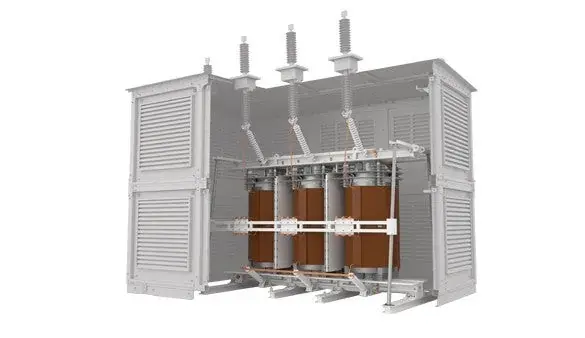
HiDry vacuum cast-resin power transformers to 72.5 kV and 63 MVA, the oil-free option at subtransmission voltage rather than MV
This model is part of SecondWatt’s transformer research catalogue. Specifications and price observations are included where supported by sources. Equipment availability and commercial terms require confirmation.
Hitachi Energy HiDry, launched as ABB HiDry72: vacuum cast-resin power transformers, 40.5-72.5 kV to 63 MVA, oil-free subtransmission specs.
HiDry extends dry-type transformer technology past the traditional 36-40.5 kV ceiling into subtransmission service at up to 72.5 kV, replacing small oil-filled power transformers in urban, indoor, and fire-critical substations. ABB launched the line as HiDry72 in the early 2010s and published the design in IEEE and ABB Review literature; Hitachi Energy sells it today as HiDry dry-type transformers above 40.5 kV, the same line under the current brand.
The published envelope runs to 63 MVA, high voltage to 72.5 kV, and low voltage to 36 kV, with insulation classes F and H, partial discharge below 10 pC, enclosures IP00 to IP55, and AN, ANAF, or AFWF cooling. No direct dry-type competitor exists at 72.5 kV: GEAFOL and Trihal top out at 36-52 kV, so the functional alternative is an ester-filled liquid unit. No used HiDry unit under any brand era was listed for sale in August 2026, consistent with a small, young installed base that owners retain.
Why it matters
At subtransmission voltage the alternatives to HiDry all carry oil: fire separation, containment, and FM Global data sheet 5-4 requirements follow. An oil-free 72.5 kV unit lets dense urban and indoor sites take higher-voltage service directly, cutting a transformation stage. Buyers should treat the line as new-build only and benchmark against ester-filled liquid units on total installed cost.
Who buys it
Urban utilities placing substations inside buildings, high-rise and tunnel projects, offshore platforms, and data center campuses that want 66-69 kV service without oil systems. The buyer profile is new-build specification rather than secondary-market bargain hunting, since used supply is effectively zero and each unit is engineered to order.
Role in the data center
Oil-free 66-72.5 kV intake transformer for urban campuses and indoor substations where an oil-filled unit would force fire-separation and containment redesign. This is subtransmission-class equipment sitting at the utility intake, not the MV distribution transformer that feeds a data hall; the MV equivalents are RESIBLOC, GEAFOL and Trihal, which stop at 36-52 kV.
Key specifications
| Power range | up to 63 MVA |
|---|---|
| HV maximum | 72.5 kV |
| LV maximum | 36 kV |
| Partial discharge | <10 pC |
| Insulation classes | F and H |
| Enclosures | IP00-IP55 |
| Cooling classes | AN / ANAF / AFWF |
| Line origin | ABB HiDry72 (IEEE paper 7000447) |
| Frequencies | 50 / 60 Hz |
| Winding connections | Y or D; indoor or enclosed outdoor |
| Current producer | Hitachi Energy; line launched by ABB as HiDry72 |
| Dry-type class lead time | 20-32 weeks (0-2 MVA, 2026) |
Technical summary
Power range: up to 63 MVA. HV: above 40.5 kV, up to 72.5 kV; LV up to 36 kV. Frequency: 50 / 60 Hz. Technology: vacuum cast resin. Cooling: AN, ANAF, AFWF. Insulation classes F and H; PD below 10 pC. Enclosures: IP00 to IP55. Connections: Y or D; indoor or enclosed outdoor. Applications: urban, indoor, offshore, fire-critical substations. Direct dry-type competitor at 72.5 kV: none; GEAFOL and Trihal top out at 36-52 kV. Launched as ABB HiDry72 (IEEE-published design).
Major variations
There is one design lineage and two brand eras: ABB HiDry72 units from the 2011-2014 period and current Hitachi Energy HiDry production above 40.5 kV. Within that lineage the variation is per-project rather than per-catalog, because units are engineered to order. Winding connection is specified Y or D, insulation is class F or class H, cooling is AN, ANAF or AFWF depending on the duty, and the enclosure runs from IP00 open-frame indoor to IP55 for enclosed outdoor siting. Low-voltage windings are rated to 36 kV, which lets a single unit cover a 72.5 kV to 36 kV subtransmission step without an intermediate stage.
Configurations and options
HiDry is engineered to order rather than picked from a size table, so the specification sheet is the configuration. The published envelope runs to 63 MVA with high voltage above 40.5 kV to 72.5 kV and low voltage to 36 kV at 50 or 60 Hz. The choices that move price and build time are rating and voltage class, insulation class F or H, cooling stage (AN natural, ANAF forced air, or AFWF, which adds a water circuit), winding connection Y or D, and enclosure from IP00 open-frame indoor to IP55 for enclosed outdoor siting. Partial discharge is specified below 10 pC. Hitachi Energy does not publish BIL ratings on the HiDry product page as of August 2026, so the BIL, impedance and tap arrangement come off the project data sheet and are the first things to read on a resale nameplate.
Compatibility and dependencies
This is subtransmission-class equipment: it sits between a 40.5-72.5 kV utility or campus source and a medium-voltage system at up to 36 kV, in the duty a small oil-filled unit would otherwise take. Impedance has to be matched to the interrupting duty of the downstream medium-voltage breakers. Dry construction removes the oil containment, sump and fire-separation engineering a liquid unit forces at this voltage, but it substitutes room clearances and ventilation: IP00 builds need a dedicated substation room, and AFWF cooling needs a water circuit with its own controls. With no oil to sample, winding temperature and partial discharge below 10 pC are the condition indicators.
Pricing and availability
Trend: rising Electrical Trader's price history, published 2026-04-01, puts power transformer prices up 77% between 2019 and 2026 with a 45-95% spread by model, and attributes about half the move to materials: copper up roughly 70% and grain-oriented electrical steel up 80-100% between 2020 and 2025, together 50-55% of production cost. The same series shows the annual rate easing, from 34.58% in 2022 to 8-10% in 2025 with 3-5% forecast for 2026. Terrapin Construction Group put dry-type lead times at 0-2 MVA at 20-32 weeks on 2026-06-10. Lead time, new: Engineered to order; dry-type class 20-32 weeks at small MVA, longer at power class. Lead time, used or refurbished: 2-12 weeks. Warranty, used: 3-year typical from major US rebuilders.
Lifecycle and maintenance
Cast-resin and VPI dry-type transformers typically serve 25-30+ years with minimal maintenance: periodic cleaning, PD testing on critical units, fan service on AF designs, and torque checks. There is no oil system to sample, so temperature and PD are the condition indicators. Rebuild options are limited compared with liquid units; failed coils are usually replaced rather than repaired, which makes pre-purchase PD and visual inspection decisive for used units.
Thermal and emissions profile
Transformers produce no combustion emissions; the regulatory profile is efficiency and fire class. US low-voltage dry-type units fall under DOE 10 CFR 431 efficiency rules (DOE 2016 levels, amended 2024 with 2029 compliance), and EU-market cast-resin units fall under Ecodesign Regulation 548/2014 Tier 2. Dry-type construction removes oil fire and spill risk entirely, which is why cast-resin units carry IEC 60076-11 fire class F1 and serve indoor and environmentally sensitive sites.
Common failure points
- Partial discharge — PD in resin voids degrading insulation toward failure
- Resin cracking — Cracks from thermal cycling or mechanical shock
- Contamination — Dust and conductive debris enabling surface tracking
- Cooling fans — Failed AF fans derating capacity
- Connections — Loose terminations overheating under load
- Overheating under harmonics — Excess temperature on non-linear loads beyond K-rating
Inspection checklist
Partial discharge: PD test per IEC 60270 practice; readings above 10 pC warrant investigation on cast-resin coils. Resin condition: inspect all coils per IEC 60076-11 practice for cracks and crazing from thermal cycling; any through-crack fails. Insulation resistance: megger HV/LV/ground; polarization index of 2.0 or higher passes. Turns ratio: TTR on all tap positions; deviation beyond 0.5% from nameplate fails. Winding resistance: three-phase balance within 2% between phases. Contamination: inspect for dust and conductive debris between coils; contamination is a leading dry-type failure driver. Cooling fans (AF units): run-test all fans and verify temperature controller setpoints. Temperature sensors: verify RTD or thermocouple channels read within 5 C of a reference at ambient.
Procurement channels
New-build only, through Hitachi Energy, quote-driven with no published pricing. No secondary channel has formed: no used HiDry unit under any brand era was listed for sale as of August 2026, which is consistent with an installed base that is small, young and retained by its owners. Buyers comparing options at this voltage are quoting HiDry against ester-filled liquid units rather than against another dry-type line.
Regional notes
HiDry is an IEC-family product sold globally by Hitachi Energy and built to order at 50 or 60 Hz; frequency is fixed at manufacture and is not a field setting. At 40.5-72.5 kV the line sits above the distribution scope of the US DOE rules at 10 CFR 431 Subpart K, so a HiDry unit carries no DOE efficiency stamp. No competing dry-type line reaches 72.5 kV, so a North American buyer is comparing it against ester-filled liquid units rather than another cast-resin product. Imported units carry the Section 232 50% tariff on non-US steel and aluminum content in transformer derivatives, effective 2025-08-18.