Hitachi Energy Mobile substations (to 120 MVA / 420 kV)
Manufacturer: Hitachi Energy
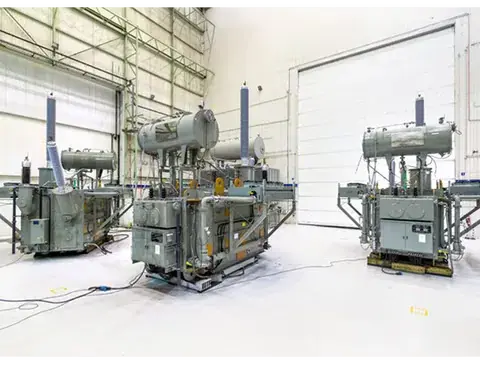
Hitachi Energy trailer-mounted substations to 120 MVA and 420 kV, deployable while fixed units wait years
This model is part of SecondWatt’s transformer research catalogue. Specifications and price observations are included where supported by sources. Equipment availability and commercial terms require confirmation.
Hitachi Energy mobile substation dossier: trailer-mounted to 120 MVA and 420 kV, 230/345 kV mobile transformers, deployment roles, inspection, market notes.
Hitachi Energy's mobile substations package a transformer, switchgear, and protection and control onto trailers and semi-trailers, continuing the ABB-era mobile offering. Published capability reaches 120 MVA and 420 kV with AIS, GIS, or hybrid switchgear, battery and fire-detection auxiliaries, and configurations from a single line bay to a full H-scheme. The company states no special transport permits are required and lists data center electrification explicitly among applications.
The companion mobile transformer line covers shell-type and core-type designs in 230 kV and 345 kV trailer-mounted classes, delivered assembled and oil-filled for on-site installation in a matter of hours, with structures rated for elevated transport accelerations.
Mobile units are the industry's bridge across 128-week fixed-transformer lead times, which is why used examples with public prices are essentially nonexistent: fleets are held by utilities and rental operators. Buyers needing mobile capacity generally quote new, rent, or turn to Delta Star's US-built alternative.
Why it matters
When a permanent 230 kV yard is 2-4 years out, a mobile substation is the difference between revenue and dirt. Hitachi's 420 kV / 120 MVA envelope covers most campus intake duties, and hours-scale installation converts a transformer failure from a months-long outage into a scheduling event. Scarcity pricing follows the fixed-unit market upward.
Who buys it
Utilities covering planned outages and storm restoration, transmission owners bridging a failed yard transformer, and data center and industrial developers who need load energized before a permanent substation arrives. The purchase trigger is schedule, not price: a mobile unit deploys in hours against a 128-week average for a fixed power transformer. Buyers work through OEM quotes, utility mutual-aid pools and rental fleets, because used mobile substations are not listed with public prices.
Role in the data center
Bridge substation carrying campus load between energization and delivery of the permanent transformers, or emergency replacement capacity after a yard transformer failure. Hitachi Energy names data center electrification directly in the listed applications for the trailer and semi-trailer line, which is unusual for a product class built around utility outage cover.
Key specifications
| Maximum capacity | 120 MVA |
|---|---|
| Maximum voltage | 420 kV |
| Switchgear options | AIS / GIS / hybrid |
| Mobile transformer classes | 230 and 345 kV trailer-mounted |
| Delivery state | assembled and oil-filled |
| Installation time | hours |
| Listed applications | incl. data center electrification |
| Fixed-unit lead time bridged | 128 weeks average (Q2 2025) |
| Scheme range | single line bay to full H-scheme |
| Auxiliaries | battery, charger, fire detection |
| Transport permits | no special transport permits claimed |
| Mobile transformer designs | shell-type and core-type |
Technical summary
Mobile substations: up to 120 MVA, up to 420 kV. Switchgear: AIS, GIS, or hybrid. Schemes: single line bay to full H-scheme. Auxiliaries: battery/charger, fire detection. Transport: no special permits claimed. Mobile transformers: 230 kV and 345 kV trailer classes. Designs: shell-type and core-type, delivered assembled and oil-filled. Installation: on-site in a matter of hours. Applications include data center electrification.
Major variations
Configurations run from transformer-only mobile trailers to complete substations with switchgear and protection. Voltage class, MVA, switchgear type, and scheme are engineered per order. The design constant is transport-rated construction, since every relocation stresses the active part in ways fixed units never see.
Configurations and options
Everything on this line is engineered to order, and the configuration decisions are the price. Mobile substations reach 120 MVA and 420 kV, with switchgear specified as air-insulated, gas-insulated or hybrid and the scheme running from a single line bay to a full H-scheme. Auxiliaries include a battery and charger and fire detection. The companion transformer-only mobiles come as shell-type or core-type designs in 230 kV and 345 kV trailer classes, delivered assembled and oil-filled for installation in a matter of hours, with structures rated for elevated transport accelerations. Hitachi Energy states that no special transport permits are required. The gas-insulated option is the largest single swing in both cost and footprint. Standards citations, BIL and cooling class do not appear on the product pages as of August 2026, so those come off the project data sheet.
Compatibility and dependencies
The value of a mobile is that it lands on an existing yard in days, so the interfaces have to be settled before it ships. That means the high-voltage and low-voltage termination arrangement to the source and to the distribution, the primary and secondary voltages and connections, the impedance against the interrupting duty of the breakers it will feed, the BIL against the arrester scheme, and a protection and control package the operator's scheme will accept. The unit needs a grounding-grid connection, level ground, and station service for cooling and controls. Choosing gas-insulated over air-insulated switchgear shrinks the footprint but adds gas handling and its own maintenance regime. Because a mobile is permanently transport-exposed, IEEE C57.150-2023 applies at 10 MVA and above at every relocation, so impact recording and post-move inspection recur rather than happening once.
Pricing and availability
Trend: rising No mobile substation price history is published, so what follows describes the fixed transformers a mobile stands in for. Electrical Trader's price history, published 2026-04-01, puts power transformer prices up 77% between 2019 and 2026 and generator step-up units up 45% since 2019, on copper up roughly 70% and grain-oriented electrical steel up 80-100% from 2020 to 2025. Terrapin Construction Group had substation units at 65-110 weeks and GSUs at 100-150+ weeks on 2026-06-10, and PwC via pv magazine USA on 2026-05-11 put high-capacity units at up to four years. That queue is what creates demand for mobile capacity. Lead time, new: Engineered to order; quoted per project. Lead time, used or refurbished: 2-12 weeks. Warranty, used: 3-year typical from major US rebuilders.
Lifecycle and maintenance
Liquid-filled transformers routinely serve 30-40 years with annual oil screening, DGA on a 1-2 year cadence (or continuous online monitoring on critical units), and gasket or bushing service as tests dictate. Major US rebuilders remanufacture units to like-new condition with warranties up to 3 years (T&R Electric, Sunbelt Solomon), and reconditioned stock ships in days against 65-210 week new-build queues. Remaining paper life, estimated by furan testing, governs end-of-life valuation.
Thermal and emissions profile
Transformers produce no combustion emissions; the regulatory profile is efficiency and fluid. US distribution-class units fall under DOE 10 CFR 431 Subpart K efficiency standards, amended in 2024 with compliance from 2029 requiring 10-30% lower losses than 2016 levels. Fluid choice drives fire and environmental posture: mineral oil versus FR3 natural ester with a 360 C fire point and ready biodegradability. Legacy units require PCB screening, with clean units documented below 2 ppm.
Common failure points
- Windings — Dielectric failure; windings dominate major-failure statistics in CIGRE TB 642
- Bushings — Failure share rises with voltage class; OIP bushing faults can rupture tanks
- OLTC — Contact and mechanism wear; prominent failure source on substation units
- Winding deformation — Through-fault or transport damage shifting SFRA signature
- Cooling system — Pump, fan, and radiator degradation derating the unit
- Moisture and paper aging — Furans in oil and reduced degree of polymerization
Inspection checklist
DGA: dissolved gas analysis per IEEE C57.104; combustible-gas trend rise between 2 samples triggers investigation. Oil quality: dielectric breakdown, moisture, acidity, and furan tests; degree of polymerization below 200 marks end of paper life. Insulation resistance: megger HV/LV/ground; polarization index of 2.0 or higher passes. Power factor: insulation power factor testing; values above 1.0% on oil-filled windings warrant investigation. Turns ratio: TTR on all taps; deviation beyond 0.5% from nameplate fails. Winding resistance: three-phase balance within 2% between phases. Bushings: capacitance and power factor test; bushing failure share rises with voltage class per CIGRE TB 642. OLTC: inspect on-load tap changer diverter and selector; OLTCs are a leading failure component in CIGRE TB 642 fleet surveys.
Procurement channels
OEM quotes through Hitachi Energy; rental and dealer channels include Belyea (40 MVA mobile substation rental observed) and general reconditioned-transformer dealers. No used mobile substation is listed with a public price as of August 2026.
Regional notes
The line is sold globally and the pages claim compliance with local grid codes and standards generically rather than citing a named standard, with no reference to the IEEE C57.12.00 mobile provisions as of August 2026, so the applicable standard set has to be fixed on the project data sheet. Voltage class and frequency are set at build. The claim that no special transport permits are required describes the vehicle envelope, not the permitting regime: road permits and route surveys remain the responsibility of each jurisdiction the unit crosses. Imported units carry the Section 232 50% tariff on non-US steel and aluminum content from 2025-08-18.