Siemens Energy FITformer fluid-immersed distribution transformers
Manufacturer: Siemens Energy
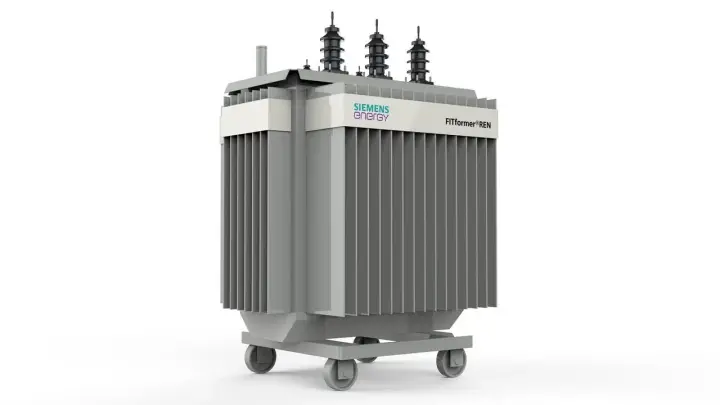
Siemens Energy FITformer fluid-immersed distribution transformers, 2,500 kVA standard units to 30 MVA at 145 kV
This model is part of SecondWatt’s transformer research catalogue. Specifications and price observations are included where supported by sources. Equipment availability and commercial terms require confirmation.
Siemens Energy FITformer dossier: fluid-immersed distribution 2,500 kVA to 30 MVA at 145 kV, ester and hermetic options, class pricing comps, inspection.
FITformer is Siemens Energy's fluid-immersed distribution transformer brand, successor to the TUNORMA and TUMETIC family names of the pre-spin-off Siemens era. Standard units run 2,500-6,300 kVA at primaries to 36 kV; large units extend 6.3-30 MVA with primaries to 145 kV; pole- and pad-mounted builds cover up to 2,500 kVA; and application variants reach 20 MVA at 66 kV for wind (FITformer WIND) and 15 MVA at 72.5 kV for solar, with low-voltage windings of 250-800 V.
Fluid options are mineral oil or fully biodegradable ester for high-temperature operation. Tank designs include hermetically sealed corrugated-wall, open designs with oil conservators, and smooth-wall tanks with radiators. Standards coverage is IEC 60076 with EU Ecodesign and US DOE efficiency compliance claimed, and named applications include data centers, wind, solar, steel mills, and offshore.
US class benchmarks are the Maddox stock pad-mounts at 74,100 USD (1,500 kVA) and 104,000 USD (2,500 kVA) new.
Why it matters
Siemens Energy is doubling down on US transformer capacity with a 421 million USD Charlotte plant expansion, so FITformer-lineage designs will increasingly carry US nameplates. The line's ester options and hermetic tanks map directly to data center yard requirements, and distribution demand is up 34-41% since 2019 against a 10% supply deficit.
Who buys it
Utilities, wind and solar developers, steel and process industry, and IEC-market data center projects buy FITformer classes; US exposure arrives through imported package substations. Used buyers should confirm 60 Hz design and DOE 10 CFR 431 compliance before placing imported units in US service.
Role in the data center
Campus MV distribution and yard transformation in IEC-market builds, taking 36 kV or lower service down to the hall supply voltage, with the large-unit range covering 145 kV intake duty. Ester-filled hermetic units suit close-coupled outdoor yards where fire separation from occupied space is tight and a conservator would add maintenance.
Key specifications
| Standard unit range | 2,500-6,300 kVA |
|---|---|
| Large unit range | 6.3-30 MVA / to 145 kV |
| Pole/pad-mount ceiling | 2,500 kVA |
| Wind variant | to 20 MVA / 66 kV |
| Solar variant | to 15 MVA / 72.5 kV |
| LV winding range | 250-800 V |
| Fluid options | mineral oil or biodegradable ester |
| Tank designs | hermetic corrugated / conservator / smooth-wall |
| US capacity investment | 421M USD Charlotte NC |
| Standard unit primary ceiling | 36 kV |
| Standards | IEC 60076; EU Ecodesign; US DOE efficiency |
| Legacy family names | TUNORMA (conservator), TUMETIC (hermetic) |
| Listed applications | data centers, wind, solar, steel mills, offshore |
Technical summary
Standard units: 2,500-6,300 kVA, primaries to 36 kV. Large units: 6.3-30 MVA, primaries to 145 kV. Pole/pad-mounted: up to 2,500 kVA. FITformer WIND: to 20 MVA at 66 kV; solar: to 15 MVA at 72.5 kV. LV windings: 250-800 V. Fluids: mineral oil or fully biodegradable ester. Tanks: hermetic corrugated-wall, conservator, or smooth-wall with radiators. Standards: IEC 60076; EU Ecodesign; US DOE efficiency. Applications: data centers, wind, solar, steel, offshore.
Major variations
Five builds share the construction: standard units, large units, pole and pad-mounted units, FITformer WIND and the solar variant, each with its own rating and voltage envelope. Fluid and tank combine into the choice that decides siting: mineral oil or fully biodegradable ester, in a hermetically sealed corrugated-wall tank, an open tank with an oil conservator, or a smooth-wall tank with radiators. Legacy TUNORMA conservator and TUMETIC hermetic names persist on installed-base nameplates and identify the same lineage.
Configurations and options
FITformer splits into five builds and the choice sets the envelope: standard units at 2,500-6,300 kVA with primaries to 36 kV, large units at 6.3-30 MVA with primaries to 145 kV, pole- and pad-mounted units to 2,500 kVA, FITformer WIND to 20 MVA at 66 kV, and a solar variant to 15 MVA at 72.5 kV, all with low-voltage windings of 250-800 V. Fluid is mineral oil or a fully biodegradable ester rated for high-temperature operation. Tank design is the other price and maintenance axis: a hermetically sealed corrugated-wall tank, an open tank with an oil conservator, or a smooth-wall tank with radiators. Legacy TUNORMA and TUMETIC nameplates identify the conservator and hermetic designs of the same lineage on the installed base, which is what a used buyer will actually encounter.
Compatibility and dependencies
Tank design decides more of the installed cost than the rating does. A hermetic corrugated-wall tank has no conservator or breather to service and suits a sealed outdoor yard; a conservator design needs breather maintenance and oil-level monitoring; a smooth-wall tank needs the radiator clearance designed into the pad. The primary ceiling differs sharply between builds, 36 kV on standard units against 145 kV on large units, so BIL and the arrester scheme have to be settled against the specific build. The 250-800 V low-voltage window covers IEC 400 and 690 V and North American 480 V, but the winding is fixed at build. Impedance has to match the interrupting duty of the gear downstream. Ester fill changes fire separation and moves the dissolved gas baseline off the mineral-oil limits in IEEE C57.104. Wind and solar variants are built for collector-network duty, not campus distribution.
Pricing and availability
Comparable secondary-market band: 74100–104000 $ per unit. Trend: rising Electrical Trader's price history, published 2026-04-01, puts power transformer prices up 77% between 2019 and 2026, with distribution classes at the top of a 45-95% spread, on copper up roughly 70% and grain-oriented electrical steel up 80-100% from 2020 to 2025, together 50-55% of production cost. Annual increases have eased from 34.58% in 2022 to 8-10% in 2025, with 3-5% forecast for 2026. Terrapin Construction Group put pad-mount lead times at 0-5 MVA at 40-65 weeks on 2026-06-10. Lead time, new: 40-65 weeks pad-mount class; 65-95 weeks substation class. Lead time, used or refurbished: 2-12 weeks. Warranty, used: 3-year typical from major US rebuilders.
Lifecycle and maintenance
Liquid-filled transformers routinely serve 30-40 years with annual oil screening, DGA on a 1-2 year cadence (or continuous online monitoring on critical units), and gasket or bushing service as tests dictate. Major US rebuilders remanufacture units to like-new condition with warranties up to 3 years (T&R Electric, Sunbelt Solomon), and reconditioned stock ships in days against 65-210 week new-build queues. Remaining paper life, estimated by furan testing, governs end-of-life valuation.
Thermal and emissions profile
Transformers produce no combustion emissions; the regulatory profile is efficiency and fluid. US distribution-class units fall under DOE 10 CFR 431 Subpart K efficiency standards, amended in 2024 with compliance from 2029 requiring 10-30% lower losses than 2016 levels. Fluid choice drives fire and environmental posture: mineral oil versus FR3 natural ester with a 360 C fire point and ready biodegradability. Legacy units require PCB screening, with clean units documented below 2 ppm.
Common failure points
- Bushings — Moisture ingress and partial discharge leading to flashover or tank rupture
- Gaskets and seals — Oil seepage at bushings, valves, and radiator headers
- Tap changer — Contact wear and mechanism faults; leading maintenance component in fleet surveys
- Winding insulation — Dielectric failure, the most common failure mode in CIGRE TB 642 data
- Tank corrosion — Base and cabinet rust on pad-mounted units
- Moisture in oil — Reduced dielectric strength and accelerated paper aging
Inspection checklist
Oil quality: dielectric breakdown, moisture, and acidity tests; verify PCB content documented below 2 ppm on older units. DGA: dissolved gas analysis per IEEE C57.104; investigate any combustible-gas trend rise between 2 consecutive samples. Insulation resistance: megger HV/LV/ground; polarization index of 2.0 or higher passes. Turns ratio: TTR on all tap positions; deviation beyond 0.5% from nameplate fails. Winding resistance: verify three-phase balance within 2% between phases. Bushings and wells: inspect for cracks, tracking, and oil weep; replace suspect bushing wells before energization. Gaskets and seals: inspect bushings, valves, and radiator headers; oil seepage is the top pad-mount defect. Tank and cabinet: corrosion survey at base and sills; enclosure integrity per IEEE C57.12.28 class requirements.
Procurement channels
New units through Siemens Energy sales, quoted per project. US buyers benchmarking the class use stock pad-mount pricing at 74,100 USD for 1,500 kVA and 104,000 USD for 2,500 kVA.
Regional notes
FITformer is an IEC 60076 line and Siemens Energy claims both EU Ecodesign and US DOE efficiency compliance on the product page, so the applicable regime has to be fixed at order. Ecodesign Regulation 548/2014 Tier 2 levels have applied since July 2021 under amendment 2019/1783; in the United States the DOE rules at 10 CFR 431 Subpart K cover in-scope liquid-immersed distribution transformers and were amended by the final rule published 2024-04-22 with a 2029 compliance date. Siemens Energy is building US power transformer capacity at Charlotte, North Carolina, but FITformer is documented as a European line, and imported content carries the Section 232 50% tariff from 2025-08-18.