Eaton MD-series motor drive isolation
Manufacturer: Eaton
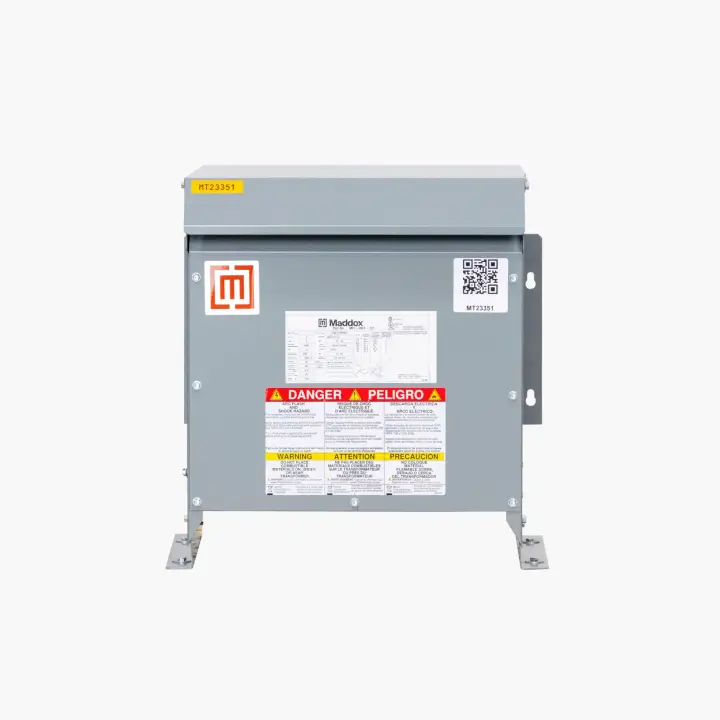
Eaton MD-series drive isolation transformers, 7.5-1,500 kVA units braced for variable-frequency drive duty.
This model is part of SecondWatt’s transformer research catalogue. Specifications and price observations are included where supported by sources. Equipment availability and commercial terms require confirmation.
Eaton MD-series drive isolation dossier: 7.5-1,500 kVA for 5-500 hp VFDs, K-4 to K-20 ratings, class pricing from 4,423 USD used, inspection points.
Eaton's motor drive isolation transformer line with MD catalog prefixes (MD330D79CU, MD1000E95), covered here. MD-series units run 7.5-1,500 kVA three-phase in the 600 V class, serving drives from 5 to 500 hp. Construction is ventilated dry-type with a 220 C insulation system at 150 C rise standard (115 C and 80 C options), K-factor ratings of K-4, K-13, and K-20 (type codes HD, ND, GD), embedded coil thermal sensors, and bracing specifically rated for the mechanical stress of SCR-drive current reversals and short circuits. Standards coverage spans ANSI C89.2, NEMA ST-20, UL 5085 and UL 1561, with seismic qualification. Voltage combinations include 460 delta primaries with 575Y/332 and 230-class secondaries.
Why it matters
Every VFD bank above roughly 50 hp wants an isolation transformer, and a general purpose unit is not a substitute in drive service. The MD line's SCR-reversal bracing and K-ratings are the substantive spec difference from general purpose units, and the used channel offers 20% savings against new at published prices, rare transparency in this market.
Who buys it
Industrial plants isolating VFDs and DC drives, water utilities, and data centers with large mechanical plant buy drive isolation units to protect drives and upstream systems from harmonics and common-mode noise. Buyers match K-factor to the measured load profile; underrated general purpose units in drive service fail early from harmonic heating.
Role in the data center
Isolation and harmonic buffering for chiller-plant VFDs and pump drives, protecting the mechanical-plant bus from drive-injected distortion.
Key specifications
| kVA range | 7.5-1500 kVA |
|---|---|
| Drive power range | 5-500 hp |
| Insulation system | 220 C |
| K-factor options | K-4 / K-13 / K-20 |
| Standards | ANSI C89.2, NEMA ST-20, UL 5085, UL 1561 |
| Example SKUs | MD330D79CU, MD1000E95 |
| Class comp, 75 kVA | 5,529 new / 4,423 used USD (Maddox) |
| Class comp, 660 kVA | 26,481 new / 21,185 used USD (Maddox) |
| Example voltage combo | 460D to 575Y/332 (275 kVA) |
Technical summary
Range: 7.5-1,500 kVA, three-phase, 600 V class Drive service: 5-500 hp Insulation system: 220 C; rise 150 C std (115/80 C options) K-factor options: K-4 / K-13 / K-20 (HD / ND / GD) Bracing: rated for SCR current reversals and short circuits Sensors: embedded coil thermal sensors Standards: ANSI C89.2, NEMA ST-20, UL 5085-1/-2, UL 1561 Seismic qualification available Example voltage combo: 460D primary to 575Y/332
Major variations
Type codes HD (K-4), ND (K-13), and GD (K-20) set harmonic capability; copper versus aluminum windings and rise class set thermal margin. Voltage combinations cover 460 and 480 delta primaries into 208Y, 240 delta, 460Y/266, and 575Y/332 secondaries for drive front ends.
Configurations and options
The catalog prefix is MD and the type code carries the harmonic rating: MD basic, HD for K-4, ND for K-13 and GD for K-20. Ratings run 7.5-1,500 kVA three-phase in the 600 V class for drives of 5-500 hp, on a 220 deg C insulation system with 150 deg C rise standard and 115 deg C or 80 deg C optional. Eaton publishes 33 primary and secondary voltage combinations, including 208 delta to 460Y/266, 460 delta to 575Y/332 and 575 delta to 480 delta. Tap options are coded A through Z and include one tap at plus 5% with one at minus 5%, and two at plus 2.5% with two at minus 2.5%. Enclosures are ventilated as standard, with totally enclosed non-ventilated and encapsulated designs to 34 kVA optional. An electrostatic shield is optional under the ES code, and a built-in winding thermo guard with normally open dry contacts is fitted except on encapsulated designs.
Compatibility and dependencies
The unit sits between the plant 480 or 600 V bus and a drive input, and the voltage combination has to match what the drive family expects rather than what the bus happens to be. The K rating has to match the drive front end rather than the kVA: a six-pulse SCR converter and a modern PWM front end present different harmonic spectra. Mechanically the line is braced to withstand the current reversals and short circuits of SCR drives, which is why a general purpose transformer is not a substitute. The winding thermo guard's normally open dry contacts have to be wired into the drive or switchboard trip circuit to do anything. Ventilated enclosures need airflow clearance; encapsulated builds stop at 34 kVA and drop the thermo guard.
Pricing and availability
Comparable secondary-market band: 4423–26481 $ per unit. Trend: up Electrical Trader's price history, published 2026-04-01, puts power transformer prices up 77% between 2019 and 2026 with a 45-95% spread by model, and attributes about half the move to materials: copper up roughly 70% and grain-oriented electrical steel up 80-100% between 2020 and 2025, together 50-55% of production cost. The same series shows the annual rate easing, from 34.58% in 2022 to 8-10% in 2025 with 3-5% forecast for 2026. Terrapin Construction Group put dry-type lead times at 0-2 MVA at 20-32 weeks on 2026-06-10. Lead time, new: Distributor quote; class stock ships 3-5 business days (Maddox). Lead time, used or refurbished: 1-2 weeks (dealer stock). Warranty, used: 3-year typical from major US rebuilders.
Lifecycle and maintenance
Cast-resin and VPI dry-type transformers typically serve 25-30+ years with minimal maintenance: periodic cleaning, PD testing on critical units, fan service on AF designs, and torque checks. There is no oil system to sample, so temperature and PD are the condition indicators. Rebuild options are limited compared with liquid units; failed coils are usually replaced rather than repaired, which makes pre-purchase PD and visual inspection decisive for used units.
Thermal and emissions profile
Transformers produce no combustion emissions; the regulatory profile is efficiency and fire class. US low-voltage dry-type units fall under DOE 10 CFR 431 efficiency rules (DOE 2016 levels, amended 2024 with 2029 compliance), and EU-market cast-resin units fall under Ecodesign Regulation 548/2014 Tier 2. Dry-type construction removes oil fire and spill risk entirely, which is why cast-resin units carry IEC 60076-11 fire class F1 and serve indoor and environmentally sensitive sites.
Common failure points
- Partial discharge — PD in resin voids degrading insulation toward failure
- Resin cracking — Cracks from thermal cycling or mechanical shock
- Contamination — Dust and conductive debris enabling surface tracking
- Cooling fans — Failed AF fans derating capacity
- Connections — Loose terminations overheating under load
- Overheating under harmonics — Excess temperature on non-linear loads beyond K-rating
Inspection checklist
Partial discharge — PD test per IEC 60270 practice; readings above 10 pC warrant investigation on cast-resin coils Resin condition — inspect all coils per IEC 60076-11 practice for cracks and crazing from thermal cycling; any through-crack fails Insulation resistance — megger HV/LV/ground; polarization index of 2.0 or higher passes Turns ratio — TTR on all tap positions; deviation beyond 0.5% from nameplate fails Winding resistance — three-phase balance within 2% between phases Contamination — inspect for dust and conductive debris between coils; contamination is a leading dry-type failure driver Cooling fans (AF units) — run-test all fans and verify temperature controller setpoints Temperature sensors — verify RTD or thermocouple channels read within 5 C of a reference at ambient Connections — torque-check HV and LV terminations; thermal-scan at first energization and re-check within 12 months Clearances — verify electrical clearances and enclosure IP rating match the installation environment Class verification — confirm fire/environmental/climatic classes (F1, E2/E3, C2/C3) against nameplate Harmonic suitability — verify K-factor rating (K-4/K-13) against the intended non-linear load profile Core and frame — inspect for shipping damage and loose core bolts; verify single core ground Energization test — verify secondary voltage within 5% on all phases and no abnormal sound level Records — factory test certificate, PD test data, and service history; missing PD data reprices the unit
Procurement channels
Eaton distribution (Crescent Electric, Platt) for new MD units; Maddox and Bruce Electric for stocked new/used drive isolation class; Surplus Record's three-phase category carries occasional drive isolation units.
Regional notes
This is a North American 600 V-class product and the standards Eaton cites are the North American set: ANSI C89.2, NEMA ST-20, UL 5085-1, UL 5085-2 and UL 1561, with seismic qualification available. The published voltage combinations are North American drive voltages, 208, 230, 460, 480 and 575 V, rather than the 400 V and 690 V an IEC-market drive would use, so a unit bought outside North America is unlikely to match. Dry-type transformers were brought inside the Section 232 50% tariff on non-US steel and aluminum content in derivative products effective 2025-08-18.