Virginia Transformer Pad-mounted oil-filled transformers (to 10 MVA)
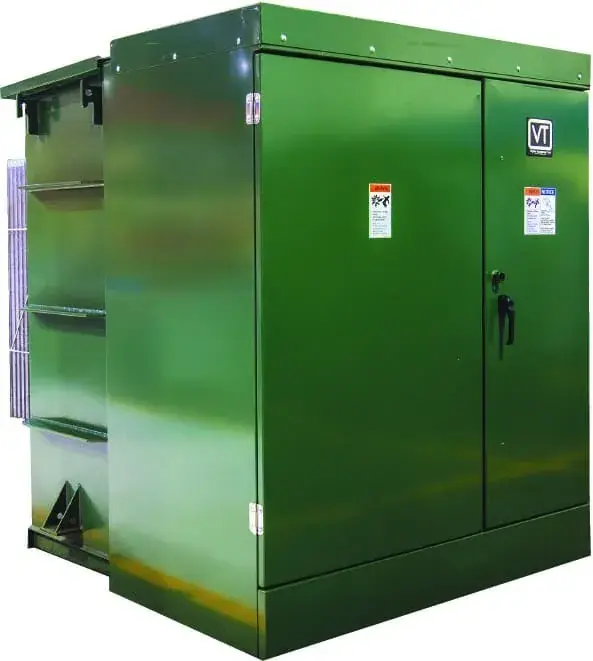
Virginia Transformer pad-mounts to 10 MVA and 35 kV with 200 kV BIL, from the largest US-owned maker
This model is part of SecondWatt’s transformer research catalogue. Specifications and price observations are included where supported by sources. Equipment availability and commercial terms require confirmation.
Virginia Transformer pad-mount dossier: to 10 MVA and 35 kV with 200 kV BIL, FR3 options, 27-unit surplus block, expansion news, inspection checklist.
Virginia Transformer Corp, founded 1971 in Roanoke, Virginia, calls itself the largest US-owned transformer manufacturer in North America, running plants in Roanoke, Troutville, Pocatello, two in Chihuahua, and the expanding Georgia Transformer site at Rincon, Georgia, for 667,000 combined sq ft and 67,000 MVA of annual capacity with 400+ engineers. Company capability claims reach 1,400 MVA at 500 kV class across core-type, shell-type, and dry-type lines.
The pad-mount line runs to 10 MVA with high voltage to 35 kV delta or wye and BIL to 200 kV, the highest BIL ceiling in the class, in dead-front or live-front builds with loop or radial feed, step-up or step-down duty, mineral oil or FR3, 55/65/75 C rise options, 3-legged stacked cores, and aluminum or copper windings.
VTC-badged secondary supply exists at scale but unpriced: 27 units of 3,900/4,400 kVA pad-mounts sat on Surplus Record price-on-request, plus an unused 2019 20/33 MVA substation unit. Corporate signals run hot: a 6 billion USD sale exploration reported January 2025 and a Rincon expansion adding 50% capacity with 400 jobs, groundbreaking April 2026.
Why it matters
VTC's shortest-lead-times positioning and 50% capacity expansion make it the US-owned counterweight to import dependence, and its 6 billion USD valuation exploration prices what transformer capacity is worth in this market. For buyers, 27 same-model surplus units in one listing is the rare chance to standardize a campus on identical hardware.
Who buys it
Utilities, renewable developers (GSU pad-mount variants), and data center EPCs buy VTC pad-mounts, with the 200 kV BIL and 35 kV class suiting harsh-system campuses. The 27-unit used block on Surplus Record points at project-surplus liquidations as the main secondary source for the brand.
Role in the data center
Campus pad-mount distribution at 2,000-10,000 kVA with headroom in the BIL rating, plus GSU pad-mount duty where an on-site generation block steps up into the campus loop. The 200 kV BIL published at the 35 kV class is above the usual pad-mount level and is what buyers specify against switching transients on a campus with large block loads.
Key specifications
| Pad-mount ceiling | 10 MVA |
|---|---|
| HV ceiling | 35 kV |
| BIL ceiling | 200 kV |
| Rise options | 55 / 65 / 75 C |
| Fluids | mineral oil or FR3 |
| Company capability claim | to 1,400 MVA / 500 kV class |
| Annual capacity | 67,000 MVA |
| Observed used block | 27x 3,900/4,400 kVA (contact for pricing) |
| Rincon expansion | +50% capacity / 400 jobs |
| Sale exploration | ~6B USD valuation (Jan 2025) |
Technical summary
Pad-mounts: up to 10 MVA. HV: up to 35 kV delta or wye. BIL: up to 200 kV. Builds: dead-front or live-front; loop or radial feed. Duty: step-up or step-down. Fluids: mineral oil or FR3; rise 55/65/75 C. Core: 3-legged stacked; aluminum or copper windings. Certifications: CSA, IEC, UL optional. Variants: utility pad-mount, E2X hardened build, GSU pad-mount for renewable step-up. Company capacity: 67,000 MVA/year across 6 plants.
Major variations
Three pad-mount builds share the platform: the utility pad-mount, the E2X hardened variant, and the GSU pad-mount for renewable step-up duty. Within each, fluid is mineral oil or FR3, rise is 55, 65 or 75 C, windings are aluminum or copper, and the compartment is dead-front or live-front on radial or loop feed. The wider company range puts the pad-mount line in context: core-type units to 400 MVA at 525 kV, shell-type from 60 to 500 MVA, and dry-types to 20 MVA at 35 kV, all from the same engineering group.
Configurations and options
The flyer gives 33 kVA to 10 MVA with a 4.16-35 kV primary and BIL to 200 kV, the highest in the pad-mount class. Temperature rise is ordered at 55, 65 or 75 deg C, fluid is mineral oil or Envirotemp FR3, and windings are aluminum or copper on a three-legged stacked core. Compartments are dead-front or live-front, feeds loop or radial, and duty step-up or step-down. Options that move price are two- and four-position loadbreak switches, current-limiting fuses, circuit breakers and an external fuse box. Finish is powder coat and baked paint with galvanized radiators. CSA, IEC and UL certifications are optional rather than standard. Three builds share the platform: the utility pad-mount, the E2X hardened variant and the GSU pad-mount for renewable step-up.
Compatibility and dependencies
The pad-mount interface is dead-front elbow connectors or live-front bushings on a loop or radial feed, and the switching option decides how the unit sectionalizes, with two- and four-position loadbreak switches giving different loop configurations, and current-limiting fuses or breaker options have to coordinate with the upstream feeder protection rather than duplicate it. The 200 kV BIL published at the 35 kV class is above normal pad-mount practice and only pays for itself if the arrester scheme is specified to exploit it. Impedance has to be matched to the interrupting duty of the switchboard downstream. GSU pad-mount duty reverses power flow and changes the protection and grounding case. Rise class of 55, 65 or 75 deg C sets the overload headroom. FR3 against mineral oil changes fire separation and moves the dissolved gas baseline off the mineral-oil limits in IEEE C57.104.
Pricing and availability
Comparable secondary-market band: 4950–104000 $ per unit. Trend: rising Electrical Trader's price history, published 2026-04-01, puts power transformer prices up 77% between 2019 and 2026, with distribution classes at the top of a 45-95% spread, on copper up roughly 70% and grain-oriented electrical steel up 80-100% from 2020 to 2025, together 50-55% of production cost. Annual increases have eased from 34.58% in 2022 to 8-10% in 2025, with 3-5% forecast for 2026. Terrapin Construction Group put pad-mount lead times at 0-5 MVA at 40-65 weeks on 2026-06-10. Lead time, new: 40-65 weeks (pad-mount class); company markets shortest-lead-time positioning. Lead time, used or refurbished: 1-8 weeks. Warranty, used: 3-year typical from major US rebuilders.
Lifecycle and maintenance
Liquid-filled transformers routinely serve 30-40 years with annual oil screening, DGA on a 1-2 year cadence (or continuous online monitoring on critical units), and gasket or bushing service as tests dictate. Major US rebuilders remanufacture units to like-new condition with warranties up to 3 years (T&R Electric, Sunbelt Solomon), and reconditioned stock ships in days against 65-210 week new-build queues. Remaining paper life, estimated by furan testing, governs end-of-life valuation.
Thermal and emissions profile
Transformers produce no combustion emissions; the regulatory profile is efficiency and fluid. US distribution-class units fall under DOE 10 CFR 431 Subpart K efficiency standards, amended in 2024 with compliance from 2029 requiring 10-30% lower losses than 2016 levels. Fluid choice drives fire and environmental posture: mineral oil versus FR3 natural ester with a 360 C fire point and ready biodegradability. Legacy units require PCB screening, with clean units documented below 2 ppm.
Common failure points
- Bushings — Moisture ingress and partial discharge leading to flashover or tank rupture
- Gaskets and seals — Oil seepage at bushings, valves, and radiator headers
- Tap changer — Contact wear and mechanism faults; leading maintenance component in fleet surveys
- Winding insulation — Dielectric failure, the most common failure mode in CIGRE TB 642 data
- Tank corrosion — Base and cabinet rust on pad-mounted units
- Moisture in oil — Reduced dielectric strength and accelerated paper aging
Inspection checklist
Oil quality: dielectric breakdown, moisture, and acidity tests; verify PCB content documented below 2 ppm on older units. DGA: dissolved gas analysis per IEEE C57.104; investigate any combustible-gas trend rise between 2 consecutive samples. Insulation resistance: megger HV/LV/ground; polarization index of 2.0 or higher passes. Turns ratio: TTR on all tap positions; deviation beyond 0.5% from nameplate fails. Winding resistance: verify three-phase balance within 2% between phases. Bushings and wells: inspect for cracks, tracking, and oil weep; replace suspect bushing wells before energization. Gaskets and seals: inspect bushings, valves, and radiator headers; oil seepage is the top pad-mount defect. Tank and cabinet: corrosion survey at base and sills; enclosure integrity per IEEE C57.12.28 class requirements.
Procurement channels
Direct quotes for new units; Virginia Transformer publishes no list pricing but markets short lead times against the class. Used supply appears on Surplus Record's Virginia Transformer category, Machinio, Equipt and Veracity Connect, all price-on-request in August 2026, including a 27-unit block of 3,900/4,400 kVA pad-mounts and an unused 2019-build 20/33 MVA substation unit. Rebuilders supply reconditioned equivalents in the same rating band with warranties up to three years.
Regional notes
This is a North American 60 Hz product built to the IEEE C57.12.34 pad-mount class standard at Roanoke and Troutville, Virginia, Pocatello, Idaho, two plants in Chihuahua, Mexico and the expanding Georgia Transformer site at Rincon, Georgia. CSA, IEC and UL certifications are optional extras rather than standard, so a Canadian or IEC-market order has to be specified that way and a used unit may not carry them. US units in scope fall under the DOE distribution transformer rules at 10 CFR 431 Subpart K, amended 2024-04-22 with a 2029 compliance date. Mexican-built content carries Section 232 50% tariff exposure from 2025-08-18.