Prolec GE Generator step-up transformers, 13.2-25 kV to 69-765 kV
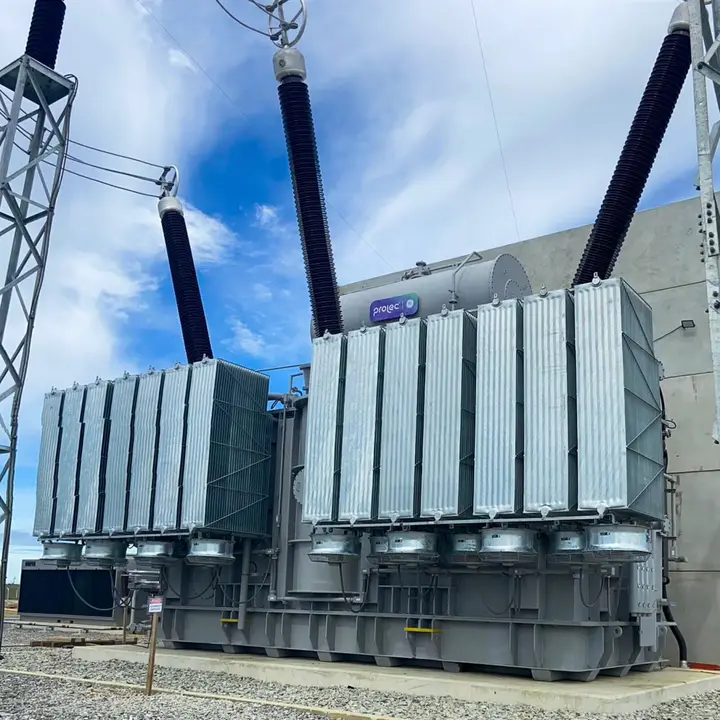
Prolec GE generator step-up transformers, 13.2-25 kV delta into 69-765 kV wye, wholly GE Vernova-owned since February 2026
This model is part of SecondWatt’s transformer research catalogue. Specifications and price observations are included where supported by sources. Equipment availability and commercial terms require confirmation.
GE Prolec GSU dossier: step-up transformers to 1,000 MVA and 765 kV, 1,675 kV BIL, GE Vernova acquisition, used-market channels, inspection checklist.
Prolec GE's generator step-up line pairs low-voltage windings of 13.2-25 kV delta with high-voltage windings of 69-765 kV wye. The two OEM documents disagree on the capacity ceiling and both are published: the product page states up to 600 MVA single-phase and 900 MVA three-phase at North American facilities, with 1,000 MVA three-phase and 800 kV available at the Canoas, Brazil plant, while the February 2024 GSU data sheet states up to 1,000 MVA three-phase and 500 MVA single-phase. Both figures appear in the specification table below, each labelled with its document.
The data sheet is the source for the rest of the envelope: 550 kV class with 1,675 kV BIL at North American facilities, ONAN/ONAF/ODAF cooling, ANSI, IEEE, CSA and IEC builds, 50 or 60 Hz, HV load or de-energized tap changers, ASTM Type I oil, and low-noise designs to NEMA minus 25 dBA, on an installed base above 300,000 MVA across 35 countries.
Ownership changed while these units were being built. GE Vernova agreed in October 2025 to buy the remaining 50% of the Prolec GE joint venture from Grupo Xignux for 5.275 billion USD and completed the purchase on 2026-02-02. Prolec GE, including the Waukesha, Wisconsin and Goldsboro, North Carolina plants, now reports inside GE Vernova's Electrification segment, with a 140 million USD Goldsboro expansion doubling medium-power output. Secondary supply is real but thin on price: the Surplus Record GSU category held 107 listings in August 2026, and a used GE Prolec 42/57/71 MVA 115 kV unit sat at a Michigan dealer, contact for pricing.
Why it matters
GSU demand rose 274% between 2019 and 2025 while the average GSU lead time reached 144 weeks, so the step-up is the transformer that sets the energization date on any behind-the-meter generation project. Prolec GE is one of the largest producers in the Americas, with seven plants and roughly 10,000 employees, and full GE Vernova ownership since February 2026 puts the US Waukesha and Goldsboro capacity behind a single balance sheet.
Who buys it
Power producers repowering gas and hydro plants, utilities holding spares against 144-week GSU lead times, and behind-the-meter generation projects at data center campuses buy this class. Waukesha-badged legacy units carry a dedicated used category, so fleet managers also source them for like-for-like replacement in existing yards.
Role in the data center
Step-up transformer for on-site generation at campuses, taking 13.8-18 kV turbine or engine output up to transmission voltage for export or utility interconnection. On behind-the-meter power projects it is the pacing item on the schedule, with GSU lead times averaging 144 weeks in Q2 2025 against 128 weeks for power transformers generally.
Key specifications
| LV winding range | 13.2-25 kV delta |
|---|---|
| HV winding range | 69-765 kV wye |
| Capacity, North America, product page | 600 single-phase / 900 three-phase MVA |
| Capacity, Canoas Brazil plant, product page | 1,000 three-phase; 800 kV MVA |
| Voltage class and BIL, GSU data sheet | 550 kV class, 1,675 kV BIL |
| Cooling classes | ONAN / ONAF / ODAF |
| Installed base | 300,000+ MVA / 35 countries |
| GE Vernova buyout | 5.275B USD, completed 2026-02-02 |
| Goldsboro NC expansion | 140M USD, 330 jobs |
| Used GSU category depth | 107 listings |
| Capacity, GSU data sheet (Feb 2024) | 1,000 three-phase / 500 single-phase MVA |
| Tap changer options, data sheet | HV load tap changer or de-energized tap changer |
| Insulating fluid, data sheet | ASTM Type I mineral oil |
| Sound level option, data sheet | NEMA minus 25 dBA |
| Ownership completed | 2026-02-02, GE Vernova acquired the remaining 50% |
| Observed used Prolec-lineage unit | 42/57/71 MVA, 115 kV, 2012 build price on request |
Technical summary
LV windings: 13.2-25 kV delta. HV windings: 69-765 kV wye. Capacity, North America: to 600 MVA 1-phase / 900 MVA 3-phase. Capacity, Brazil (Canoas): to 1,000 MVA 3-phase, 800 kV. NA voltage/BIL ceiling: 550 kV class, 1,675 kV BIL. Cooling: ONAN / ONAF / ODAF. Standards: ANSI, IEEE, CSA, IEC; 50/60 Hz. Noise: low-noise designs to NEMA minus 25 dBA. Installed base: 300,000+ MVA in 35 countries. Related lines: station service and unit auxiliary transformers below 50 MVA.
Major variations
GSU manufacturing splits across Prolec Monterrey, Prolec Brazil, and Prolec Waukesha (Wisconsin and North Carolina). Legacy nameplates in the same lineage include SPX Transformer Solutions and Waukesha (acquired October 2021) plus McGraw-Edison-era units. Station service and unit auxiliary transformers below 50 MVA round out the plant-side family.
Configurations and options
Low-voltage windings run 13.2-25 kV in delta and high-voltage windings 69-765 kV in wye. The two published OEM documents give different capacity ceilings and both are current: the product page states 600 MVA single-phase and 900 MVA three-phase in North America with 1,000 MVA three-phase and 800 kV from Canoas, Brazil, while the February 2024 GSU data sheet states 1,000 MVA three-phase and 500 MVA single-phase. The North American voltage and insulation ceiling is 550 kV class with 1,675 kV BIL. Cooling is ONAN, ONAF or ODAF; fluid is ASTM Type I mineral oil. Tap control is a de-energized tap changer, or a load tap changer placed on the high-voltage side where required. Sound follows NEMA TR1 with low-noise designs to NEMA minus 25 dBA. Single-phase banks are ordered as four units, three plus a spare. Builds are available to ANSI, IEEE, CSA or IEC at 50 or 60 Hz.
Compatibility and dependencies
A GSU is defined by what it bolts to at both ends. On the low-voltage side the delta winding at 13.2-25 kV typically lands on isolated-phase bus duct through high-temperature bushings, so the bus duct maker's flange and the bushing have to be coordinated at order. On the high-voltage side the wye winding at 69-765 kV goes to the switchyard, with the neutral bushing taken to the station ground. Impedance sets the generator's contribution to system fault current and the duty on switchyard breakers, and BIL to 1,675 kV has to coordinate with the arrester scheme. A load tap changer needs a motor drive and control cabinet, and ONAF or ODAF stages need fan and pump supplies. The companion station service and unit auxiliary transformers below 50 MVA ground their low-voltage neutral through a neutral grounding resistor. Transport at 10 MVA and above follows IEEE C57.150-2023.
Pricing and availability
Trend: rising Electrical Trader's price history, published 2026-04-01, puts power transformer prices up 77% between 2019 and 2026 and generator step-up transformers up 45% since 2019, on copper up roughly 70% and grain-oriented electrical steel up 80-100% from 2020 to 2025. It records Q2 2025 lead times of 128 weeks for power transformers and 144 weeks for GSUs. PwC figures reported by pv magazine USA on 2026-05-11 put high-capacity units at up to four years, with GSU demand up 274% between 2019 and 2025. Lead time, new: 100-150+ weeks (GSU class); 144 weeks Q2 2025 average. Lead time, used or refurbished: 2-12 weeks. Warranty, used: 3-year typical from major US rebuilders.
Lifecycle and maintenance
Liquid-filled transformers routinely serve 30-40 years with annual oil screening, DGA on a 1-2 year cadence (or continuous online monitoring on critical units), and gasket or bushing service as tests dictate. Major US rebuilders remanufacture units to like-new condition with warranties up to 3 years (T&R Electric, Sunbelt Solomon), and reconditioned stock ships in days against 65-210 week new-build queues. Remaining paper life, estimated by furan testing, governs end-of-life valuation.
Thermal and emissions profile
Transformers produce no combustion emissions; the regulatory profile is efficiency and fluid. US distribution-class units fall under DOE 10 CFR 431 Subpart K efficiency standards, amended in 2024 with compliance from 2029 requiring 10-30% lower losses than 2016 levels. Fluid choice drives fire and environmental posture: mineral oil versus FR3 natural ester with a 360 C fire point and ready biodegradability. Legacy units require PCB screening, with clean units documented below 2 ppm.
Common failure points
- Windings — Dielectric failure; windings dominate major-failure statistics in CIGRE TB 642
- Bushings — Failure share rises with voltage class; OIP bushing faults can rupture tanks
- OLTC — Contact and mechanism wear; prominent failure source on substation units
- Winding deformation — Through-fault or transport damage shifting SFRA signature
- Cooling system — Pump, fan, and radiator degradation derating the unit
- Moisture and paper aging — Furans in oil and reduced degree of polymerization
Inspection checklist
DGA: dissolved gas analysis per IEEE C57.104; combustible-gas trend rise between 2 samples triggers investigation. Oil quality: dielectric breakdown, moisture, acidity, and furan tests; degree of polymerization below 200 marks end of paper life. Insulation resistance: megger HV/LV/ground; polarization index of 2.0 or higher passes. Power factor: insulation power factor testing; values above 1.0% on oil-filled windings warrant investigation. Turns ratio: TTR on all taps; deviation beyond 0.5% from nameplate fails. Winding resistance: three-phase balance within 2% between phases. Bushings: capacitance and power factor test; bushing failure share rises with voltage class per CIGRE TB 642. OLTC: inspect on-load tap changer diverter and selector; OLTCs are a leading failure component in CIGRE TB 642 fleet surveys.
Procurement channels
New units quote through GE Vernova/Prolec GE. Used channel: Surplus Record GSU category (107 listings, mostly price-on-request), Transformer Exchange (used GE Prolec 115 kV unit in stock), MARS Transformers (new-surplus 230 kV GSU), and the Waukesha-brand category for legacy units.
Regional notes
Builds are offered to ANSI, IEEE, CSA or IEC at 50 or 60 Hz, from plants in Mexico, the United States (Waukesha, Wisconsin and Goldsboro, North Carolina) and Brazil (Canoas). The plant decides the ceiling: North American facilities top out at 550 kV, and 800 kV is available only from Canoas. Ownership has changed and the current description matters on a purchase order: GE Vernova completed the purchase of Grupo Xignux's remaining 50% on 2026-02-02, so Prolec GE is a wholly owned GE Vernova business, not a joint venture. Mexican and Brazilian units carry Section 232 50% tariff exposure on non-US steel and aluminum content from 2025-08-18; the Wisconsin and North Carolina plants do not.