Eaton Rack PDU G4, 12 to 100 A across Basic, Metered Input, Metered Outlet and Managed tiers
Manufacturer: Eaton
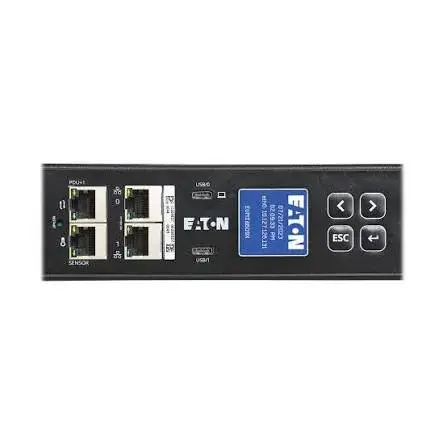
Renamed from ePDU, the only rack PDU line publishing a G3-to-G4 controller upgrade path and 1% Class 1 metering
This model is part of SecondWatt’s pdu research catalogue. Specifications and price observations are included where supported by sources. Equipment availability and commercial terms require confirmation.
Eaton Rack PDU G4 dossier: renamed from ePDU, 12 to 100 A across four tiers, 1% Class 1 metering, controller upgrade path and observed pricing.
Eaton's current market-facing name for this line is Rack PDU G4, not ePDU G4. The ePDU name belongs to the earlier generations, and Eaton published an end-of-life notice dated 1 January 2021 covering a long list of legacy EBA, EMA, EMI, EMO and ePBZ series models. G4 launched in December 2023 and runs four tiers: Basic, Metered Input, Metered Outlet and Managed.
The generation change is substantive rather than cosmetic. G4 moved from a single 10/100 Mb port to dual Gigabit Ethernet, added REST API, MQTT and Modbus TCP to the SNMP, CLI and SSH that G3 supported, extended the standard warranty from two years to three, and added 1U and 2U horizontal form factors alongside the 0U vertical. Metering is quoted at 1% IEC Class 1 billing-grade accuracy for voltage, current, watts and kilowatt-hours, and the line carries UL 2900-1 and IEC 62443-4-2 cybersecurity certifications, which no other manufacturer in this category publishes.
The commercially decisive feature for a used buyer is controller continuity. Eaton publishes explicit instructions for replacing a G3-era network management card with the G4 Gigabit module on compatible units, which means an older power section is a firmware upgrade rather than a write-off. That is the strongest answer in this category to the problem that ends most rack PDU lives.
Why it matters
A documented upgrade path from one controller generation to the next is the single most valuable thing a manufacturer can publish for a secondary market in this category. Firmware support rather than wear is what ends a rack PDU's life, so a power section that can take a current network module keeps its value in a way that a fixed-controller unit cannot.
Who buys it
Enterprise and colocation operators standardising a rack power platform across a fleet, and owners of an installed G3 base deciding between replacement and a controller upgrade. Eaton positions the line at up to 100 A and up to 48 managed outlets, so the buyer is typically fitting high-density cabinets rather than network closets.
Role in the data center
Cabinet power distribution and per-outlet measurement in enterprise and colocation halls, including high-density cabinets where three-phase 400 or 415 V distribution and 63 A or higher feeds apply. Basic tier units serve the same cabinets where no measurement is required.
Key specifications
| Tiers | Basic, Metered Input, Metered Outlet, Managed |
|---|---|
| Current range | 12 to 100 depending on model A |
| Three-phase input options | 120/208 wye, 208 delta, 240/415 wye, 220/380 wye, 230/400 wye V |
| Outlets | C13, C19 and C39 combination; up to 54 total and 48 managed |
| Metering accuracy | 1 IEC Class 1 billing-grade % |
| Network protocols | REST API, SNMPv3, Modbus TCP, MQTT, CLI, SSH |
| Ethernet ports | dual Gigabit, against a single 10/100 Mb port on G3 |
| Daisy chain limit | 32 per the cross-reference document, 40 per the EMEA catalogue units |
| Environmental sensors | up to 3 Environmental Monitoring Probe Gen 2 per PDU |
| Form factors | 0U vertical, plus 1U and 2U horizontal new in G4 |
| Operating temperature | up to 60 degrees C |
| Cybersecurity certifications | UL 2900-1 and IEC 62443-4-2 |
| Warranty | 3 years standard, extendable by 1 or 3 years |
| Controller upgrade path | documented replacement of the G3 network card with the G4 Gigabit module |
| Legacy end of life | EBA, EMA, EMI, EMO and ePBZ series ended 2021-01-01 |
Technical summary
Tiers: Basic, Metered Input, Metered Outlet and Managed. Input, single phase: 100 to 240 V, 100 to 127 V, 200 to 240 V and 208 V options. Input, three phase: 120/208 V wye, 208 V delta, 240/415 V wye and 230/400 V wye. Current: 12 A to 100 A depending on model, with 16, 32 and 63 A example configurations published. Outlets: C13, C19 and the C39 combination outlet; up to 54 outlets and up to 48 managed. Metering accuracy: 1% IEC Class 1 billing-grade for voltage, current, watts and kilowatt-hours. Network: REST API, SNMPv3, Modbus TCP, MQTT, CLI and SSH on dual Gigabit Ethernet ports. Daisy chain: up to 32 units, or 40 per the EMEA catalogue, using RSTP. Environmental sensors: up to 3 Environmental Monitoring Probe Gen 2 units per PDU. Form factors: 0U vertical primary, plus 1U and 2U horizontal new in G4. Certifications: UL 2900-1 and IEC 62443-4-2 cybersecurity certifications. Warranty: 3 years standard against 2 on G3, extendable by 1 or 3 further years.
Major variations
Four tiers across 0U, 1U and 2U form factors, plus a universal-input variant supporting fifteen input cable options and a G4e lite build carrying NEMA 5-15R and 5-20R outlets. Eaton also sells a wholly separate Tripp Lite branded rack PDU range following the March 2021 acquisition, so the company runs two brands in the same category at different price points.
Configurations and options
The common data center build is a 0U Managed unit with the colour LCD, dual Gigabit ports and C13 and C39 outlets. The C39 outlet is an Eaton design accepting both C14 and C20 plugs, so it is not an IEC 60320 standard designation and should not be described as one. Cybersecurity certification to UL 2900-1 and IEC 62443-4-2 is applied to the G4 line rather than sold as an option.
Compatibility and dependencies
The C39 outlet is proprietary, so a rack standardised on it constrains future PDU choice. Two Eaton documents disagree on the cascade limit, at 32 units against 40, so the figure should be taken from the document matching the firmware in service. Network module compatibility between G3 and G4 applies to specific units and should be checked per part number.
Pricing and availability
Published price range: $1,199 - $2,855 per unit new. Trend: stable No published price series exists. Three new-condition observations give the narrowest and most internally consistent range in the category: a 24-outlet EVMAL620A at 1,199.77 USD or 50.00 per outlet, a 42-outlet EVMAL630X at 2,324.90 or 55.36, and a three-phase EVMA4609X at 2,854.90 or 67.97. Eaton is therefore the only rack PDU manufacturer whose per-outlet pricing holds within a narrow band across models. Lead time, new: Distributor stock. Lead time, used or refurbished: No refurbished G4 listing is publicly available as of August 2026.
Lifecycle and maintenance
A rack PDU has almost no wearing parts in the power path, so service life is set by firmware support rather than hardware fatigue. Warranty terms cluster at two to five years: Raritan two extendable to five, Eaton three on the G4 against two on the G3, CyberPower three, and Vertiv five if registered within 120 days. What actually ends a unit's life is the controller: when a manufacturer stops issuing firmware, a networked PDU becomes an unpatchable device on a production network. That is why controller replaceability matters more than any mechanical specification here, and why Eaton publishing an upgrade path from its G3 network card to the G4 module, and Raritan shipping a hot-swappable controller, are the most commercially significant features in this category. End of life is an IT-asset recovery: aluminium extrusion, copper busbar, a controller board and relays.
Thermal and emissions profile
A rack PDU has no emissions of its own. Its environmental relevance runs in two directions: what its metering enables, and what happens to the hardware at end of life. Outlet-level metering is the measurement layer under capacity planning, chargeback billing and stranded-capacity recovery, so accuracy class is an efficiency question rather than a feature one. Published accuracy runs from 0.5% on the tightest product to 3% on a mainstream metered unit, and only the tightest tier cites IEC 62053-21 Class 0.5. At end of life the unit is an IT asset rather than electrical infrastructure: extrusion, copper busbar, a controller board and relays. Schneider publishes 843 kg of carbon dioxide equivalent and 53% recyclability for one metered model, the only published figure of its kind in the category.
Common failure points
- Outlet relay failure — An outlet will not switch, or switches but does not report state, on a unit whose entire premium is remote control
- Firmware obsolescence — An unsupported controller leaves published vulnerabilities open on a device that can power-cycle production loads remotely
- Firmware licensing — Network management card firmware moved to paid subscription at one major manufacturer in Q3 2023
- Controller failure — The unit distributes power but loses metering, switching and network presence together
- Power-on state misconfiguration — Outlets energise or stay dark on restore against the operator's expectation, restarting or stranding loads
- Outlet retention wear — Contacts lose retention and a cord drops out under vibration
Inspection checklist
Metering tier: confirm whether the unit switches only, meters only, or does both, because 3 different products carry similar names. Relay operation: cycle every outlet relay individually on and off, since relay failure is the defining wear mechanism of a switched unit. Outlet state on power loss: confirm the configured power-on state per outlet, because a wrong default reboots a load the moment the unit is energised. Switching sequence timing: confirm the per-outlet startup delay, which prevents an inrush event when a whole rack restarts. Metering accuracy: published figures range from 0.5% to 3% across this category, a 6-fold spread that decides billing suitability. Firmware version and support: confirm the unit can still receive firmware, because an unpatchable switched PDU is a remote-control surface on the network.
Procurement channels
New stock through IT distribution and marketplace sellers. No warranted refurbished Rack PDU G4 is publicly listed on the refurbished or surplus channels as of August 2026, consistent with a line launched in December 2023 not yet having reached the secondary market in volume. Legacy ePDU generations do appear used.
Regional notes
Sold in both North American and EMEA catalogues with different input configurations and different published cascade limits. UL 62368-1 and CE are not itemised in Eaton's published G4 datasheets as of August 2026, which cite UL 2900-1 and IEC 62443-4-2 cybersecurity certification instead.