Raritan PX4 intelligent rack PDU, 12 to 100 A, up to 48 outlets
Manufacturer: Raritan
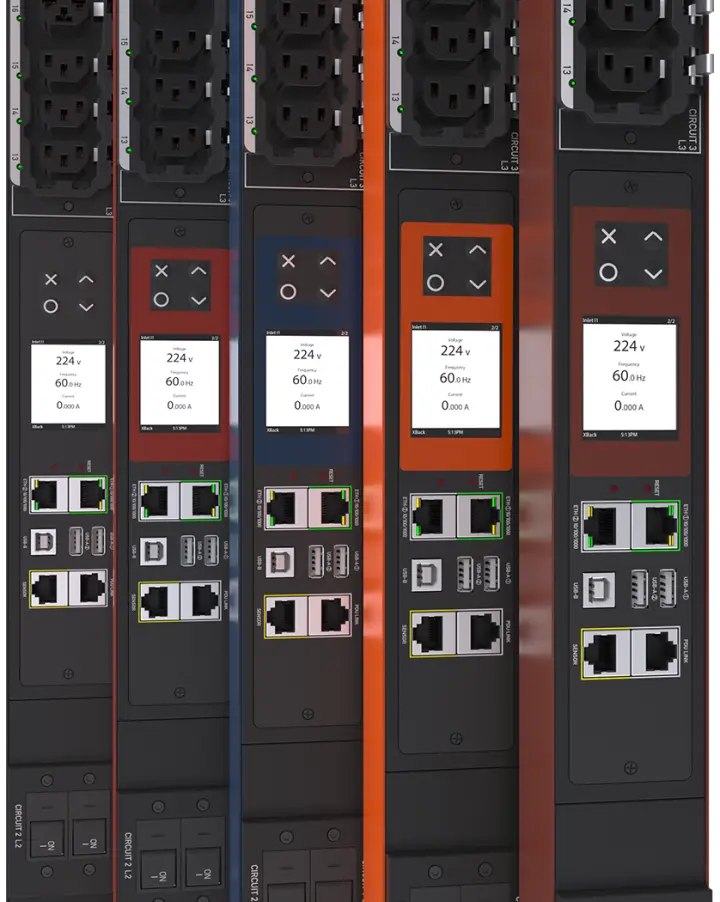
The tightest metering in the category at 0.5%, and the only line citing IEC 62053-21 by name
This model is part of SecondWatt’s pdu research catalogue. Specifications and price observations are included where supported by sources. Equipment availability and commercial terms require confirmation.
Raritan PX4 dossier: 12 to 100 A intelligent rack PDU with 0.5% metering accuracy citing IEC 62053-21, hot-swappable controller and observed pricing.
PX4 is Raritan's current intelligent rack PDU generation, launched on 1 May 2023 alongside the Server Technology PRO4X, which is Legrand's second rack PDU brand launched the same day. It spans 12 to 100 A across single and three phase at 100 to 415 V, in 0U, 1U, 2U and 3U form factors, with up to 48 outlets mixing HDOT C13 and HDOT Cx combination outlets that accept C14 and C20 plugs.
The specification that separates this line is measurement. Raritan publishes 0.5% metering accuracy citing IEC 62053-21 and IEC 61557-12 by name, and one model spec sheet states Class 0.5 energy metering with per-line and per-circuit-breaker tracking. Against 1% Class 1 on Eaton's G4 and 3% on an APC AP8858 metered unit, that is a six-fold accuracy range across products a buyer might otherwise treat as equivalent, and it is what decides whether the data can support chargeback billing.
Two generation facts belong on any listing. PX3-iX is not a separate tier; it is a PX3 chassis fitted with the newer iX7 controller. And Raritan announced end of life for the PX3-5000 series on 8 December 2025, with last orders in June 2026 and end of service life in June 2028, naming PX4 replacement part numbers. The PX4 controller itself is hot-swappable, which is the direct answer to the firmware-obsolescence problem that ends most rack PDUs.
Why it matters
This is the reference point for what metering accuracy actually costs. A buyer comparing a Raritan PX4 against an APC metered unit is comparing 0.5% against 3%, and no tier name in the category communicates that.
Who buys it
Colocation providers billing customers on measured consumption, and enterprises running capacity-planning programmes that need per-outlet data they can defend. The 0.5% accuracy claim is bought by people who invoice against it, which is a narrower buyer than the category as a whole.
Role in the data center
Cabinet power distribution where measured consumption is billed or formally reported, and high-density racks needing three-phase 400 or 415 V feeds at up to 100 A. The hot-swappable iX controller allows the metering layer to be replaced without dropping the cabinet.
Key specifications
| Input voltage options | 100, 120, 200, 208, 230, 240, 400 and 415 V |
|---|---|
| Current range | 12 to 100 depending on model A |
| Outlets | up to 48, mixing HDOT C13 and HDOT Cx combination |
| Metering accuracy | 0.5 citing IEC 62053-21 and IEC 61557-12 % |
| Metering class | Class 0.5 with per-line and per-circuit-breaker tracking |
| Network protocols | SNMP v2c and v3, Modbus TCP, REST, Redfish, SSH, TLS, HTTPS, MQTT |
| Cascade limit | 32 PDUs per Ethernet port, plus a Link feature for 8 |
| Environmental sensors | up to 32 sensor functions or 12 sensor packages |
| Form factors | 0U, 1U, 2U and 3U |
| Operating temperature | up to 60 degrees C |
| Controller | hot-swappable iX controller, iX12 on current models |
| Certifications | UL and cUL, IEC 62368, FCC Part 15 Class A, CE, UKCA |
| Warranty | 2 years standard, extendable to 5 |
| Predecessor end of life | PX3-5000 series announced 2025-12-08, last order June 2026, end of service June 2028 |
Technical summary
Input voltage: 100, 120, 200, 208, 230, 240, 400 and 415 V, single and three phase. Current: 12 A to 100 A depending on model. Outlets: up to 48, mixing HDOT C13 and HDOT Cx combination outlets accepting C14 and C20 plugs. Metering accuracy: 0.5%, citing IEC 62053-21 and IEC 61557-12; Class 0.5 with per-circuit-breaker tracking. Network: SNMP v2c and v3, Modbus TCP, REST and Redfish APIs, SSH, TLS, HTTPS, MQTT, IPv4 and IPv6. Cascade: 32 PDUs under one Ethernet port, plus a Link feature for up to 8 units. Environmental sensors: up to 32 sensor functions or 12 sensor packages, plug and play. Display: multi-colour LCD with auto-flip orientation; form factors 0U, 1U, 2U and 3U. Operating temperature: up to 60 degrees C standard. Controller: hot-swappable iX controller, with iX12 confirmed on a current model. Certifications: UL and cUL, IEC 62368, FCC Part 15 Class A, CE, UKCA. Warranty: 2 years standard, extendable to 5 through service tiers.
Major variations
PX4 spans metered and managed configurations across four form factors, with model codes encoding voltage, phase, current and capacity: PX4-2161-E7 is 230 V single phase at 32 A and 7.4 kVA, while PX4-5551-E7V2 is 208 V three phase at 48 A and 17.3 kVA. The prior PX3 generation remains in circulation, and PX3-iX denotes a PX3 chassis carrying the newer iX7 controller rather than a distinct product tier.
Configurations and options
The colocation build is a 0U vertical unit with HDOT Cx combination outlets, which reduce the number of distinct SKUs a site has to stock because one outlet accepts both C14 and C20 plugs. Mass firmware update over USB is published, which matters when a fleet has to be patched quickly. Warranty is 2 years standard, extendable to 5 through Raritan service tiers.
Compatibility and dependencies
PX4 adds a hardware cryptographic security module and secure boot that Raritan's own security note describes as PX4 only, so a PX3 unit cannot be brought to the same security posture by firmware alone. Two Raritan documents give different cascade figures, 32 under one Ethernet port against 16 over USB on a model spec sheet, so the applicable limit depends on the cascade method.
Pricing and availability
Published price range: $1,355 - $3,414 per unit new. Trend: stable No published price series exists and PX4 pricing is thin, which is consistent with a generation launched in 2023 that distributors often quote rather than list. Three published new-unit prices give a 36-outlet PX4-12A0-E7 at 1,355.39 USD or 37.65 per outlet, a 36-outlet PX4-531A-E7 at 2,667.99 or 74.11, and a three-phase PX4-5551-E7V2 at 3,414.00 on backorder with no outlet count confirmed. Prior-generation PX2 and PX3 units carry the refurbished trade at 3.31 to 5.35 USD per outlet. Lead time, new: Distributor stock, with end-of-life PX3 SKUs on backorder. Lead time, used or refurbished: Days to 2 weeks through refurbished IT channels for prior generations.
Lifecycle and maintenance
A rack PDU has almost no wearing parts in the power path, so service life is set by firmware support rather than hardware fatigue. Warranty terms cluster at two to five years: Raritan two extendable to five, Eaton three on the G4 against two on the G3, CyberPower three, and Vertiv five if registered within 120 days. What actually ends a unit's life is the controller: when a manufacturer stops issuing firmware, a networked PDU becomes an unpatchable device on a production network. That is why controller replaceability matters more than any mechanical specification here, and why Eaton publishing an upgrade path from its G3 network card to the G4 module, and Raritan shipping a hot-swappable controller, are the most commercially significant features in this category. Raritan set PX3-5000 end of service life at June 2028 with last orders in June 2026, naming PX4 replacement part numbers.
Thermal and emissions profile
A rack PDU has no emissions of its own. Its environmental relevance runs in two directions: what its metering enables, and what happens to the hardware at end of life. Outlet-level metering is the measurement layer under capacity planning, chargeback billing and stranded-capacity recovery, so accuracy class is an efficiency question rather than a feature one. Published accuracy runs from 0.5% on the tightest product to 3% on a mainstream metered unit, and only the tightest tier cites IEC 62053-21 Class 0.5. At end of life the unit is an IT asset rather than electrical infrastructure: extrusion, copper busbar, a controller board and relays. Schneider publishes 843 kg of carbon dioxide equivalent and 53% recyclability for one metered model.
Common failure points
- Firmware obsolescence — An unsupported controller cannot be patched, leaving published vulnerabilities open on a networked device
- Firmware licensing — Network management card firmware sits behind a paid subscription at one major manufacturer since Q3 2023
- Controller or network card failure — The PDU keeps distributing power but disappears from the management system
- Outlet retention wear — Contacts lose retention force and a cord drops out under vibration or during cable work
- Breaker nuisance tripping — A branch breaker trips below nameplate under normal load
- Residual configuration — A used unit arrives carrying the previous owner's accounts, directory settings and network configuration
Inspection checklist
Metering tier: establish which of the 5 rungs the unit actually occupies, because basic, metered inlet, metered by outlet, switched and switched metered by outlet are different products. Metering accuracy: published accuracy spans 0.5% on a Raritan PX4 to 3% on an APC AP8858, a 6-fold difference that decides whether the data can support chargeback billing. Accuracy standard cited: confirm whether the datasheet names IEC 62053-21 and a class, because 1% corresponds to Class 1 and only Class 0.5 is utility grade. Firmware version and support: confirm the unit can still receive firmware, since a networked PDU that cannot be patched is a permanent exposure. Firmware licensing: Schneider moved network management card firmware to paid subscription in Q3 2023, so budget for a licence rather than assuming free updates.
Procurement channels
New stock through IT distribution including CDW, SHI and specialist resellers, with several PX4 SKUs quoted rather than priced. The refurbished channel carries prior generations rather than PX4: one specialist lists refurbished PX2 and PX3 units at 3.31 to 5.35 USD per outlet, and a warranted refurbished specialist carries Raritan inventory without a visible PX4 price.
Regional notes
Global product with 100 to 415 V input options and UL, cUL, CE and UKCA marks, so the same platform serves North American and European racks with different plug and voltage configurations. Legrand runs Raritan and Server Technology as parallel brands in this tier.