CyberPower PDU81005 switched metered-by-outlet rack PDU, 20 A, 8 outlets
Manufacturer: CyberPower
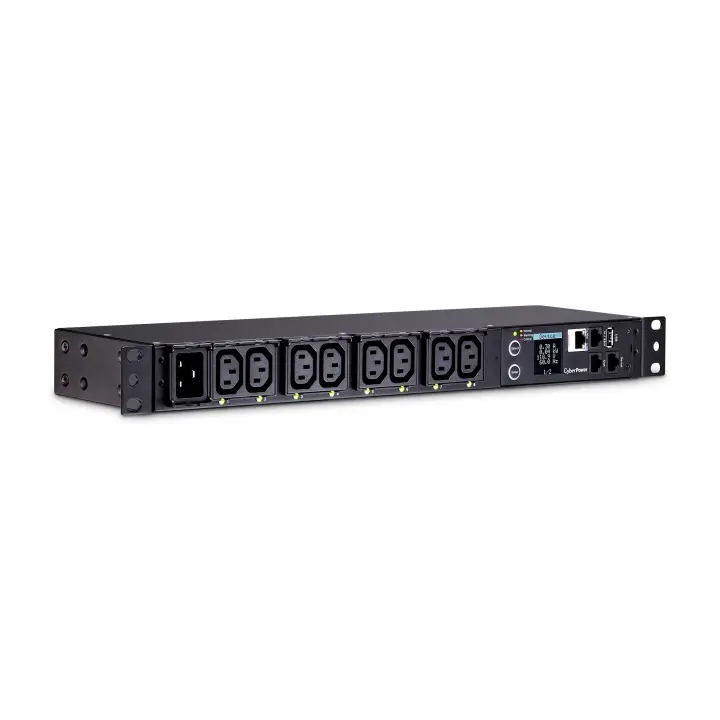
A switched metered-by-outlet rack PDU, and the widest price dispersion of any unit in this category.
This model is part of SecondWatt’s pdu research catalogue. Specifications and price observations are included where supported by sources. Equipment availability and commercial terms require confirmation.
CyberPower PDU81005 dossier: a switched metered-by-outlet rack PDU rather than a monitored one, with 8 C13 outlets, observed pricing and inspection guidance.
CyberPower publishes four separate rack PDU tiers and the PDU81005 sits in the top one. Switched, Metered, Monitored and Switched Metered-by-Outlet are distinct products in the manufacturer's own taxonomy, and this unit does both per-outlet metering and per-outlet remote switching, which is not what a monitored PDU does. Describing it as a monitored PDU understates the product by two rungs of the ladder.
The hardware is a 1U rackmount unit at 100 to 240 VAC single phase, 20 A derated to 16 A continuous, on a C20 inlet feeding 8 C13 outlets across a single circuit. It measures 17.05 by 1.75 by 4.41 inches at 4.63 lb, runs 0 to 55 degrees C, carries a multifunction LCD showing amperage, voltage, kilowatts and IP address, and supports an optional environmental sensor through an RJ45 port. Network support is broad, covering HTTPS, SNMP v1 and v3, SSH v2, RADIUS, LDAPv3 and Syslog, though CyberPower lists neither Modbus TCP nor Redfish among the supported protocols.
Two gaps matter commercially. CyberPower publishes no metering accuracy class or standard, which is unusual for a product whose whole premium is per-outlet measurement, and the manufacturer page states UL 62368 while a distributor-hosted datasheet still states the withdrawn UL 60950-1, so confirm the listing against the current datasheet revision before relying on it.
Why it matters
The same 8-outlet SKU trades between 596 and 1,116 dollars across three channels against a 1,300 dollar manufacturer list, an 87% spread on identical hardware. A buyer comparing a single quote has no way to know which of those numbers is the market without seeing the spread.
Who buys it
Colocation and enterprise operators who need remote reboot and per-outlet consumption data at small cabinet scale, and edge sites where an 8-outlet 1U unit is the whole rack. The buyer is choosing capability over outlet count: at roughly 75 to 140 dollars per outlet this is among the most expensive ways in the category to buy an outlet.
Role in the data center
Remote reboot and per-outlet consumption measurement in small cabinets, edge sites and network closets, where 8 outlets covers the whole rack and a 1U slot is available.
Key specifications
| Metering tier | switched metered-by-outlet |
|---|---|
| Input voltage | 100 to 240 single phase VAC |
| Maximum current | 20, derated to 16 continuous A |
| Inlet | IEC 60320 C20 |
| Outlets | 8 x C13 on a single circuit |
| Metering accuracy | no class or standard published by CyberPower |
| Network protocols | HTTPS, SNMP v1 and v3, SSH v2, RADIUS, LDAPv3, Syslog |
| Modbus TCP and Redfish | not listed among the supported protocols |
| Dimensions | 17.05 x 1.75 x 4.41 in (433 x 44 x 112 mm) |
| Weight | 4.63 lb or 2.1 kg |
| Operating temperature | 0 to 55 degrees C |
| Environmental sensor | optional through an RJ45 port |
| Listings | UL 62368 per the manufacturer page; a distributor datasheet cites the withdrawn UL 60950-1 |
| Warranty | 3 years limited, 5-year extension SKU available |
| Manufacturer list price | 1,300 USD against street pricing from 596 |
Technical summary
Tier: switched metered-by-outlet, the top rung of CyberPower's four-tier ladder Input: 100 to 240 VAC, single phase, 50 or 60 Hz Current: 20 A maximum, derated to 16 A continuous Inlet: IEC 60320 C20; outlets 8 x C13 on 1 circuit Metering: real-time per-outlet current, voltage and kilowatts Metering accuracy: no class or standard published by CyberPower Network: HTTP, HTTPS, SNMP v1 and v3, SSH v2, Telnet, FTP, RADIUS, LDAPv3, Windows AD, NTP, Syslog Display: multifunction LCD showing amperage, voltage, kilowatts and IP address Form factor: 1U rackmount at 17.05 by 1.75 by 4.41 in and 4.63 lb Operating temperature: 0 to 55 degrees C at 0 to 95% non-condensing humidity Listings: UL 62368 per the manufacturer page, with a distributor datasheet still citing UL 60950-1 Warranty: 3-year limited, with a 5-year extension SKU available
Major variations
The 81000 series is the switched metered-by-outlet family, with adjacent SKUs including PDU81001G, PDU83107, PDU83108 and PDU83111. CyberPower also sells metered automatic transfer switch and switched automatic transfer switch variants combining dual-input failover with these metering tiers, plus a separate maintenance bypass PDU line for UPS service work.
Configurations and options
A 1U horizontal build is standard on this SKU, with 0U vertical and wall-mount configurations elsewhere in the family. Rack brackets in two lengths and a cord retention tray are included, and an environmental probe is the one significant option.
Compatibility and dependencies
The C20 inlet needs a matching C19 cord from the rack whip, and the single-circuit design means all 8 outlets share one 16 A continuous budget. No published model code decode exists, so a used nameplate does not resolve to a configuration without the datasheet.
Pricing and availability
Published price range: $596 - $1,116 per unit against a $1,300 list. Trend: flat No published price series exists. Three new-condition observations of the same SKU run 596, 949.95 and 1,116 USD, which works out to 74.50, 118.74 and 139.50 dollars per outlet against a 1,300 dollar manufacturer list. That is an 87% spread on identical hardware in one condition tier, and it is the widest single-SKU dispersion in this category. Lead time, new: Distributor stock, with at least one channel on backorder. Lead time, used or refurbished: No used unit listed as of August 2026.
Lifecycle and maintenance
A rack PDU has almost no wearing parts in the power path, so service life is set by firmware support rather than hardware fatigue. Warranty terms cluster at two to five years: Raritan two extendable to five, Eaton three on the G4 against two on the G3, CyberPower three, and Vertiv five if registered within 120 days. What actually ends a unit's life is the controller: when a manufacturer stops issuing firmware, a networked PDU becomes an unpatchable device on a production network. That is why controller replaceability matters more than any mechanical specification here, and why Eaton publishing an upgrade path from its G3 network card to the G4 module, and Raritan shipping a hot-swappable controller, are the most commercially significant features in this category.
Thermal and emissions profile
A rack PDU has no emissions of its own. Its environmental relevance runs in two directions: what its metering enables, and what happens to the hardware at end of life. Outlet-level metering is the measurement layer under capacity planning, chargeback billing and stranded-capacity recovery, so accuracy class is an efficiency question rather than a feature one. Published accuracy runs from 0.5% on the tightest product to 3% on a mainstream metered unit, and only the tightest tier cites IEC 62053-21 Class 0.5. At end of life the unit is an IT asset rather than electrical infrastructure: extrusion, copper busbar, a controller board and relays. Schneider publishes 843 kg of carbon dioxide equivalent and 53% recyclability for one metered model, the only published figure of its kind in the category.
Common failure points
- Outlet relay failure — An outlet will not switch, or switches but does not report state, on a unit whose entire premium is remote control
- Firmware obsolescence — An unsupported controller leaves published vulnerabilities open on a device that can power-cycle production loads remotely
- Firmware licensing — Network management card firmware moved to paid subscription at one major manufacturer in Q3 2023
- Controller failure — The unit distributes power but loses metering, switching and network presence together
- Power-on state misconfiguration — Outlets energise or stay dark on restore against the operator's expectation, restarting or stranding loads
- Outlet retention wear — Contacts lose retention and a cord drops out under vibration
Inspection checklist
Metering tier — confirm whether the unit switches only, meters only, or does both, because 3 different products carry similar names Relay operation — cycle every outlet relay individually on and off, since relay failure is the defining wear mechanism of a switched unit Outlet state on power loss — confirm the configured power-on state per outlet, because a wrong default reboots a load the moment the unit is energised Switching sequence timing — confirm the per-outlet startup delay, which prevents an inrush event when a whole rack restarts Metering accuracy — published figures range from 0.5% to 3% across this category, a 6-fold spread that decides billing suitability Firmware version and support — confirm the unit can still receive firmware, because an unpatchable switched PDU is a remote-control surface on the network Firmware licensing — network management card firmware moved to paid subscription at one major manufacturer in Q3 2023, so confirm entitlement before purchase Known vulnerabilities — CVE-2021-22825 names APC AP7xxx and AP8xxx rack PDUs, and CVE-2024-6387 reached the Vertiv IMD-5 module, so check the advisory for the exact firmware Credentials and configuration — factory-reset the unit and confirm 0 residual accounts, because a used PDU frequently arrives with the previous owner's directory settings Inlet and plug — match the plug to the rack whip; L6-30P, L21-30P and IEC 60309 are not interchangeable Outlet count and mix — record C13, C19 and combination outlets separately, since dollars per outlet is the category price unit Breaker condition — exercise every branch breaker, because nuisance tripping is the most common in-service complaint Form factor and length — a 0U vertical unit is cut to a cabinet height and will not fit a shorter rack Daisy chain limit — confirm the published cascade maximum, which varies between 16 and 50 units by manufacturer Certification — confirm UL 62368-1 rather than the withdrawn UL 60950-1, superseded on 2020-12-20
Procurement channels
New stock through IT distribution including Compsource, Barcodes and marketplace sellers, with at least one channel showing backorder. One European reseller lists the unit with both new and refurbished options but does not disclose price by condition. No used or refurbished PDU81005 is publicly priced on the specialist refurbished channels.
Regional notes
North American product at 100 to 240 VAC with FCC Class A, CE and RoHS declarations alongside the safety listing. Confirm the safety listing (UL 62368-1 on the manufacturer page versus the withdrawn UL 60950-1 on a distributor datasheet) against the current datasheet revision before relying on it for compliance.