
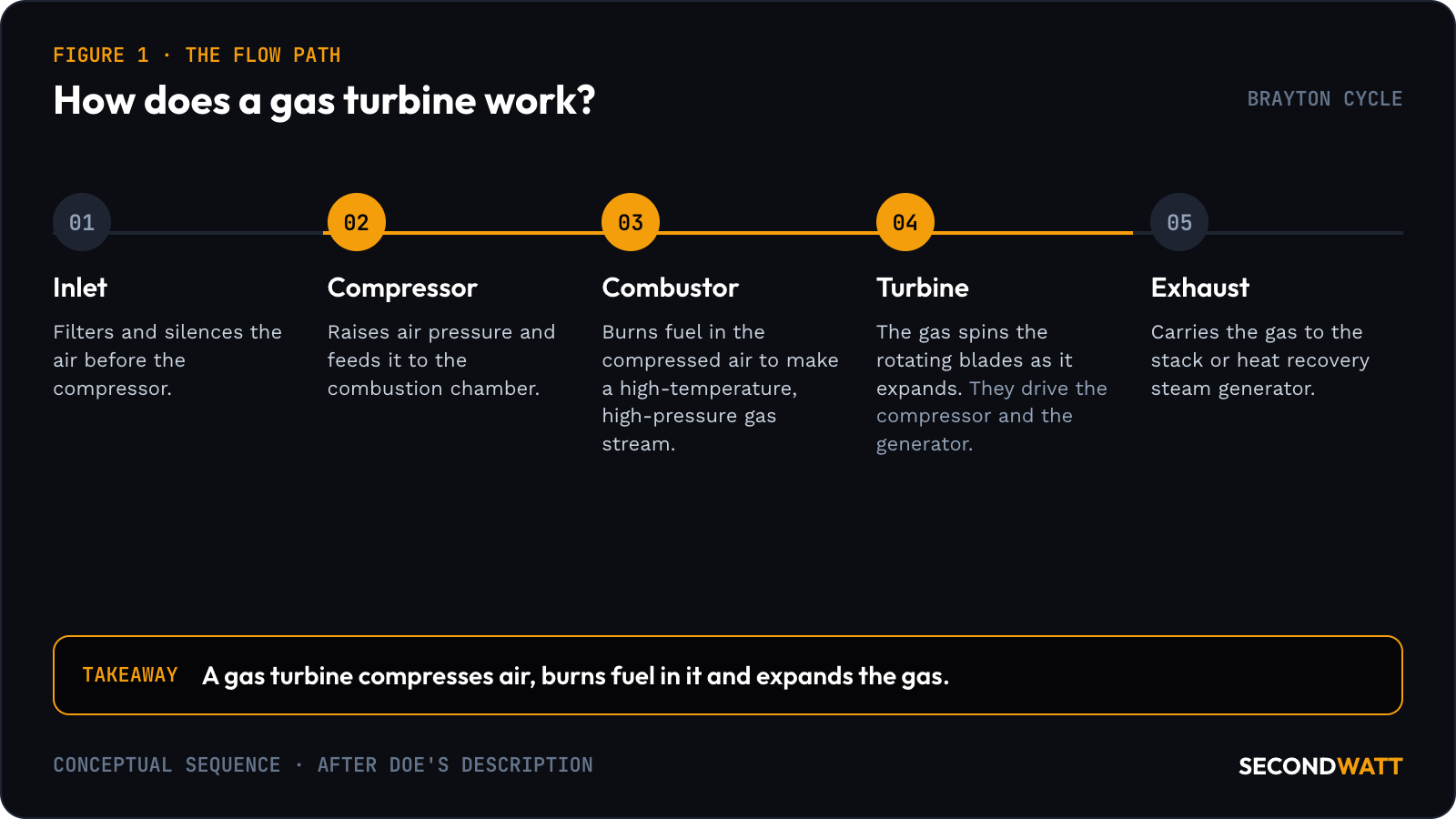
How does a gas turbine work? It squeezes air, burns fuel in that air and lets the hot gas expand through a turbine. As DOE's explainer on how gas turbine power plants work puts it, the turbine's rotating blades do two jobs: they drive the compressor that feeds the machine, and they spin a generator.
Each part wears in its own way, so a buyer of a used gas turbine asks part by part: what the combustor and hot-section records show, what the compressor has breathed, and whether the package around the engine still works.
Key Takeaways
- A gas turbine compresses air, burns fuel in it and expands the gas. The turbine blades then drive both the compressor and the generator.
- On GE Vernova heavy-duty frames, combustion and hot gas path parts need the most careful attention. The guide names liners, transition pieces, fuel nozzles, turbine nozzles, shrouds and buckets.
- Duty type changes how a hot section wears. On GE Vernova heavy-duty frames, thermal mechanical fatigue dominates peaking machines' life; creep, oxidation and corrosion dominate continuous duty.
- Compressor fouling is a recoverable loss. GE Vernova's heavy-duty guide puts fouling at typically 70–85% of performance losses; a 5% airflow loss cuts output by up to 8%.
- Whole engines can be swapped instead of repaired on site. GE Vernova, Siemens Energy and Solar Turbines each describe engine or module exchange programs.
How does a gas turbine work?#
DOE breaks the machine into three main sections. The compressor feeds pressurized air to the combustion chamber at speeds of hundreds of miles per hour. The combustion system, typically a ring of fuel injectors, burns fuel in that air to make a high-temperature, high-pressure gas stream. The turbine is an array of alternate stationary and rotating blades, and the gas spins the rotating ones as it expands.
The thermodynamic name for this sequence is the Brayton cycle. NASA Glenn Research Center calls it the cycle "used in all gas turbine engines": compression raises the air's pressure and temperature, combustion happens at constant pressure, and the gas then does work in a turbine that drives the compressor.
Gas turbine parts, in the order the air meets them#
Wear entries come from GE Vernova's guide for its heavy-duty frames unless a row names another source.
Gas turbine parts, what wears them and what a buyer checks (GE Vernova GER-3620-P revision P, released 2021-03-15; Siemens Energy SGT-800 page; Solar Turbines Titan 130 data sheet DS130PG/0525/EO; GE Vernova generator inspection page)#
| Part | What it does | What wears it | What a buyer checks |
|---|---|---|---|
| Inlet and filtration | Filters and silences the air before the compressor; the Titan 130 package lists barrier-type or self-cleaning filters | Water carry-over from inlet foggers, evaporative coolers or excess water washing can degrade the compressor (GER-3620-P) | Filter house condition, filter change records, any fogging or evaporative cooling history |
| Compressor | Raises air pressure; 21.1:1 on the SGT-800 62 MW rating, 19.1:1 on the Titan 130 | Erosion, corrosion and fouling of the blades (GER-3620-P) | Wash records, borescope findings on the blading, performance against the baseline |
| Combustor | Burns fuel in the compressed air | Liners, end caps, transition pieces and fuel nozzles, the first parts to need replacement and repair in a good maintenance program (GER-3620-P) | Combustion inspection reports and the parts replaced; combustor type (dry low NOx or water injected) |
| Turbine (hot gas path) | Nozzles guide the gas onto the buckets, which turn the rotor | Thermal mechanical fatigue in peaking duty; creep, oxidation and corrosion in continuous duty; coating loss (GER-3620-P) | Hot gas path inspection reports, coating condition, starts and hours since the last inspection |
| Exhaust diffuser | Carries the gas to the stack or heat recovery steam generator | Cracks in sheet metal and welds; erosion from extended operation at high temperatures (GER-3620-P) | Diffuser findings from each outage |
| Rotor and bearings | Carry the compressor and turbine stages | Contaminated or deteriorated lube oil damaging bearing liners; a bowed rotor if the warm rotor is not turned after shutdown (GER-3620-P) | Lube oil sample history, turning-gear practice, rotor inspection findings |
| Generator | Converts shaft power to electricity | Stress corrosion cracks in retaining rings; loose windings, corrosion or cracks in the rotor structure, as issues GE Vernova's generator inspections help detect (GE Vernova generator page) | Stator and rotor electrical test results, retaining-ring inspection records |
| Package auxiliaries | Lube oil, fuel, starting, controls, enclosure fire detection and suppression | Batteries, filters, oil and water levels, relays and calibrations, all serviced in standby inspections (GER-3620-P) | Start system and battery records, control system generation, fire system test records |
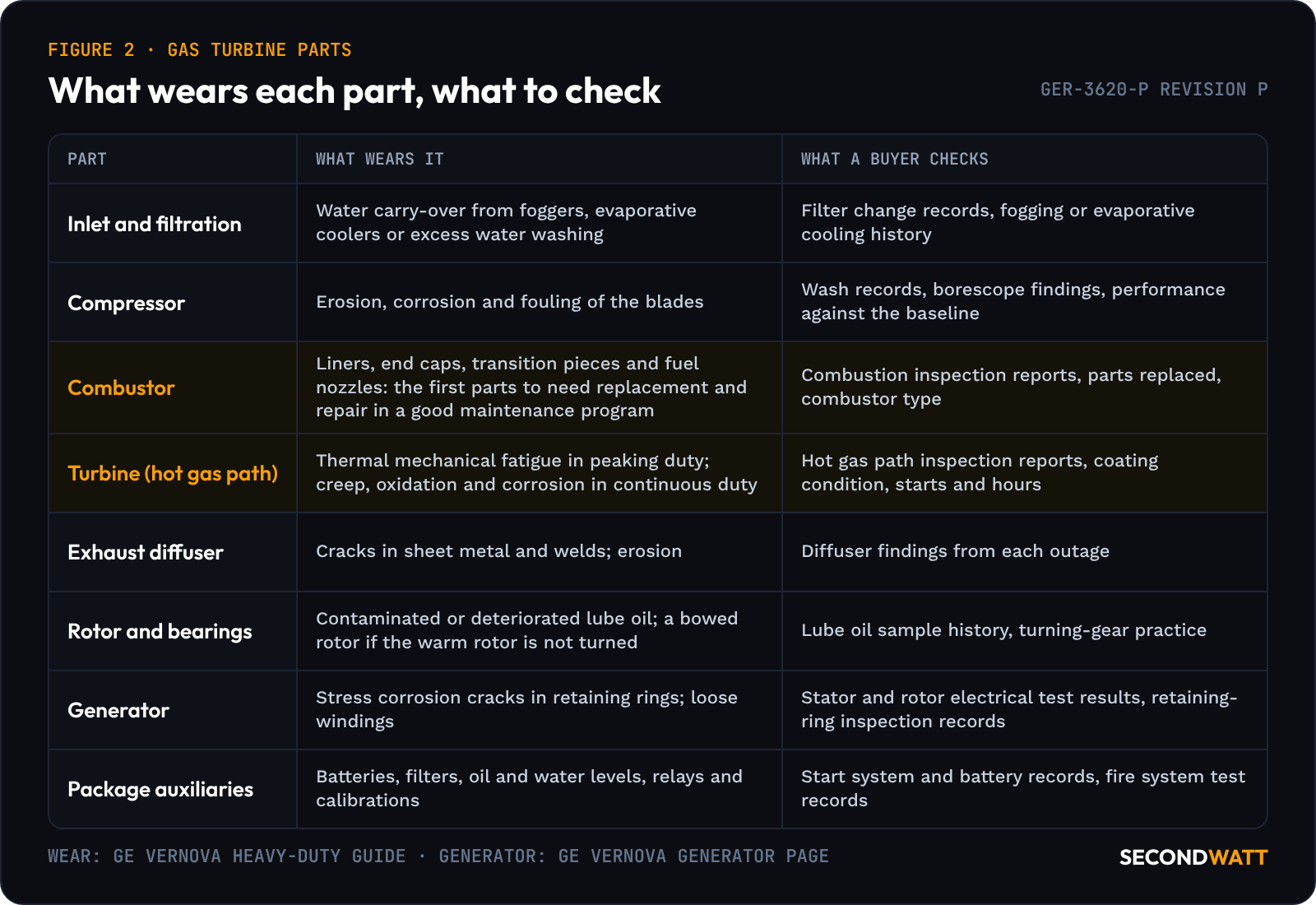
GE Vernova's heavy-duty guide, GER-3620-P, calls the combustion and hot gas path parts those "requiring the most careful attention": combustion liners, end caps, fuel nozzle assemblies, crossfire tubes, transition pieces, turbine nozzles, stationary shrouds and buckets.
Compressor#
Pressure ratio is compressor discharge pressure divided by inlet air pressure, in DOE's definition. Siemens Energy's SGT-800 has a 15-stage compressor, and its product page lists a pressure ratio of 21.1:1 at its 62 MW rating (62.5 MW gross, 50/60 Hz). Across the five ratings on the page, the ratio runs from 18.3:1 to 22.0:1. Those values assume standard design, ISO ambient conditions, natural gas and no intake or exhaust loss.
The Titan 130 has a 14-stage axial compressor, variable inlet guide vanes and stators, and a 19.1:1 pressure ratio. Solar Turbines' Titan 130 data sheet gives its rating basis as ISO: 15°C (59°F), sea level, no inlet or exhaust losses, 60% relative humidity and natural gas fuel. The same sheet lists on-crank and on-line compressor cleaning systems.
On GE Vernova's heavy-duty units, contaminants such as dust, salt and oil can cause compressor blade erosion, corrosion and fouling. Axial compressor deterioration is generally the major cause of lost output and efficiency there, according to GE Vernova's guide.
8% — the output loss, at most, that GE Vernova's heavy-duty guide shows when compressor fouling cuts airflow by 5%; heat rate rises by up to 3%.
In the guide, fouling losses are recoverable, and they typically account for 70–85% of the performance losses seen. On-line wash systems clean the compressor at load before significant fouling builds up, and off-line washes clean heavily fouled compressors.
Worked example: in GE Vernova's May 2025 7E fact sheet, the 7E.03's simple-cycle rating is 90 MW net plant, 60 Hz, at ISO conditions on natural gas, with a net heat rate of 10,107 Btu/kWh (LHV). Applying the guide's fouling percentages to that rating:
90 MW × 8% = up to 7.2 MW of output lost; 10,107 × 1.03 = up to 10,410 Btu/kWh.
The guide's percentages describe the gas turbine's own performance, and the 7E.03 figure is a net plant rating, so treat the result as an approximation. It shows why wash logs and a performance trend belong in a seller's records. Hot inlet air also cuts output, a separate effect covered in the derating guide.
Combustor#
The combustor is where fuel meets compressed air. Dry low-emissions or dry low-NOx systems premix fuel and air. GE Vernova's explainer on how turbine combustion works notes that premixed fuel is ideal for low NOx. Other combustors use water or steam injection for NOx abatement, according to GE Vernova's heavy-duty guide.
Named models show the range. The Titan 130 has an annular combustion chamber with either 21 conventional fuel injectors or 14 lean-premixed SoLoNOx dry low emissions injectors. On its LM6000 page, GE Vernova offers the LM6000VELOX package with either a DLE or a SAC (water injected) combustor.
On GE Vernova heavy-duty units, a combustion inspection concentrates on the combustion liners, transition pieces, fuel nozzles and end caps. In a good maintenance program, these are the first parts to require replacement and repair, and their proper care contributes to longer life of the downstream turbine nozzles and buckets. The checklist in Figure 31 of GE Vernova's guide covers foreign object damage, cracking, liner cooling hole plugging, thermal barrier coating condition, oxidation, corrosion, erosion, and hot spots or burning.
Every SGT-800 carries a dual-fuel Dry Low Emission (DLE) combustion system to minimize NOx and CO emissions, per Siemens Energy. Combustor type therefore belongs early in any permit discussion, which the emissions permitting guide covers.
Turbine and hot section#
The turbine section turns hot gas into shaft power. In GE Vernova's terms its parts are turbine nozzles, stator shrouds and buckets, and the hot gas path inspection adds them to the combustion inspection scope. The top half of the turbine shell must come off to do it.
How the hot section wears depends on how the unit ran. On GE Vernova's heavy-duty frames, thermal mechanical fatigue is the dominant life limiter for peaking machines, while creep, oxidation and corrosion dominate for continuous-duty machines. The causes of wear in Figure 4 of the guide also include rupture, erosion, high-cycle fatigue, rubs and foreign object damage for continuous duty, and high-cycle fatigue, rubs and foreign object damage for cyclic duty.
GE Vernova bases most maintenance requirements on independent counts of starts and hours, and whichever limit is reached first sets the interval. The guide covers GE Vernova heavy-duty frames; the LM6000 and LM2500 aeroderivatives fall outside it. The maintenance intervals guide covers the counts themselves.
Coatings protect the hot parts, but even the best coatings have a finite life, and coating condition plays a major role in determining bucket life. If recoating is selected, GE Vernova's guide says it should be done before the coating is breached to expose base metal. For 7E.03 turbines, that normally means at the hot gas path inspection.
On some GE Vernova heavy-duty installations, the controls hold firing temperature constant with steam or water injection. This wet control adds output but decreases parts life, the guide notes. Running hotter costs part life too. Peak load means operation above base load at higher turbine temperatures, and significant operation there requires more frequent maintenance and replacement of hot gas path and combustion parts.
596°C (1,104°F) — the exhaust temperature Siemens Energy lists for the SGT-800 at its 62 MW rating (62.5 MW gross, 50/60 Hz), on ISO conditions and natural gas with no intake or exhaust loss.
Shafts, layouts and model families#
The shaft layout decides what turns what. The SGT-800 is single-shaft, in Siemens Energy's words: "The single-shaft engine is composed of a 2-bearing rotor with a 15-stage compressor and a 3-stage turbine." Its turbine speed is 6,600 rpm on every rating listed. The SGT-800 dossier collects its ratings.
The Titan 130 is an industrial, single-shaft gas turbine with a 3-stage reaction power turbine, per Solar's data sheet. An epicyclic main reduction drive brings the output to 1,500 or 1,800 rpm for a 50 or 60 Hz generator. It is rated 16,530 kWe at ISO conditions with no accessory losses; the sheet does not tie the rating to 50 or 60 Hz.
The LM6000 aeroderivative is built differently: GE Vernova describes a "simple two-spool design". Its September 2025 fact sheet rates the LM6000 PF+ Sprint at 56.9 MW net in simple cycle, at 41.0% net efficiency (LHV). The rating assumes ISO conditions, 50/60 Hz and natural gas, with inlet and exhaust losses included and balance of plant excluded.
GE Vernova offers the LM2500 with a singular annular combustor or dry low emissions combustion. Its page notes an open configuration for faster access, easier maintenance and quicker engine removal and replacement. On the heavy-duty side, the 7E.03 page lists a three-stage turbine and an enhanced compressor of high-strength, corrosion-resistant material; the Frame 7EA dossier covers the family. The aeroderivative vs industrial comparison sets the two classes side by side.
What a buyer inspects on a used turbine#
Start with the paper. Ask for the borescope reports, the combustion and hot gas path inspection reports with parts replaced, and starts, hours and trips since each. In GE Vernova's guide, running inspections start with baseline operating data from a new unit's startup and after any major disassembly, so later deterioration can be measured against it.
Then the compressor and inlet. Wash logs, filter records and any fogging history show what the blading has breathed. The guide adds that during borescope inspections, the upstream systems from the filter house to the compressor inlet should be checked too.
The rotor and bearings come next. GE Vernova's major inspection checks the unit rotor for heavy corrosion, cracks, object damage or rubs, and the bearing liners and seals for clearance and wear. The guide calls routine lube oil sampling an essential part of a complete maintenance plan, with quarterly sampling at a minimum and monthly sampling recommended.
The generator needs its own tests. GE Vernova's generator testing and inspection program lists stator electrical tests (IR, PI index, DC and AC hipot), stator magnetic tests, end-winding vibration testing and rotor field electrical tests. Its retaining-ring scanner looks for stress corrosion cracks without removing the rings.
Then check the package around the engine. GE Vernova's heavy-duty guide says standby inspections are performed on all gas turbines but pertain particularly to peaking and intermittent-duty service. A periodic startup test run is an essential part of them. Site space counts too: Solar's Titan 130 sheet marks a minimum clearance required for engine removal.
Finally, ask whether the engine is the original. On GE Vernova heavy-duty frames, the guide says, exchanging engine modules or even the complete gas turbine can, in some cases, improve plant availability as an alternative to on-site maintenance.
GE Vernova's LM6000 page lists module and engine exchanges, with outages as short as two days. Siemens Energy lists the possibility of a 48-hour core engine exchange for the SGT-800. Solar's overhaul and exchange page says an exchange returns equipment to operation in as little as two days.
An exchanged engine brings its own records, so ask for them alongside the package's. The remaining-life method, the condition labels guide and the used LM2500 checklist turn these records into a decision.
FAQ: how gas turbines work#
What is the difference between a gas turbine and a jet engine?#
A jet engine is a gas turbine built to make thrust. NASA's guide to gas turbine propulsion notes that the gas turbine engine is sometimes called a jet engine, and that its accelerated gas is the jet exhaust. A power-generation turbine sends its energy into a shaft that drives a generator instead. GE Vernova says some of its gas turbines, the aeroderivatives, are built from the same core as GE Aerospace's jet engines.
How hot does a gas turbine get?#
The exhaust alone is hot enough to raise steam in a heat recovery steam generator, DOE notes. Solar lists the Titan 130's exhaust at 490°C at its ISO rating. That converts to 914°F; the sheet prints 910°F.
Inside the machine it runs hotter. GE Vernova's heavy-duty guide illustrates its 7E.03 control curves with firing temperatures of 1,994°F and 2,020°F (1,090°C and 1,104°C), as example points in Figure 12. DOE notes that compressor air may be used to cool key turbine components.
Why does a gas turbine lose output in hot weather?#
On the Titan 130, output falls and heat rate rises as inlet air temperature climbs above the 15°C ISO point, in the chart on Solar's data sheet. The sheet lists an inlet evaporative cooler and inlet chiller coils as options. GE Vernova's SPRINT system on the LM6000 cools the air during compression to increase mass flow and boost performance.
What does a borescope inspection show?#
GE Vernova's heavy-duty guide lists what a borescope inspection should look for: excessive gas path fouling, erosion, corrosion or spalling, displaced or deformed parts, object damage, material loss, nicks, dents, cracking, and signs of contact or rubbing. Its heavy-duty designs have borescope holes through the compressor casings and turbine shell.
How long does a gas turbine last?#
No single number applies. In its gas turbine explainer, GE Vernova says a gas turbine's lifespan depends on how well it is built and maintained, and that the timeframe "can’t be distilled down to a specific number". Its heavy-duty guide treats life part by part, with the compressor rotor, turbine rotor, casings and exhaust diffuser as longer-term planning items.
Inspecting before you buy#
SecondWatt publishes equipment research and helps buyers source power equipment; it earns a fee when a sale it arranges closes. If you are buying, send a request that lists the records you need, from borescope reports to generator test results, so offers can be compared on condition as well as output. If you own a turbine you plan to sell, the gas turbine seller page sets out how SecondWatt works with owners.