Mitsubishi Power Aero FT8 MOBILEPAC (formerly Pratt & Whitney FT8)
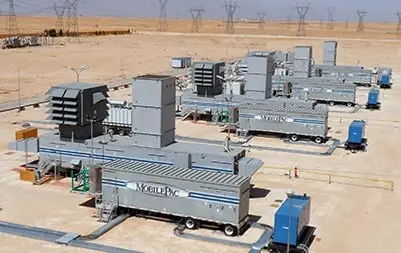
25-31 MW mobile and skid-mounted aeroderivative package
This model is part of SecondWatt’s gas turbine research catalogue. Specifications and price observations are included where supported by sources. Equipment availability and commercial terms require confirmation.
Pratt & Whitney FT8 MOBILEPAC and SWIFTPAC dossier: 25-31 MW specs, 10-minute starts, used pricing from 2.59M USD, and buyer inspection checklist.
The FT8 is an aeroderivative gas turbine built on the Pratt & Whitney JT8D-219 turbofan core, introduced in 1991 and sold today by Mitsubishi Power Aero (renamed from PW Power Systems in 2021). The trailer-mounted FT8 MOBILEPAC delivers 30.9 MW at 60 Hz from a two-trailer package with no foundation required, and the skid-built SWIFTPAC delivers 30.9 MW single or 62.1 MW twin. More than 150 MOBILEPAC and 400 SWIFTPAC units have shipped.
The FT8's role is speed: 10 minutes from cold start to full power, installation in days, and relocation on standard trailers. Fleets serve emergency and bridge power worldwide, including 54 units delivered to Algeria in 2013-2015, and APR Energy's rental fleet, acquired by xAI in 2026 for roughly 1 billion USD, runs FT8 MOBILEPACs among more than 1 GW of mobile capacity.
Secondary supply trades actively: a new MOBILEPAC asking 26.46 million USD sold through Free Oilfield Quote, four refurbished 2013-2015 units sit in stock in the eastern US, and 1995 Twin Pacs with 70,000 hours ask 2.59 million USD per unit in Asia. Pre-boom asks ran 558-712 USD per kW for low-hour units.
Why it matters
Mobile aeroderivative capacity became strategic in 2025-2026: new CCGT slots run 2,000 USD per kW with 2030-2031 delivery, so in-hand FT8 fleets command premiums, and the roughly 1 billion USD xAI-APR transaction validated fleet-scale value near 1,000 USD per kW. A JT8D parts pool from more than 14,750 engines built keeps overhaul economics predictable.
Who buys it
Data center developers needing bridge power, utilities covering emergency and seasonal capacity, island grids, and rental-fleet operators buy FT8s; xAI's APR Energy purchase put a hyperscaler directly into the owner base. The trigger is mobility and speed: trailer packages reach full power within a day of arrival while fixed plants wait years for interconnection.
Role in the data center
Rapid-deploy bridge power: multiple 30 MW trailer units energized within days of delivery, run 1-3 years until utility interconnection or permanent plant completion, then redeployed or resold.
Key specifications
| ISO output, MOBILEPAC 60 Hz | 30941 kW |
|---|---|
| ISO output, MOBILEPAC 50 Hz | 28528 kW |
| ISO output, SWIFTPAC 30 (60 Hz) | 30892 kW |
| ISO output, SWIFTPAC 60 twin-engine package (60 Hz) | 62086 kW |
| Efficiency, MOBILEPAC 60 Hz | 36.7 % |
| Heat rate, MOBILEPAC 60 Hz | 9825 kJ/kWh |
| Exhaust flow | 92 kg/s |
| Exhaust temperature, 60 Hz | 491 C |
| Power turbine speed (50/60 Hz) | 3000 / 3600 rpm |
| Cold start to full power | 10 minutes |
| NOx with water injection | 25 ppm |
| Generator voltage (50 / 60 Hz) | 11.5 / 13.8 kV |
| Turbine module size / weight | 5 x 2 x 3 / 13000 m / kg |
| MOBILEPAC site footprint | 80 x 54 ft |
| Fleet, MOBILEPAC / SWIFTPAC | 150 / 400 units (more than) |
| Hot section inspection interval | 25000 hours |
Technical summary
ISO output, MOBILEPAC 60 Hz: 30941 kW ISO output, MOBILEPAC 50 Hz: 28528 kW ISO output, SWIFTPAC 30 / 60: 30892 / 62086 kW at 60 Hz Efficiency, MOBILEPAC 60 Hz: 36.7 % Heat rate, MOBILEPAC 60 Hz: 9825 kJ/kWh Exhaust flow: 92 kg/s Exhaust temperature: 491 C Power turbine speed: 3000 / 3600 rpm direct drive Start, cold to full power: 10 minutes NOx with water injection: 25 ppm Generator voltage: 11.5 kV (50 Hz) / 13.8 kV (60 Hz) Hot section inspection: 25000 hours
Major variations
FT8 base and POWERPAC (GG8 gas generator), FT8-1 Twin Pac (paired engines on one generator, 48 MW class), FT8-3 (30,480 kW with 15% better hot-day output), FT8 SWIFTPAC 30/60 (skid-mounted, 1993), and FT8 MOBILEPAC (trailer-mounted, 2004). Free-turbine design drives 50 or 60 Hz directly without a reduction gearbox.
Configurations and options
Market units appear as MOBILEPAC trailer sets (turbine-generator trailer plus electrical/control trailer), SWIFTPAC skids, and legacy Twin Pacs. Dual-fuel capability is standard on most packages; options include inlet fogging (2,000 psi, 336-nozzle systems documented on APR units), black-start packages, and 50/60 Hz convertibility on refurbished sets.
Compatibility and dependencies
Water injection for NOx requires demineralized water supply sized to run hours; dual-fuel operation needs on-site liquid storage. Free-turbine direct drive avoids gearbox dependencies. Overhauls route through Mitsubishi Power Aero and JT8D-experienced shops; the aviation JT8D parts pool supports gas-generator maintenance.
Pricing and availability
Published price range: $2,592,000 – $16,750,000. Trend: up Pre-boom asks: FT8 MobilePacs at 16-17.8 million USD in 2013-2015 listings and 16.75 million USD (about 558 USD per kW) in January 2018. By 2026 a new MOBILEPAC asking 26.46 million USD (about 853 USD per kW) sold, and xAI's roughly 1 billion USD purchase of the APR Energy mobile fleet in mid-2026 implied about 1,000 USD per kW for in-hand mobile capacity. Lead time, new: 12-36 months. Lead time, used or refurbished: 2-12 weeks. Warranty, used: As-is to refurbisher terms; varies by seller.
Supply, delivery and overhaul
- Delivery time: 4.8 months (FT8 MOBILEPAC)
- gas generator inspections and repairs (64 HPT T-1 blades, 25 honeycomb air seals, 9th stage disk, carbon seal)
- hot section inspection: 25,000 hours
- major shop inspection: 50,000 hours
Lifecycle and maintenance
The FT8 runs a fixed 25,000-hour hot section inspection interval per Combined Cycle Journal fleet reporting, and users are pressing for cycle-based intervals in peaking duty. Turbine Technics cites fleet reliability above 99% across more than 100 locations. The JT8D heritage (14,750+ engines built through 1985) sustains a deep parts pool, and Mitsubishi Power Aero supports refurbished MOBILEPAC rebuilds with new generator sets on 2013-2015 cores.
Thermal and emissions profile
Standard NOx control is water injection to 25 ppm per the PW Power Systems MOBILEPAC brochure; no DLE option is documented on current OEM pages. That meets the 40 CFR 60 Subpart KKKK 25 ppm bin for 50-850 MMBtu/h turbines, and the January 2026 KKKKa revision holds temporary combustion turbines at 25 ppm. The xAI Memphis controversy showed regulators treating large mobile turbines as stationary sources, so buyers should permit mobile fleets as fixed installations.
Common failure points
- Combustion chamber hardware — Mounting-pin liberation and rivet loosening with downstream damage
- Carbon oil seals and bearings — Coking blocks lubrication; rotor lock-ups during synchronous condensing
- Compressor stages 8-9 — Vibration-driven blade failures
- First-stage turbine vanes — Erosion beyond limits between inspections
- Tie-rods — Failures from overheating
- EGT sensors and thermocouples — Frequent sensor failures and spread alarms
Inspection checklist
Hot section — borescope combustion chambers for mounting-pin liberation and gang-channel rivet loosening; reject loose hardware findings Hot section hours — verify position against the fixed 25,000-hour hot section inspection interval; within 3,000 hours prices as HSI-due First-stage turbine vanes — borescope for erosion; a documented wear point at the 25,000-hour interval Compressor stages 8-9 — inspect for vibration-driven blade failures documented in fleet reporting Carbon oil seals and bearings — review oil consumption and coking history; rotor lock-ups from lubrication starvation are documented Tie-rods — verify inspection records for overheating-related failures Water injection system — pressure-test pumps, nozzles, and demineralized water train; verify 25 ppm NOx capability at load Inlet system — check anti-ice provisions and filtration; inlet icing is a documented fleet issue EGT and thermocouples — replace suspect sensors; verify spread within 30 C at steady load Trailer systems (MOBILEPAC) — inspect axles, kingpins, and leveling systems; roadworthiness certification current within 12 months Generator — megger stator; insulation resistance below 100 megohms warrants rewind pricing Start system — demonstrate cold start to full load within 10 minutes per OEM specification Frequency configuration — verify 50/60 Hz setup matches destination grid; conversion is documented on refurbished units Load test — 4-hour run at base load; output within 5% of ISO-corrected rating Records — require complete O&M logs, HSI certificates, and any refurbishment scope with serial traceability
Procurement channels
Dealer-brokers (Free Oilfield Quote, Power Plants Online, Reflowx), rental-fleet disposals and acquisitions (APR Energy lineage), Asian trading houses for high-hour Twin Pacs, and Mitsubishi Power Aero for new and factory-refurbished units. Mobile units transact fast relative to fixed plants.
Regional notes
Fleets concentrate in North America, North Africa (54 Algerian units), the Middle East, and Asia. 50/60 Hz convertibility on refurbished MOBILEPACs eases cross-region resale; US mobile deployments face stationary-source permitting regardless of trailers.
Content owner: Gary Martin, SecondWatt