Gas turbine maintenance is scheduled on the machine's own counters: fired hours, starts, or an equivalent-hours count that folds the two together. The OEM's document for each model sets which counter applies, the limit for each inspection and the operating conditions that shorten it. Frequent starts and trips can bring an inspection due years before the hours do, and some OEMs also time overhauls on inspected condition.
The work itself depends on the class of gas turbine. GE Vernova's heavy-duty frames are opened and inspected in place, while its LM aeroderivatives can swap modules or the whole engine. A service agreement then settles who plans each outage and who pays for parts.
Key Takeaways
- Frames run on two clocks. Most GE Vernova frame maintenance falls due at whichever factored limit, hours or starts, comes first; fuel, peak firing, injection and trips shorten it.
- Frame intervals differ by model. GE Vernova baseline (natural gas, base load, dry): PIP-hardware 7E.03 hot gas path, 32,000 factored hours or 1,200 factored starts; 7HA.02, 25,000 or 720.
- Aeroderivatives trade inspection time for exchange. GE Vernova quotes a two-to-three-day outage to swap an LM engine on site, against in-place inspections on its heavy-duty frames.
- Frequent starts bring inspections due early. At 250 base-load starts and 1,000 fired hours yearly, a trip-free PIP-hardware 7E.03 hits its hot gas path starts limit in 4.8 years.
- Contracts decide who carries parts risk. GE Vernova's long-term agreements generally bill on usage or at major events; its fixed-price LM repair takes large-parts and airfoil risk.
How gas turbine maintenance is scheduled#
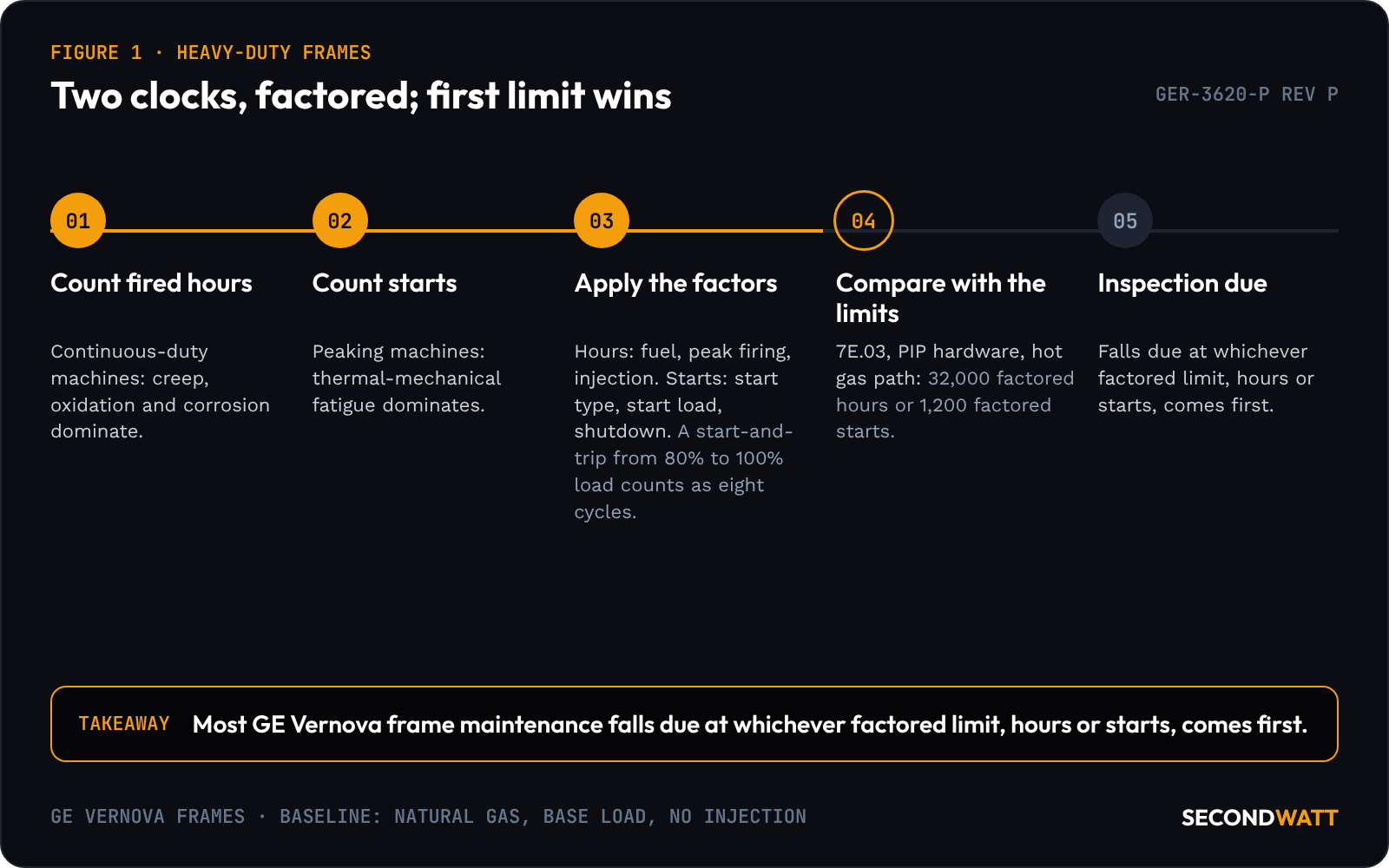
Most maintenance on GE Vernova's heavy-duty frames runs on independent counts of starts and hours, and the first limit reached sets the interval. Creep, oxidation and corrosion are the dominant life limiters on continuous-duty machines. Thermal-mechanical fatigue dominates on peaking machines, according to GE Vernova's operating and maintenance guide, GER-3620-P, in Rev P released 15 March 2021.
The baseline is a unit on natural gas at base load with no water or steam injection, which sets the longest intervals. Operation away from it carries a maintenance factor, and a factor of two halves the interval. In GER-3620-P, fuel, peak firing and injection act on hours, while start type, start load and shutdown type act on starts.
Distillate oil shows how far the factor can move. GE Vernova's experience puts the distillate hot gas path factor anywhere from one to three, and it recommends 1.5 unless operating experience suggests otherwise. On that default, a PIP-hardware 7E.03 at base load with no water or steam injection, burning only distillate, reaches its 32,000-factored-hour limit after about 21,300 fired hours (32,000 ÷ 1.5).
Trips count against starts, and one trip counts as several cycles. A trip from peak load counts as ten normal start-stop cycles, and one from full speed no load as two.
8 normal start-stop cycles — the life effect GE Vernova assigns to one start-and-trip cycle from 80% to 100% load on its heavy-duty frames.
Some fleets count equivalent operating hours (EOH) instead. GE Vernova's former Alstom units, now its Annular/Silo fleet, are scheduled that way, as Figure 38 of GER-3620-P shows.
Inspection levels on heavy-duty frames: combustion, hot gas path, major#
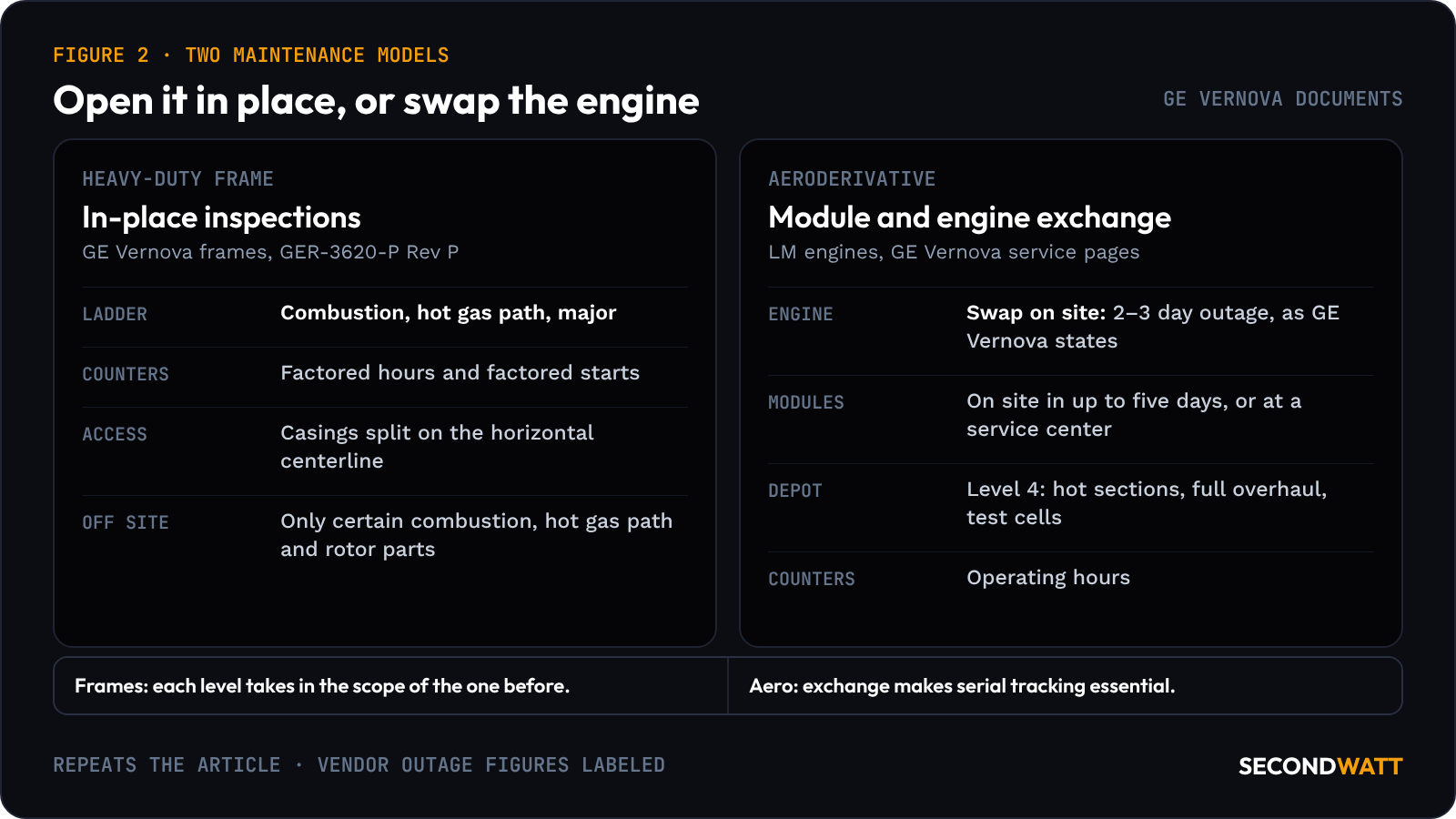
In GER-3620-P, disassembly inspections on a GE Vernova frame progress from combustion to hot gas path to major, and each takes in the scope of the one before. The scope of each level, and what a gas turbine overhaul label should name, sit in the condition-labels article.
The 7E.03 intervals also apply to 7121(EA) models in the Frame 7EA family. All figures in the table reflect current production hardware unless a note says otherwise.
Baseline inspection intervals for selected GE Vernova frames, factored hours / factored starts: base load, natural gas, dry; initial intervals in the absence of operating experience, from Figure 36 of GER-3620-P Rev P#
| Model | Combustion (DLN) | Hot gas path | Major | Notes in Figure 36 |
|---|---|---|---|---|
| 6B.03 | 12,000 / 450 | 32,000 / 1,200 | 64,000 / 2,400 | Hot gas path: PIP hardware only, older models may be shorter; combustion and major: precedent technology may be shorter, upgraded technology longer |
| 7E.03 | 12,000 / 450 | 32,000 / 1,200 | 64,000 / 2,400 | As 6B.03; combustion also varies by non-DLN, DLN and DLN-with-AFS configuration; applies to 7121(EA) |
| 7F.03 | 24,000 / 900 | 24,000 / 900 | 48,000 / 2,400 | Non-DLN, DLN and DLN-with-AFS configurations exist |
| 9F.03 | 24,000 / 900 | 24,000 / 900 | 48,000 / 2,400 | No model-specific note |
| 7HA.02 | 25,000 / 720 | 25,000 / 720 | 50,000 / 1,440 | Intervals assume base firing temperature |
GER-3620-P still shows an older 6B.03/7E.03 baseline in its Figure 7: 24,000 hours or 1,200 starts for the hot gas path, and 48,000 hours or 2,400 starts for the major. Rev P's revision history records increased hot gas path and major intervals for these models, and Figure 36 raises the hours while keeping the starts. Ask the service provider which figure the installed hardware qualifies for.
Aeroderivatives: modules, depots and engine exchange#
On its aeroderivative repair and maintenance page, GE Vernova offers exchange at engine and module level for its LM aeroderivatives. It can swap a whole LM engine on site for a new, refurbished or partial-life one, in what it states is a 2–3 day outage. Modules can be exchanged on site in up to five days, depending on the scope involved, or repaired at a service center.
Deeper work goes to depots. GE Vernova's Aero Alliance Level 4 depot at Jacintoport, Houston, repairs the LM2500, LM6000 and LMS100, with hot sections, full overhaul and two test cells.
GE and Baker Hughes publish aero intervals in operating hours. GE's 2007 Xtend upgrade kit was designed to eliminate the 25,000-hour hot section interval on LM2500 base-rated engines, according to a GE press release of 29 January 2007. It applied to engines on gas fuel with a SAC combustor and no NOx reduction. The current Xtend hot section upgrade removes one hot section repair or exchange in each major overhaul cycle, by GE Vernova's account.
50,000 hours — the hot section life GE Vernova states for LM2500 and TM2500 Base SAC 1.0 engines with Xtend, twice the 25,000-hour interval the kit eliminated.
The LM6000PF+ is listed at 8,000 hours to a borescope inspection, 25,000 to a hot section and 50,000 to a major on Baker Hughes' LM6000PF+ page. Baker Hughes calls those intervals typical of aeroderivative gas turbines and says the PF+ is designed to extend them to 10,000, 30,000 and 60,000 hours, depending on the operating profile.
Industrial turbines: Solar and Siemens#
The SGT-800 allows up to 60,000 equivalent operating hours between major overhauls, under time- or cycle-based maintenance concepts. Overhaul can be on site or modular, with an off-site option using a 48-hour core engine exchange, according to Siemens AG's 2017 SGT-800 brochure.
The SGT-750 runs an A-B-C cycle on operating hours at base load. A inspections are borescope checks, hot section parts are replaced at 34,000 and 102,000 hours, and the turbine is overhauled at 68,000. On site, the B inspection takes 12 days and the C inspection 16. Exchanging the gas generator off site cuts them to two and five days, according to Siemens AG's 2015 SGT-750 brochure.
Under Solar Turbines' service solutions, overhauls for units such as the Taurus 60 follow a condition-based approach, by Solar's own description. Its fleet managers use machine data, borescope inspections and condition assessments to plan maintenance and extend the time between major overhauls. About 80% of Solar customers choose its engine exchange program, Solar says, with equipment back in operation in as little as two days.
Routine and condition-based maintenance#
On GE Vernova heavy-duty frames, standby inspections matter most on peaking and intermittent units, where starting reliability comes first. They cover batteries, filter changes, oil and water levels, relay cleaning and device calibration, with a periodic startup test run. Running inspections trend vibration, exhaust temperatures, fuel flow, bearing and lube oil readings, and startup and coast-down times. Their baseline comes from first startup and after any major disassembly, according to GER-3620-P.
Borescope inspection looks at internal parts without removing casings. For GE Vernova frames on gas or distillate, plan one at each combustion inspection or annually, whichever comes first. On heavy fuel oil, GER-3620-P makes the annual check semiannual. The guide also recommends a borescope after a severe trip whenever component damage is suspected.
Frame lube oil should be sampled at least quarterly, and GE Vernova recommends monthly. On-line compressor wash cleans the compressor at load before fouling builds, GER-3620-P notes. Wash water belongs in the site's water budget for gas turbines.
What data center duty does to the calendar#
In Appendix C of GER-3620-P, duty classes run on service factor and fired hours per start. Standby is under 1% service factor at 1 to 4 hours per start, and peaking 1–17% at 3 to 10. Cycling is 17–50% at 10 to 50, and continuous is above 90%. A data center turbine can sit near either end: standby when it backs up the grid, continuous when it carries the load.
Illustrative hot gas path timing for a 7E.03 under three duties (calculated from GER-3620-P Rev P, Figures 36 and 42; PIP hardware, natural gas, no injection, normal base-load starts)#
| Input or result | Continuous | Peaking | Peaking with trips |
|---|---|---|---|
| Fired hours per year | 8,000 | 1,000 | 1,000 |
| Normal base-load starts per year | 12 | 250 | 250 |
| Trips from base load per year (factor 8) | 0 | 0 | 10 |
| Factored starts per year | 12 | 250 | 320 |
| Years to 32,000 factored hours | 4.0 | 32 | 32 |
| Years to 1,200 factored starts | 100 | 4.8 | 3.75 |
| Limit reached first | Hours, at 4.0 years | Starts, at 4.8 years | Starts, at 3.75 years |
Trips pull the date in further. Ten base-load trips a year add 70 factored starts, because each adds its severity factor less one to the normal cycle: (8 − 1) × 10 = 70. That moves the inspection from 4.8 to 3.75 years, about a year earlier. In GER-3620-P's Figure 42, part-load cycles below 60% load weigh 0.5 in the hot gas path starts count, and peak-load cycles above 100% weigh 1.3.
Fast starts and load swings add more. For B/E-class units with peaking-fast start capability, GE Vernova gives a conservative hot gas path factor of 3.5 per such start that may apply. That factor counts in full, with no 1 deducted as for a trip, and the baseline factors may not apply to all units. Load steps of more than 20% of rated load in 10 seconds or less also add factored starts, according to GER-3620-P.
Other classes count differently. The SGT-800 uses time- or cycle-based concepts in EOH, and the LM intervals quoted here are in hours only. Ask for the unit's own cycle-counting rules in its manual or service agreement; the remaining-life method applies them to a used unit's logs.
Service agreements: LTSA, CSA and time and materials#
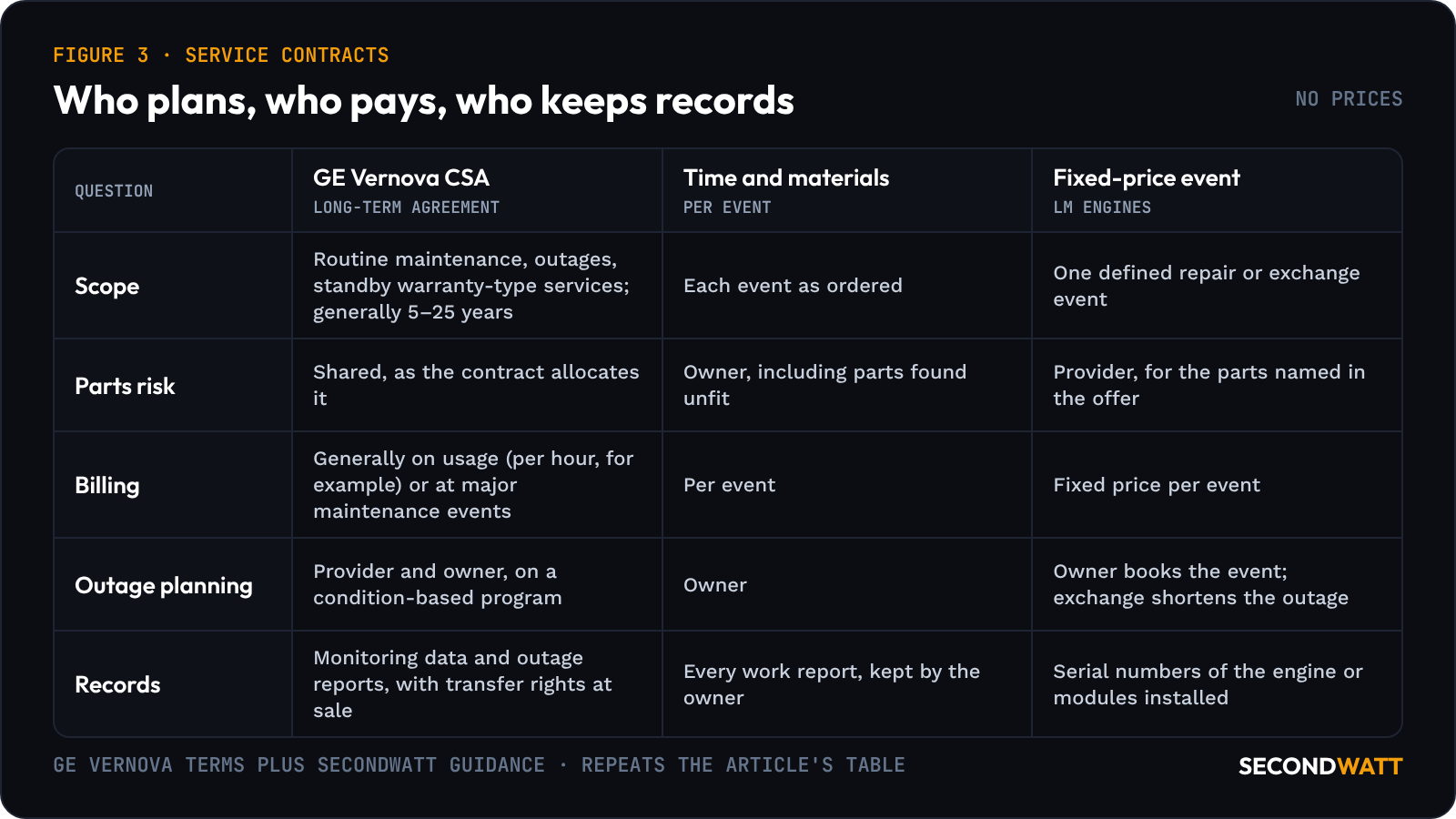
GE Vernova calls the long-term service agreements in its Power segment contractual service agreements (CSAs). They cover preventive and routine maintenance, outage services and standby "warranty type" services with assurances on performance and uptime. Terms generally run 5 to 25 years, according to GE Vernova's Form 10-K for 2025. Customers generally pay on usage, per hour for example, or when a major maintenance event occurs.
Under a CSA, GER-3620-P says, GE Vernova can set a program that differs from its general recommendations, based on condition-based maintenance. On a unit under agreement, check the contract's program as well as the generic intervals.
Time and materials, which GE Vernova's 10-K lists as a separate category, buys each event as it happens. Before signing one, check who pays for parts found unfit at the inspection. On frames, GER-3620-P notes, parts that fail repair are replaced with new ones, and that fallout varies with operating history and design. For LM engines, GE Vernova's repair page says its firm fixed-price repair takes the risk of large parts and flow-path airfoils.
Service contract types compared: GE Vernova terms from its Form 10-K for 2025 and repair page, plus SecondWatt guidance on parts risk, planning and records; no prices#
| Question | GE Vernova CSA (long-term agreement) | Time and materials | Fixed-price repair or exchange (LM engines) |
|---|---|---|---|
| Scope | Routine maintenance, outages and standby warranty-type services, generally over 5–25 years | Each event as ordered | One defined repair or exchange event |
| Parts risk | Shared, as the contract allocates it | Owner, including parts found unfit | Provider, for the parts named in the offer |
| Billing basis | Generally on usage (per hour, for example) or at major maintenance events | Per event | Fixed price per event |
| Outage planning | Provider and owner, on a condition-based program | Owner | Owner books the event; exchange shortens the outage |
| Records to secure | Monitoring data and outage reports, with transfer rights at sale | Every work report, kept by the owner | Serial numbers of the engine or modules installed |
Records that follow the turbine#
GER-3620-P calls a good record of all inspections and maintenance work essential to a sound program. Off-frequency events must be recorded for the maintenance plan, and significant overspeed hours counted in the maintenance factor. Records worth holding:
- Fired hours and fired starts as separate counters, with the counting method named.
- Trips with the load at the trip, peaking-fast starts, load steps, and hours on each fuel and at peak load.
- Inspection reports that name the level and list each part as found, repaired or replaced.
- Borescope reports with images, dated against the counters.
- Lube oil analyses and the running-data baseline after each major disassembly.
- The Technical Information Letters issued after shipment, and which were applied.
Exchange makes serial tracking essential. Some owners keep their own engine through repair, GE Vernova's repair page notes, because of permitting requirements or the need to keep the same engine serial number. For a new package, Solar's 2025 Titan 130 data sheet lists drawings, a quality control data book, an inspection and test plan, test reports and O&M manuals.
Equal fired hours can hide unequal starts, so compare units on both counters. The LM2500 document checklist lists what to request, and the seller's documentation guide shows owners how to assemble it.
FAQ: gas turbine maintenance#
How often does a gas turbine need a major overhaul?#
It depends on the class, and each OEM counts on its own basis. GE Vernova's frame majors in Figure 36 fall at 48,000–64,000 factored hours. The SGT-800 allows up to 60,000 EOH, the SGT-750 is overhauled at 68,000 operating hours at base load, and Baker Hughes' LM6000PF+ table lists 50,000 hours.
The rotor runs on a separate clock. For GE Vernova's heritage frames, the baseline rotor interval is 200,000 factored hours for B/E-class and 144,000 for F-class, or 5,000 fired starts for B, E and F-class rotors. FA.05 and HA-class rotors follow unit-specific documentation, which also overrides the baseline. Annular/Silo rotors follow their own welded-rotor criteria, built to reach four C inspections.
What is an equivalent operating hour?#
It is a counter that converts starts and other cyclic events into hours, so one number carries both kinds of wear. In GER-3620-P's Figure 43, EOH for later Annular/Silo upgrades equals weighted operating hours plus ten times weighted cyclic events. The fuel and penalty factors are specific to turbine type and upgrade, so two EOH totals compare only when the same formula produced them.
Is a hot gas path inspection the same as an overhaul?#
Not in GE Vernova's frame terms: it sits one step below the major inspection. In GER-3620-P, the major examines every internal rotating and stationary component from inlet to exhaust. Compressor and bearing condition drives its planning. Siemens, by contrast, calls its on-site SGT-750 C inspection a major overhaul, so match the word to the level the work report names.
Can gas turbine maintenance be done on site?#
Mostly, on a GE Vernova frame: its heavy-duty units are built for on-site maintenance, with casings split on the horizontal centerline. Off-site shop repair is needed only for certain combustion, hot gas path and rotor parts. HA units need special tooling to remove the inner turbine shell, and Annular/Silo units need the upper half, inner shell and rotor out to reach all nozzles. LM aeroderivatives rely on engine or module exchange instead.
Does an offline water wash restore output?#
Partly. Off-line washing cleans heavily fouled compressors, and fouling losses are recoverable; they typically account for 70–85% of performance losses. GER-3620-P says fouling that cuts airflow by 5% can reduce output by up to 8% and raise heat rate by up to 3%. Erosion, blade tip rubs and larger turbine clearances are non-recoverable, so some loss remains even on a well-maintained unit.
Planning the maintenance calendar#
SecondWatt publishes equipment research and helps buyers source power equipment; it earns a fee when a sale it arranges closes. If you are buying, send a request that states your planned duty, expected hours and starts, and the service contract you want. Offers can then be compared on their next inspection as well as their price. If you own a turbine with its counters and inspection reports in order, the gas turbine seller page sets out how SecondWatt works with owners.