
NFPA 110 is the National Fire Protection Association's Standard for Emergency and Standby Power Systems. It sets performance requirements for the system that supplies alternate power when the normal source fails. That system includes power sources, transfer equipment, controls, supervisory equipment and accessories, according to NFPA's page for NFPA 110. It grades each system by Level, Type and Class, and it sets inspection, exercise and test duties.
For a buyer, NFPA 110 describes an installed system. The code or contract that calls for it usually sets the Level, Type, Class and edition. A seller of a standby generator can hand over evidence. That means rating and fuel data, the listing, the OEM's NFPA 110 statement and, for a used set, test and maintenance records.
Key Takeaways
- Adoption, not the standard, decides the edition. NFPA's current edition is 2025, the 2024 IBC references the 2022 edition, and federal hospital rules incorporate the 2010 edition.
- Level follows the consequence of failure. Level 1: failure could cost life or cause serious injury. Level 2, in the 2016 text: failure less critical to human life and safety.
- Type 10 is a 10-second budget at the transfer switch. In Cummins' reading, start delay, signal detection and transfer time count inside it; set and load recovery do not.
- Class 48 is a large fuel commitment. One Cat 3516E at its full 2,750 ekW standby rating, 60 Hz, burns about 34,600 L in 48 hours, before any tank margin.
- OEM NFPA 110 statements are vendor claims about a set. The 3516E "meets NFPA 110 loading requirements," per Caterpillar; the standard's scope covers the whole system, including transfer equipment.
What NFPA 110 covers#
The current edition of NFPA 110 is 2025, and NFPA lists earlier editions back to 1983. Its scope statement, on NFPA's page for the standard, covers "performance requirements for emergency and standby power systems providing an alternate source of electrical power in buildings and facilities in the event that the normal electrical power source fails."
Chapter 4 classifies systems and Chapter 5 covers energy sources. Chapter 6 covers transfer switches, Chapter 7 installation, and Chapter 8 routine maintenance and operational testing. That outline comes from "An Overview of NFPA 110," a 23 Jan 2023 NFPA blog post. The post is by an NFPA technical services engineer, and NFPA marks it as the author's opinion.
Many of the most widely used codes and standards reference NFPA 110, the same post notes. A code or standard that requires an emergency power supply system typically calls out the class, type and level. NFPA 110 defines what those terms mean.
The emergency power supply system#
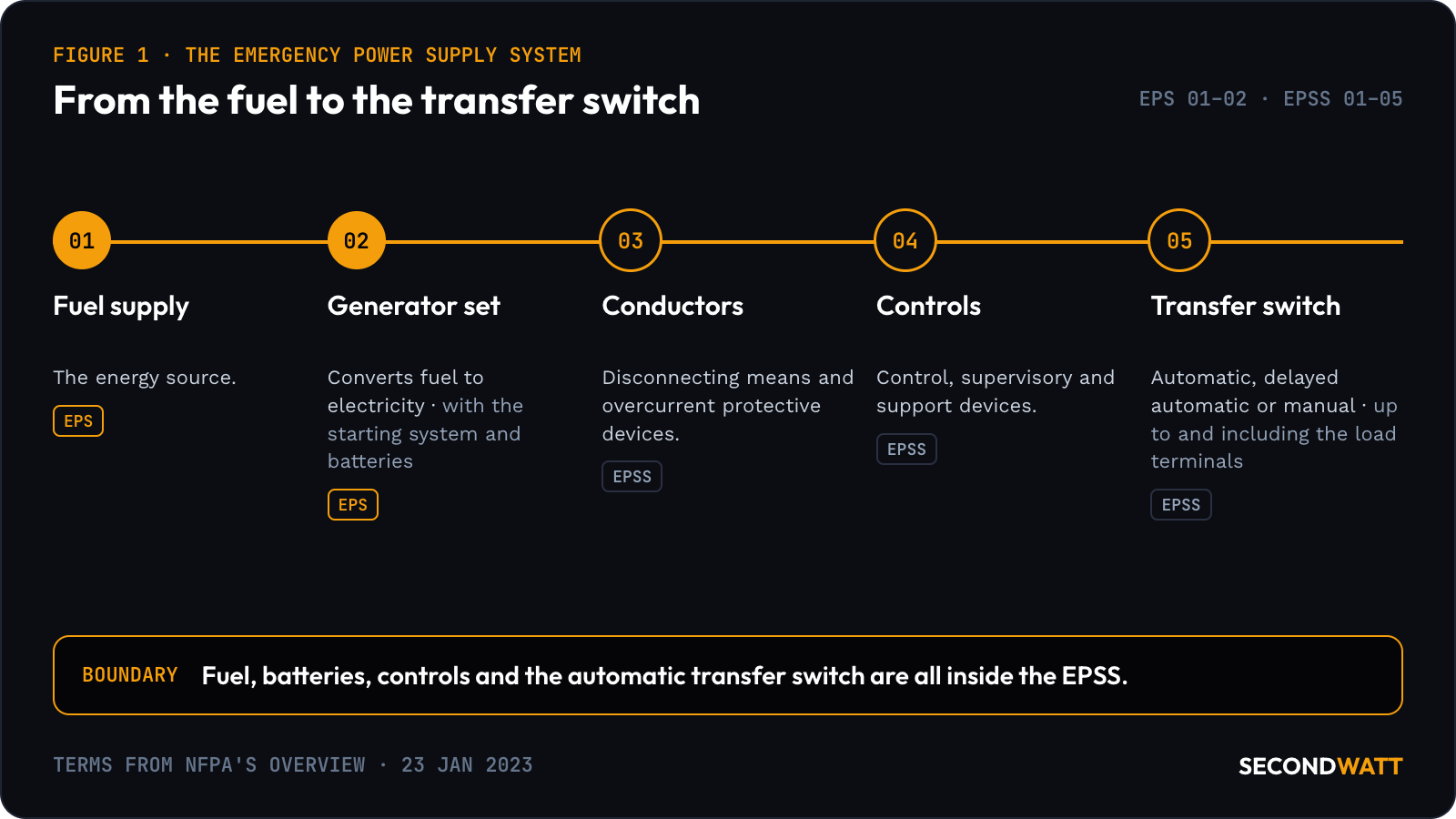
NFPA 110 uses two terms that are easy to merge. The emergency power supply (EPS) is the source of power. NFPA's overview post says it includes the fuel supply, the equipment that converts fuel to electricity, and accessories such as the starting system and batteries.
The emergency power supply system (EPSS) is the EPS plus everything needed to deliver its power: conductors, disconnecting means, overcurrent protective devices and transfer switches. It also takes in all control, supervisory and support devices "up to and including the load terminals of the transfer equipment." The boundary therefore sits at the load side of the transfer switch. Fuel, batteries, controls and the automatic transfer switch are all inside it.
Transfer switches come in three kinds: automatic, delayed automatic and manual. The choice depends on the load served and the required system type, per the same overview. Sizing is covered in the ATS sizing and procurement guide, and static switches in ATS vs STS for data centers.
Level 1 and Level 2 systems#
Clauses 4.4.1 and 4.4.2 of the 2016 edition define the two Levels, as Cummins reprints them in an "Ask the Experts" deck of 25 Mar 2021. Level 1 systems are installed where failure of the equipment to perform could result in loss of human life or serious injuries. Level 2 systems are installed where failure of the EPSS to perform is less critical to human life and safety.
The Level for a given building typically comes from outside NFPA 110: the code that requires the system calls it out. As Cummins puts it in white paper 5544190, Rev. 9/24, NFPA 110 defines the requirements. It leaves application codes to say when a given Type, Class and Level is needed.
Level changes the test burden. Clause 8.4.9 of the 2016 edition, as Cummins reprints it in a PowerHour deck of 15 Dec 2020, applies the 36-month test to Level 1 systems. A buyer comparing two used sets should ask which Level each served, because the records differ.
Type and Class ratings#
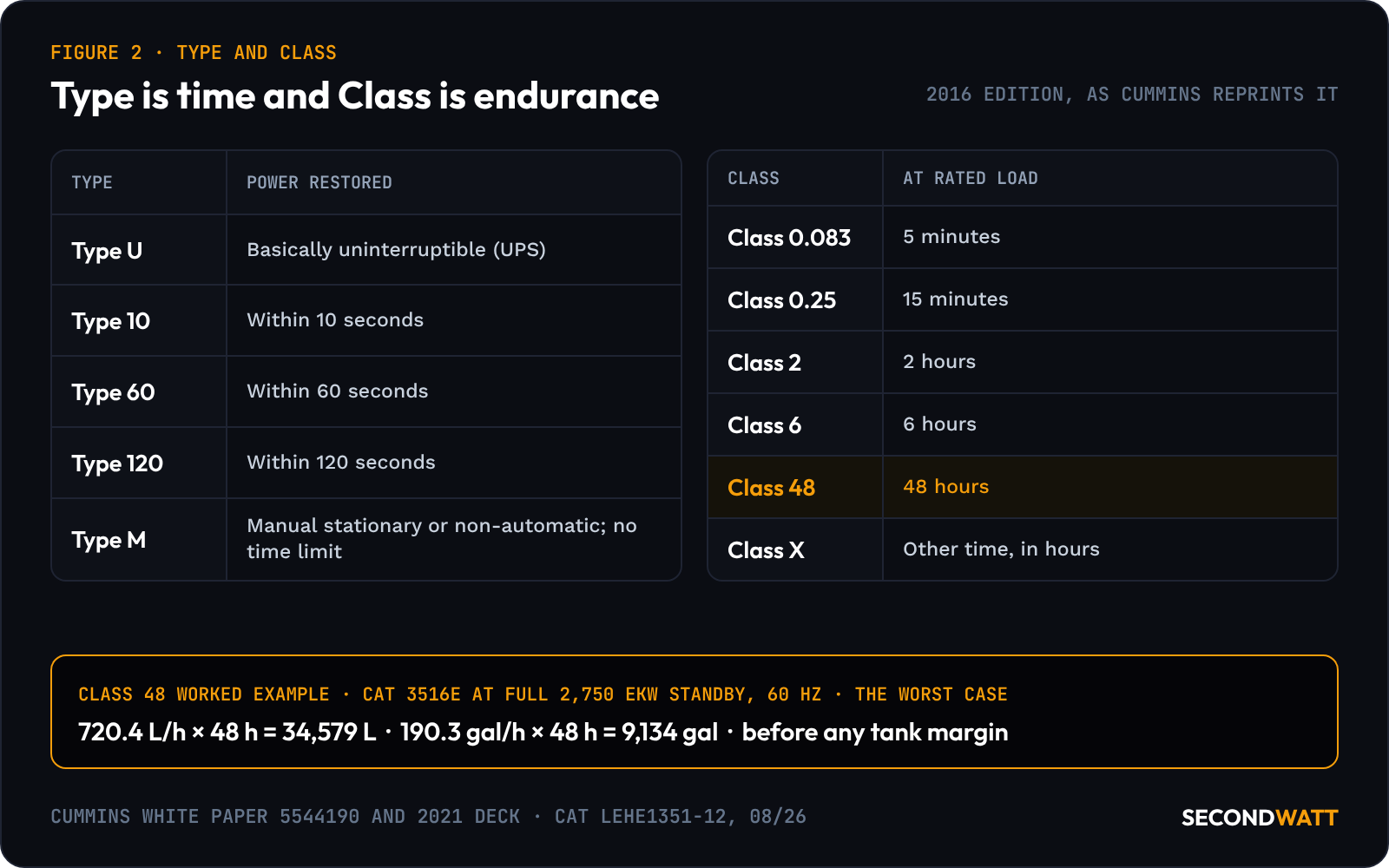
Type is time and Class is endurance, as clauses 4.2 and 4.3 of the 2016 edition define them. The Cummins deck of 25 Mar 2021 reprints both: Type is the maximum time, in seconds, that the EPSS will permit the load terminals of the transfer switch to be without acceptable electrical power. Class is the minimum time, in hours, for which the EPSS is designed to operate at its rated load without being refueled or recharged. A specification names both, for example Type 10, Class 48, Level 1.
NFPA 110 Level, Type and Class designations (2016 edition as Cummins reprints it in white paper 5544190 and its 2021 deck; NFPA's 23 Jan 2023 blog lists the same designations)#
| Designation | Meaning |
|---|---|
| Type U | Basically uninterruptible (UPS) |
| Type 10 | Power restored within 10 seconds |
| Type 60 | Power restored within 60 seconds |
| Type 120 | Power restored within 120 seconds |
| Type M | Manual stationary or non-automatic; no time limit |
| Class 0.083 | 5 minutes at rated load |
| Class 0.25 | 15 minutes at rated load |
| Class 2 | 2 hours at rated load |
| Class 6 | 6 hours at rated load |
| Class 48 | 48 hours at rated load |
| Class X | Other time, in hours, as required by the application, code or user |
| Level 1 | Failure could result in loss of human life or serious injuries |
| Level 2 | Failure less critical to human life and safety |
These lists date from before the 2025 edition, so a specification should quote the tables of the edition the project adopts.
Class turns directly into fuel. Caterpillar's 3516E spec sheet LEHE1351-12, dated 08/26, gives the set's fuel burn. On its 2,750 ekW standby rating, 60 Hz, a Cat 3516E burns 720.4 L/h (190.3 gal/h) at 100% load with fan, reported to ISO 3046-1. This worked example takes the worst case for sizing: the system's rated load equals that full standby rating for all 48 hours.
720.4 L/h × 48 h = 34,579 L (190.3 gal/h × 48 h = 9,134 gal)
That is fuel burned in 48 hours, before any tank-sizing margin.
34,579 L — the diesel one Cat 3516E burns in 48 hours at its full 2,750 ekW standby rating (60 Hz), the worst case for a Class 48 supply.
Full standby output is the worst case. On the same sheet, the standby rating's average power output is 70% of the standby rated ekW. At 75% load it gives 549.7 L/h, or 26,386 L over 48 hours. Fuel polishing covers keeping that much stored diesel usable.
Which edition applies#
NFPA 110 becomes binding through adoption, and each route can name a different edition. Chapter 27 of the ICC's 2024 International Building Code covers emergency and standby power systems required by the IBC or the International Fire Code. Under Section 2702.1.3, they "shall be installed in accordance with the International Fire Code, NFPA 70, NFPA 110 and NFPA 111." The IBC's Chapter 35 lists that reference as NFPA 110-22.
The same IBC section sets its own timing. Under Section 2702.1.4, emergency systems must provide secondary power automatically within 10 seconds of losing primary power, and standby systems within 60 seconds, "unless specified otherwise in this code." Section 2702.1.5 requires both to be designed to provide the required power for at least 2 hours without being refueled or recharged, with the same exception.
Federal rules for health care take a separate route. Under the federal hospital conditions of participation, 42 CFR 482.15(e)(2), a hospital "must implement the emergency power system inspection, testing, and maintenance requirements found in the Health Care Facilities Code, NFPA 110, and Life Safety Code." Long-term care facilities carry the same duty under 483.73(e)(2).
Both sections incorporate "NFPA 110, Standard for Emergency and Standby Power Systems, 2010 edition, including TIAs to chapter 7, issued August 6, 2009."
2010 — the NFPA 110 edition that the federal hospital and long-term care rules incorporate by reference, five editions before NFPA's current 2025 edition.
The edition a jurisdiction references "may not be the most current revision," Cummins notes in white paper 5544190. Which route reaches a site is a question for the design engineer and the authority having jurisdiction (AHJ). A data center owner who writes NFPA 110 into its specification should name the edition there; see data center redundancy.
Testing and maintenance requirements#
NFPA's overview post says that, in general, the system "needs to be inspected weekly, exercised monthly, and tested at least once every 36 months." The conditions sit in Chapter 8. Selected Chapter 8 clauses from the 2016 edition appear, reprinted with NFPA's permission, in a Cummins PowerHour training deck of 15 Dec 2020.
NFPA 110 (2016 edition) test and maintenance clauses, as reprinted in Cummins' PowerHour deck of 15 Dec 2020#
| Clause | Interval | Conditions in the clause |
|---|---|---|
| 8.3.6 | Weekly | Storage batteries, including electrolyte levels or battery voltage, inspected and maintained to the manufacturer's specifications |
| 8.4.2 | Monthly, at least 30 minutes | Generator sets in service exercised either with loading that maintains the manufacturer's minimum exhaust gas temperatures, or under operating temperature conditions at not less than 30% of the EPS standby nameplate kW rating |
| 8.4.2.3 | Monthly and annually | Diesel EPS installations that do not meet 8.4.2: exercised monthly with the available EPSS load, and annually with supplemental loads at not less than 50% of nameplate kW for 30 continuous minutes and not less than 75% for 1 continuous hour, at least 1.5 continuous hours in total |
| 8.4.6 | Monthly | Transfer switches operated electrically from the primary position to the alternate position and back |
| 8.4.9 | At least once every 36 months | Level 1 EPSS tested continuously for the duration of its assigned class; where the class exceeds 4 hours, the test may end after 4 continuous hours |
| 8.4.9.5 | With the 36-month test | Diesel: not less than 30% of nameplate kW (a supplemental load bank is permitted) or loading that maintains the manufacturer's minimum exhaust gas temperatures; spark-ignited: the available EPSS load |
| 8.3.7 | At least annually | Fuel quality test using appropriate ASTM standards or the manufacturer's recommendations; the deck also shows 8.3.7.1.1, marked TIA: diesel fuel tested for degradation at least twice a year, at least 6 months apart |
Under the 2016 8.4.2, 30% of the worked example's 2,750 ekW standby nameplate is 825 ekW. A diesel site's building load may hold neither that level nor the manufacturer's minimum exhaust temperature. The 2016 8.4.2.3 then has that site exercise monthly with the available load and test annually with supplemental load: at least 1,375 ekW (50%) for 30 continuous minutes and at least 2,062.5 ekW (75%) for 1 continuous hour, which load banks can supply.
Records are part of the requirement. Under clauses 8.5.1 and 8.5.2 of the same 2016 text, records are kept for all inspections, operational tests, exercising, repairs and modifications, and are made available to the AHJ on request. Under clause 8.5.3, the permanent record shows the date of the maintenance report and the servicing personnel. It also notes any unsatisfactory condition with its corrective action and parts replaced, and the testing of any repair for the time the manufacturer recommends.
What to ask for when buying a set#
Start with the listing. UL Standards & Engagement's UL 2200 Edition 3, last revised 5 Sep 2025, is the UL standard for stationary engine generator assemblies. Its scope covers assemblies intended for installation and use in ordinary locations under NFPA 70, NFPA 37, NFPA 99 and NFPA 110, among other codes. Section 2702.1.1 of the 2024 IBC requires stationary emergency and standby generators "required by this code" to be listed to UL 2200.
On mtu spec sheet 231210, revision 2026-03, UL 2200 is optional on the 16V4000 DS2250, marked as offered on its 380 V to 480 V configurations. Its 600 V and medium-voltage columns carry no UL 2200 mark, so ask for the listing on the exact configuration.
Then collect the OEM's own NFPA 110 wording, read as a vendor claim. The 3516E "accepts 100% block load in one step" and "meets NFPA 110 loading requirements," per Caterpillar's sheet LEHE1351-12. The set also "facilitates compliance" with NFPA 110, per the sheet's codes list, which notes that codes "may not be available in all model configurations." The DS2250 "accepts rated load in one step per NFPA 110," and its control panel is "NFPA 110 compatible," per mtu's sheet.
Each statement describes what the set brings to a system. For a new set, ask for the factory test report and the prototype test basis behind the OEM's claims. As Cummins' PowerHour deck of 15 Dec 2020 puts it, prototype testing validates a product's operating characteristics and limits; factory testing validates the assembled set.
For a used set, ask for the records the 2016 Chapter 8 clauses describe: monthly exercise logs with load or exhaust temperature, any annual supplemental-load results, the 36-month test for a Level 1 system, transfer switch operation, battery checks and fuel quality tests. The used 2 MW standby generator checklist covers the mechanical side, and the Cat 3516E dossier the model data.
When a seller writes "NFPA 110 compliant," ask which Level, Type and Class the system met, under which edition, at which site. Then ask for the records that show it.
FAQ: NFPA 110#
Does NFPA 110 apply to data center generators?#
Where a code, a regulation or the owner's contract calls for it. The 2024 IBC's installation rule covers systems "required by this code or the International Fire Code." For a set installed for uptime alone, the owner's specification and the AHJ decide whether NFPA 110 is called up. The data center line on the 3516E's sheet LEHE1351-12, "Tier III/Tier IV compliant per Uptime Institute requirements," is a separate claim by Caterpillar.
What is the difference between NFPA 110 and NFPA 99?#
NFPA 99, the Health Care Facilities Code, sets criteria for levels of health care services or systems based on risk to patients, staff or visitors. Its current edition is 2027. NFPA 110 is the performance standard for the power system itself. In Cummins' reading, set out in white paper 5544190, NFPA 99 classes its essential electrical system power sources as Type 10, Class X under NFPA 110.
How often must an NFPA 110 generator be tested?#
Under the 2016 clauses above: monthly exercise, an annual supplemental-load test for diesel sites whose monthly test falls short, and a 36-month test for Level 1 systems. Clause 8.4.9.6 of that edition lets the 36-month test be combined with one monthly test and one annual test as a single test. Under clause 8.4.9.7, when it is combined with the annual load bank test, the first portion runs at not less than the 36-month minimum load. The last hour runs at not less than 75% of nameplate kW, and the duration follows 8.4.9.1 and 8.4.9.2.
What does NFPA 110 Type 10 mean?#
The system must restore power within 10 seconds. Cummins' white paper 5544190 reads the clock as running from the loss of power at the load side of the transfer switch until acceptable power returns there. The window includes the start time delay, signal detection and transfer, but not generator set and load recovery time.
Can a generator meet NFPA 110 on its own?#
A generator is one part of the system NFPA 110 grades, and the duties reach past the set. In the 2016 edition, as Cummins reprints it, clause 8.4.9.3 starts the 36-month test at the transfer switches. It is initiated through their test functions or by opening the normal supply to all of them. Under clause 8.1.1 of that edition, the maintenance program rests on all four of the manufacturer's recommendations, instruction manuals, the chapter's minimum requirements and the AHJ.
Specifying a standby set to NFPA 110#
SecondWatt publishes equipment research and helps buyers source power equipment; it earns a fee when a sale it arranges closes. Buyers who need a standby set with documented ratings, listing and test records can request equipment and state the Level, Type, Class and edition required. Owners can sell generators with the maintenance and test file attached.