
For data center power, the largest mtu generators are Rolls-Royce's Series 4000 sets: diesel models with standby, data center continuous and prime ratings, and natural gas models listed for continuous duty. A 25 MW block documented on SecondWatt packages ten of the gas sets. Most diesel models carry several ratings, and the one that matters for a data hall depends on how long the sets must run.
That choice changes the plant. The 16V4000 DS2250 has one 60 Hz sheet for standby and one for data center continuous power (DCCP), each with its own engine model. A redundant plant sized on the DCCP sheet can need an extra set. This page sets the Series 4000 generators side by side on the rating bases mtu prints, then shows what the bases do to a set count.
Key Takeaways
- mtu is a Rolls-Royce product and solution brand. Rolls-Royce's Power Systems business unit sells Series 4000 diesel and natural gas generator sets under it.
- For an assumed 18,000 kW load, DCCP sizing adds a set. An N+1 plant takes 9 DS2250 sets at 2,250 kWe standby, 10 at 2,045 kWe DCCP (60 Hz).
- Standby sheets cap the 24-hour average at 85%. Held to it, the same plant needs 11 DS2250 standby sets; DCCP sheets allow up to 100% with unlimited hours.
- A 2.8 MW full-output gas set is announced for 2026. Rolls-Royce's 60 Hz 20V4000 is to reach it in 45 seconds, against 120-second fast starts on current versions.
- Ten gas sets make a 25.18 MW gross block. The seller's datasheet rates each 20V4000 GS at 2,518 kWe (group 3A, 60 Hz); seller scope ends at 13.8 kV.
What mtu makes for data centers#
Rolls-Royce Power Systems makes drive, propulsion and power generation solutions under its mtu product and solution brand. The unit is headquartered in Friedrichshafen in southern Germany, according to a Rolls-Royce release of 2 Oct 2025. The mtu manufacturer page and the Rolls-Royce page list the models SecondWatt documents.
Three Series 4000 options reach data center projects. In mtu brochure 16120923, Series 4000 diesel sets cover 1,125 to 3,250 kWe at 60 Hz, a range that spans standby, DCCP and prime ratings. Series 4000 natural gas sets reach 2,520 kWel at 60 Hz on mtu sheet 3237291, Edition 01/24. The 25 MW block in SecondWatt's power-block dossiers packages ten of those gas sets with switchgear and catalysts.
The 60 Hz mtu Series 4000 diesel brochure 16120923, Edition 01/23, lists four rating types: standby (3D), prime power for stationary emergency (3E), data center continuous (3F) and prime (3B). The next section's table uses mtu's 60 Hz standby and DCCP sheets.
Series 4000 diesel generator sets#
The table covers three 60 Hz mtu generator models: the 16V4000 DS2250 and two 20-cylinder sets. All five sheets are revision 2026-03 and list the set as EPA Tier 2 certified.
mtu Series 4000 diesel ratings at 60 Hz (mtu spec sheets, revision 2026-03)#
| Model | Standby (sheet) | Data center continuous (sheet) | Frequency, power factor | Engine model on the sheets | Cooling package |
|---|---|---|---|---|---|
| 16V4000 DS2250 | 2,250 kWe (231208) | 2,045 kWe (231235) | 60 Hz, 0.8 | 16V4000G84S standby; 16V4000G24S DCCP | 40 °C |
| 20V4000 DS3000 | 3,000 kWe (231218) | 2,800 kWe (231243) | 60 Hz, 0.8 | 20V4000G94S standby; 20V4000G44S DCCP | 45 °C |
| 20V4000 DS3250 | 3,250 kWe (231221) | No DCCP rating in brochure 16120923 | 60 Hz, 0.8 | 20V4000G94S | 43 °C |
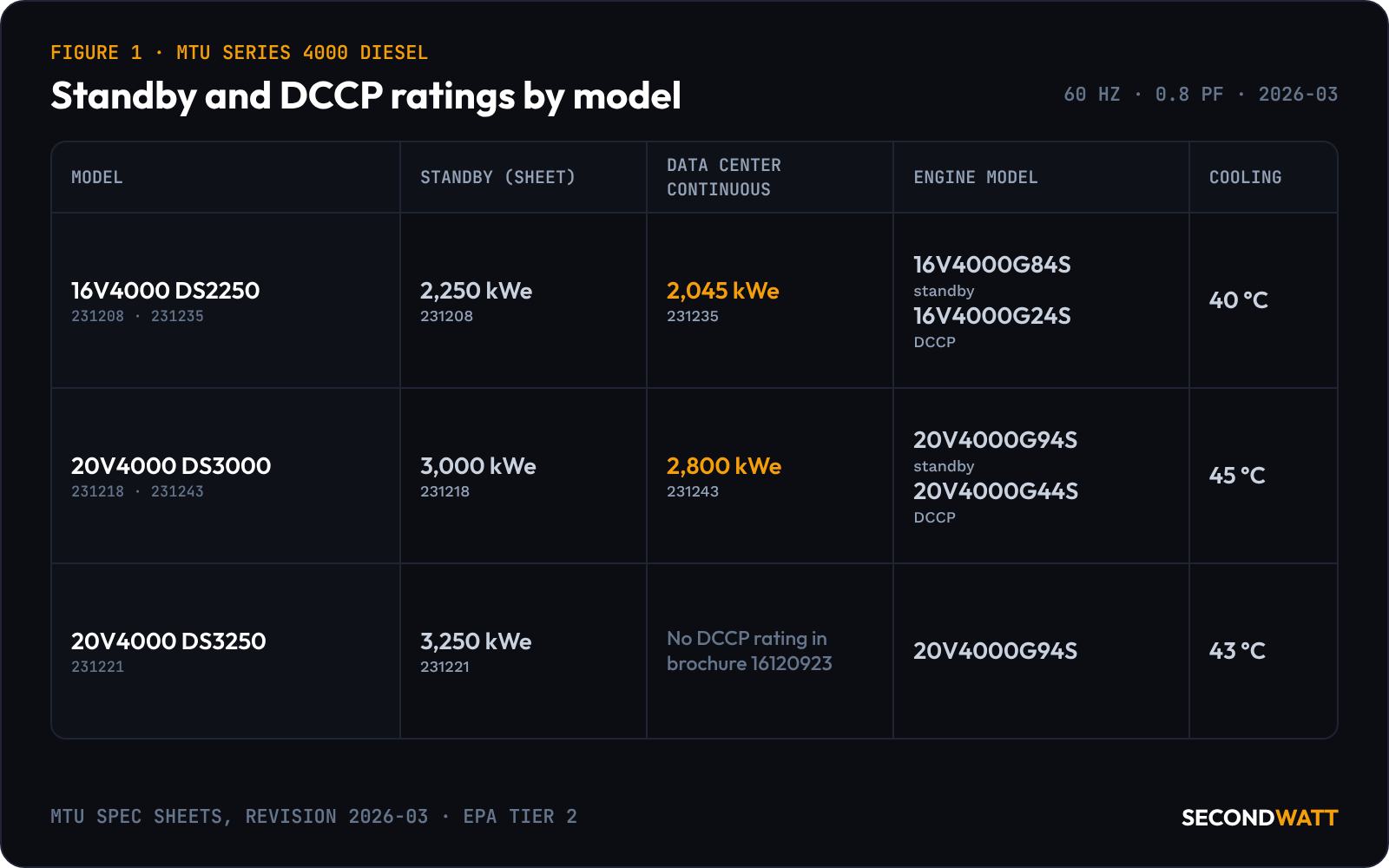
Each DCCP sheet names its standby partner as the reference for standby technical data. The header of mtu sheet 231235, revision 2026-03, reads "Reference: mtu 16V4000 DS2250 (2,250 kWe) 40 °C for Standby Rating Technical Data." The DS2250's engine "Maximum power" is 2,500 kWm on the standby sheet and 2,280 kWm on the DCCP sheet.
2,045 kWe — the data center continuous rating of the mtu 16V4000 DS2250 at 60 Hz and 0.8 power factor, on sheet 231235 (2026-03).
The brochure's ratings table gives no DCCP or prime figure for the DS3250 or the 16V4000 DS2500. It does give DCCP figures for the smaller 20V4000 DS2500 and DS2800. The 2 MW standby comparison sets the DS2250 against other makers, and the 3-megawatt generator guide does the same for the 20-cylinder class.
Standby vs data center continuous ratings#
The two ratings answer different questions. A standby rating covers an outage on a site with a reliable utility. A DCCP rating covers a data center with utility power, running without an hour limit.
mtu sheet 231208, revision 2026-03, says standby ratings "apply to installations served by a reliable utility source" and to "varying loads for the duration of a power outage." There is "No overload capability for this rating." Average load factor is ≤85%, and "Permissible average power output during 24 hours of operation is approved up to 85%." Brochure 16120923 also gives standby a 500-hour yearly maximum and Uptime Tier I and II compliance.
DCCP ratings "apply to data center installations where a utility power is available and comply with Uptime Institute Tier III and IV requirements." At constant or varying load, operating hours are unlimited. Sheet 231235 permits a 10% overload for one hour in twelve and sets the average load factor at ≤100%. Both sheet types rate at 25 °C and 300 m and refer derations to the local mtu distributor.
10% — the overload DCCP sheet 231235 permits for one hour in twelve, against "No overload capability" on standby sheet 231208.
The set count below uses each sheet's own rating. The two DS2250 sheets print different engine models, as do the two DS3000 sheets, so neither pair gives one engine's standby-to-DCCP ratio. Both DS2250 sheets are 60 Hz, 0.8 power factor, 40 °C cooling and EPA Tier 2.
Worked example: a site with 18,000 kW of steady load, built N+1 on DS2250 sets at the sheets' 25 °C and 300 m conditions. The load is an assumption for illustration. N+1 means the sets needed to carry the load plus one spare.
- Standby sheet 231208: 18,000 ÷ 2,250 = 8.00, so 8 sets carry the load and 9 are installed.
- DCCP sheet 231235: 18,000 ÷ 2,045 = 8.80, so 9 sets carry the load and 10 are installed.
- Standby held to the 85% average: 2,250 × 0.85 = 1,912.5 kW per set; 18,000 ÷ 1,912.5 = 9.41, so 10 sets carry the load and 11 are installed.
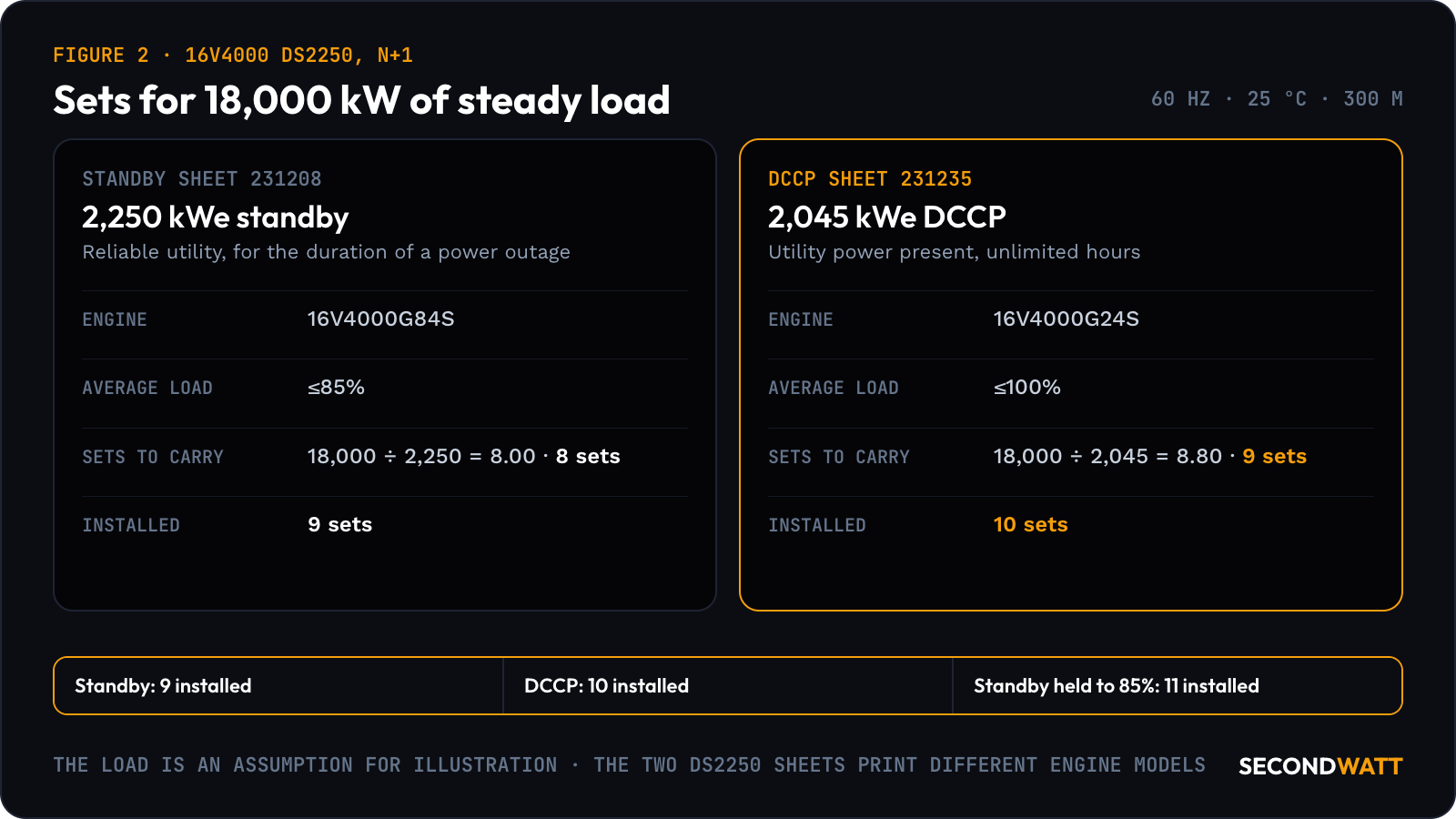
With one set out, the standby count runs eight sets at 100% of rating. An outage of 24 hours or more would break the sheet's 85% average at that loading. With all nine sharing the load, each carries 18,000 ÷ 9 = 2,000 kW, or 88.9% of its 2,250 kWe standby rating, still above that average. Sized on DCCP, the plant stays inside its own sheet's conditions for an unlimited run, with one more set.
The redundancy guide covers N+1 and 2N, and the prime power rating guide compares the rating families across makers.
Series 4000 gas generator sets#
The largest set on mtu's current 60 Hz natural gas sheet is the 20V4000 GS with the L64FNER engine. mtu Series 4000 natural gas sheet 3237291, Edition 01/24, lists it at 2,520 kWel at 480 V and 60 Hz, at power factor 1.0 and nominal voltage and frequency. Electrical efficiency is 43.6% on an energy input of 5,781 kW, a figure the sheet gives per ISO 3046/I-2002 with a 5% tolerance.
The engine's rated speed is 1,500 rpm, and the same sheet lists a 1,500–1,800 rpm gearbox. The referenced methane number is 72 or more. The hot ambient row drops output to 2,516 kWel and raises the methane number to 80 or more. The 20V4000 L64 dossier carries the full specification.
The mtu power generation product finder puts the gas sheets under the "Continuous power + CHP (3A)" application group. For mtu that group means constant load, a load factor of ≤100% and unlimited hours. The finder lists no 10% overload for gas in that group.
A faster version is announced for 2026. Rolls-Royce's release of 2 Oct 2025 says the new 20-cylinder Series 4000 L64 for the 60 Hz market "will be able to deliver its full output of 2.8 Megawatts in just 45 seconds." The release puts the performance increase at ten percent over the previous version and says the new engine needs no gearbox.
Current Series 4000 gas sets, at 50 and 60 Hz, have a 120-second fast-start capability, per the same release. It says the fast-start sets can serve data centers for emergency supply, continuous supply, or alongside mtu diesel sets. No rating type or site conditions accompany the 2.8 MW figure. On 7 Nov 2026, mtu's two 60 Hz natural gas sheets, 3237291 and 3237301, go no higher than 2,520 kWel.
The reciprocating gas engine guide compares Series 4000 gas sets with other makers' engines.
The 25 MW gas power block#
The block documented on SecondWatt is ten mtu 20V4000 GS units, each rated 2,518 kWe at 60 Hz for mtu application group 3A. That rating is at the mtu datasheet conditions in the seller's documents, 95 °F and 328 ft. Ten units give 25,180 kW gross, before auxiliary load and site derate.
The seller's scope ends at the 13.8 kV outgoing terminals of the E-house, and a zig-zag grounding transformer with a neutral grounding resistor is inside it. The seller quotes grid-parallel operation, with island operation and black start as options. With one unit out, the base block is 22,662 kW gross, and the seller does not represent it as 25 MW firm. The block article and the block dossier set out the seller's scope and the arithmetic.
Fuel and emissions#
Each diesel set in the table is "EPA Tier 2 certified" on its sheet. For owners and operators, the federal Subpart IIII covers stationary compression-ignition engines that are not fire pump engines, ordered after July 11, 2005 and manufactured after April 1, 2006. Under § 60.4200, it also covers any stationary compression-ignition engine modified or reconstructed after July 11, 2005. For emergency engines of this size, it names the same tier.
Under 40 CFR 60.4202(b)(2), stationary compression-ignition engine manufacturers must certify their 2011 model year and later emergency stationary compression-ignition engines to the Tier 2 emission standards described in 40 CFR part 1039, appendix I, for all pollutants. The smoke standards in 40 CFR 1039.105 also apply. The paragraph covers engines that are not fire pump engines, with a "maximum engine power" greater than 2,237 kW (3,000 HP) and a displacement of less than 10 liters per cylinder.
Under § 60.4205, owners and operators of 2007 model year and later emergency stationary compression-ignition engines must meet the § 60.4202 standards for all pollutants, for the same model year and maximum engine power. That duty covers engines that are not fire pump engines, with a displacement of less than 30 liters per cylinder.
Under § 60.4219, the rule's maximum engine power is the term defined in 40 CFR 1039.801. The diesel sheets in the table print a "Maximum power" engine rating above 2,237 kW. That rating runs from 2,280 kWm on the DS2250 DCCP sheet to 3,490 kWm on the DS3250. Displacement is 76.3 L over 16 cylinders and 95.4 L over 20, or about 4.77 L per cylinder in both, below the 10-liter limit.
Non-emergency engines face a different rule. Under § 60.4201(c), stationary compression-ignition engine manufacturers must certify their 2011 model year and later non-emergency stationary compression-ignition engines with a "maximum engine power" greater than 2,237 kW (3,000 HP) and a displacement of less than 10 liters per cylinder. The standards are those for new nonroad compression-ignition engines in 40 CFR 1039.101, 1039.102, 1039.104, 1039.105, 1039.107 and 1039.115, as applicable. They apply for all pollutants, for the same maximum engine power.
mtu also publishes sheet 231310, revision 2026-07, a 16V4000 DS2250 standby sheet marked "EPA Tier 4 certified." It adds after-treatment, from DEF tank, air compressor and DEF pump to controller and reactor, using 35 L/h of DEF at 100% of power rating. The Tier 4 procurement article covers that choice in more depth.
The 60 Hz natural gas sets are listed in two emission versions. One sheet gives NOx below 500 mg/Nm³; the other, sheet 3237301 (Edition 01/24), gives NOx below 1 g/bhp-hr. In the block, an SCR and an oxidation catalyst on each unit handle the after-treatment.
Choosing among mtu diesel, gas and the block#
Each option suits a different duty. The table keeps each rating on the basis its source prints.
mtu options for data center power compared (mtu sheets 231208, 231221, 231235, 231243 and 3237291; mtu product finder; Rolls-Royce release of 2 Oct 2025; SecondWatt block article)#
| Option | Fuel | Duty as rated | Start as stated | Unit size | When it fits |
|---|---|---|---|---|---|
| Series 4000 diesel, standby sheet | Diesel #2 or HVO | Standby: reliable utility, outage duration, ≤85% average | Accepts rated load in one step per NFPA 110 | 2,250–3,250 kWe standby, 60 Hz (table rows) | Emergency backup on a site with a reliable utility |
| Series 4000 diesel, DCCP sheet | Diesel #2 or HVO | DCCP: utility power present, unlimited hours, ≤100% average | Accepts rated load in one step per NFPA 110 | 2,045–2,800 kWe DCCP, 60 Hz (table rows) | Uptime Tier III or IV designs with a utility feed |
| Series 4000 gas, 20V4000 GS | Natural gas, methane number ≥72 | Continuous power (3A): constant load, unlimited hours | 120-second fast start (Rolls-Royce) | 2,520 kWel, 60 Hz, pf 1.0 | Continuous or long-running supply where gas reaches the site |
| 20V4000 gas, 2026 version (announced) | Natural gas | Emergency or continuous supply (release) | Full output in 45 seconds (announced) | 2.8 MW, 60 Hz, basis not stated | Projects that can wait for the 2026 version |
| 25 MW gas block | Natural gas | Grid-parallel base; island and black start optional | No block-level figure stated | 25,180 kW gross, ten units | Projects that take power at 13.8 kV and supply the step-up transformer and interconnection |
The diesel rows split on hours, and the arithmetic above shows the cost of that split in sets. The gas rows split on start time and on whether the announced version suits the schedule. The NFPA 110 guide explains the one-step load acceptance the diesel sheets claim.
FAQ: mtu generators#
How did the mtu brand change in 2021?#
Since June 2021, Rolls-Royce has been the corporate and employer brand, and mtu the sole product and solution brand. The Power Systems unit's subsidiaries with mtu in their names took "Rolls-Royce Solutions" names. MTU Friedrichshafen GmbH became Rolls-Royce Solutions GmbH, according to an mtu release of 11 Jun 2021.
What was mtu Onsite Energy?#
It was a Rolls-Royce Power Systems brand, according to a Rolls-Royce release of 4 Apr 2019. Under it, the unit marketed "diesel and gas systems for mission critical, standby and continuous power, combined generation of heat and power, and microgrids." The 2021 brand change discontinued the name and merged it within the mtu brand.
What is mtu's DCCP rating?#
It is mtu's application group 3F, which the sheets call "optimized for data center applications." It sits beside the ISO 8528-1 DCP rating in mtu's product finder, which lists Uptime compliance as Tier I to Tier IV. The DCCP sheets and the brochure state Tier III and IV.
Are mtu generators approved for renewable diesel?#
mtu approves HVO meeting EN15940 for its Series 4000 diesel sets. Each diesel sheet cited here lists "HVO and GtL fuels meeting fuel specification EN15940" and recommends diesel #2 or HVO. Fuels to EN15940 "are approved for all Series 4000 system configurations and emission calibrations," per the 60 Hz diesel brochure. It also claims the same maximum power, load acceptance and fuel consumption on those fuels, a vendor claim.
What is the largest mtu generator set for data centers?#
According to mtu brochure 16120923, the Series 4000 diesel range, which spans standby, prime and data center continuous ratings, reaches 4,000 kVA at 50 Hz. At 60 Hz its top rating is the DS3250's 3,250 kWe standby. For larger plants, mtu's data centers page lists Modular Engine Power Plants from 5 MW to 150 MW, built from standardized mtu engine-generator modules.
Sourcing mtu generator sets#
SecondWatt publishes equipment research and helps buyers source power equipment; it earns a fee when a sale it arranges closes. Buyers can request equipment with the model, rating type, frequency and emissions tier the site needs, and owners of Series 4000 sets can sell generators with the sheet numbers and hours on record.