A 2 MW generator from Caterpillar, Cummins or mtu carries the same headline rating: 2,000 kWe standby at 60 Hz and 0.8 power factor. The datasheet separates them. Read five things: the duty behind the standby rating, fuel at your real load, the emissions label, weight and cooling ambient, and the unit's generation.
Renting a 2 MW set is a separate decision; this comparison is for buyers and specifiers choosing a platform to own.
Key Takeaways
- Three platforms meet at 2,000 kWe. The Cat 3516C, Cummins DQKAE (QSK60) and mtu 16V4000 DS2000 are each rated 2,000 kWe standby at 60 Hz and 0.8 power factor.
- Perkins's 4000-series reaches 2 MW only at 50 Hz. Its selector lists the 4016-61TRG3 at 2,000 kWe standby at 1,500 rpm; the 60 Hz 2,000 kWe entry is the 5016C-E61TRG7.
- Fuel at 75% load differs by about 8% on paper. Tier 2 sheets give 393.9 L/h (Cat 3516C) to 426 L/h (mtu DS2000), on different fuel bases and cooling.
- Emergency operation caps other running. Under 40 CFR 60 subpart IIII, emergency engines get 100 hours a year for testing and non-emergency use.
- Read the build behind the model name. One 3516C name covers a 69.0 L Tier 2 engine and a 78.1 L Tier 4 Final engine.
Ratings first: what a 2 MW generator rating means#
The 2 MW figure on each 60 Hz sheet is a standby rating, and each OEM attaches its own duty to it. Caterpillar's 08/26 sheet LEHE1376-11 assumes standby average output of 70% of the rating, typically 200 hours a year with maximum expected usage of 500 hours. On mtu's 2026-03 sheet 231151, standby allows "Average load factor: ≤ 85%" with "No overload capability for this rating".
Caterpillar's closer match to that is its mission critical rating: the same 2,000 ekW, with average output of 85% and peaks to 100% "for up to 5% of the operating time".
On its 12/22 sheet D-3510, Cummins rates Emergency Standby Power to ISO 8528, for "the duration of power interruption of a reliable utility source".
All three 60 Hz platforms also publish 1,825 kWe, under different names. Caterpillar calls it prime; Cummins lists it as prime and data center continuous (DCC), adding that DCC is "available at standby power subject to Cummins' site-specific assessment". mtu calls it data center continuous power, on a different engine. General definitions are in the rating definitions.
The four platforms at a glance#
The 60 Hz rows share rating type, frequency and power factor; cooling ambient and alternator voltages differ by sheet. The Perkins row is a 50 Hz engine and is not comparable cell for cell.
Caterpillar 3516, Cummins QSK60, mtu 16V4000 and Perkins 4000-series at 2 MW class: standby kWe at 60 Hz and 0.8 power factor (Perkins at 50 Hz) with alternator voltages, second rating, engine, cooling ambient and emissions entry, per OEM datasheet and revision#
| Platform, model and document | Standby, 60 Hz, 0.8 pf (alternator voltages on the sheet) | Second rating | Engine | Cooling ambient on the sheet | Emissions entry on the sheet |
|---|---|---|---|---|---|
| Cat 3516C, LEHE1376-11 (08/26) | 2,000 ekW (380–13,800 V) | 1,825 ekW prime; 1,650 ekW continuous | V-16, 69.0 L | Cooling "up to 50°C" | U.S. EPA Stationary Emergency Use Only (Tier 2) |
| Cat 3516C Tier 4 Final, LEHE1330-07 (08/26) | 2,000 ekW (480–13,800 V) | 1,825 ekW prime | V-16, 78.1 L | Cooling "up to 50°C" | U.S. EPA Tier 4 Final |
| Cummins DQKAE (QSK60-G6 NR2), D-3510 (12/22) | 2,000 kW (380–13,800 V) | 1,825 kW prime and DCC; 1,600 kW continuous | V16, 60 L | Standard radiator 46.3 °C; full standby to 750 m at 40 °C | EPA NSPS Stationary Emergency Tier 2 |
| mtu 16V4000 DS2000 (16V4000G74S), 231151 and 231233 (2026-03) | 2,000 kWe (380–13,800 V) | 1,825 kWe data center continuous (16V4000G14S, 45 °C sheet) | 16-V, 76.3 L | 50 °C radiator; ratings at 25 °C and 300 m | EPA Tier 2 certified; SCAQMD |
| Perkins 4016-61TRG3 (engine), PN3234/04/20 | Not comparable: 2,000 kWe typical at 50 Hz; engine only, no alternator | Not comparable: 1,800 kWe prime typical at 50 Hz | 16-cylinder vee, 61.1 L | — | "Fuel optimised" (no EPA entry) |
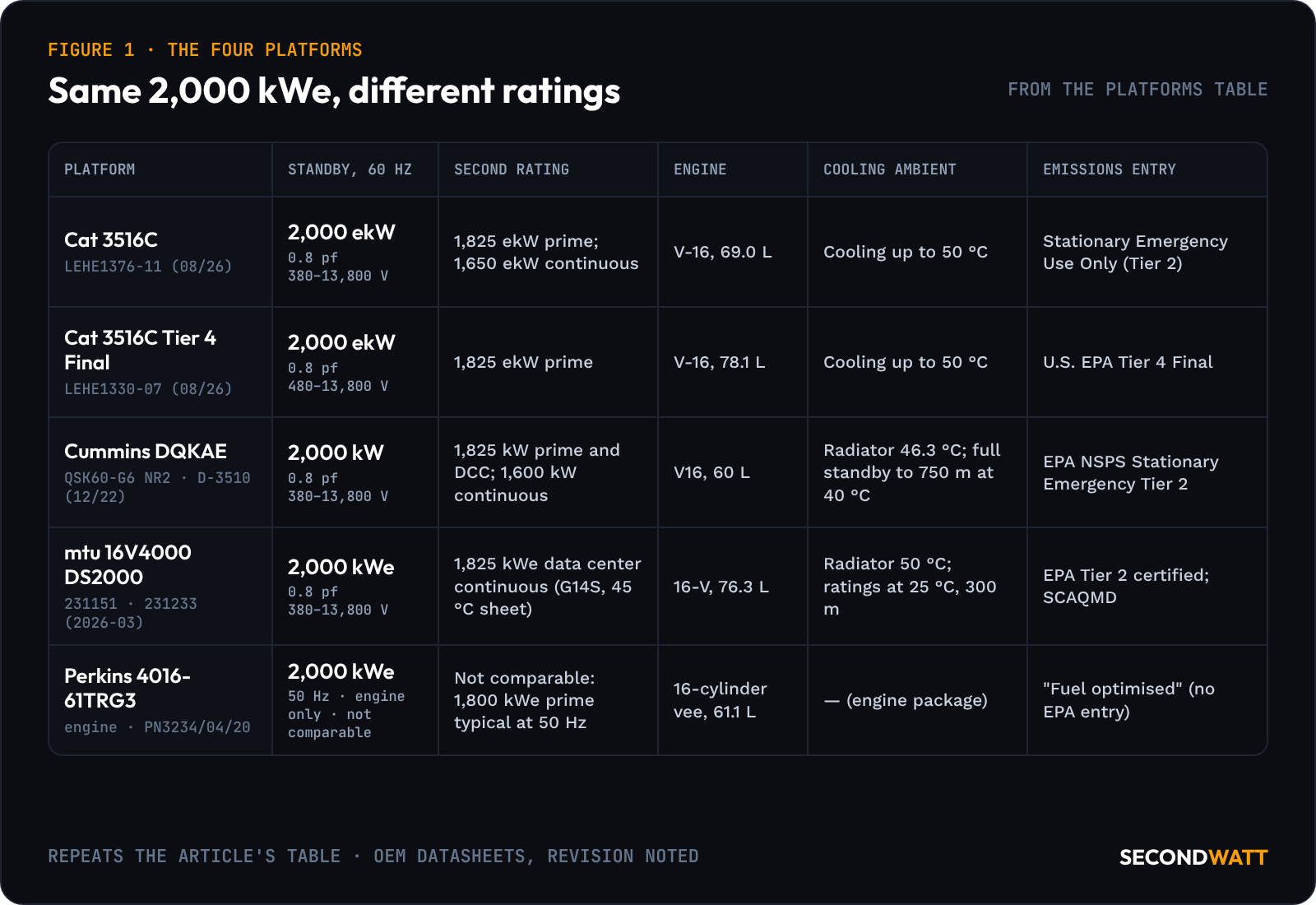
Caterpillar documents the two 3516C builds on separate sheets, LEHE1376-11 and LEHE1330-07; the V-16 layout is on the 3516C range page. The DQKAE pairs the QSK60-G6 with PowerCommand 3.3 and a 1,825 kW DCC rating in Cummins's June 2021 product guide. mtu's second rating is on its 45 °C sheet 231233, dated 2026-03.
Perkins publishes the 4016-61TRG3 as an engine on its 4016-61TRG sheet PN3234/04/20, with generator output that is "typical" at a power factor of 0.8. Its power selector 100063-EN-04 (01/26) lists the 4016 only on its 50 Hz pages; its 60 Hz entry at 2,000 kWe standby is the 5016C-E61TRG7, under U.S. EPA Tier 2.
Model detail sits on the Caterpillar 3516B, Caterpillar 3516E, Cummins QSK60 and mtu 16V4000 pages; Perkins units sit in the wider generator category.
Fuel burn at the duty point, recomputed#
The 75% load point sits between Caterpillar's 70% standby average and mtu's ≤85% load factor. Liters per MWh is liters per hour divided by megawatts delivered. The last two columns are illustrative: 12 test hours a year at 75% of standby, and one 168-hour week at 75% of the 1,825 kWe second rating.
Fuel consumption at 75% and 100% of the 2,000 kWe standby rating, 60 Hz, per OEM datasheet, with liters per MWh (calculated) and two illustrative duty profiles#
| Model and document | 75% load (1.5 MW assumed), L/h | 100% load (2.0 MW assumed), L/h | L/MWh at 75% (calculated) | L/MWh at 100% (calculated) | 12 test hours at 75% standby, L (illustrative) | 168-hour week at 75% of 1,825 kWe, L (illustrative) |
|---|---|---|---|---|---|---|
| Cat 3516C Tier 2, LEHE1376-11 | 393.9 | 505.8 | 262.6 | 252.9 | 4,727 | 61,606 (prime, 366.7 L/h) |
| Cat 3516C Tier 4 Final, LEHE1330-07 | 396.0 | 510.9 | 264.0 | 255.5 | 4,752 | 62,093 (prime, 369.6 L/h) |
| Cat 3516B low fuel, LEHE1374-07 | 373.9 | 497.5 | 249.3 | 248.8 | 4,487 | 57,506 (prime, 342.3 L/h) |
| Cummins DQKAE, D-3510 (12/22) | 402 | 532.5 | 268.0 | 266.3 | 4,824 | 62,563 (prime, 372.4 L/h) |
| mtu 16V4000 DS2000, 231151 and 231233 | 426 | 558 | 284.0 | 279.0 | 5,112 | 60,648 (data center continuous, 361 L/h) |
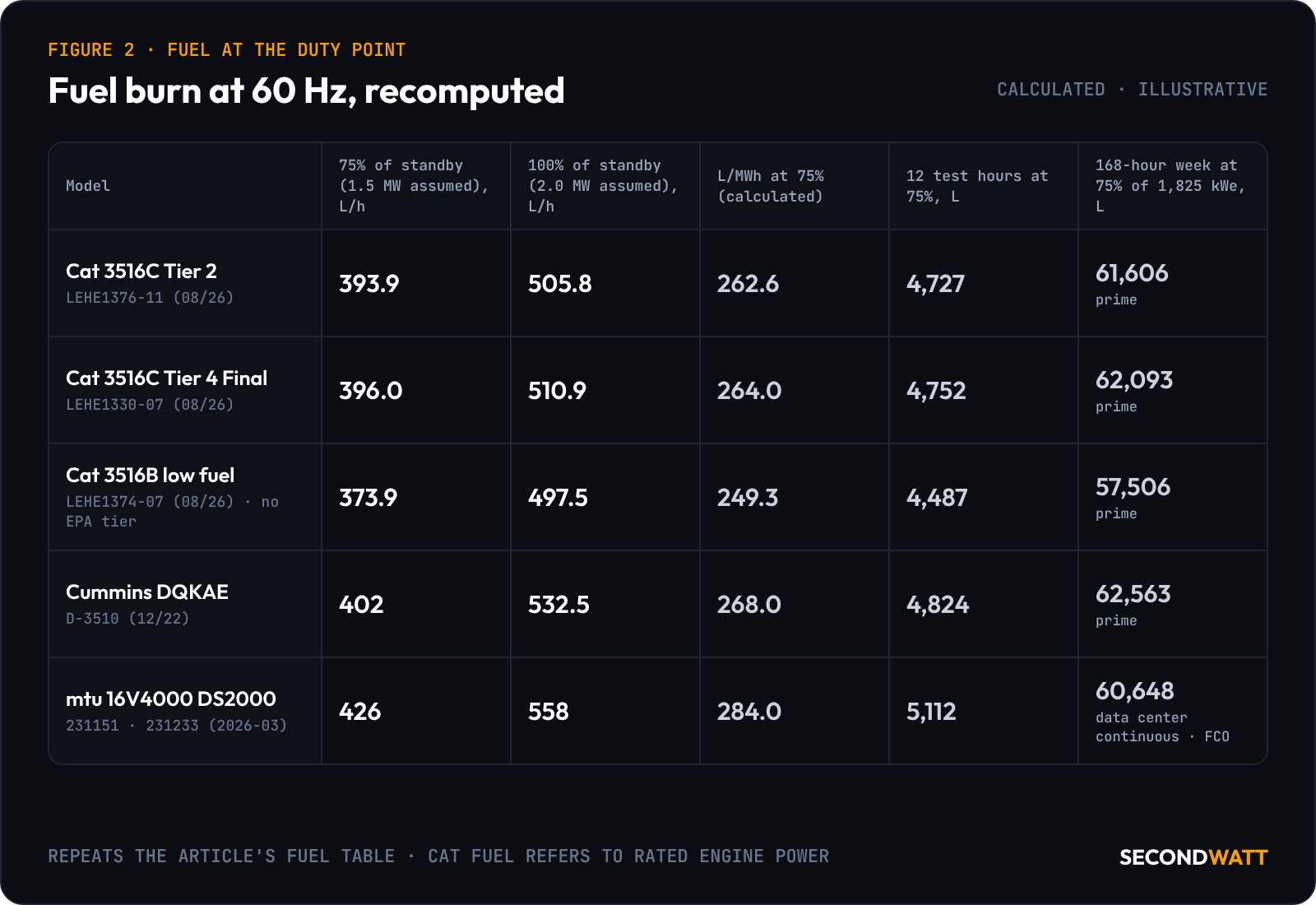
Cat fuel values "refer to rated engine power", so the MW column is an assumption and the per-MWh figures compare sheets. A guaranteed figure for your fuel and site comes from each OEM.
8.1% — the paper gap at 75% load across the three Tier 2 sheets: 426 L/h (mtu DS2000) less 393.9 L/h (Cat 3516C) is 32.1 L/h, or 385 L over 12 test hours (calculated).
Cooling packages differ. The mtu sheet is a 50 °C package with a 105.9 kW fan load. Cummins's optional 50.6 °C radiator draws 66 kWm against 46 kWm for its standard one, and D-3510 gives one fuel table for both.
The Cat 3516B burns less on a build that LEHE1374-07 labels "Low Fuel", with no EPA tier named.
The week reorders the field. mtu's 1,825 kWe set burns 60,648 L, below the Cat 3516C and Cummins prime figures and above the 3516B's 57,506 L. The duties differ: mtu's data center continuous rating allows "Average load factor: ≤ 100%" on a different engine, while Caterpillar's prime assumes 70% average output. The week holds 14 times the yearly test hours, so duty moves fuel volume more than platform does.
Both lowest week figures come from builds whose sheets name no EPA tier: the 3516B's "Low Fuel" and mtu's "Fuel Consumption Optimized (FCO)". A US ranking therefore reads the emissions entry beside the fuel.
Emissions variants: emergency, non-emergency and Tier 4 Final#
The US federal rule here is 40 CFR part 60, subpart IIII. For owners, § 60.4200(a)(2)–(3) applies it to diesel engines ordered after 11 July 2005 and manufactured after 1 April 2006, or modified or reconstructed after 11 July 2005. Construction dates from "the date the engine is ordered by the owner or operator". Other rules, such as 40 CFR part 63 subpart ZZZZ and state permits, may also apply.
Under § 60.4219, an emergency engine produces power when electricity "from the local utility … is interrupted". Otherwise it runs only as § 60.4211(f) allows.
100 hours — the calendar-year cap on maintenance checks and readiness testing for an emergency engine, with up to 50 non-emergency hours counted inside it under § 60.4211(f)(2)–(3).
Under § 60.4211(f)(2)(i), more test hours need a petition, unless records show government standards require them. An engine run outside those limits "must meet all requirements for non-emergency engines".
Owners of model year 2007 and later engines meet the standards in § 60.4205(b) (emergency) or § 60.4204(b) (non-emergency), and under § 60.4211(c) they comply by "purchasing an engine certified" to them. All four platforms sit under 10 liters per cylinder; the 78.1 L Cat build has 4.9 L (calculated).
For emergency engines with maximum engine power output up to 2,237 kW, § 60.4202(a)(2) sets "the Tier 2 or Tier 3 emission standards" for nonroad engines. Above 2,237 kW of engine output, § 60.4202(b) sets Tier 2 from model year 2011. The mtu 16V4000G74S lists 2,280 kWm maximum power, so it sits above that line.
Under § 60.4201, non-emergency engines take the 40 CFR part 1039 nonroad standards for their model year and maximum engine power. Under § 60.4201(b), model years 2007–2010 above 2,237 kW of engine output take Table 1 to the subpart instead.
Caterpillar offers the 2,000 ekW 3516C as Stationary Emergency Use Only (Tier 2) or Tier 4 Final, the latter with a catalyst and SCR module. Cummins's DQKAE sheet is EPA NSPS Stationary Emergency Tier 2. Its June 2021 60 Hz guide lists the DQKAM (QSK60-G17) at 2,250 kW standby under EPA Tier 4. mtu's DS2000 sheet states "EPA Tier 2 certified".
For engines of 130 kW and up, Table 5 to subpart IIII starts the labeling and run-log requirements with model year 2011. From then, § 60.4210(f) requires a "stationary emergency use only" label on engines meeting the emergency standards but not all non-emergency ones. Checks for a 2 MW unit:
- Model year, date of manufacture and order date, from the nameplate, certification papers and purchase records; § 60.4200(a) dates construction from the order.
- Planned hours against the 100-hour limit, if the unit will run as an emergency engine.
- A non-resettable hour meter on emergency engines that do not meet non-emergency standards, per § 60.4209(a). Where "the emergency engine does not meet the standards applicable to non-emergency engines", from model year 2011, a log of the time and reason for each run, per § 60.4214(b).
- Installation deadlines and relocation history. After 31 December 2008, owners may not install engines that miss the 2007 model-year requirements, under § 60.4208(a). After 31 December 2016, they "may not install non-emergency stationary CI ICE with a maximum engine power of greater than or equal to 560 KW" that miss the 2015 model-year requirements, under § 60.4208(f). Under § 60.4208(i), both exclude engines "removed from one existing location and reinstalled at a new location"; confirm how yours is treated with the permitting authority.
- Maintenance to "the manufacturer's emission-related written instructions", per § 60.4211(a)(1).
A specific unit's status is established from its own documents during diligence. Cost is covered in the Tier 4 Final cost analysis, and procurement in the diesel procurement guide.
Footprint, weight and enclosures in the yard#
On these sheets, a 2 MW standby generator as an open set is 6.5–7.0 m long and weighs 16–22 metric tons dry. Perkins gives the 4016-61TRG3 engine package only: 4,542 mm long and 5,570 kg dry.
Open-set dimensions and dry weight at 2,000 kWe standby, 60 Hz, per OEM datasheet, with plan area and weight per kWe (calculated); cooling packages differ by sheet#
| Model and document | Length × width × height, mm | Dry weight, kg | Plan area, m² (calculated) | Weight per kWe standby, kg (calculated) |
|---|---|---|---|---|
| Cat 3516C Tier 2, LEHE1376-11 | 6,761 × 2,339 × 2,997 | 16,275 | 15.8 | 8.1 |
| Cat 3516C Tier 4 Final, LEHE1330-07 | 6,995 × 2,379 × 2,970, plus a 3,460 × 2,257 × 895 emissions module | 16,874, plus 2,064 for the module | 16.6 for the set | 8.4 for the set |
| Cummins DQKAE, D-3510 (standard features) | On outline drawing A034T734 | 17,377 | — | 8.7 |
| mtu 16V4000 DS2000, 231151 (50 °C radiator, estimate) | 6,474 × 2,539 × 3,434 | 21,554 | 16.4 | 10.8 |
The mtu weight is 5,279 kg above the Cat 3516C Tier 2 set (calculated). It is an estimate for a 50 °C package, and the Cummins weight is for a set with standard features. Compare weights at one cooling ambient before a roof or deck design.
Enclosures change the yard plan more than the platform does. Caterpillar's 3516C 60 Hz enclosure for 2.0 eMW standby at 480 V is 13,868 mm long, about twice the open set (calculated). Its 05/24 sheet LEHE20856-01 lists "24 hour run time @ 2.0 eMW" and 74–79 dBA at 7 m. Yard-level trade-offs are in the generator capacity and cost comparison.
Generations you will be offered used#
Generations by platform: 3516B, 3516C, 3516E; QSK60 G-series; 16V4000 G-codes; 4016, with what the OEM document shows and where to look#
| Platform | Generation or build | What the OEM document shows | Where to look |
|---|---|---|---|
| Cat 3516 | 3516B | 69.0 L, ADEM A3 governor; 2,000 ekW standby at 60 Hz, "Low Fuel" or "Low Emissions", no EPA tier named | LEHE1374-07 (08/26) |
| Cat 3516 | 3516C Tier 2 | 69.0 L, 190 mm stroke; Stationary Emergency Use Only (Tier 2) | LEHE1376-11 (08/26) |
| Cat 3516 | 3516C Tier 4 Final | 78.1 L, 215 mm stroke; ADEM A4; catalyst and SCR module | LEHE1330-07 (08/26) |
| Cat 3516 | 3516E | 78.1 L, ADEM A5; 2,750 ekW standby, 2,500 ekW prime at 60 Hz; Tier 2 emergency | LEHE1351-12 (08/26) |
| Cummins QSK60 | QSK60-G6 (DQKAB, DQKAE) | 2,000 kW standby, 1,825 kW prime at 60 Hz; EPA Tier 2 | Product guide (June 2021); D-3510 |
| Cummins QSK60 | QSK60-G14 (DQKAF), G17 (DQKAM), G19 (DQKAN) | 2,250 kW standby Tier 2; 2,250 kW standby Tier 4; 2,500 kW standby Tier 2 | Product guide (June 2021) |
| mtu 16V4000 | G74S, G14S, G84S | DS2000 standby 2,000 kWe; DS2000 data center continuous 1,825 kWe; DS2250 standby 2,250 kWe, all 60 Hz | Sheets 231151, 231233, 231210 (2026-03) |
| Perkins 4000 | 4016-61TRG1, TRG2, TRG3 | 1,600, 1,800 and 2,000 kWe standby typical at 1,500 rpm | PN3234/04/20 |
A used unit's model name can cover several builds. The 3516E is rated 2,750 ekW standby, above this class, on its current sheet LEHE1351-12, dated 08/26.
For mtu, the rating code is the cue. In the 01/21 edition of its Series 4000 brochure, 3D marks standby, 3B prime and 3F data center continuous. For Cummins, it is the engine suffix after QSK60.
One size up, the Cummins QSK95 range runs 2,680–3,500 kW standby across 50 and 60 Hz. Hours and records are in the used 2 MW checklist; adjacent platforms are the Cummins QSK50 and the Rehlko KD2000.
Controls, paralleling, service footprint and cost drivers#
Cat 3516C sheets list Cat ECS or EMCP 4.4 controllers, with paralleling switchgear and controls as options. Cummins lists PowerCommand 3.3 on its 60 Hz QSK60 sets. mtu's brochure names Deif and Basler controllers for "island, island parallel and grid parallel" modes. Perkins publishes the 4016 as an engine, so the genset packager supplies the controller.
Caterpillar claims "over 1,800 dealer branch stores operating in 200 countries", and mtu claims time between overhaul of "up to 48,000 hours" for Series 4000 diesel sets. Mixed fleets meet at the switchgear, covered in the paralleling switchgear guide.
Cost drivers sit in the same documents, without a price: the Tier 4 Final module and its diesel exhaust fluid, enclosure level and tank size, alternator voltage, and the cooling ambient of the package.
Which should be on your shortlist#
Duty and site set the shortlist.
- Emergency standby at 60 Hz in the US: all three 60 Hz platforms publish 2,000 kWe standby sets with an EPA Tier 2 entry. Compare fuel at 75% load, then weight at the same cooling ambient.
- Running beyond the 100-hour emergency limit: settle non-emergency compliance first. Two Tier 4 options near this size are the Cat 3516C Tier 4 Final (2,000 ekW standby) and the Cummins DQKAM (2,250 kW standby, EPA Tier 4).
- Data center continuous duty near 1,825 kWe: mtu and Cummins publish a data center continuous rating there, and Cummins will consider DCC at standby power after a site assessment. Check mtu's 3F build's emissions entry beside its fuel figure.
- Heavy outage loads on a Caterpillar set: compare its mission critical rating with mtu's standby.
- A 50 Hz export project: add the Perkins 4016-61TRG3 and ask each OEM for its 50 Hz sheet.
- A used unit: generation and emissions label first, then hours.
FAQ: 2 MW standby generators#
Why does one model name carry several standby ratings?#
Each rating belongs to a specific build and sheet. The 3516B is rated 2,000 ekW standby on LEHE1374-07, while the 3516B range page runs to 2,250 ekW standby on a separate sheet. Ask for the sheet that matches the unit's engine code and build.
What changes for a 50 Hz export project?#
The engine runs at 1,500 rpm instead of 1,800 rpm, and the ratings change with it. On its QSK60 range page, Cummins lists the 50 Hz DQKAJ at 2,000 kW standby but 1,600 kW prime, against 1,825 kW prime for the 60 Hz DQKAE. The frequency principle is in the 50 Hz and 60 Hz guide.
How much diesel exhaust fluid does a Tier 4 Final 3516C use?#
The 2,000 ekW standby Tier 4 Final set uses 24.9 L/h of diesel exhaust fluid at 75% load and 38.1 L/h at 100%, per LEHE1330-07. That is 6.3% of the fuel volume at 75% load (calculated).
Can an emergency-certified unit earn grid revenue?#
Narrowly. Its 50 non-emergency hours can earn revenue when "the local balancing authority or local transmission and distribution system operator" dispatches it to avert "potential voltage collapse or line overloads", under reliability protocols. Under § 60.4211(f)(3)(i), the power must go only to the facility or the local system, and the owner records the dispatching entity and the standard followed. Peak shaving and non-emergency demand response are excluded.
Reading the datasheet behind the nameplate#
SecondWatt publishes equipment research and helps buyers source power equipment; it earns a fee when a sale it arranges closes. If you are sourcing 2 MW units, send the rating type, frequency, voltage, cooling ambient and emissions duty through a request for quote, and the comparison starts from the right datasheet. If you own 2 MW sets with their datasheets and hour logs, the seller page sets out how SecondWatt works with owners.