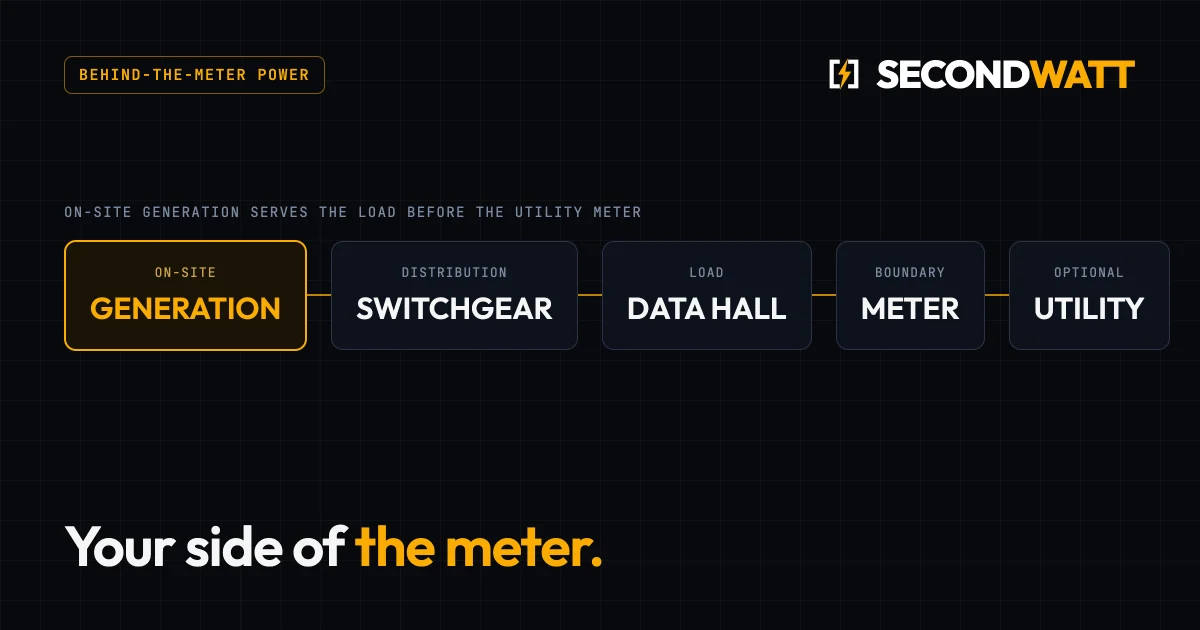
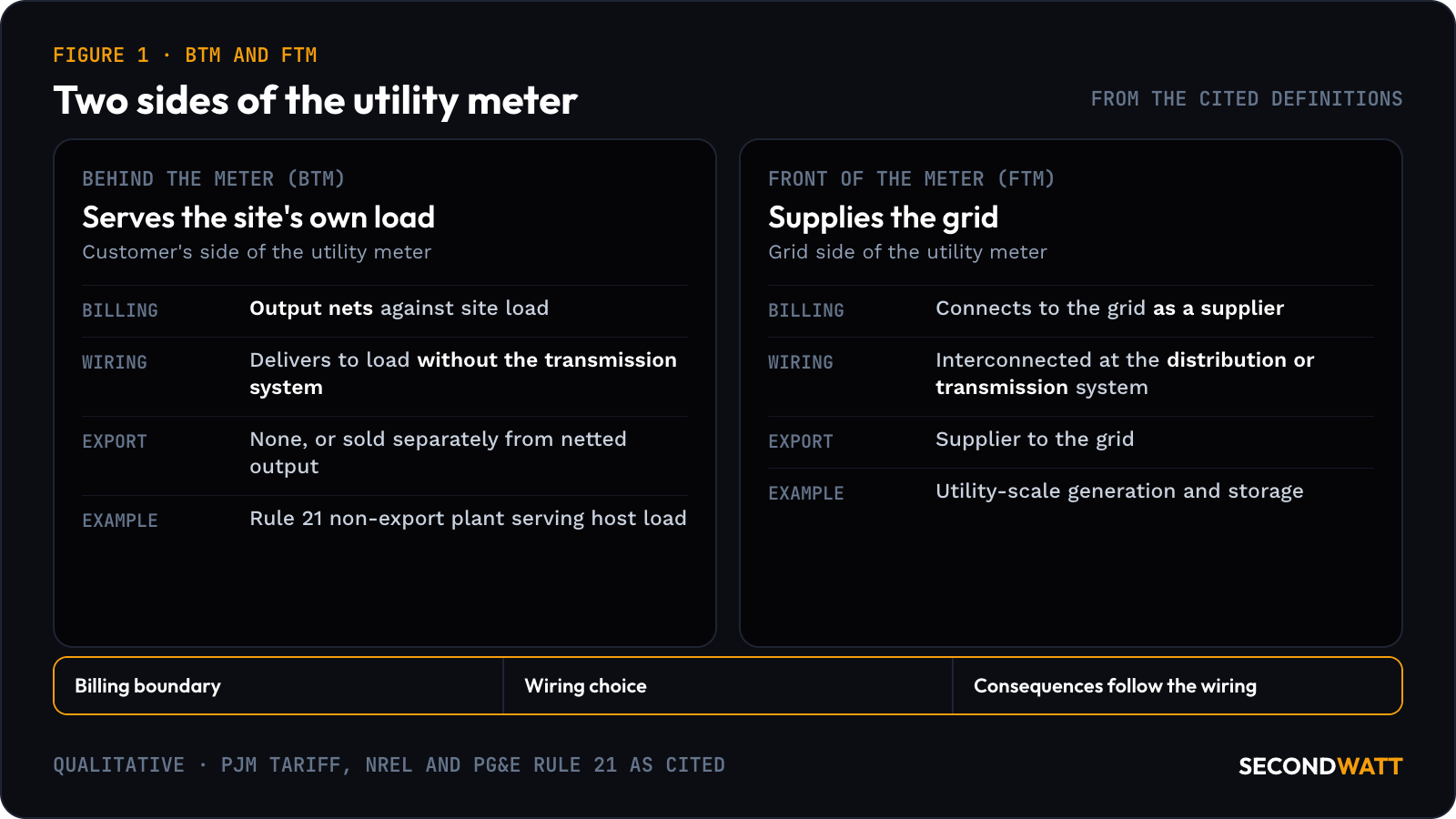
Behind the meter (BTM) means a power plant sits on the customer's side of the utility's service meter, so its output serves the site's own load first. In an August 2021 NREL storage FAQ, front of the meter (FTM) means the plant is interconnected at the distribution or transmission system. It supplies the grid, as utility-scale generation and storage do. For a data center, the BTM label answers two separate questions: who meters and bills the energy, and what is wired to what.
The wiring decides the project. Four configurations follow from it: islanded, grid-parallel without export, grid-parallel with export, and bridge-to-grid. Each brings its own studies, agreements and design rules, so choose the configuration first; the equipment list follows from it.
Key Takeaways
- Behind the meter answers two questions. Billing: on-site output nets against site load. Wiring: what connects to the grid, and whether power can flow out.
- Export status sets the interconnection path. Under PG&E's Rule 21, a non-export answer at Screen I skips Screens J to M; an exporting plant goes on to Screen J.
- Grid rules reach sites that net on-site output. PJM's 50 MW netting cap, accepted by FERC in June 2026, awaits final tariff text; Texas reviews stand-alone generators that net a new large load.
- Fuel and air permits apply in every configuration. Interruptible interstate pipeline transport ranks below firm under 18 CFR Part 284; state or local agencies issue most air permits.
- Islanding moves the spare unit into the plant. Ten C1400N6C gensets (1.0 pf) carry a 10 MW load at 2,000 m and 30 °C; islanded, an eleventh is the spare.
Behind the meter: the billing boundary and the wiring#
Both meanings sit in PJM's tariff. The wiring meaning is in its definition, as the FERC order of 18 June 2026 quotes it: "a generation unit that delivers energy to load without using the Transmission System or any distribution facilities". Distribution facilities may carry that energy if their owner consents and PJM accepts the consent.
The billing meaning is netting. Since 2004, PJM has let market participants net such generation against load "at the same electrical location for the purposes of calculating applicable PJM charges". Load served that way drops out of a network customer's daily load, according to PJM's 23 Feb 2026 compliance filing.
The definition is being rewritten. In its partial compliance filing of 17 August 2026 (ER26-1479-002), PJM proposed splitting it into Retail and Non-Retail behind-the-meter generation. In PJM's draft tariff language of 16 Sep 2026, the netting cap discussed below applies to the retail kind.
The four configurations#
An islanded plant has no utility connection. It carries every load step and every unit outage on its own.
A grid-parallel plant runs connected to the utility. In PG&E's California territory, parallel operation means staying connected for more than 60 cycles, or one second. Sheet 31 of PG&E Electric Rule 21 sets that definition, under Advice 7540-E, effective 17 April 2025.
Non-export is a design property under the same tariff. Sheet 30 describes the plant as "sized and designed such that the Generator output is used for Host Load only", and designed to stop energy flowing back to the utility.
Protection makes that physical. One Rule 21 option is reverse power protection, set by default at 0.1% of the service transformer's rating as export, with at most a 2.0-second delay. Another holds a minimum import of 5% of the plant's gross rating.
Bridge-to-grid is the fourth case: the plant runs first, and a utility connection takes over later. The 12-month bridge power plan works through that schedule.
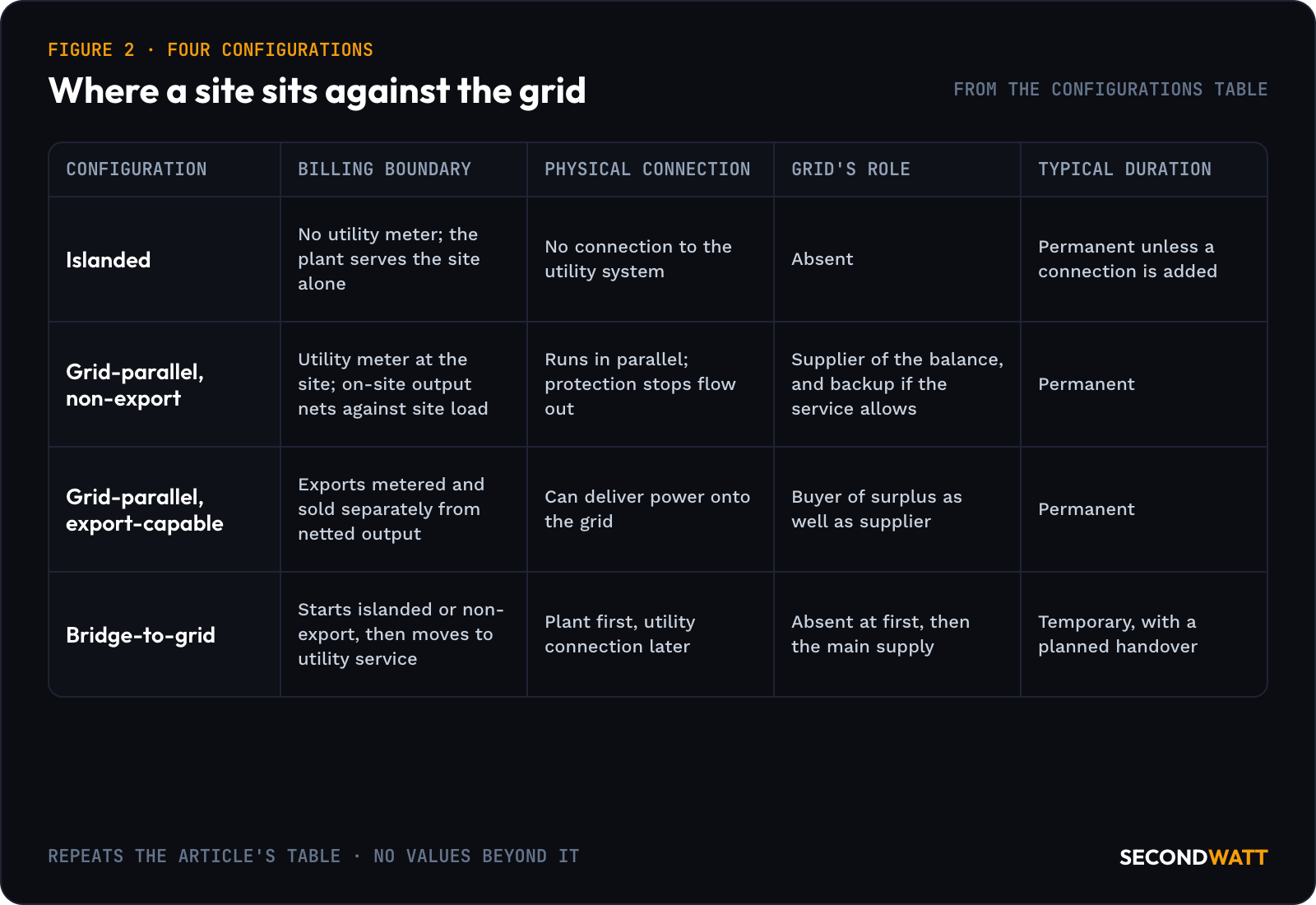
Four behind-the-meter configurations: billing boundary, physical connection, what the grid is to the site, typical duration#
| Configuration | Billing boundary | Physical connection | What the grid is to the site | Typical duration |
|---|---|---|---|---|
| Islanded | No utility meter; the plant serves the site alone | No connection to the utility system | Absent | Permanent unless a connection is added |
| Grid-parallel, non-export | Utility meter at the site; on-site output nets against site load | Runs in parallel; protection stops flow out across the point of common coupling | Supplier of the balance, and backup if the service allows | Permanent |
| Grid-parallel, export-capable | Exports metered and sold separately from netted output | Can deliver power onto the grid | Buyer of surplus as well as supplier | Permanent |
| Bridge-to-grid | Starts islanded or non-export, then moves to utility service | Plant first, utility connection later | Absent at first, then the main supply | Temporary, with a planned handover |
What each configuration triggers at the interconnection#
Export status is the first fork in the utility's process. On sheets 147–148 of PG&E's Rule 21, effective 29 August 2025, Screen I asks "Will power be exported across the PCC?", meaning the point of common coupling with the utility. A "no" requires one of the listed non-export options, after which Screens J to M are skipped and initial review is complete. A "yes" sends the application on to Screen J.
Transmission-level plants split the same way. Under sheet 15 of Rule 21, effective 17 April 2025, a plant connecting to PG&E's transmission system applies to the California ISO. If it does not export, it stays under Rule 21. An islanded plant sits outside this process, since Rule 21 covers generating facilities "to be connected" to the utility's system.
PJM handles co-located load through transmission service. On 18 December 2025, FERC found PJM's tariff unjust and unreasonable on co-located load, as its order of 18 June 2026 recites. It directed three services: network service with an interim non-firm version, firm contract demand service and non-firm contract demand service. Co-located load is load "physically connected to the facilities of an existing or planned" generator on the generator's side of the point of interconnection, in FERC's February 2025 wording.
The December order also directed PJM to consider interconnection requests below a new generator's full output when it serves co-located load. Such a generator may also request provisional or surplus interconnection service. The wider queue picture is in the interconnection roadmap, and the federal rulemaking in FERC's large-load docket.
50 MW — the most load a network customer may net with behind-the-meter generation at one electrical location in PJM, a level FERC accepted on 18 June 2026.
FERC rejected PJM's nameplate basis, so the cap counts netted load, and it gave PJM 60 days to file compliant tariff text. The cap covers Retail BTMG, generation serving a retail load at the same electrical location for a network customer, one taking PJM network transmission service.
PJM filed partial compliance on 17 August 2026. In a 14 Aug 2026 notice, FERC extended the deadline for some of the June directives to 16 November 2026. PJM's draft Retail BTMG text for a November 2026 filing, posted on 16 September 2026, is marked "subject to change".
The draft exempts, with conditions, generation the load owns, operates or had under contract by 18 December 2025, for the remaining contract term. It also exempts cogeneration that meets PURPA requirements and is integrated with the load it serves. Generation already serving load on 18 December 2025 would get a transition through 18 December 2028. Under the 16 Sep 2026 draft, affiliated loads within a one-mile radius would count as one electrical site.
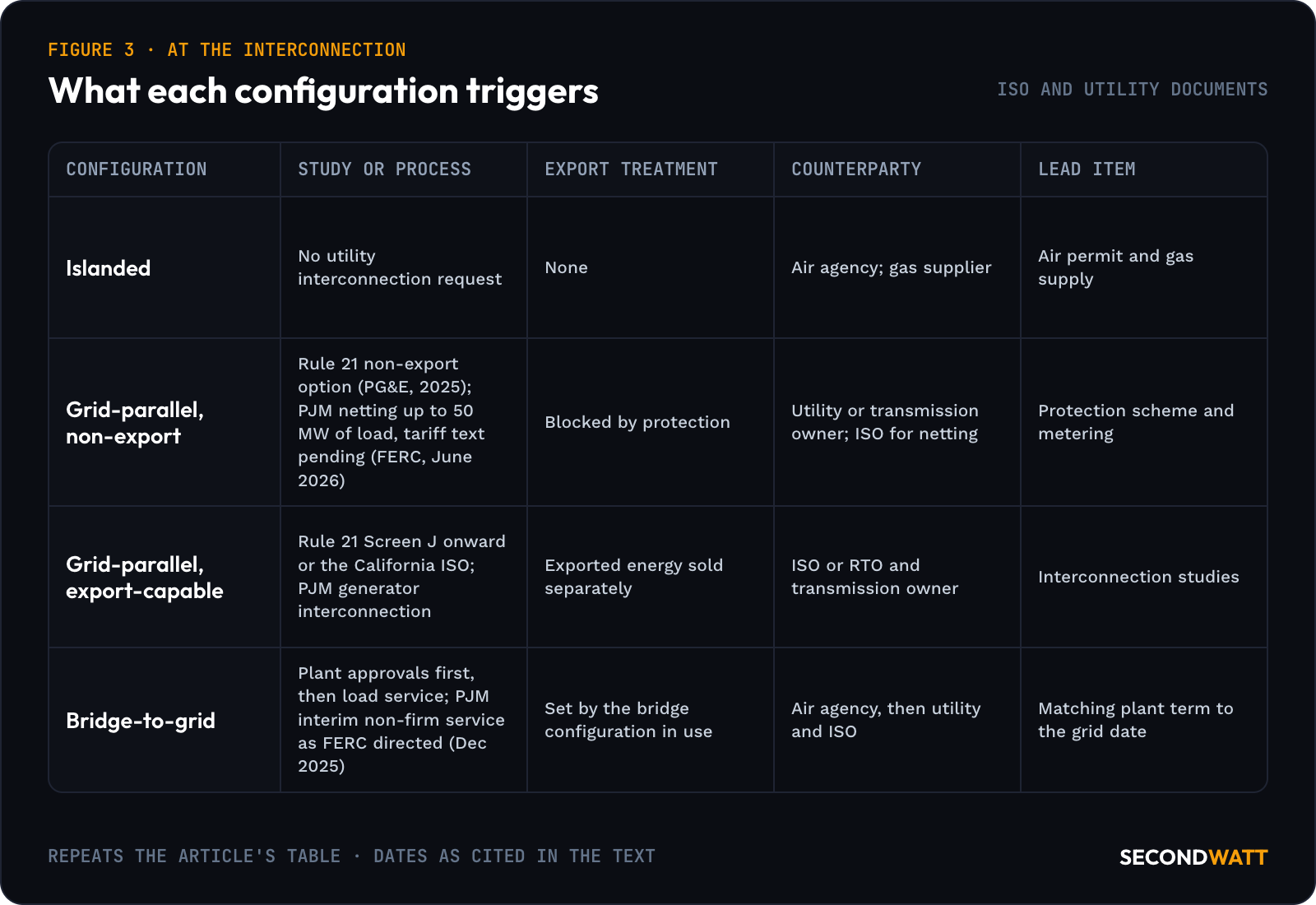
Interconnection consequences by configuration (ISO and utility documents, dated)#
| Configuration | Study or process (examples) | Export treatment | Counterparty | Typical lead item |
|---|---|---|---|---|
| Islanded | No utility interconnection request; Rule 21 covers plants to be connected | None | State or local air agency; gas supplier | Air permit and gas supply |
| Grid-parallel, non-export | Rule 21 non-export option (PG&E, 2025); PJM netting up to 50 MW of load, tariff text pending (FERC, June 2026) | Blocked by protection | Distribution utility or transmission owner; ISO for netting rules | Protection scheme and metering |
| Grid-parallel, export-capable | Rule 21 Screen J onward, or the California ISO for transmission-level exporters; PJM generator interconnection, which may be below full capability for co-located load (FERC, Dec 2025) | Exported energy sold separately | ISO or RTO and transmission owner | Interconnection studies |
| Bridge-to-grid | On-site plant approvals first, then load service; in PJM, FERC directed an interim non-firm network service until upgrades finish (Dec 2025) | Set by the bridge configuration in use | Air agency first, then utility and ISO | Matching plant term to the grid date |
Permits: the classes you will meet#
Air permits follow the plant, whatever its wiring. Under US federal New Source Review, a new major source needs a Prevention of Significant Deterioration permit where the air meets the national quality standards, and a nonattainment permit where it does not. Smaller sources get minor source permits, according to EPA's New Source Review basics page, updated 12 Nov 2025. These permits "specify what construction is allowed, emission limits, and often how the source must be operated", and state or local air agencies issue most of them.
Operating permits come next. Title V permits go to all major sources and "a limited number of smaller sources", according to EPA's Title V basics page, updated 8 Dec 2025. The emissions permitting guide works through which class applies to turbines.
Settle the equipment model before the application goes in. Air permits "often list specific turbine models and capacities", according to a Cleanview report. The federal rule changes for 2026 are in the generation facility rules update.
Texas adds a hold on data center permits. On 21 September 2026, the governor directed the Texas Commission on Environmental Quality to "halt all permits sought by data centers" until ERCOT completes its audit, the Office of the Governor announced.
Fuel supply as a dependency#
A gas plant behind the meter is only as firm as its gas. On an interstate pipeline, 18 CFR 284.7 defines firm transportation as service "not subject to a prior claim by another customer or another class of service". Under 18 CFR 284.9, interruptible service is subject to such a claim and "receives a lower priority than such other classes of service". Intrastate pipelines may offer either class under Part 284, but are not required to.
Gas bought from a local distribution company follows that company's service contract. In the EIA glossary, interruptible gas carries a "provision that permits curtailment or cessation of service at the discretion of the distributing company".
The wiring sets the consequence. At a grid-parallel site, a gas curtailment can shift load back to the utility, if the transmission service allows it. At an islanded site, the plant stops with the gas.
Before fixing the plant design, ask the pipeline or distribution company three things: the service class, the delivery pressure held at full load, and the in-service date of any new lateral. The turbine fuel guide covers the plant-side fuel specification.
Reliability design when the grid is backup, or absent#
A plant that can run with the grid or without it makes the site a microgrid. Such a system "can connect and disconnect from the grid to enable it to operate in both grid-connected or island-mode", in the US Department of Energy's 2012 definition, as quoted on the New Jersey BPU microgrid page.
Take a 10 MW site load at 2,000 m and 30 °C, served by Cummins C1400N6C natural gas gensets. Cummins's December 2019 data sheet D-6452 rates them at 1,400 kWe continuous at 60 Hz and 1.0 pf.
1,078 kWe — one C1400N6C's continuous output off-grid at 2,000 m and 30 °C (multiplier 0.77), against 1,106 kWe on-grid with a soft start (multiplier 0.79).
Ten units carry the load either way: 10,000 ÷ 1,078 = 9.28 and 10,000 ÷ 1,106 = 9.04, so nine units fall short even on-grid, at 9,954 kWe (calculated). Islanded, an eleventh unit covers one unit out. Grid-parallel, the grid may take that role.
Whether it can depends on the transmission service. In PJM, the December 2025 order made non-firm contract demand service available during normal operations and "curtailed during emergency operations". Where PJM finds too little transmission capacity, the June 2026 order lets the customer seek firm service instead or take none of it. Taking none leaves "no contractual right to withdraw power from the transmission system", so that site should plan its spare units as an islanded site would.
Plant redundancy levels are in the plant sizing and redundancy guide, and facility tiers in the data center redundancy explainer.
Equipment classes that fit each configuration#
About 2 GW of behind-the-meter generation was online across four data center projects as of mid-2026. The classes in use include mobile gas generators on trucks, aeroderivative turbines, reciprocating engines and refurbished industrial turbines, according to the Cleanview report.
Islanded duty favors many units over few, so one outage costs a small share of output. A reciprocating block such as the mtu 20V4000 gas power block, or a set of Jenbacher J624 engines, splits output that way. The power block article works through one block's output with a unit out.
An aeroderivative such as the LM6000 puts more output in each unit. The trade-offs are set out in the engines-against-turbines comparison.
Bridge plants that leave after the handover favor trailer-mounted sets; the options are in the mobile turbine guide. In the NREL storage FAQ, behind-the-meter storage acts "as both a load (while charging) and a generation asset (while discharging)". The wider ranges sit on the gas-engine and power-block category pages.
Configuration consequences: permits, fuel, reliability design and equipment (editorial synthesis of the cited sources)#
| Configuration | Permit classes | Fuel dependency | Reliability design | Equipment classes to compare |
|---|---|---|---|---|
| Islanded | NSR or minor source permit; Title V if major | Total: a gas curtailment stops the site | Spare units inside the plant (N+1) | Reciprocating blocks in multiples; aeroderivatives; off-grid derate |
| Grid-parallel, non-export | As islanded, plus utility interconnection approval | Partial: the grid can carry load if the service allows | Grid as backup only under a service that permits withdrawal | Reciprocating blocks; aeroderivatives; storage |
| Grid-parallel, export-capable | As islanded, plus generator interconnection | Partial, as above | As above, with the plant studied for injection | Larger turbines and blocks |
| Bridge-to-grid | Permit term matched to the grid date | Total until the grid date | Spare units until handover, then grid service | Trailer-mounted turbines and gensets |
The approvals and limits that stay in place#
A common reading is that behind the meter is a way around interconnection. That holds only for an islanded plant. A grid-parallel plant still goes through the utility or ISO process described above, and a co-located load in PJM still needs a transmission service.
FERC reopened PJM's netting rules for a planning reason. FERC's June 2026 order, summarizing its December 2025 finding, says PJM "is obligated to serve transmission customers using BTMG but does not consider such customers' full gross load in transmission and resource adequacy planning".
Texas adds a review for one case, in Utilities Code § 39.169 of the SB 6 enrolled text. A generator registered with ERCOT as a stand-alone resource as of 1 September 2025 must give notice before net metering a new large load, with exemptions. ERCOT's large load integration page says it starts its study only once it holds the required information, including the utility's completed large-load interconnection study.
ERCOT then has 120 days to study the arrangement, and the Public Utility Commission 60 days from the results to approve, deny or set conditions. That is 180 days if both use their full time (calculated). Under § 39.169(e), silence past the deadline counts as approval.
Conditions must keep at least the generator's prior dispatchable capacity available to ERCOT ahead of an anticipated emergency. They may also require "the retail customer who is served behind-the-meter to reduce load during certain events". State tariff protections for other ratepayers are tracked in the state tariffs review. Buying an existing plant to serve a campus is a separate project, covered in the plant conversion guide.
FAQ: behind-the-meter power#
Does a non-export plant get a faster utility review?#
Yes, in PG&E's territory. On sheet 55 of Rule 21, effective 29 August 2025, the utility "shall evaluate Non-Exporting Generating Facilities" under Fast Track review. That means an initial review, plus a supplemental review where needed. Failing that review "means only that further review and/or study are required".
What changes if the site is in ERCOT versus PJM?#
In ERCOT, Texas SB 6 (2025) required large-load interconnection standards by rule, under Utilities Code § 37.0561. They cover loads above 75 MW at one site unless the Public Utility Commission sets a lower threshold. According to a 25 Sep 2026 White & Case alert, the commission adopted that rule, 16 TAC § 25.194, on 18 September 2026. ERCOT now studies large loads in batches, starting with Batch Zero on 11 July 2026, as a 23 Jun 2026 ERCOT notice set out.
In PJM, the questions are which transmission service a co-located load takes and how much load it may net.
What happens to a co-located load in PJM with no transmission service?#
Under section 403(A)(1)(r)(iv), as PJM proposed it, a developer serving co-located load without naming an Eligible Customer must "terminate its generating facility's interconnection to the Transmission System and serve the Co-Located Load fully islanded". The Eligible Customer is the entity taking transmission service for the load. FERC relied on that proposed text on 18 June 2026 when it rejected PJM's separate disconnection wording as duplicative.
Does on-site backup count toward PJM's netting cap?#
No. FERC accepted PJM's proposal to leave on-site backup out of the 50 MW cap. In PJM's 17 August 2026 definition, the exclusion covers generation at the same electrical location "that can only be used to serve such retail load during conditions that may threaten the integrity or reliability" of the PJM region.
Can a behind-the-meter plant in PJM also sell power?#
It can, but what it sells stops counting as behind the meter. The FERC order of 18 June 2026 quotes PJM's definition, which excludes capacity designated as a capacity resource at any time. Hour by hour, it also excludes output sold to another entity or into PJM's energy market. Under PJM's 23 Feb 2026 compliance filing, energy the customer injects into the transmission system also does not reduce its daily load.
Choosing the configuration first#
SecondWatt publishes equipment research and helps buyers source power equipment; it earns a fee when a sale it arranges closes. If you have settled on a configuration, send the site load, export intent and grid date through a request for quote, and the equipment shortlist starts from those three facts. If you are still comparing turbine options for an on-site plant, the gas turbine hub sets out the models by class.