A 25 MW natural-gas power block is ten packaged gas gensets, a collection switchgear lineup, emissions control and a control building, delivered as one engineered scope. The mtu 20V4000 gas power block documented in SecondWatt's power-block dossier is built on ten Rolls-Royce mtu 20V4000 GS units and hands over 13.8 kV at the E-house. Whether it fits a data-center project comes down to three facts: the duty the plant will run, the gas it will burn, and the date the site must have power.
This article walks through what sits inside the scope line and what sits outside it. It shows the output at full and part load with the arithmetic, the fuel and emissions basis, the electrical design, the quoted schedule, and the cases where another route serves better. Every figure carries its source and its rating basis, and the few that SecondWatt estimated rather than read from a document are labeled as estimates.
SecondWatt holds the seller's documents for this block and can arrange an introduction to the seller's side; pricing is released to a qualified buyer on request.
Key Takeaways
- The block is 25.18 MW gross at datasheet conditions. Ten units at 2,518 kWe each at 95 °F and 328 ft; the site derate comes from the engine maker's curve.
- Part load is where the engines earn their place. Seller data shows 41.0% electrical efficiency at half load against 43.4% at full load, a 2.4-point drop.
- Emissions control is inside the scope. Each unit carries SCR and an oxidation catalyst; engine-out NOx sits above the federal 82 ppmvd ceiling, so the catalyst does the compliance work.
- The scope line is 13.8 kV at the E-house. The step-up transformer, interconnection, fuel infrastructure, permits and field cabling belong to the buyer.
- Two dates are supplier-quoted. First engine-generator into packaging in December 2027; ten units and the E-house complete April to May 2028; the rest is planning logic.
What the block is, and where the scope line falls#
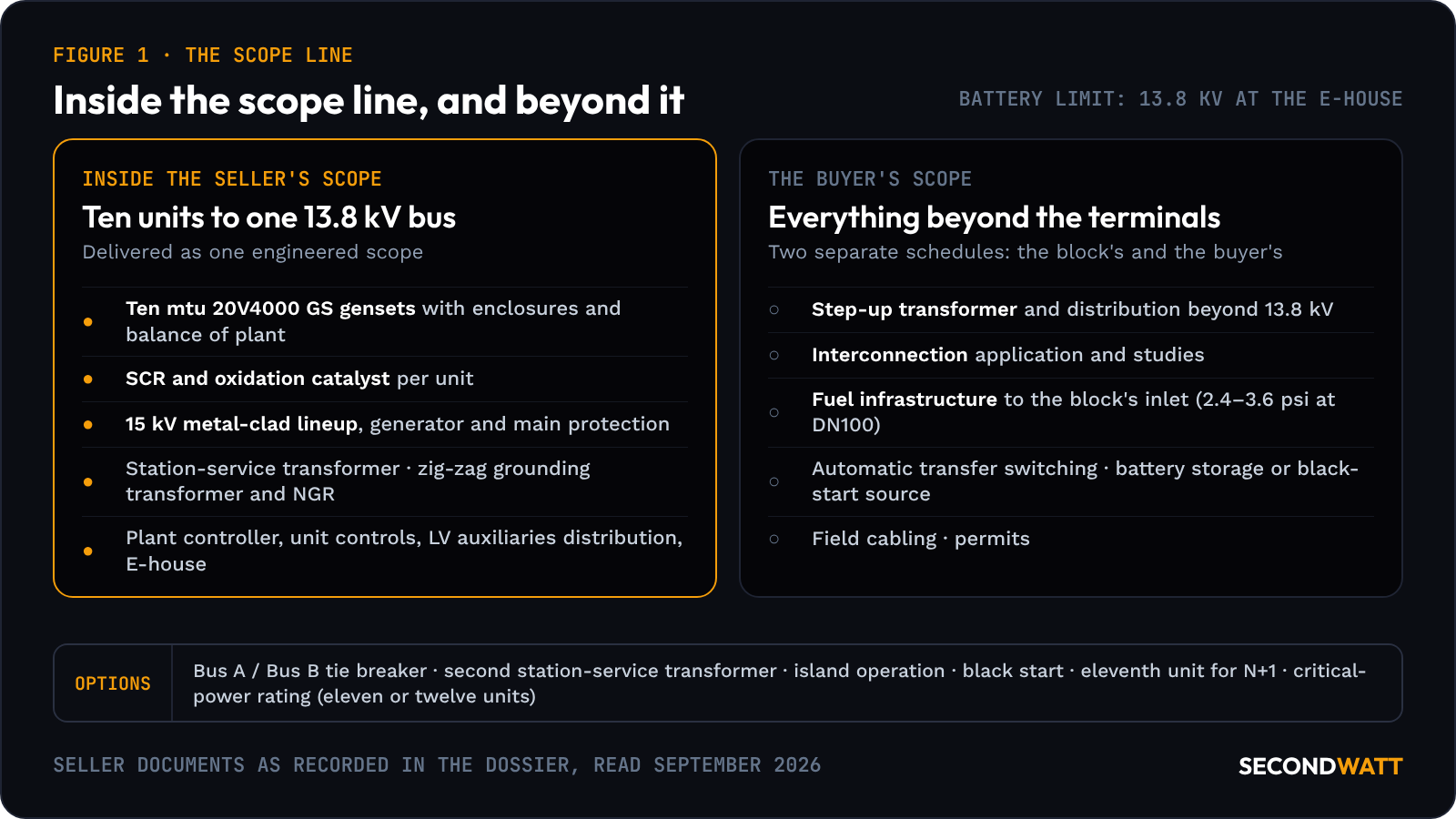
The block is an integrated scope rather than ten loose generator sets. Each mtu 20V4000 GS engine-generator arrives in its own enclosure with its balance of plant, a selective catalytic reduction unit and an oxidation catalyst. The ten enclosures connect to a 15 kV metal-clad switchgear lineup inside an E-house. That E-house also holds the plant controller, the generator and main protection relays, a station-service transformer and the low-voltage distribution for the package auxiliaries.
The seller's battery limit is the 13.8 kV outgoing terminals at that E-house. Everything beyond that point is the buyer's project. The scope matrix below comes from the seller's documents as recorded in the dossier. It is the first thing to read before comparing this block with a turbine package or with loose gensets.
Scope matrix for the 25 MW block (seller documents, read September 2026)#
| Included in the seller's scope | Offered as options | The buyer's scope |
|---|---|---|
| Ten gas gensets with enclosures and balance of plant | Bus A / Bus B sectionalizing tie breaker | Generator step-up transformer and distribution beyond 13.8 kV |
| SCR and oxidation catalyst per unit | Second station-service transformer | Interconnection application and studies |
| 15 kV metal-clad collection switchgear lineup | Island operation | Automatic transfer switching |
| Generator and main protection | Black start | Battery storage or black-start source |
| Station-service transformer | Eleventh unit for N+1 | Fuel infrastructure to the block's inlet |
| Zig-zag grounding transformer and neutral grounding resistor | Critical-power rating (eleven or twelve units) | Field cabling |
| LV distribution for package auxiliaries, plant controller, E-house | Permits |
Two lines in that table decide more than the rest. The step-up transformer is the buyer's, so the block's delivery and the transformer's delivery are two separate schedules. The transformer sizing guide explains why the second one is often the longer.
Island operation and black start are options rather than base scope. That is the largest single difference between this block as quoted and a plant designed from the start for a site where the grid is backup.
Output: 25.18 MW gross, what N−1 leaves, and the site derate#
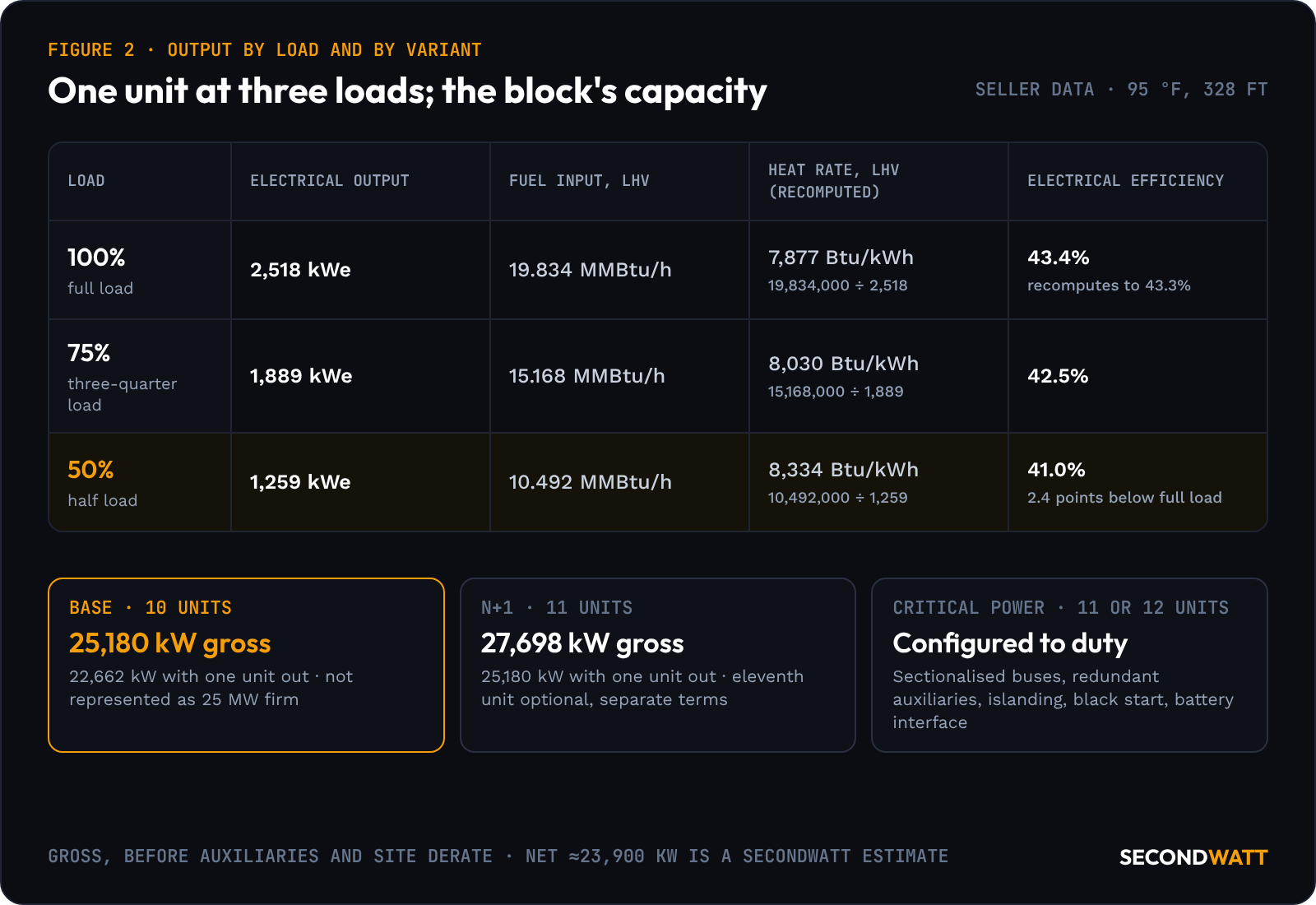
The headline figure is gross output at the mtu datasheet conditions: 95 °F combustion air, 328 ft elevation and a 79 °F maximum dew point. At those conditions each unit is rated 2,518 kWe for unrestricted heavy duty, the engine maker's application group 3A. Ten units give 25,180 kW gross.
The dossier records that the mtu brochure lists the same engine at 2,521 kW at 60 Hz; the 3 kW gap is the difference between the seller's project datasheet at its stated site conditions and the OEM's generic sheet at its own reference conditions. Both numbers are shown so a buyer can ask which one the contract will carry.
25.18 MW — ten mtu 20V4000 GS units at 2,518 kWe each at 95 °F and 328 ft, gross, before auxiliary load and before any site derate.
Two adjustments follow. The first is auxiliary load. Radiator fans, pumps, SCR and controls draw from the block's own output, and the seller publishes no net figure. SecondWatt's dossier carries an estimate of 23,900 kW net on an assumed 5% auxiliary load, labeled as an estimate rather than seller data.
The second adjustment is the site. Output falls with ambient temperature and elevation, and the radiators are rated to 110 °F at 2,500 ft. No derated figure is published for any other site, so the engine maker's performance curve is applied to the buyer's stated conditions before a firm number exists.
The N−1 case is subtraction. Ten units at 2,518 kWe less one unit is 22,662 kW gross, and the seller's base variant is explicitly not represented as 25 MW firm. The N+1 variant adds an eleventh unit for 27,698 kW gross, with 25,180 kW when one is out, subject to availability, engineering and separate commercial terms. The 100 MW sizing article shows how that reserve arithmetic belongs in the requirement before any vendor quotes, and the redundancy explainer covers the N+1 and 2N vocabulary.
Capacity variants as the seller defines them#
| Variant | Units | Gross at datasheet conditions | With one unit unavailable | Note |
|---|---|---|---|---|
| Base | 10 | 25,180 kW gross | 22,662 kW gross | Not represented as 25 MW firm |
| N+1 | 11 | 27,698 kW gross | 25,180 kW gross | Eleventh unit optional; separate commercial terms |
| Critical power | 11 or 12 | Configured to the selected duty | Configured to the selected duty | Sectionalized buses, redundant auxiliaries and controls, islanding, black start, battery interface |
The engine: mtu 20V4000 L64, and the 2026 version behind it#
The engine is the mtu 20V4000 L64 FNER, a 20-cylinder lean-burn Otto-cycle gas engine at 1,500 rpm with a 170 mm bore and 210 mm stroke. The mtu Series 4000 natural gas brochure, edition 01/21, rates the 20V4000 GS at 2,521 kW at 60 Hz with 43.6% electrical efficiency. Total efficiency is 90.3% where the heat is recovered, and the engine reaches 100% load from zero in under 120 seconds.
The bare generator set measures 6,600 by 2,000 by 2,400 mm and weighs 21,000 kg dry. The packaged, enclosed unit in this block is listed by the seller at roughly 52,000 lb, which is the figure a foundation designer needs. The unit dossier carries the full specification table.
Rolls-Royce announced the next version of this engine on 2 October 2025. From 2026 the 20V4000 for the 60 Hz market is rated at 2.8 MW, reaches full output in 45 seconds, performs ten percent above the previous version and needs no gearbox.
That release raises one question for the seller. The datasheet behind this block is dated July 2024 and lists 1,500 rpm; at 60 Hz a synchronous alternator turns at 1,800 or 1,200 rpm, so an engine at 1,500 rpm drives it through a gearbox, which is the component the 2026 version removes. A buyer should ask which engine version will be packaged and whether the 2,518 kWe rating or the 2.8 MW rating applies to the units delivered.
The release also states 84,000 hours before overhaul for the Series 4000 gas range, which the brochure carries as the lifetime to major overhaul. That interval is a vendor claim, and it is useful for one reason: it makes remaining life computable from an hour meter, which is how a gas engine's condition is valued later.
mtu 20V4000 GS unit figures: OEM brochure against the seller's project datasheet#
| Item | mtu brochure, edition 01/21 | Seller datasheet for this block (TD_0944_L64_2518_60_1, July 2024) |
|---|---|---|
| Electrical output, 60 Hz | 2,521 kW | 2,518 kWe, application group 3A, at 95 °F and 328 ft |
| Electrical efficiency, full load | 43.6% | 43.4% |
| Total efficiency with heat recovery | 90.3% | 90.0% |
| Start to full load | under 120 seconds | engine maker's figure; block start sequence is a plant-controller item |
| Bore and stroke, speed | 170 mm, 210 mm, 1,500 rpm | same engine |
| Methane number required | 72 standard, 80 hot and humid | 80 |
| Lifetime to major overhaul | 84,000 operating hours (vendor claim) | not restated |
| Alternator | not specified | Stamford 3,427 kVA, class H insulation, class F rise |
One arithmetic check on that alternator: 3,427 kVA at the block's 0.8 power-factor limit is 2,742 kW, above the 2,518 kWe rating. The engine sets the unit's output and the alternator carries margin.
Efficiency by load, fuel quality and the arithmetic behind the heat rate#
Gas engines keep most of their efficiency when the load falls. That characteristic shapes this block's fit for a data center that ramps over two or three years. The seller's performance data for the 20V4000 L64 gives 43.4% electrical efficiency at full load, 42.5% at three-quarter load and 41.0% at half load.
The US EPA's reciprocating-engine technology characterization states the general case the same way: spark-ignition engine efficiency at 50% load is roughly 8 to 10 percent lower than at full load in relative terms, where gas turbines typically lose 15 to 25 percent at half load.
41.0% — electrical efficiency of one 20V4000 L64 unit at half load (1,259 kWe), against 43.4% at full load, per the seller's performance data.
The heat rate recomputes from the fuel-input figures. At full load the seller lists 19.834 MMBtu/h of fuel for 2,518 kWe. Dividing 19,834,000 Btu by 2,518 kW gives 7,877 Btu/kWh on a lower-heating-value basis, and 3,412 Btu/kWh divided by 7,877 Btu/kWh is 43.3%, a tenth of a point from the seller's 43.4% on rounding. At half load, 10.492 MMBtu/h over 1,259 kWe is 8,334 Btu/kWh, or 40.9%.
The dossier also shows a higher-heating-value heat rate of 8,728 Btu/kWh. That is a SecondWatt conversion at a 1.108 ratio, and a buyer pricing gas on an HHV tariff should use it with that label attached.
Load-point performance per unit (seller performance data, datasheet conditions)#
| Load | Electrical output | Fuel input, LHV | Heat rate, LHV (recomputed) | Electrical efficiency (seller) | Total efficiency with heat recovery |
|---|---|---|---|---|---|
| 100% | 2,518 kWe | 19.834 MMBtu/h | 7,877 Btu/kWh | 43.4% | 90.0% |
| 75% | 1,889 kWe | 15.168 MMBtu/h | 8,030 Btu/kWh | 42.5% | 90.4% |
| 50% | 1,259 kWe | 10.492 MMBtu/h | 8,334 Btu/kWh | 41.0% | 90.0% |
The block runs ten engines as a fleet, so part-load behavior compounds with dispatch. A 12 MW demand can be met by five units near full load or by ten at half. The plant controller's loading plan, rather than the single-engine curve, sets the fuel bill. That dispatch logic is the document to ask for in writing, with the number of units in rotation and the hours each accumulates.
Fuel quality is the other input. The seller's fuel specification calls for a methane number of 80 and a minimum methane content of 95%. The design heating value is 969.1 to 1,014.5 Btu/ft³, with an operating window of 773.0 to 1,062.8 Btu/ft³ without derating. Supply pressure at the DN100 inlet is 2.4 to 3.6 psi, which is low-pressure gas; the compression, metering and lateral to reach it are buyer scope.
The brochure's rule of a methane number of 72 standard and 80 for hot and humid conditions matches the seller's figure, and a site gas analysis against it is the first document to commission.
Emissions: what the engine emits, what the catalyst removes, and the federal ceiling#
The engine-out numbers come from two places. The mtu brochure states NOx below 500 mg/Nm³ at 5% O₂ dry. The seller quotes raw engine emissions at or above 50% load of under 1.0 g/bhp-h NOx, under 3.0 g/bhp-h CO and under 0.7 g/bhp-h VOC. Converting the brochure figure to the basis US permits use, 500 mg/Nm³ at 5% O₂ is 243.6 ppmv, and corrected to 15% O₂ it is 90.4 ppmvd.
The federal reference point is Table 1 to 40 CFR 60 Subpart JJJJ. For non-emergency spark-ignition natural gas engines of 500 HP or more manufactured on or after 1 July 2010, the standard is 1.0 g/HP-hr NOx or 82 ppmvd at 15% O₂, 2.0 g/HP-hr CO or 270 ppmvd, and 0.7 g/HP-hr VOC or 60 ppmvd. Engine-out NOx at 90.4 ppmvd sits above the 82 ppmvd ceiling, and the seller's raw 1.0 g/bhp-h sits at it.
That is why the SCR and oxidation catalyst are inside the scope rather than offered as an option.
82 ppmvd — the NOx limit at 15% O₂ in Table 1 to Subpart JJJJ for non-emergency natural-gas engines of 500 HP or more built after 1 July 2010; engine-out NOx for this engine converts to 90.4 ppmvd.
What the catalyst delivers at the stack is the open item. The dossier records that outlet guarantees after the catalyst are not defined, and the block's engineering list asks for permit-ready outlet guarantees before purchase. State and local permits, non-attainment status and the operating hours the permit allows are a separate workstream. The emissions and permitting article covers that process for a turbine plant; the questions are the same for an engine plant with the pollutant basis changed.
Electrical design: the 15 kV lineup, protection and operating mode#
The collection system is a 15 kV metal-clad lineup with a 2,000 A bus, 95 kV BIL and 40 kA bracing, indoor Type 1 and non-arc-resistant as quoted. Each generator connects through a 13.8 kV, 1,200 A, 40 kA drawout vacuum breaker with SEL-700G protection. Two 13.8 kV, 2,000 A main breakers with SEL-751 protection carry the output.
A zig-zag grounding transformer with a neutral grounding resistor branch sets the system grounding. A 5.5 MVA station-service transformer on the 13.8 kV bus feeds the plant's own load. Voltage tolerance is 13,800 V ±5% and frequency 60 Hz ±5%, with the units rated from 0.8 inductive to 1.0 capacitive power factor.
The operating mode as quoted is grid-parallel. Island operation and black start are options. A buyer who intends to run the block as the site's primary source with the grid as backup should treat those options as base requirements and price them in. The paralleling switchgear article explains why synchronizing, load sharing and load shedding are specified with the switchgear rather than added later, and the medium-voltage lineup checklist covers the ratings a lineup must state.
The dossier lists eight engineering items the seller's documents leave open. They are the buyer's due-diligence agenda, and each is a question for the seller's engineer rather than a defect.
Engineering items to close before purchase (from the dossier's engineering controls)#
| Item | Why it matters |
|---|---|
| Confirm the Bus A / Bus B topology, the tie duty and the eleventh breaker cell | Decides whether half the plant can be isolated for maintenance |
| Complete fault, load-flow and protection studies; issue relay settings | Required before the lineup's 40 kA rating can be accepted for the site |
| Reconcile the grounding transformer and neutral grounding resistor rating | Sets ground-fault current and relay coordination |
| Confirm the station-service secondary voltage | Documents cite both 480 V and 600Y |
| Engineer islanding, load shed, black start, battery interface and redundant controls | Only if those options are taken; none is base scope |
| Confirm site ambient and elevation derating with the engine maker | No derated figure is published |
| Define permit-ready emissions outlet guarantees after the catalyst | The air permit is written against outlet numbers |
| Decide on arc-resistant switchgear | The quoted lineup is non-arc-resistant; a change affects room design and delivery |
Schedule and commercial basis: two quoted dates and the market around them#
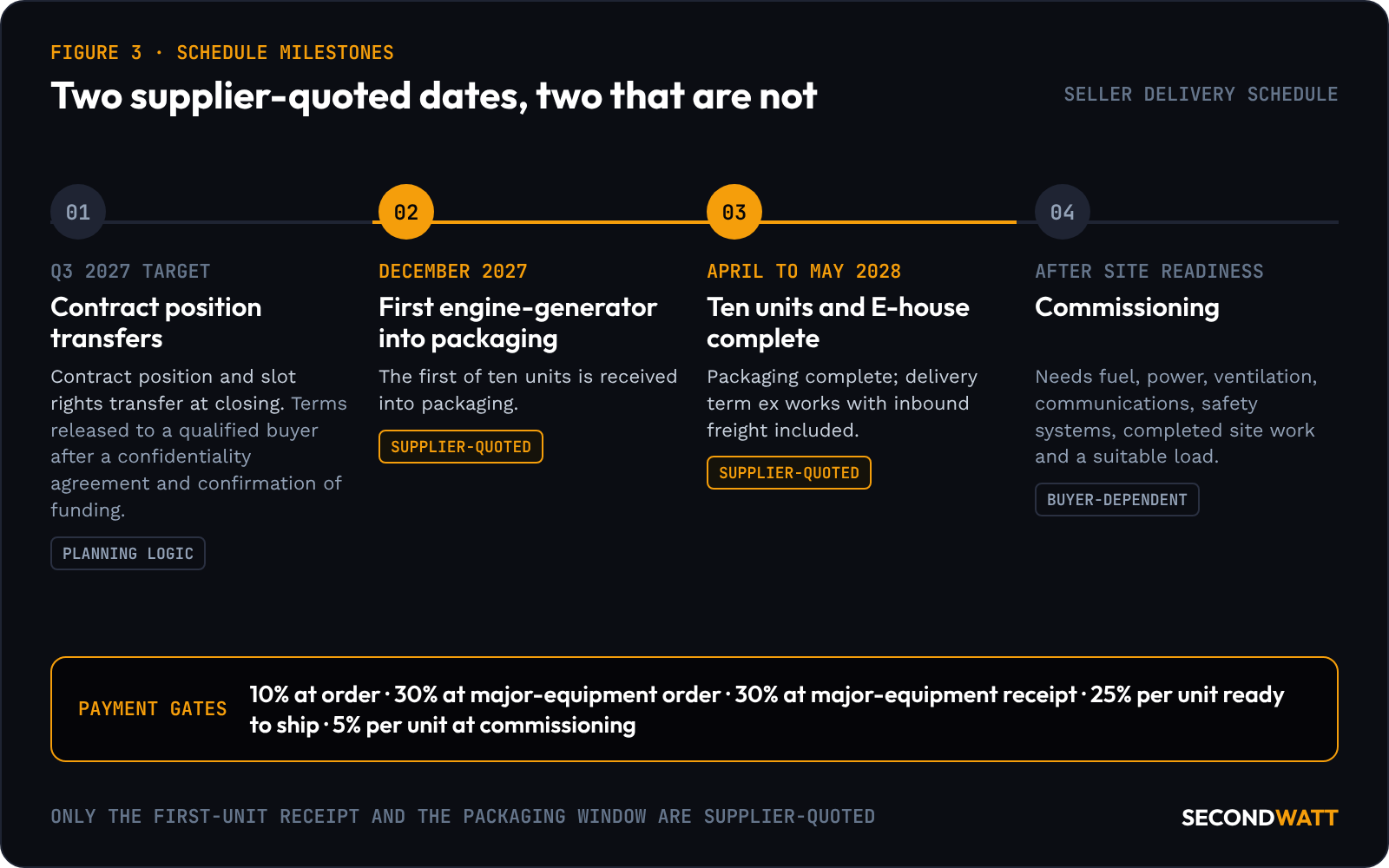
The seller's manufacturing and delivery schedule gives two supplier-quoted dates. The first engine-generator is received into packaging in December 2027. The ten units and the E-house are complete in April to May 2028. The target for transferring the contract position is the third quarter of 2027, and the contract position and slot rights transfer at closing.
The dossier is explicit that only the first-unit receipt and the packaging window are supplier-quoted; every other span is planning logic and is not committed.
2 dates — carry supplier quotations: December 2027 for the first engine-generator into packaging, and April to May 2028 for ten units and the E-house complete.
Payment follows the build: 10% at order, 30% at major-equipment order, 30% at major-equipment receipt, 25% per unit ready to ship and 5% per unit at commissioning. The delivery term is ex works the packaging facility in the United States, with inbound freight to that facility included. Onward shipping, tariffs and state and local taxes are excluded unless a definitive agreement changes the basis.
No price is published on the dossier. SecondWatt holds the seller's commercial summary, equipment summary, preliminary one-line and delivery schedule, and the seller releases commercial terms, including pricing, to a qualified buyer after a confidentiality agreement and confirmation of funding. That is the sequence described in how SecondWatt works: the request starts with the site's three facts, and the documents are read against them before any introduction is made.
Schedule milestones and their status#
| Milestone | Date | Status in the seller's documents |
|---|---|---|
| Contract position transfers | Q3 2027 target | Planning logic |
| First engine-generator into packaging | December 2027 | Supplier-quoted |
| Ten units and E-house complete | April to May 2028 | Supplier-quoted |
| Commissioning | After site readiness: fuel, power, ventilation, communications, safety systems, site work and a suitable load | Buyer-dependent |
That window sits against a market where new-build generation of any kind is slot-constrained. GE Vernova reported a gas turbine backlog and slot-reservation book of 116 GW at its second-quarter 2026 results, with output of 20 GW a year in the third quarter of 2026 rising to 24 GW in 2028. Its chief executive said in December 2025 that he expected reservations to be sold out through 2030 by the end of 2026. Siemens Energy's finance chief put lead times at three years or more in August 2026.
The engine makers have long order books as well. Cummins said on its August 2026 call that it is generally selling new power-generation equipment into the second half of 2028. Behind all of it, LBNL's Queued Up 2026 edition counted 2,061 GW waiting for grid interconnection at the end of 2025, with time to commercial operation above five years in the regions with data.
Gas engines are the capacity data centers have been booking into that gap. Wärtsilä announced a 412 MW order of forty 34SG engines for a hyperscale project in Ohio in April 2026, with commercial operation anticipated in early 2028, taking its US data-center engine sales past 1.6 GW.
INNIO and Rehlko signed a framework agreement the same month for 1.25 GW of gas-engine capacity over three years, expanding a 700 MW reservation. Power Engineering reported in April 2026 that Nscale plans Caterpillar G3500 engines for 2 GW of on-site generation in West Virginia.
A documented 25 MW block with a 2028 packaging window is a small lot by those standards. That is the point. It is sized for one campus phase rather than a fleet program, and it is a contract position SecondWatt can put in front of a qualified buyer, rather than a place in a queue.
Who the block fits, and who should keep looking#
The fit case is a site that needs 20 to 25 MW of on-site generation at prime or continuous duty, in grid-parallel operation, on pipeline gas that meets a methane number of 80. It needs power in 2028, and it has a project team ready to own the step-up transformer, the interconnection and the permits. For that buyer, pricing and the full document set are a request away: the seller releases them once the project is registered with SecondWatt, the confidentiality agreement is in place and funding is confirmed.
A phased campus suits it particularly well: the ten-unit format lets the first halls run on a few engines near full load while the rest wait, and the part-load curve keeps the fuel bill honest while the site ramps.
Three kinds of project should keep looking. A site that needs the grid only as backup, with island operation and black start from day one, is buying the critical-power variant rather than the base block, and that is an engineering exercise with its own schedule.
A site above 2,500 ft, hotter than 110 °F, or on gas below a methane number of 80 needs a derate study before the 25 MW figure means anything. A site that needs firm 25 MW with one unit out needs the eleventh unit, which is an option under separate terms rather than a line to assume.
For a comparison against the alternatives in the same class, the gas-engines category holds dossiers on the Jenbacher J624, the Wärtsilä 20V34SG and the Cat G3520H. The power-blocks category is where integrated scopes like this one appear as they are documented. The OEM backlog article and the interconnection roadmap cover the two schedules this block is measured against.
FAQ: the mtu 25 MW block#
Is 25.18 MW the number to put in the site's load model?#
No. It is gross output at 95 °F and 328 ft before auxiliary load. Subtract the block's own consumption, which SecondWatt estimates at about 5% pending seller data, apply the engine maker's derate for the actual site, and decide whether the design case is ten units running or nine. For most data-center load models the planning figure is the N−1 net number, which sits below 22,662 kW once auxiliaries are deducted.
Can the block run the site if the utility feed is lost?#
As quoted, no. The base operating mode is grid-parallel. Island operation and black start are options that require their own engineering, controls and a black-start source or battery interface, which is buyer scope. The critical-power variant with eleven or twelve units, sectionalized buses and redundant auxiliaries is the configuration designed for that duty.
Does the block arrive with its air permit?#
No permit travels with equipment. The block includes the SCR and oxidation catalyst the engine needs against the federal Subpart JJJJ limits, but outlet guarantees after the catalyst are not yet defined. The state or local permit is written against outlet numbers, operating hours and the site's attainment status. The permit application is the buyer's scope and should start as soon as the site is chosen.
What does a buyer have to supply before commissioning can start?#
Fuel at the block's inlet within the pressure and quality specification, electrical power for auxiliaries, ventilation, lighting, communications, safety systems, completed site work and a suitable load. The 13.8 kV connection beyond the E-house, including the step-up transformer and the interconnection, has to be in place for the plant to export.
Why is a 2028 packaging window treated as early?#
Because the alternatives are measured in years from order. OEM gas-turbine backlogs ran to 116 GW at GE Vernova in mid-2026 with reservations expected to sell out through 2030, Siemens Energy quoted lead times of three years or more, and Cummins is selling new generation equipment into the second half of 2028. The grid-interconnection queue runs more than five years to commercial operation in the regions LBNL measures. A quoted packaging window with a transferable contract position is a dated commitment inside that range.
How do I get pricing for this block?#
Through SecondWatt. The dossier publishes no price, and the seller releases commercial terms, including pricing and the payment schedule, to a qualified buyer after a confidentiality agreement and confirmation of funding. Send the site conditions, the load profile and the target energization date with the request, so that the block's documents can be read against them first and the introduction, when it is made, is to a seller who already knows the project fits.
Reading the block against your own three facts#
SecondWatt publishes equipment research and helps buyers source power equipment; it earns a fee when a sale it arranges closes. If your site's duty, gas and date line up with what this article describes, send the requirement with the site conditions, the load profile and the target energization date; SecondWatt reads the block's documents against it, and pricing follows the confidentiality agreement and funding confirmation; readers comparing engine blocks in general can start at the power-blocks category.