
A 3 MW generator is a set rated near 3,000 kW, and the figure means little until the rating basis sits beside it. On current Cat 60 Hz sheets and Cummins 60 Hz pages, one set carries a standby rating for outages and a lower rating for unlimited hours. At 0.8 power factor, 3,000 kW is 3,750 kVA.
For a data center built to Uptime Institute Tier III or IV, the engine-generator plant qualifies only on a rating without a run-time limit. Compare quotes on the same rating, voltage and emissions certification. The generator category holds SecondWatt's model dossiers.
Key Takeaways
- One 3 MW set carries several ratings. The QSK95-powered Cummins C3000D6E is rated 3,000 kW standby and 2,750 kW Data Center Continuous, both at 60 Hz.
- On the five Cat and Cummins sets, the data center rating is 90–92% of standby. The C3000D6E is 2,750 of 3,000 kW; the DQKAN, 2,250 of 2,500 kW.
- At 480 V, 3,000 kW standby at 0.8 power factor carries about 4,511 A. At 4,160 V it carries about 520 A; at 13.8 kV, about 157 A.
- The 3516E burns 720.4 L/h at 100% load on its 2,750 ekW standby rating, 60 Hz. That is 190.3 US gallons an hour, or about 4,567 gallons over 24 hours.
- Cat's Tier 2 3516E and C175-16 sets are certified for stationary emergency use only. Its C175-16 Tier 4 Final package meets that standard through averaging, banking and trading.
What a 3 MW generator rating means#
Caterpillar sells the 3516E in two 60 Hz packages. The Tier 2, Low NOx package is rated 2,750 ekW standby and 2,500 ekW prime. The Tier 2 package is rated 3,000 ekW standby and 2,725 ekW prime.
Cat data sheet LEHE1351-12, dated 08/26, defines Cat's ratings. Standby covers the interruption of the normal source at an average 70% of rating, typically 200 hours a year with up to 500 expected. Mission critical carries the same hours at an average 85%, with typical peaks up to 100% for up to 5% of the time. Prime allows unlimited hours at an average 70%, with a 10% overload for emergency use for one hour in twelve, up to 25 hours a year.
Cat's prime-DCP rating is for data centers only, according to data sheet LEHE2679-12, dated 08/26. It allows unlimited hours at an average load up to 100% of rating, with the same overload terms as prime.
ISO 8528-1:2018, edition 3, defines the classifications for generating-set application, rating and performance. ISO last confirmed it in 2023 and now lists it as to be revised. A Cummins bulletin, revised 2/25, summarizes the ISO classes. Continuous power has no run-time limit at 100% of rating, prime none at 70% or less, and standby no more than 200 hours a year.
The prime power rating explainer sets out the general definitions.
The diesel sets in the 3 MW class#
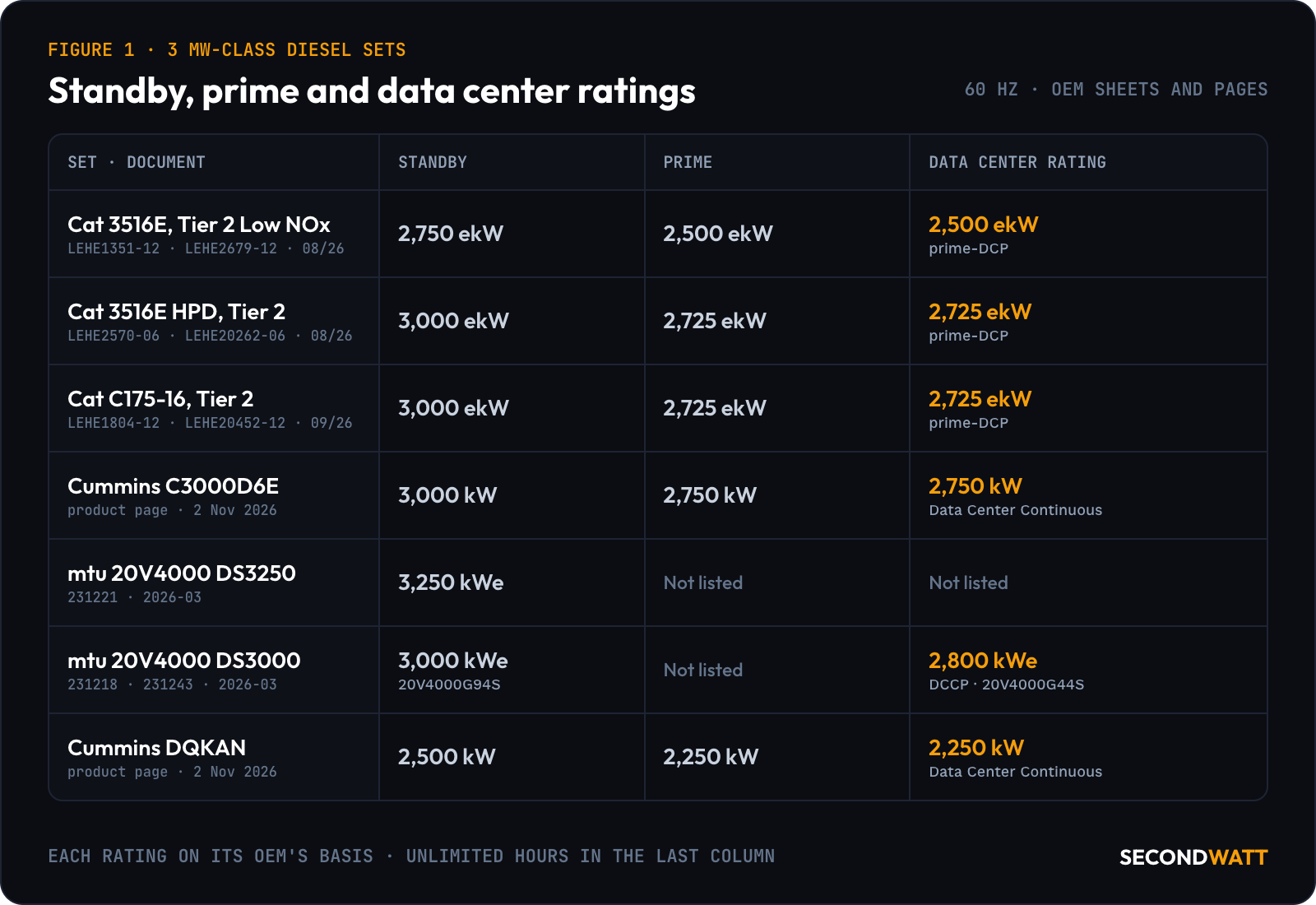
The table covers current 60 Hz sets from Cat, Cummins and mtu rated 2,500 to 3,250 kW standby.
3 MW-class diesel generator sets at 60 Hz, ratings by basis (OEM sheets and product pages, revision or as-of date noted)#
| Set and package (document) | Engine | Standby | Mission critical (limited hours) | Prime | Data center rating, OEM's name (unlimited hours) | Continuous | Voltage range |
|---|---|---|---|---|---|---|---|
| Cat 3516E, Tier 2 Low NOx (LEHE1351-12 and LEHE2679-12, 08/26) | 3516E, 78.1 L | 2,750 ekW / 3,438 kVA | 2,750 ekW | 2,500 ekW | 2,500 ekW prime-DCP | Not listed | 416–13,800 V |
| Cat 3516E HPD, Tier 2 (LEHE2570-06 and LEHE20262-06, 08/26) | 3516E, 78.1 L | 3,000 ekW / 3,750 kVA | 3,000 ekW | 2,725 ekW | 2,725 ekW prime-DCP | Not listed | 480–13,800 V |
| Cat C175-16, Tier 2, with fan (LEHE1804-12 and LEHE20452-12, 09/26) | C175-16, 84.7 L | 3,000 ekW / 3,750 kVA | 3,000 ekW | 2,725 ekW | 2,725 ekW prime-DCP | 2,500 ekW | 480–13,800 V |
| Cummins C3000D6E (product page, as of 2 Nov 2026) | QSK95-G9 | 3,000 kW / 3,750 kVA | Not listed | 2,750 kW | 2,750 kW Data Center Continuous | 2,500 kW | Not listed |
| mtu 20V4000 DS3250, 43 °C (231221, 2026-03) | 20V4000G94S, 20-V, 95.4 L | 3,250 kWe / 4,062 kVA | Not listed | Not listed | Not listed | Not listed | 480–13,800 V |
| mtu 20V4000 DS3000, 45 °C (231218 and 231243, 2026-03) | 20V4000G94S standby; 20V4000G44S DCCP | 3,000 kWe | Not listed | Not listed | 2,800 kWe Data Center Continuous Power | Not listed | 380–13,800 V (DCCP sheet) |
| Cummins DQKAN, class floor (product page, as of 2 Nov 2026) | QSK60-G19 | 2,500 kW / 3,125 kVA | Not listed | 2,250 kW | 2,250 kW Data Center Continuous | Not listed | Not listed |
The mtu DS3000 sheets list different engine models for standby and DCCP, so treat that pair as two configurations. The Cat 3516E dossier and Cummins QSK60 dossier cover two of these engines, and the 2 MW comparison and 1 MW guide cover the smaller classes.
Which rating data centers buy#
The core premise of Uptime Institute's Tier Standard: Topology is that the engine-generator plant is the only reliable source of power for a data center. The abstract of Uptime's engine-generator ratings paper states: "Only continuous ratings, derated prime ratings or standby ratings with no runtime limitations qualify for the Tier III or IV requirement for engine generators."
ISO added data center power (DCP) in 2018. Cummins calls it not appropriate for Tier III or IV certification, because its definition refers to a reliable utility and prohibits prolonged operation in parallel with a utility. In the same bulletin, Cummins says its Data Center Continuous rating meets the Tier III and IV requirements. Cat's prime-DCP sheets, such as LEHE2679-12, claim ISO 8528-1 DCP compliance, and all six Cat sheets print "All ratings Tier III/Tier IV compliant per Uptime Institute requirements", a vendor claim.
mtu's DCCP rating applies to data center installations where utility power is available. It allows unlimited hours at constant or varying load, an average load factor up to 100% and a 10% overload for one hour in twelve. mtu's DCCP sheet 231243, dated 2026-03, states that the rating complies with Uptime Institute Tier III and IV requirements.
On Cummins' product pages, the C3000D6E Data Center Continuous rating is 2,750 ÷ 3,000 = 0.917 of standby, and the DQKAN rating is 2,250 ÷ 2,500 = 0.900. Cat's prime-DCP sheets give 2,500 ÷ 2,750 = 0.909 for the 2,750 ekW 3516E and 2,725 ÷ 3,000 = 0.908 for the HPD and C175-16. Counting sets on the standby nameplate would credit each with 9–11% more unlimited-hour capacity than its maker lists (3,000 ÷ 2,750 = 1.09; 2,500 ÷ 2,250 = 1.11). The data center redundancy guide covers the configurations.
Low-voltage or medium-voltage output#
A set rated 3,000 kW standby at 0.8 power factor is 3,000 ÷ 0.8 = 3,750 kVA. Line current is I = kVA × 1,000 ÷ (√3 × V), so the voltage sets the current every breaker, bus and cable must carry.
3,000 kW standby at 0.8 power factor: line current at three voltages, 60 Hz (calculated)#
| Voltage, three-phase | Apparent power | Current, calculated |
|---|---|---|
| 480 V | 3,750 kVA | 4,510.5 A |
| 4,160 V | 3,750 kVA | 520.4 A |
| 13,800 V | 3,750 kVA | 156.9 A |
The mtu DS3000 standby sheet 231218, dated 2026-03, lists the set at 3,000 kW and 3,750 kVA at 0.8 power factor. It prints the same 4,511 A at 480 V, 520 A at 4,160 V and 157 A at 13,800 V.
At 480 V the current is 4,160 ÷ 480 = 8.7 times the 4,160 V figure. Fewer amps mean smaller breaker frames and conductors: the case for a medium voltage generator at this size.
The low-voltage switchgear guide and medium-voltage switchgear guide cover the gear at each level. The paralleling switchgear guide covers the bus that ties several sets together.
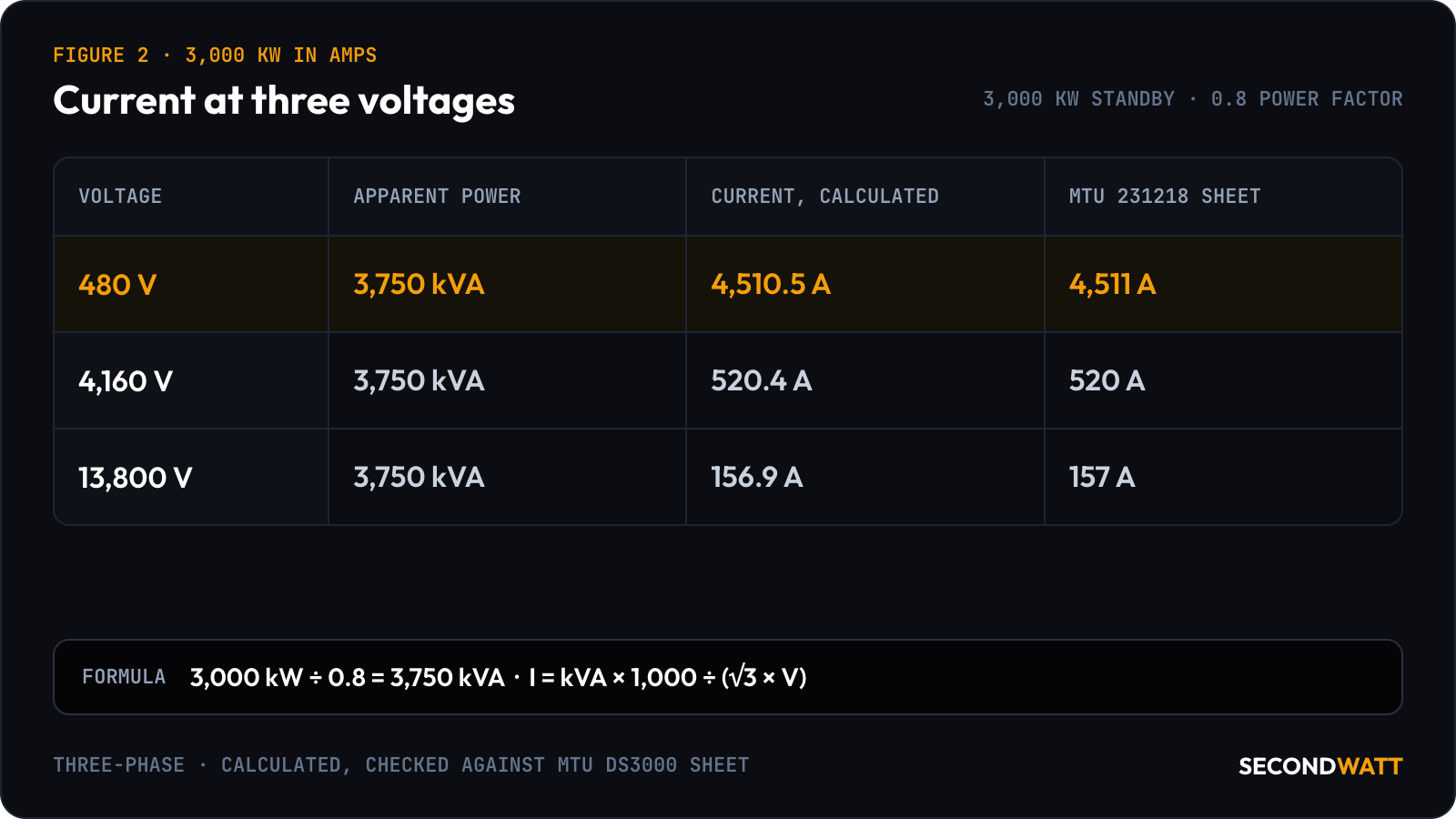
4,511 A — the line current of a set at 3,000 kW standby, 0.8 power factor and 480 V, calculated from I = kVA × 1,000 ÷ (√3 × V).
Fuel use and tank hours#
The 3516E burns 720.4 L/h (190.3 gal/h) at 100% load in the 2,750 ekW standby column of its current 60 Hz sheet, with fan. On Cat's LEHE1351-12, fuel is stated to ISO 3046-1, on fuel of 35° API gravity with a lower heating value of 42,780 kJ/kg. All fuel values refer to rated engine power.
Over 24 hours at full standby load, that is 720.4 × 24 = 17,289.6 L. At 3.78541 L per US gallon, it is 17,289.6 ÷ 3.78541 = about 4,567 gallons.
At 3,000 ekW standby, on the same Cat fuel basis, the C175-16's sheet LEHE1804-12, dated 09/26, lists 784.9 L/h. The 3516E HPD's sheet LEHE2570-06 lists 773.2 L/h. The C175-16 burns 784.9 ÷ 773.2 = 1.015, or 1.5% more, at full load. The mtu DS3250's 844 L/h at 3,250 kWe standby stays out of the comparison, because its sheet 231221, dated 2026-03, states no fuel heating value.
Worked example: run hours of the Cat 3516E (2,750 ekW package) on three tank sizes (illustrative; calculated from LEHE1351-12)#
| Usable fuel | Hours at 100% (190.3 gal/h) | Hours at 75% (145.2 gal/h) | Hours at 50% (106.1 gal/h) |
|---|---|---|---|
| 2,000 gal | 10.5 | 13.8 | 18.9 |
| 5,000 gal | 26.3 | 34.4 | 47.1 |
| 10,000 gal | 52.5 | 68.9 | 94.3 |
Each figure is usable volume divided by the sheet's standby-column fuel rate at that load. The fuel polishing guide covers keeping stored fuel usable.
720.4 L/h — Cat's listed full-load fuel use for the 3516E at 2,750 ekW standby, 60 Hz, or about 4,567 US gallons over 24 hours.
Footprint, weight and enclosures#
Cat's dimensions are for reference only, and mtu's are estimates for an open power unit.
Dimensions and weights of 60 Hz diesel sets rated 2,750–3,250 kW standby, as listed (OEM sheets; not for installation)#
| Set and document | Configuration as listed | Length × width × height | Weight as listed |
|---|---|---|---|
| Cat 3516E, 2,750 ekW (LEHE1351-12) | Package as drawn | 7,015 × 2,558 × 3,163 mm | 18,480 kg dry |
| Cat 3516E HPD, 3,000 ekW (LEHE2570-06) | Package as drawn | 7,678 × 2,874 × 3,639 mm | 20,380 kg dry |
| Cat C175-16, 3,000 ekW with fan (LEHE1804-12) | Package as drawn | 8,182 × 2,983 × 3,410 mm | 22,906 kg dry |
| mtu 20V4000 DS3250 (231221) | Open power unit, 480 V | 7,756 × 3,072 × 3,590 mm | 27,340 kg, estimate |
On Cat's sheets at 3,000 ekW standby, the C175-16 is 504 mm longer than the 3516E HPD (8,182 − 7,678) and 2,526 kg heavier dry (22,906 − 20,380).
The generator docking station explainer covers connection points for temporary sets.
Emissions: emergency or non-emergency#
In the US, 40 CFR part 60 subpart IIII applies to manufacturers, owners, operators and other persons as it specifies for stationary compression-ignition engines. Owners and operators are covered for engines that commence construction after 11 July 2005 and are manufactured after 1 April 2006, other than fire pump engines, which have their own entry. Engines modified or reconstructed after 11 July 2005 are also covered. Under 40 CFR 60.4200, construction commences when the owner or operator orders the engine.
The standards follow maximum engine power, which 40 CFR 1039.140 defines as the maximum brake power point on the engine's nominal power curve. The band for sets this size covers engines above 2,237 kW (3,000 HP) of engine power, not generator output, and under 10 liters per cylinder. The mtu DS3250's 20V4000G94S lists 3,490 kWm maximum, and any set rated 2,500 ekW or more needs more than 2,500 kW at the shaft.
All three engines with published cylinder data sit under 10 liters per cylinder. The 3516E's 170 mm bore and 215 mm stroke give 4.9 L, the C175-16's 175 × 220 mm give 5.3 L, and the 20V4000's 95.4 L over 20 cylinders gives 4.8 L.
In that band, § 60.4202(b) requires manufacturers to certify emergency engines other than fire pump engines to table 1 to subpart IIII for model years 2007–2010. From model year 2011, the standard is Tier 2 in appendix I to part 1039, plus the smoke standards. Under § 60.4205(b), owners must meet the same standards for the engine's model year and maximum engine power. Above 560 kW rated power, appendix I to part 1039 sets Tier 2 at 6.4 g/kW-hr NOx plus NMHC, 3.5 CO and 0.20 PM.
Under § 60.4201(c), manufacturers must certify non-emergency engines in the band, model year 2011 and later, to §§ 1039.101, 1039.102, 1039.104, 1039.105, 1039.107 and 1039.115, as applicable, for the same maximum engine power. Owners comply through § 60.4204(b). 40 CFR 1039.101 holds the Tier 4 standards that apply after the 2014 model year.
Section 60.4208(f) sets an install deadline. After 31 December 2016, owners may not install a non-emergency engine with a maximum engine power of 560 kW or more that misses the 2015 model-year non-emergency requirements.
Subpart IIII sets three criteria for an emergency engine in § 60.4219, and all must be met. It runs during emergencies such as a utility outage, and in limited other circumstances under § 60.4211(f). Outside emergencies, it runs under a financial arrangement with another entity only as § 60.4211(f)(3)(i) allows. It must also comply with § 60.4211(f) to count as emergency.
Under § 60.4211(f), emergency use has no time limit. Maintenance checks and readiness testing get up to 100 hours a calendar year. The tests must be recommended by federal, state or local government, the manufacturer, the vendor, the regional transmission organization or equivalent balancing authority and transmission operator, or the engine's insurer. The owner may petition the Administrator for more maintenance and testing hours; no petition is needed if records show federal, state or local standards require maintenance and testing beyond 100 hours.
Up to 50 of those 100 hours may be non-emergency use. They "cannot be used for peak shaving or non-emergency demand response, or to generate income for a facility to an electric grid or otherwise supply power as part of a financial arrangement with another entity". The one exception lets them supply power under a financial arrangement if all five conditions are met.
The local balancing authority or local transmission and distribution system operator must dispatch the engine. The dispatch must aim to mitigate local transmission or distribution limits so as to avert potential voltage collapse or line overloads that could interrupt power in a local area or region. It must follow reliability, emergency operation or similar protocols that follow specific NERC, regional, state, public utility commission or local standards or guidelines.
The power must go only to the facility itself or to support the local transmission and distribution system. The owner must record the dispatching entity and the specific standards or guidelines followed; the local balancing authority or system operator may keep those records on the owner's behalf.
For the engine to count as emergency, any other operation is prohibited. An engine run outside those limits is not an emergency engine and "must meet all requirements for non-emergency engines".
Cat sheets LEHE1351-12 and LEHE1804-12 list the Tier 2 3516E and C175-16 sets as EPA certified for stationary emergency use only. A C175-16 Tier 4 Final package is also rated 3,000 ekW standby. Cat publication LEXE7582-23, dated March 2026, says it meets Tier 4 Final using the averaging, banking and trading program. The Tier 4 Final guide and 2026 data center diesel guide cover that route.
One 3 MW set or several smaller ones#
As an illustration, take a 12 MW load at N+1 with every set on the same data center rating. Sets rated 3 MW need 12 ÷ 3 + 1 = 5, or 15 MW installed; sets rated 2 MW need 12 ÷ 2 + 1 = 7, or 14 MW installed. The larger sets mean two fewer sets to parallel and 1 MW more installed rating.
In the makers' claims, the Cat 3516E and C175-16 sets accept 100% block load in one step, and the DS3250 accepts rated load in one step per NFPA 110.
Used and rental sets bring their own paperwork. Under § 60.4200(e), a temporary replacement unit on site under a year, properly certified to the applicable nonroad standards, need not meet subpart IIII's other provisions. Under § 60.4209(a), an emergency engine that does not meet non-emergency standards needs a non-resettable hour meter before startup. Under § 60.4208(i), the section's install deadlines do not apply to an engine moved from one existing location to a new one.
The used 2 MW standby checklist sets out inspection steps, and the used 10 MW format guide covers how larger plants are assembled.
FAQ: 3 MW standby generators#
How much fuel does a 3 MW generator use per hour?#
The 3516E burns 549.7 L/h at 75% load and 401.7 L/h at 50% in its 2,750 ekW standby column, with load referred to rated engine power. At its 2,500 ekW prime rating, it burns 649.4 L/h at 100% load, according to Cat's LEHE1351-12. Divide liters by 3.78541 for US gallons: 549.7 L/h is about 145.2 gal/h.
How much does a 3 MW diesel generator cost?#
Capacity-band pricing for generators, built from public sources, is in SecondWatt's pricing index. Its notes put most of the spread on the tier (new OEM, gray market, refurbished or used), with capacity, voltage class and delivery terms adding to it.
How many 3 MW generators does a data center need?#
At 2N, a 12 MW load on 3 MW data center sets needs two complete groups of 12 ÷ 3 = 4 sets. That is 8 sets and 24 MW of rating installed. The redundancy guide compares 2N with N+1.
What is the difference between kW and kVA on a generator?#
kW is real power; kVA is apparent power, and the power factor links them. At 0.8 power factor, the 3516E's 2,750 ekW standby is 3,438 kVA and its 2,500 ekW prime is 3,125 kVA on Cat's sheet.
Are there natural gas generators in the 3 MW class?#
Yes. Cat's LEXE7582-23 lists the G3520 with Fast Response at 2,500 and 3,120 ekW standby, 60 Hz, 1,800 rpm and 0.8 power factor, as EPA factory certified. 40 CFR 60.4230 places stationary spark-ignition engines under subpart JJJJ as it specifies, rather than subpart IIII. The gas engine category holds the dossiers.
Sourcing a 3 MW standby set#
SecondWatt publishes equipment research and helps buyers source power equipment; it earns a fee when a sale it arranges closes. If you are sourcing a 3 MW set, send the rating basis, voltage, emissions use and load profile through a request for quote. Owners with a set to place can read the generator seller page, which sets out how SecondWatt works with owners.