
A steam turbine generator makes electricity from heat it does not produce itself. A boiler or heat recovery steam generator (HRSG) raises high-pressure steam, the steam turbine expands that steam to turn a shaft, and a generator on the shaft produces power. Because the fuel burns elsewhere, the heat can come from natural gas, coal, biomass, process waste or a gas turbine's exhaust.
For a buyer, that separation decides the purchase. A steam turbine has to suit the pressure, temperature, flow and exhaust conditions of the steam it will receive, and a used unit's condition shows in its inspection and outage records. In a combined-cycle plant, the steam turbine sits behind the gas turbines whose exhaust feeds it.
Key Takeaways
- A steam turbine generator runs on heat from a separate source. A boiler or HRSG raises the steam, and the turbine expands it to drive a generator.
- Exhaust pressure separates the main types. In EPA's example (750 psig, 800 °F inlet), a 150 psig exhaust instead of vacuum can give up slightly more than half the power.
- A bottoming cycle adds 50 MW net plant output to GE Vernova's 7E.03. Net plant ratings: 90 MW simple cycle, 140 MW 1x1 combined cycle (ISO, natural gas, 60 Hz).
- Steam turbines are built to their steam conditions. Siemens Energy rates each industrial model by inlet pressure, temperature and exhaust pressure; a used unit must match its new steam source.
- On a used unit, start with the rotor and outage records. GE Vernova lists boresonic and ultrasonic rotor tests, and names valve, blade and seal failures among common combined-cycle findings.
What a steam turbine generator is#
A steam turbine is a prime mover that converts thermal energy in high-pressure steam into rotating power, which can drive a generator. DOE's CHP Technology Fact Sheet on steam turbines, dated January 2025, says the steam most often comes from fired boilers. It can also come from HRSGs that recover waste heat from processes or exhaust.
Section 4 of EPA's CHP catalog, dated March 2015 in a catalog revised September 2017, covers steam turbines. A steam turbine "is captive to a separate heat source and does not directly convert fuel to electric energy," in EPA's description. That separation lets steam turbines use fuels from natural gas to wood waste and bagasse.
Siemens Energy says steam turbines run in fossil-fired steam, nuclear and combined-cycle power stations. Combined heat and power (CHP) users include paper mills, chemical plants, campuses, hospital complexes and district heating systems, according to DOE.
DOE counts more than 530 US sites running steam turbines with boilers for CHP, 25% of installed US CHP capacity or around 20 GW. The figures come from the CHP Installation Database of August 2024 and exclude steam turbines fed by HRSGs in combined-cycle CHP.
How a steam turbine works#
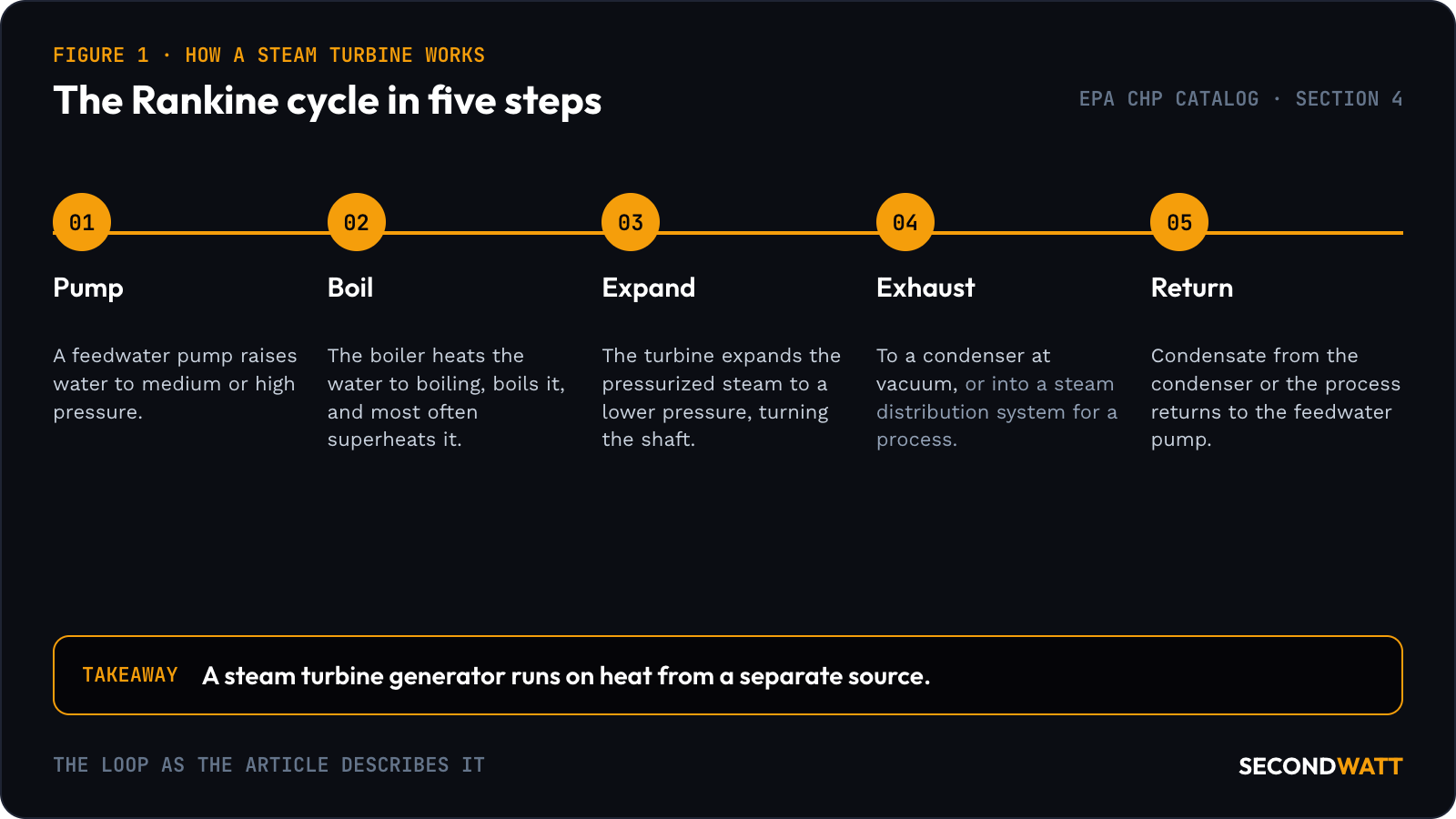
The steam turbine's thermodynamic cycle is the Rankine cycle. EPA's catalog describes the loop:
- A feedwater pump raises water to medium or high pressure.
- The boiler heats the water to boiling, boils it, and most often superheats it.
- The turbine expands the pressurized steam to a lower pressure, turning the shaft.
- The exhaust goes either to a condenser at vacuum or into a steam distribution system for a process.
- Condensate from the condenser or the process returns to the feedwater pump.
Inside the turbine, stationary nozzles accelerate the steam by expanding it to lower pressure. Rotating bladed discs change the steam's direction, which produces torque on the shaft. Torque and speed together are the turbine's output, EPA notes in Section 4.3.2.2. A reduction gear may bring a fast turbine down to generator speed.
Large turbines may add reheat. When steam expands through a very high pressure ratio, it can start to condense, and water drops would erode the blades. The steam is sometimes returned to the boiler, reheated, and sent back for further expansion.
Condensing, back-pressure and extraction turbines#
The main types differ in where the exhaust steam goes, which sets how much power the turbine makes and how much heat it leaves for a process.
Steam turbine types by exhaust destination (EPA CHP catalog section 4, March 2015; DOE fact sheet, January 2025; seller questions added)#
| Type | Where the exhaust steam goes | Typical use | Question for the seller |
|---|---|---|---|
| Condensing | To a condenser held at vacuum | Power-only utility plants | What condenser pressure and cooling source was it designed for? |
| Back-pressure (non-condensing) | To process or facility steam mains, at atmospheric pressure or above | Industrial CHP; district heating; in parallel with a pressure-reducing valve | What exhaust pressure was it built for, and does the new process need that pressure? |
| Extraction | Part bled at an intermediate pressure; the rest to a condenser or a low-pressure user | CHP with varying steam demand; feedwater heating in utility plants | Is the extraction controlled, and at what pressure and flow? |
| Admission | Extra steam admitted into the casing to add to the steam path flow | Plants with several boilers at different pressures | What admission pressures and flows does it accept? |
| Reheat | Partly expanded steam returns to the boiler for reheating, then re-enters | Large industrial and utility units | Does the new steam source have a reheat section to match? |
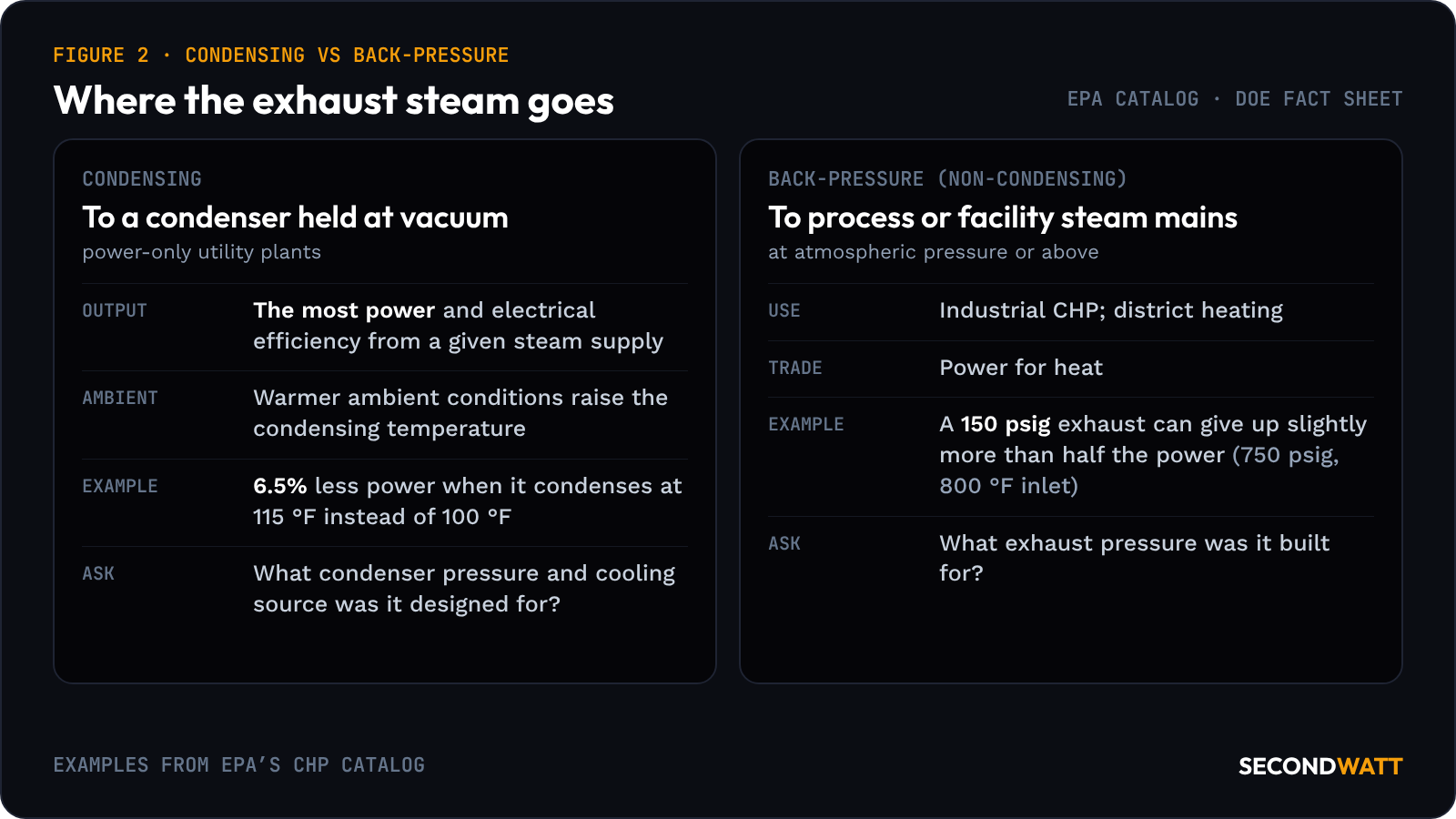
A condensing turbine gives the most power and electrical efficiency from a given steam supply and boiler fuel. Its output is sensitive to ambient conditions, EPA notes in Section 4.3.2.3, because warmer ambient conditions raise the condensing temperature.
6.5% — the power a condensing steam turbine loses from the same inlet steam when it condenses at 115 °F instead of 100 °F, in EPA's CHP catalog example.
A back-pressure turbine trades power for heat. Section 4.3.2.4 of EPA's catalog gives an example with inlet steam at 750 psig and 800 °F. Discharging into a distribution system at 150 psig can sacrifice slightly more than half the power a vacuum exhaust would give. DOE lists 50, 150 and 250 psig as the most typical distribution pressures: the lower ones most often for district heating, the higher ones for industrial processes.
EPA's Section 4.3.2.5 notes that controlled extraction lets more steam flow through an extraction turbine to make more electricity when the CHP site's heat demand is low. Between a condensing and a back-pressure turbine, EPA says essentially any ratio of power to heat can be supplied.
How steam turbines are rated#
A steam turbine is specified by its steam as much as by its output. The ratings that matter are inlet pressure and temperature, exhaust pressure, any extraction pressures and flows, output, and speed. Siemens Energy publishes output, speed, inlet conditions and exhaust pressures for each industrial model, shown below as vendor data.
Siemens Energy industrial steam turbines: vendor ratings (Siemens Energy industrial steam turbines page)#
| Model | Power output | Speed | Inlet pressure and temperature | Exhaust pressure, back-pressure | Exhaust pressure, condensing |
|---|---|---|---|---|---|
| SST-200 | Up to 25 MW output | Up to 13,500 rpm | 120 bar(a); 540 °C | 20 bar(a) | 0.7 bar(a) |
| SST-300 | Up to 60 MW output | Up to 12,000 rpm | 140 bar(a); 540 °C | 20 bar(a) | 0.7 bar(a) |
| SST-400 | Up to 65 MW output | Up to 7,100 rpm | 140 bar(a); 540 °C | 25 bar(a) | 0.5 bar(a) |
| SST-500 | Up to 150 MW output | 3,000/3,600, up to 15,000 rpm | 30 bar(a); 400 °C | Up to 3.0 bar(a) | 0.7 bar(a) |
| SST-600 | Up to 200 MW output | 3,000/3,600, up to 18,000 rpm | 165 bar(a); 565 °C | 72 bar(a) | Up to 1.2 bar(a) |
| SST-800 | Up to 250 MW output | 3,000/3,600, up to 7,100 rpm | 165 bar(a); 565 °C | 72 bar(a) | Up to 1.2 bar(a) |
The same industrial steam turbines page gives an overall industrial inlet range of 103 to 160 bar(a) and 400 to 565 °C, while the SST-600 and SST-800 entries list 165 bar(a). Ask the seller for the unit's own design conditions.
Steam flow ties the ratings together. In DOE's representative 3 MW output back-pressure example, 114,000 lb/h of steam enters at 650 psig and 650 °F and exhausts at 150 psig. That is 38 lb of steam per kWh (114,000 ÷ 3,000 kW output), with 140 MMBtu/h of useful heat: 13.7 times the 10.2 MMBtu/h of power (3 MW output × 3.412). DOE says the example is not a specific product.
Utility units run at higher conditions. On Siemens Energy's utility steam turbine page, the SST-3000 series covers 90 to 275 MW output at 50 or 60 Hz, with inlet pressure up to 177 bar. The SST-6000 series covers 300 to 1,200 MW output, also at 50 or 60 Hz. Table 4-1 of EPA's catalog shows utility steam turbines operating with inlet pressures up to 3,500 psig and exhaust as low as 2 psia.
A steam turbine often goes into a system that already exists, and Section 4.4.2 of EPA's catalog notes that the turbine "must be properly matched to these conditions." Section 4.4.3 adds that turbines are made in finite size steps. One used at the upper end of its power range costs less per kW generated than one used at the lower end.
Steam turbines in combined-cycle and CHP plants#
In a combined-cycle plant, a gas turbine's exhaust raises steam in an HRSG, and a steam turbine turns that steam into more power. Mitsubishi Power defines the gas turbine combined-cycle plant as one in which a steam turbine is used in the bottoming cycle.
GE Vernova's 7E fact sheet GEA35773, dated 05/2025, publishes both cycles for its 7E.03 on one basis: net plant, at ISO conditions on natural gas, 60 Hz. The 7E.03 rates 90 MW net output in simple cycle, 140 MW net output in a 1x1 combined cycle and 283 MW net output in a 2x1. GE Vernova's 7E page lists Frame 7E and 7EA among the model's former names.
Worked example, the output a bottoming cycle adds on GE Vernova's net plant ratings:
1x1: 140 − 90 = 50 MW net, or 50 ÷ 140 = 35.7% of plant output.
2x1: 283 − (2 × 90) = 103 MW net, or 51.5 MW per gas turbine and 103 ÷ 283 = 36.4% of plant output.
50 MW — the net plant output a 1x1 combined cycle adds to GE Vernova's 7E.03, from 90 MW simple cycle to 140 MW, at ISO conditions on natural gas, 60 Hz.
The 50 MW is a net plant gain from adding the HRSG and steam turbine. It is not the steam turbine's nameplate, which GE Vernova's sheet does not give. The HRSG guide works through the fuel side of the same ratings.
Basis matters when a seller quotes such figures. Siemens Energy's table rates the SGT6-5000F 1x1 combined cycle (SCC6-5000F, 260 MW version) at 398 MW gross plant output and 60.5% gross plant efficiency. The text of Siemens Energy's SGT6-5000F page gives 387 MW and 59.6% efficiency for the same 1x1 version, with no net or gross label. Ask which figure applies, and whether it is net or gross.
CHP plants use the steam differently. DOE's fact sheet says CHP configurations use back-pressure or extraction turbines, and a turbine can do the job of a pressure-reducing valve while generating electricity. Combined-cycle CHP can use a condensing or back-pressure steam turbine, with or without steam extraction, per Siemens Energy's SGT6-5000F page. The simple-cycle vs combined-cycle comparison and the heat rate guide cover the cycle choice.
The generator side#
The DOE fact sheet notes that steam turbines can drive induction or synchronous generators. A synchronous generator can run independently of the grid and keep operating through a utility outage; an induction generator needs an external source of electricity. Induction generators are typically used with steam turbines under 1 MW of output, and synchronous generators more often with larger ones.
Cooling and size go together. GE Vernova's air-cooled generators reach 260 MVA at up to 19 kV, and its hydrogen-cooled units 710 MVA at up to 26 kV. Both figures are for 60 Hz at 0.8 power factor. GE Vernova offers water cooling where output exceeds what air or hydrogen cooling can handle.
Excitation is a second choice. On Siemens Energy's air-cooled generator page, the SGen-100A series spans 25 to 370 MVA and 6.3 to 15.75 kV. For its SGen-1000A series (180 to 370 MVA), the same page offers a rotating brushless exciter or static excitation through collector rings.
The generator's voltage and MVA set the electrical package that follows. The GSU transformer guide covers the step-up transformer, with a GSU dossier for one product line, and the generator circuit breaker guide covers the breaker between them.
What to check on a used steam turbine#
A used steam turbine's condition sits inside a closed casing, so the records carry the evidence.
Records and tests to request on a used steam turbine (GE Vernova, Siemens Energy and EPRI documents as cited in the text)#
| Component | Record or test to ask for | Why it matters |
|---|---|---|
| Rotor | Boresonic inspection on older bored rotors; periphery ultrasonic testing on solid rotors | Looks for deterioration from the bore outward, or at the rotor surface; boresonic results feed remaining-life assessment |
| Wheels and blade attachments | Phased array wheel dovetail tests; wheelsonic tests on built-up low-pressure rotors; finger dovetail NDT and borescope | Looks for stress corrosion cracking in time to repair the wheel before a bucket is released |
| Blades and steam path | Last outage findings on blade erosion and seals; steam path performance trends | GE Vernova lists blade and seal failures among common findings, and ties cycling to droplet erosion of rotor blades |
| Casings and joints | Findings on shell creep, shell cracking and steam leaks at bolted joints | GE Vernova links shell creep and cracking to its fleet's age, and lists bolted-joint leaks as an uncommon finding |
| Stop and control valves | Valve inspection and repair records; checks of safety and protection equipment | GE Vernova lists valve failures among common findings and calls stop and control valve reliability critical to safe operation |
| Bearings and oil systems | Bearing vibration trends; lube and control oil analysis | Trends can flag developing problems before an outage opens the machine |
| Overhaul history | Last major overhaul report, equivalent operating hours since, and any suggested actions not carried out | Shows how far the unit is from its next casing opening |
| Generator | Partial discharge monitoring records; rotor-in inspection results | Lets the owner plan generator maintenance without removing the rotor |
GE Vernova's steam turbine outage services page describes three tests. Boresonic inspection of older bored rotors looks for deterioration "from the inside to the outside," periphery ultrasonic testing covers solid rotors, and phased array wheel dovetail testing looks for stress corrosion cracking. A November 1999 EPRI document, TE-114462, notes that boresonic inspection and evaluation have served as primary components of rotor remaining-life assessment.
On its steam turbine services page, GE Vernova reports that its combined-cycle steam turbine fleet averages 21 years old. It says owners at that age are likely to see shell creep, shell cracking or rotor bow. Its common combined-cycle findings include valve failures, water induction, lube oil loss after a power loss, and blade and seal failures. Steam leaks at bolted joints and valves are listed as uncommon.
GE Vernova's TEAMS Lite inspections, which can run with the unit online, may include vibration analysis, lubricating and control oil systems analysis and component condition assessment. GE Vernova's 2024 TEAMS fact sheet says a TEAMS Base inspection should follow directly after a major inspection to set a performance baseline.
For its industrial steam turbines, Siemens Energy's major overhaul examines the turbine dismantled with the casing open; its inspection, which checks the monitoring, safety and protection equipment, and its minor overhaul do not require opening the casing. Siemens Energy's maintenance and overhaul page says its FlexLTP monitoring can avoid opening the turbine at 50,000 equivalent operating hours (EOH), with no full overhaul within 100,000 EOH (up to 12 years).
GE Vernova designs its generators for borescopic and robotic rotor-in inspections and offers online partial discharge monitoring. EPA's installation guidance applies when a unit moves: the turbine and generator package is heavy and must be mounted carefully on a suitable pedestal or baseplate. Its high-pressure steam pipes typically swing 750 °F between cold standby and full power, EPA notes in Section 4.4.3. The installation must accommodate that expansion to minimize stress on the casing.
The relocation scope guide covers transport and recommissioning, and the seller's documentation guide lists the records buyers ask owners for.
FAQ: steam turbine generators#
What is the difference between a gas turbine and a steam turbine?#
Where the fuel burns: a steam turbine's fuel burns in a separate boiler, unlike a gas turbine's, as Section 4.3.2.1 of EPA's catalog explains. The internal flow passages are very similar to a gas turbine's expansion section; there, the differences lie in the two fluids' properties, such as density.
Section 4.4.1 of EPA's catalog says large steam turbines can take over ten hours to warm up because their thick casings must heat slowly. Gas turbines can start in a moderate amount of time. The aeroderivative vs industrial gas turbine guide covers the gas turbine side.
How efficient is a steam turbine?#
Turbine efficiency measures how well the turbine extracts work from the steam: EPA gives 65% for very small multistage units, under 1,000 kW of output, and over 90% for large industrial and utility units. Small single-stage turbines can be as low as 40%.
Electrical efficiency measures power against the fuel burned in the boiler. EPA puts large central station boilers and steam turbines at up to 45% HHV, with a field average around 33%. Siemens Energy lists 46.5% for its SST-6000 series, or 48% with double reheat, without stating the basis.
How long do steam turbines last?#
For decades, though the sources differ. EPA states that operational life often exceeds 50 years. GE Vernova states that steam turbines typically have a 30+ year lifespan, depending on operational history, and offers steam path and casing upgrades to extend it.
When is a single-stage steam turbine used?#
Generally at outputs up to 3 MW, according to DOE. Single-stage turbines are less complex and have lower capital costs. Multistage turbines reach higher isentropic efficiencies and can produce more power from the same high-pressure steam.
Valve count is a separate choice. DOE puts single-valve turbines at outputs up to 10–15 MW, with multi-valve turbines more common above that.
What sizes do steam turbines come in?#
CHP steam turbines run from under 100 kW to over 250 MW of output, per DOE. Siemens Energy offers industrial units from 2 to 250 MW output and utility units from 90 to 1,900 MW, plus Dresser-Rand turbines rated from under 10 kW to 25 MW. Mitsubishi Power sorts its thermal plant turbines into output classes up to 250 MW and up to 1,200 MW.
Sourcing a steam turbine#
SecondWatt publishes equipment research and helps buyers source power equipment; it earns a fee when a sale it arranges closes. Buyers can request equipment with the steam conditions, output and records they need, and owners selling a steam turbine generator can start at sell equipment.