
ANSI device numbers are the function numbers printed beside relays, breakers and switches on a one-line diagram. Each number names what a device does, such as interrupting a circuit, sensing overcurrent or comparing currents for a differential trip. The numbers come from IEEE C37.2, and letters after a number narrow the function to a piece of equipment or a measured quantity.
For a buyer or seller of a generator, a paralleling lineup or medium-voltage switchgear, the numbers show what protection the drawing calls for. They do not show how that protection is set or whether it was tested. Those answers sit in the relay settings files and test records, so a used lineup is judged on its records as much as on its one-line.
Key Takeaways
- IEEE C37.2 is the source of the numbers. Its 2022 edition assigns 95 numbers and 22 acronyms, defines how prefixes and suffixes are used and covers contact designations.
- Suffix letters follow the maker's legend. GE Vernova's G60 labels restricted ground fault 87G, while ABB's REG615 uses 87G for generator differential protection.
- Generator relays carry machine functions. GE's G60, Beckwith's M-3425A and ABB's REG615 all list power direction (32), field or excitation (40) and unbalance or negative sequence (46), ABB with suffixes.
- The ordered package decides which numbers a relay has. Beckwith's M-3425A base package covers 11 of 15 generator numbers counted here; a larger package and options add four.
- Records show what the protection does. The one-line names the functions; the settings files and test reports show how each one is set and when it was last tested.
What ANSI device numbers are#
ANSI device numbers, also called ANSI relay numbers, are defined in IEEE C37.2-2022. Its full title is the IEEE Standard for Electrical Power System Device Function Numbers, Acronyms, and Contact Designations. It covers devices and functions "used in electrical substations and generating plants and in installations of power utilization and conversion apparatus." Published on 14 Dec 2022 and listed as active by IEEE SA, it assigns 95 numbers and 22 acronyms.
95 — function numbers assigned in IEEE C37.2-2022, which also assigns 22 function acronyms.
The 2022 edition superseded C37.2-2008. IEEE's summary lists function numbers or acronyms in it for arc flash detection, digital fault recorders, phasor measurement units and trip circuit monitors. The 1996 edition assigned 94 numbers; the 2008 and 2022 editions assign 95.
The 1996 edition carried ANSI approval: IEEE's page for C37.2-1996 records it on 15 May 1997. Relay makers still use the label, as in the "ANSI Device Numbers & Functions" heading of GE's G60 generator relay brochure.
The standard itself is a paid document, so the definitions quoted here come from Appendix B of FIST 3-8, the US Bureau of Reclamation's relay maintenance manual. The manual is dated May 2011, with minor revisions on 27 Sep 2021. Reclamation states the numbers are incorporated in C37.2-2008. Devices in control and switching equipment "are referred to by numbers, with appropriate suffix letters when necessary, according to the functions they perform."
How to read a device number#
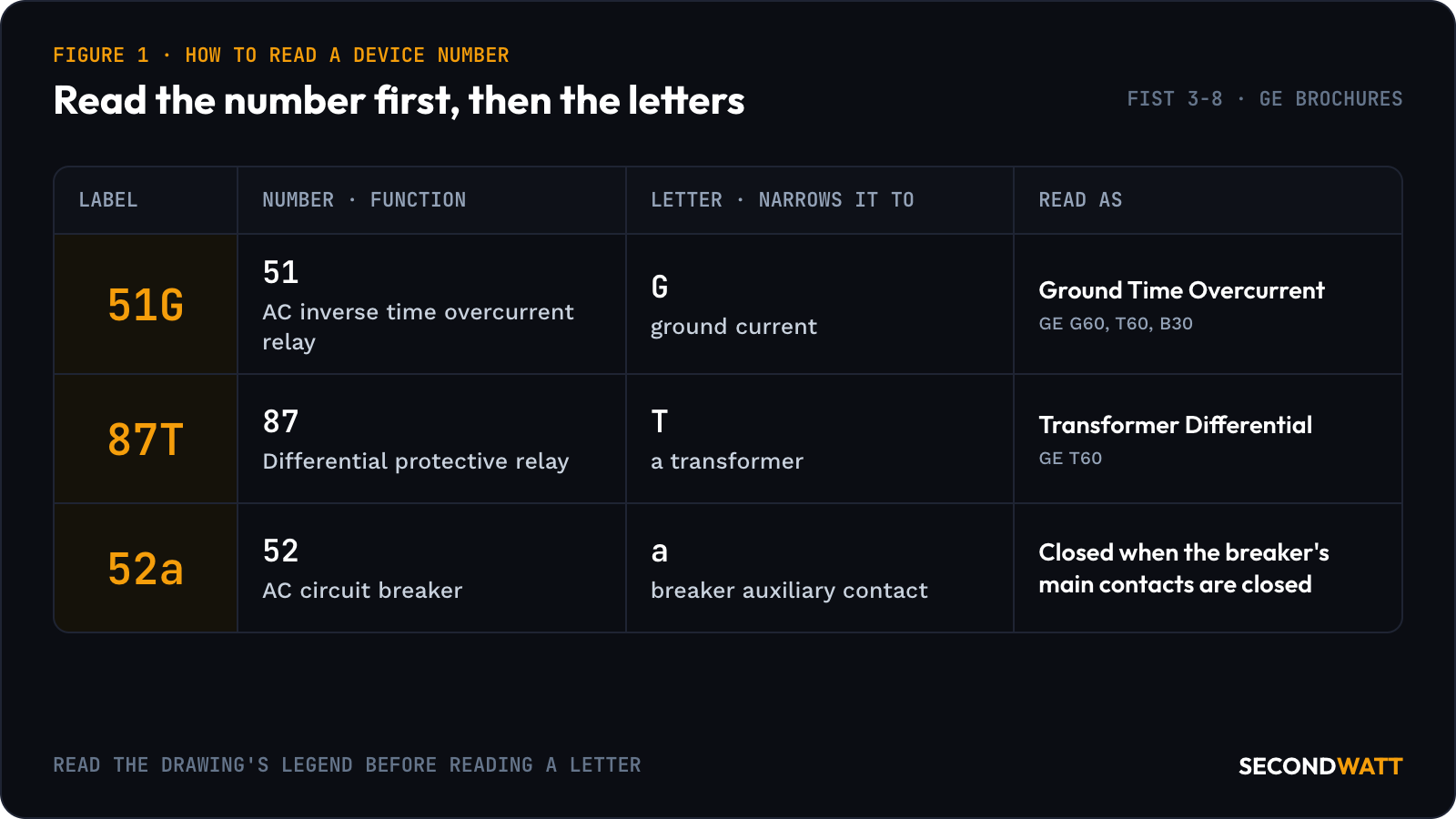
Read the number first. It names the function, and the letters come next. In IEEE's summary of C37.2, "the use of prefixes and suffixes to provide a more specific definition of a function is defined." Relay makers apply them in their own tables. GE Vernova's Multilin brochures use P for phase, N for neutral and G for ground, as in 50P, 50N and 50G.
Device labels as three GE Vernova Multilin brochures print them (G60 GEA-12587G, T60 GEA-12650H, B30 GEA-12748A; © 2013)#
| Label on the drawing | Function name in the OEM table | Relay brochure |
|---|---|---|
| 51G | Ground Time Overcurrent | G60, T60, B30 |
| 87T | Transformer Differential | T60 |
| 87B | Restrained Bus Differential | B30 |
| 87S | Generator Stator Differential | G60 |
| 87G | Restricted Ground Fault | G60, T60 |
| 50/27 | Accidental Energization | G60 |
| 50BF | Breaker Failure | G60, T60 |
The same letter can mean different things from one maker to the next. GE's G60 brochure uses 87G for restricted ground fault, "also known as zero-sequence differential." Beckwith's M-3425A specification labels ground (zero sequence) differential 87GD. ABB's REG615 bulletin uses 87G, in standard configuration D, for "Stabilized and instantaneous differential protection for machines."
Read the drawing's legend before reading a letter. In Reclamation's Appendix B, every function of multifunction device 11 "shall be defined in the drawing legend, device function definition list, or relay-setting record." Where a device performs only two important functions, the text prefers both numbers. GE's G60 lists 50/27 for accidental energization, joining the numbers for instantaneous overcurrent and undervoltage.
Contact designations add a letter after 52: Reclamation writes 52A and 52B, and Beckwith writes 52b. Reclamation's glossary states that the 52A contact "is an auxiliary contact in the breaker, and the 'A' indicates that the contact follows the main contact position of the breaker."
Three worked readings follow from those sources. In GE's tables, 51G is a time overcurrent function on ground current, named "Ground Time Overcurrent." In GE's T60 brochure, 87T is a differential function on a transformer, named "Transformer Differential." 52a is the breaker auxiliary contact that is closed when the breaker's main contacts are closed.
Generator protection functions#
Generator protection is the subject of IEEE C37.102-2023. IEEE SA lists the guide as active and says it helps protection engineers apply relays to protect generators "from damage caused by internal electrical faults, system faults, or abnormal operating conditions." GE states the G60 is "compliant with IEEE C37.102." Beckwith states the M-3425A "Exceeds IEEE C37.102 and Standard 242 requirements for generator protection."
The table lists the functions a buyer meets on a generator one-line. Each row has a label in both relay documents.
Generator protection functions in two OEM relay documents (GE G60 brochure GEA-12587G, © 2013; Beckwith M-3425A specification Rev-19, 08/24)#
| Number | Function in Reclamation FIST 3-8 Appendix B (C37.2-2008 basis) | What it responds to on a generator | GE G60 label | Beckwith M-3425A label |
|---|---|---|---|---|
| 24 | Volts per hertz relay | Voltage-to-frequency ratio above a preset value, or below a different one | Volts Per Hertz | Overexcitation (V/Hz) |
| 25 | Synchronizing or synchronism-check device | Two AC circuits within limits of frequency, phase angle or voltage before paralleling | Synchronism Check | Sync Check (larger package) |
| 27 | Undervoltage relay | A given value of undervoltage | Phase Undervoltage (27P) | Phase Undervoltage |
| 32 | Directional power relay | Generator motoring; GE uses it "to protect the prime mover from damage" | Sensitive Directional Power | Reverse Power, Low Forward Power or Overpower |
| 40 | Field relay | Low or failed field current, or excess reactive armature current showing low excitation | Loss of Field Relay | Loss of Field |
| 46 | Reverse-phase or phase-balance current relay | Reverse phase sequence, unbalanced currents, or negative-sequence current above a set amount | Generator Unbalance | Negative Sequence Overcurrent |
| 49 | Machine or transformer thermal relay | Winding temperature in Appendix B; Beckwith's 49 works on positive-sequence overcurrent | Thermal Overload | Stator Overload (larger package) |
| 50, 51, 51V | Instantaneous and AC inverse time overcurrent relays | Excessive current; 51V adds voltage restraint or control | 50P, 51P, 51PV | 50, 51V |
| 59, 59N | Overvoltage relay | Input voltage above a set value; N on the neutral | 59P, 59N | 59, 59N |
| 64 | Ground protective relay | Insulation failure to ground | 64F field, 64S and 64TN stator | 64F field ground, 64B brush lift-off, 64S stator (options) |
| 78 | Phase-angle measuring relay | Out-of-step: GE trips "when an unstable power swing is detected" | Out-of-Step | Out-of-Step (larger package) |
| 81 | Frequency relay | Under, over or rate-of-change of frequency | 81O, 81U, 81R | 81; 81R, 81A (larger package) |
| 87 | Differential protective relay | Stator phase faults | Generator Stator Differential (87S) | Phase Differential Current (87) |
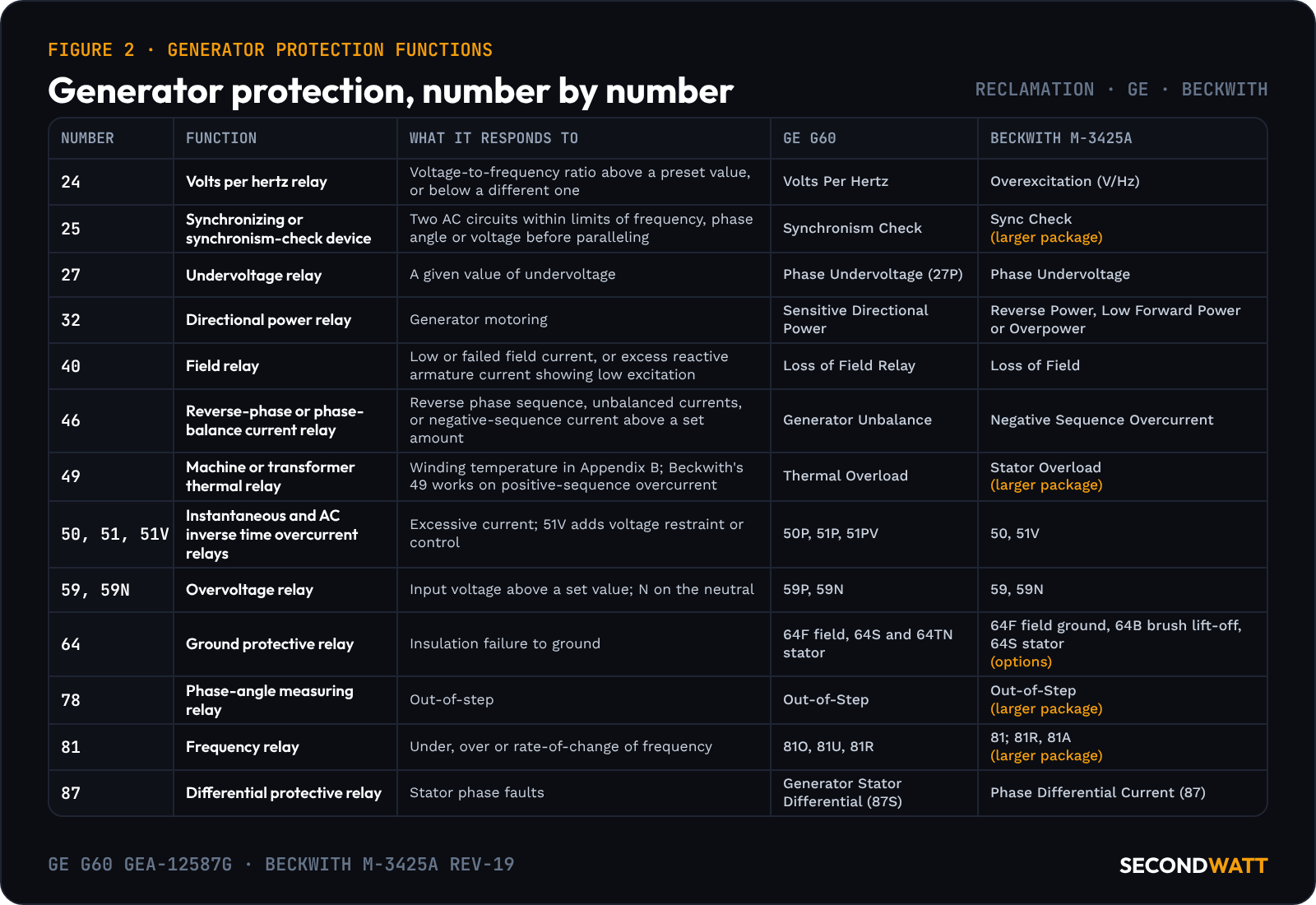
The same protection can carry different labels. GE marks stator differential 87S, and Beckwith marks it 87.
Reclamation's Appendix B notes that C37.2-2008 lists the out-of-step relay as device 68. Beckwith's M-3425A specification still labels out-of-step tripping 78. The G60 does too, and lists power swing blocking as 68.
ABB's REG615 bulletin carries the same machine numbers with its own suffixes: 32R and 32U for reverse and under power, 40 for underexcitation and 46M for machine negative-sequence overcurrent. Both GE and Beckwith also list inadvertent or accidental energization (50/27) and breaker failure (50BF). For breaker failure, if a trip command does not clear the fault, GE's element "can be used to send trip signals to upstream breakers." The generator circuit breaker article covers that breaker in detail.
Transformer and feeder functions#
Transformer protection has its own guide, IEEE C37.91-2021. Its IEEE SA page says it covers three-phase power transformers "of more than 5 MVA rated capacity and operating at voltages exceeding 10 kV." In some cases, it notes, a user may apply the techniques below 5 MVA or 10 kV. GE states the T60 is "compliant with IEEE C37.91."
The T60 table lists 87T transformer differential, 87G restricted ground fault, 24 volts per hertz and 49 thermal overload. Three general-purpose numbers in Reclamation's Appendix B cover pressure, liquid level and temperature. Device 63 is a pressure switch that operates "on given pressure values or on a given rate of change of pressure." Device 71 is a liquid level switch, and device 26 is an apparatus thermal device that can act on a liquid's temperature.
In Appendix B, device 49 names the transformer directly, covering the temperature of a "power transformer." The same reading applies to a generator step-up transformer such as the GE Prolec GSU, and to pad-mount transformers.
Feeders carry the overcurrent family. For the F60 feeder relay, GE brochure GEA-12595F lists phase, neutral and ground versions of 50 and 51. It also lists 67P and 67N directional overcurrent, 79 automatic recloser and 52 AC circuit breaker. Reclamation's Appendix B defines 67 as a relay that "functions on a desired value of ac overcurrent flowing in a predetermined direction."
Buses use differential protection. For the B30, GE brochure GEA-12748A lists 87B restrained bus differential, 50/87 unrestrained bus differential and 50/74 CT trouble. The same feeder and bus numbers apply on medium-voltage and low-voltage switchgear. Lineups such as the Eaton VacClad-W, Powell PowlVac and ABB UniGear ZS1 are read the same way.
Paralleling and transfer functions#
Genset and paralleling controls print their own protection lists, which are vendor statements. Caterpillar's EMCP 4.4 control panel page lists 27/59 over/under voltage, 81 o/u frequency and 32 reverse power. It adds 32RV reverse reactive power, 50/51 overcurrent and 46 current balance. Generator and bus phase sequence also appear; device numbers 40, 87 and 25 are not on that list.
Cat's page treats the Master Control Panel as a separate compatible product, beside the EMCP 4.4 with XLM and EGP switchgear stack. None of the GE, Beckwith or ABB relay documents cited here uses Cat's 32RV label.
The ASCO 7000 Series power control systems "synchronize and connect multiple power sources after comparing voltage, frequency, and phase angle," in ASCO's words. Its 2023 R2 brochure lists protective relays among the devices operators manage. ASCO states the systems parallel up to 32 generators.
Cummins describes the PowerCommand DMC8000 as "a completely customizable power system paralleling control" controlling an unlimited number of gensets, utilities and loads. The paralleling switchgear article covers the lineups themselves.
Transfer equipment has a number of its own. In Appendix B, device 83 is an automatic selective control or transfer relay. It selects automatically between certain sources or conditions in equipment, or performs a transfer operation automatically. The automatic transfer switch sizing guide and the ATS pages cover that equipment.
The 86 lockout relay and breaker 52#
In Reclamation's Appendix B, device 52 is an AC circuit breaker that closes and interrupts an AC power circuit "under normal conditions or to interrupt this circuit under fault or emergency conditions." On a one-line, protective functions trip it, either directly or through a lockout relay.
Reclamation's lockout test describes the chain. A protective relay action trips the lockout relay, and the lockout trips the circuit breakers or other protective devices.
Lockout relays are among the most important devices in a facility, according to Reclamation. A lockout relay failing to trip protective breakers "is known to be the root cause of several large powerplant incidents." Reclamation's standard designs monitor the lockout coil and the breaker trip coil. They use red lights or relay trip-circuit monitoring.
15 years — the age past which Reclamation recommends considering replacement of lockout relays, because constant torque can twist or bind their shafts.
Multifunction relays can take over part of this role. GE states the G60's mechanically latching outputs "can be used to develop secure interlocking applications and replace electromechanical lockout relays."
ABB's REG615 table shows "Master trip" (86/94) in both generator configurations, with three included instances. Its footnote says master trip "is included and connected to the corresponding HSO in the configuration only when the BIO0007 module is used." Device 94 is a tripping or trip-free relay in Reclamation's Appendix B.
Multifunction relays and settings#
A modern multifunction protective relay provides many numbered functions in one box. A microprocessor relay "can take the place of several electromechanical or solid-state relays," Reclamation notes. Its software settings "do not drift with time." It also warns that removing one from service "will remove all its protective functions."
The drawing shows the functions, and the ordered package and the settings file decide which of them exist and how they act.
The Beckwith M-3425A shows the effect. Count 15 numbers from the generator table: 24, 25, 27, 32, 40, 46, 49, 50, 51V, 59, 59N, 64, 78, 81 and 87. The base package covers 11 of them.
Worked example, from the M-3425A specification. The larger Comprehensive package adds 25, 49 and 78: 11 + 3 = 14. The 64F/64B field ground or 64S stator ground option adds 64: 14 + 1 = 15. A used M-3425A therefore needs its order code read before its one-line is trusted.
The settings come from engineering studies. Reclamation states that relays "are calibrated with settings derived from system fault and load studies." For its own plants, it requires fault and load studies and relay settings to be evaluated on a 5-year cycle, and new settings go on a relay setting change form.
Testing is the other record. ANSI/NETA ATS-2025 covers acceptance testing for "the suitability for initial energization of electrical power equipment and systems." ANSI/NETA MTS-2023 covers maintenance testing for "suitability for continued service." The switchgear maintenance field guide covers practice.
On a used lineup, ask for six records before trusting the one-line.
Records to request for a used protected lineup (Reclamation FIST 3-8; Beckwith M-3425A-SP Rev-19; ANSI/NETA ATS-2025 and MTS-2023)#
| Record | What it shows | Why, from the sources above |
|---|---|---|
| As-built one-line with its legend | The functions the drawing calls for, and what each letter means on that drawing | Appendix B puts multifunction definitions in the legend, definition list or relay-setting record |
| Each relay's model and order code | Which numbers the relay actually has | The M-3425A base package covers 11 of the 15 generator numbers |
| Settings files and setting change forms | How each function is set | Reclamation derives settings from fault and load studies and documents changes on a form |
| Fault, load and coordination studies | Why the settings are what they are | Reclamation evaluates its studies and settings on a 5-year cycle |
| Acceptance and latest maintenance test reports | Whether the protection operated when tested | NETA ATS-2025 covers initial energization; MTS-2023 covers continued service |
| Lockout relay age and trip-circuit monitoring | Whether the trip chain is sound | Reclamation recommends considering replacement past 15 years and monitors the trip coils |
The used medium-voltage switchgear guide covers how settings are reviewed against a new site.
FAQ: ANSI device numbers#
What does ANSI 50/51 mean?#
It means instantaneous and time overcurrent protection in one label. In Reclamation's Appendix B, device 50 "functions instantaneously on an excessive value of current or on an excessive rate of current rise." Device 51, an AC inverse time overcurrent relay, has "either a definite or inverse time characteristic" there. In GE Vernova's tables, 50N/51N act on neutral current and 50G/51G on ground current.
What is an 86 lockout relay?#
Appendix B of Reclamation's FIST 3-8 defines device 86 as one that "trips and maintains associated equipment or devices as inoperative until it is reset by an operator, either locally or remotely." Arteche's ANSI 86 lockout relay page states that the relays "hold out for a reset (hand or electrical reset) before allow any other trip command."
What do 52a and 52b mean?#
Both are breaker auxiliary contacts, and 52b is the mirror of 52a: the "B" contact is "opposite of the main contact position of the breaker," in Reclamation's glossary. Relays read them for breaker status. On the M-3425A, the breaker-closed LED lights "when the 52b contact input is open."
What does device 25 do?#
It covers both the device that brings two circuits together and the one that checks them first. Reclamation's Appendix B definition includes devices that "permit or to cause" paralleling, so a synchronizer and a check relay share the number. GE states the G60's synchronism check can work "as an independent check of the synchronizer prior to closing the generator breaker."
What is the IEC equivalent of ANSI device numbers?#
Some relay documents print an IEC 61850 function name beside each ANSI number. ABB's REG615 ANSI descriptive bulletin lists PHLPTOC beside 51P, PHIPTOC beside 50P, UEXPDIS beside 40, SECRSYN beside 25 and TRPPTRC beside 86/94.
Buying or selling a protected lineup#
SecondWatt publishes equipment research and helps buyers source power equipment; it earns a fee when a sale it arranges closes. Buyers who need a generator lineup or switchgear with its protection documented can request equipment and list the one-line, relay models and records they need. Owners of a lineup with its settings files and test reports can sell switchgear.