Cummins PowerCommand DMC2000/6000/8000 digital master control
Manufacturer: Cummins
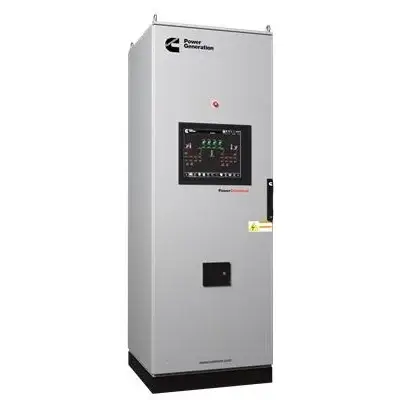
Cummins PowerCommand DMC digital master controls, the paralleling brains behind Cummins standby plants
This model is part of SecondWatt’s switchgear research catalogue. Specifications and price observations are included where supported by sources. Equipment availability and commercial terms require confirmation.
Cummins PowerCommand DMC dossier: DMC2000/6000/8000 digital master controls for generator paralleling switchgear, plus a used-plant inspection checklist.
The Cummins products in this stack are the PowerCommand DMC series digital master controls, DMC2000, DMC6000 and DMC8000, which coordinate multi-generator paralleling, synchronizing, load add and shed, and utility interface for Cummins standby and prime plants, with HMI-driven operation and integration into the genset-mounted PowerCommand controls. The string 'PCS DMC' that appears in some references is not a Cummins designation.
DMC8000 is the flagship of the family and the unit with published product presence; smaller DMC tiers serve simpler plants. Like every OEM paralleling stack in this category, the controls carry a 15-20 year practical life against 30-plus year switchgear iron, so the DMC generation is the first thing to check on any used Cummins plant.
Buyers acquiring used Cummins power plants should budget controls retrofit unless the DMC generation is current and program backups exist.
Why it matters
Cummins is one of the two largest standby genset fleets in critical facilities, and its master controls decide whether a used plant restarts as a system or a pile of engines. Searching distributor inventory by the DMC tier number is what turns up stock, and controls vintage drives the entire recommissioning budget.
Who buys it
Data centers, hospitals, and industrial plants standardized on Cummins gensets buy DMC controls with their paralleling switchgear through Cummins distributors. Used-plant buyers inherit them and need program files, settings, and distributor support confirmed before commissioning.
Role in the data center
Master paralleling control for Cummins standby plants, sequencing generator start, synchronizing and load pickup behind the critical bus. It is the layer that decides whether a multi-engine plant meets its start-to-load window, and in a Cummins-standardized facility it is also the integration point to the building management and power monitoring systems.
Key specifications
| Product family | DMC2000 / DMC6000 / DMC8000 |
|---|---|
| Controls tiers | DMC2000, DMC6000 and DMC8000 |
| Flagship model | DMC8000 |
| Core functions | paralleling, sync, load add/shed, utility interface |
| Operator interface | HMI-driven master control |
| Genset integration | Cummins PowerCommand controls |
| Application | Cummins standby and prime plants with paralleled gensets |
| Class lead time | 45-90 weeks (engineered switchgear) |
| Controls service life | 15-20 years typical against 30-plus year switchgear iron |
| Rating basis | plant-specific rather than catalog-published |
Technical summary
Family: PowerCommand DMC2000, DMC6000 and DMC8000 digital master controls. Functions: multi-generator paralleling, synchronizing, load add and shed, utility interface. Operation: HMI-driven master control. Integration: Cummins PowerCommand genset controls. Flagship: DMC8000. Service: Cummins distributor network. Controls life: 15-20 years typical against 30-plus year switchgear iron. Naming note: 'PCS DMC' is not a Cummins designation. Electrical ratings: plant-specific rather than catalog-published.
Major variations
DMC2000, DMC6000 and DMC8000 scale by plant complexity and generator count, with DMC8000 the flagship and the tier that carries published product presence. Beyond the tier, configurations vary by transfer scheme and by what the utility interface has to do: open transition, closed transition, or a soft-loading scheme for peak shaving. On a used plant the controls generation and the availability of program files matter more than the tier number, because a DMC without its program is a recommissioning project.
Configurations and options
Three tiers scale by plant complexity and generator count, DMC2000, DMC6000 and DMC8000, with DMC8000 the flagship. Beyond the tier, price moves on the utility-interface scheme the plant needs, open transition, closed transition or a soft-loading arrangement for peak shaving, and on the depth of the load add and shed logic. Electrical ratings belong to the switchgear the master control commands and are plant-specific rather than catalog-published. On used equipment the tier number matters less than the controls generation and whether program files, protection settings and as-built drawings come with it; a DMC without its program is a recommissioning project.
Compatibility and dependencies
The master control sits between Cummins PowerCommand genset-mounted controls and the paralleling switchgear, so it depends on both: engine controls it can start and synchronise, and breakers whose close and trip circuits it drives. Its operator interface is HMI-driven and its upward connection is to the site power monitoring and building management systems. Closed-transition and soft-loading schemes add protection and metering obligations at the utility interface that open transition does not. Sequence timing has to be re-verified against NFPA 110 after any controls work. Rehlko's switchgear service brochure documents the governing constraint for this whole class: control hardware turns over on a 15-20 year cycle against switchgear iron that lasts 30 years or more.
Pricing and availability
Trend: rising Lead time, new: 45-90 weeks (engineered switchgear class). Lead time, used or refurbished: Distributor channel; no open used market. Warranty, used: 1-year typical from reconditioning dealers.
Lifecycle and maintenance
Paralleling switchgear iron lasts 30+ years but its control systems turn over every 15-20: PLCs, HMIs, and network hardware go obsolete long before bus and breakers wear out. OEM modernization programs (Kohler switchgear service, ASCO, Eaton, Russelectric) replace controls in place with sequence re-verification and load testing, typically warranted 1-2 years. A used lineup's value concentrates in its breakers and bus; controls should be assumed a retrofit cost unless current.
Thermal and emissions profile
Switchgear produces no combustion emissions; the regulatory profile is electrical safety and materials. NFPA 70B became a standard in its 2023 edition, making maintenance programs mandatory rather than recommended, and arc-flash rules (NFPA 70E) govern work practices. LV air-insulated gear carries no F-gas exposure, and construction standards (UL 891, UL 1558, IEEE C37.20.1) plus arc-resistant options under IEEE C37.20.7 define the safety envelope buyers should verify.
Common failure points
- PLC and HMI obsolescence — Discontinued controllers and dead touchscreens risk weeks of downtime
- Program and settings loss — No PLC backup means no recovery after controller failure
- Control power systems — Failed batteries and chargers disable the entire paralleling function
- Breaker mechanisms — Sticky electrically-operated breakers miss the paralleling window
- Synchronizer drift — Out-of-window closures stress generators and trip protection
- Sensing and CT wiring — Bad CT/PT inputs corrupt load share and metering
Inspection checklist
Controls vintage: identify PLC generation and firmware; controllers older than 15 years risk obsolescence downtime. PLC redundancy: verify dual-master architecture; fail one controller and confirm bumpless transfer. HMI: verify touchscreen, alarm history, and event logs; displays are common 10-15 year failures. Synchronizer: test sync-check phase, voltage, and frequency windows against settings. Breakers: exercise every generator and tie breaker; 5-cycle class closing required for paralleling duty. Load add/shed: test priority sequencing through all programmed stages (typically 8). Protection: injection-test generator and feeder relays; verify device 32 reverse-power and 25 sync elements. Transfer modes: test open transition and any closed-transition mode; verify the 100 ms utility-parallel limit.
Procurement channels
The Cummins distributor network supplies new controls and modernization work for installed plants. Buyers should require program files, settings and as-built drawings as a condition of purchase, and confirm distributor support for the specific DMC generation.
Regional notes
North American engineered practice at 60 Hz, built around NFPA 110 and NEC Article 700 and supported through the Cummins distributor network, whose territory coverage decides who can service a given plant and which DMC generations remain supported. Ratings are plant-specific rather than published, so nothing transfers from one installation to another by model number. A control system engineered for a 50 Hz plant carries different protection settings and synchronising parameters and would need re-engineering rather than re-labelling.