Schneider Electric GM AirSeT SF6-free primary GIS
Manufacturer: Schneider Electric
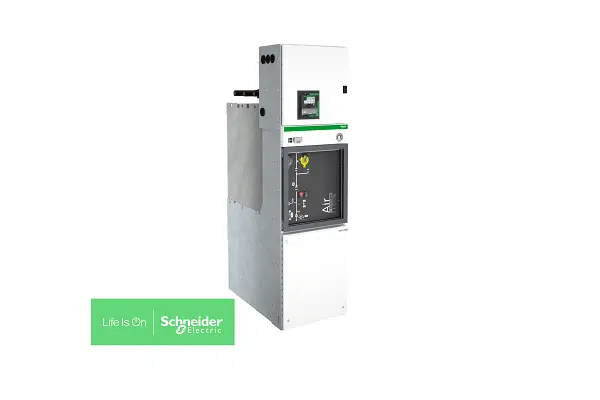
Schneider GM AirSeT, pure-air primary GIS to 24 kV that replaces SF6 with air and vacuum interruption
This model is part of SecondWatt’s switchgear research catalogue. Specifications and price observations are included where supported by sources. Equipment availability and commercial terms require confirmation.
Schneider Electric GM AirSeT dossier: pure-air primary GIS to 24 kV with vacuum interruption, digital monitoring, F-gas context, market structure.
GM AirSeT is Schneider Electric's SF6-free primary-distribution gas-insulated switchgear, launched 2022-06-03 as the top of the AirSeT family: pure-air insulation (no F-gases, no proprietary mixtures) in a factory-sealed tank with vacuum interruption. The range page documents up to 24 kV with an example configuration at 12 kV, 1,250 A, 31.5 kA, dual-busbar options, and a GM AirSeT Performance variant. A third-party trade guide dated 2026-06-16 describes 36 kV capability that se.com does not list as of August 2026.
The line ships natively digital: wireless thermal and humidity sensors, embedded optical arc-flash detection, gas-pressure monitoring, optional partial-discharge and breaker-health monitoring, and the EcoCare condition-based service plan claiming 40% maintenance reduction.
SF6-free MV gear has no used supply yet, so buyers needing immediate delivery still land on legacy SF6 or air-insulated stock.
Why it matters
GM AirSeT is Schneider's answer to the category's defining transition, and its pure-air approach (versus Siemens clean air and Hitachi's C4-FN chemistry) is one of the two philosophies splitting the SF6-free market. Tracking when AirSeT units first hit auction will date the birth of the SF6-free secondary market.
Who buys it
EU utilities and sustainability-driven campus operators specify GM AirSeT for primary substations ahead of the 2026 F-gas cutoff; data center operators in IEC markets take it for MV rooms where SF6 handling is unwanted. There is nothing to buy used; procurement is new-build against 60-80 week class leads.
Role in the data center
Primary medium-voltage substation switchgear for IEC-market campuses that want an SF6-free electrical room with condition monitoring built in rather than bolted on. It is a new-build specification only: no used supply exists, so it competes on lead time and gas-handling liability rather than on price against surplus.
Key specifications
| Voltage ceiling, Schneider GM AirSeT Performance range page | 24 kV |
|---|---|
| Example configuration | 12 kV / 1,250 A / 31.5 kA |
| Insulation | pure air, sealed tank + vacuum |
| Arc-flash detection | embedded optical |
| Condition monitoring | thermal, humidity, pressure, optional PD |
| Maintenance claim | -40% (EcoCare) |
| Launch | 2022-06-03 |
| Busbar configurations | single and dual busbar |
| Variant tiers | GM AirSeT and GM AirSeT Performance |
| Platform family | SeT Series: GM AirSeT, SM AirSeT, RM AirSeT |
Technical summary
Voltage: up to 24 kV. Example configuration: 12 kV / 1,250 A / 31.5 kA. Insulation: pure air, factory-sealed tank; vacuum interruption. Variants: GM AirSeT and GM AirSeT Performance; dual-busbar options. Digital: thermal/humidity sensors, optical arc-flash detection, PD monitoring option. Service: EcoCare plan claiming 40% maintenance reduction. Design life: 40 years (third-party guide). Launch: 2022-06-03; SeT Series platform.
Major variations
GM AirSeT ships in a standard and a Performance tier, in single and dual-busbar arrangements, with breaker and switch panels and an optional partial-discharge and breaker-health monitoring package on top of the standard thermal, humidity and pressure sensing. The same pure-air platform carries SM AirSeT, the modular secondary-distribution switchboard, and RM AirSeT, the sealed ring main unit, so a project can specify one insulation technology from the primary substation down to the loop.
Configurations and options
Two tiers, GM AirSeT and GM AirSeT Performance, in single or dual-busbar arrangements with breaker and switch panels, and the digital content is the option set that moves price. Standard sensing covers thermal, humidity and gas pressure with embedded optical arc-flash detection; partial-discharge and breaker-health monitoring are separately specified, as is the EcoCare condition-based service plan. Schneider's range page documents up to 24 kV with an example configuration at 12 kV, 1,250 A and 31.5 kA, while a third-party trade guide dated 2026-06-16 describes 36 kV capability that se.com does not list. Internal arc class and BIL live in catalogues NRJCAT21027EN and 998-23511861.
Compatibility and dependencies
Insulation is pure air in a factory-sealed tank with vacuum interruption, so there is no F-gas inventory, no gas handling on relocation and no end-of-life recovery obligation, but the tank is still sealed and not field-serviceable. The digital layer is the integration question: embedded sensors, optical arc-flash detection and the monitoring package feed a supervisory system, and the EcoCare service plan assumes that data reaches Schneider. Bus rating and short-circuit withstand have to be matched to the upstream transformer at the specific voltage rather than to the family ceiling. The same pure-air platform carries SM AirSeT for secondary distribution and RM AirSeT for ring main units, so one insulation technology can run from the primary substation down to the loop.
Pricing and availability
Trend: rising Lead time, new: 60-80 weeks (MV metal-clad class). Lead time, used or refurbished: No used supply exists (line <5 years old). Warranty, used: 1-year typical from reconditioning dealers.
Lifecycle and maintenance
Gas-insulated switchgear targets 35-40 year service from sealed-for-life compartments with minimal maintenance: density monitoring, PD surveys, and mechanism service. Sealed tanks cannot be repaired in the field, so gas loss or internal fault usually ends the asset. EU F-gas and CARB rules add end-of-life SF6 recovery and reporting obligations that must be priced into any SF6 unit, while SF6-free designs (clean air, dry air, C4-FN mixtures) remove that liability entirely.
Thermal and emissions profile
Switchgear produces no combustion emissions, and SF6-free designs remove the category's one regulatory exposure: instead of SF6 (GWP 24,300), these units insulate with clean air, dry air, or pure air at GWP below 1 and interrupt in vacuum. That satisfies EU F-gas Regulation 2024/573, which bars new SF6 MV switchgear from the EU market from 2026, and California's CARB phase-out of new SF6 equipment acquisitions from 2025. Buyers avoid gas handling, leak reporting, and end-of-life recovery costs entirely.
Common failure points
- Gas leakage — Density alarms and lockout; insulation margin lost as pressure falls
- Partial discharge in compartments — PD at spacers, particles, or terminations progressing to internal fault
- Operating mechanism — Spring and motor failures on switch and breaker drives
- Cable terminations — Tracking in cable boxes and poorly seated plug-in connectors
- Density monitor drift — False alarms or missed low-gas conditions from drifted gauges
- End-of-life gas liability — SF6 recovery and reporting costs land on the owner at decommissioning
Inspection checklist
Gas density: verify density monitors against nameplate fill (150 kPa class systems); alarm thresholds intact. Leak rate: review gas top-up logs; leakage above 0.5% per year fails modern acceptance. Gas quality: test SF6 moisture and decomposition before transfer; SO2 presence flags internal arcing. F-gas compliance: verify EU 2024/573 and CARB status; new SF6 MV gear is barred from the EU market from 2026. Partial discharge: UHF or acoustic survey per IEC 60270 practice; PD is the dominant latent defect. Vacuum interrupters: hipot test breaking units; interruption is vacuum even in gas-insulated designs. Mechanism: exercise and verify spring charge; check counters against 10,000-operation class ratings. Terminations: inspect cable boxes for tracking; verify stress cones and plug-in connectors seated.
Procurement channels
New units come through Schneider Electric channels only. The channel to watch is the SF6 gear this product replaces, since those decommissioning events are what will eventually seed an AirSeT secondary market.
Regional notes
An IEC-market primary gas-insulated line launched 2022-06-03 and documented on Schneider's international range pages, with no ANSI listing, so a 50 Hz lineup is not usable on a North American project without significant engineering. Its commercial driver is EU Regulation 2024/573, which bars new SF6 switchgear at and below 24 kV from 2026, and it is that deadline rather than price that decides specifications in European markets. North American buyers seeking an SF6-free 24 kV primary alternative are choosing between vendor platforms rather than between markets.