Siemens 8DB10 gas-insulated switchgear (double busbar)
Manufacturer: Siemens
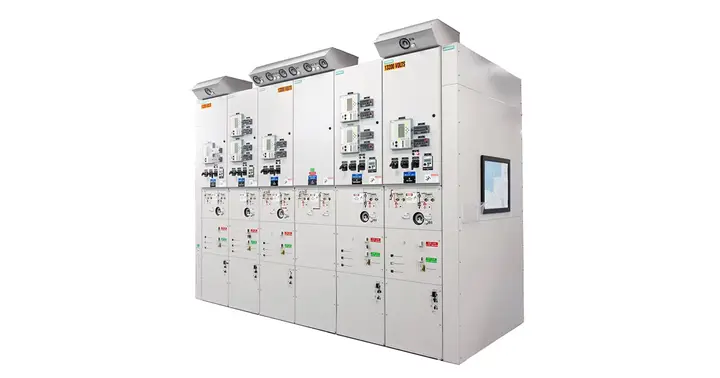
Siemens 8DB10, the double-busbar variant of the 8DA/8DB GIS platform for redundancy-critical substations
This model is part of SecondWatt’s switchgear research catalogue. Specifications and price observations are included where supported by sources. Equipment availability and commercial terms require confirmation.
Siemens 8DB10 dossier: double-busbar GIS to 40.5 kV and 40 kA for redundancy-critical substations, Siemens AG ownership, market structure, inspection.
8DB10 is the double-busbar variant of the Siemens 8DA/8DB compact GIS platform, sharing every platform rating with 8DA10: 12/24/40.5 kV classes, BIL 75/125/185 kV, busbars to 5,000 A, 40 kA/3 s withstand, vacuum interruption with low-pressure SF6 insulation, and IAC A FL/FLR 40 kA 1 s arc classification. The owner is Siemens AG Smart Infrastructure, not Siemens Energy, per the shared siemens.com product pages.
Double-busbar architecture is bought for operational flexibility: bus transfer without outage, segregated feeds for redundancy schemes, and maintenance isolation, which places 8DB10 in utility and mission-critical substations where the single-bus 8DA10 will not satisfy the operating philosophy.
Double-busbar GIS is engineered so tightly to its substation one-line that redeployment is rare even at decommissioning, so there is no used trading channel to plan around.
Why it matters
Double-busbar MV GIS is the redundancy endgame of compact switchgear, and its absence from every surplus channel as of August 2026 shows the pattern: the more engineered the lineup, the less it trades. Buyers should plan spares and service contracts at purchase, because the secondary market will not rescue them later.
Who buys it
Transmission-adjacent utilities and redundancy-driven campuses specify 8DB10 for two-bus operating schemes; data center intake substations use it where concurrent maintainability extends to the MV bus itself. No used channel exists to serve, so spares and service contracts have to be negotiated at the time of purchase.
Role in the data center
Two-bus MV intake substations for campuses whose concurrent-maintainability requirements extend to the medium-voltage bus.
Key specifications
| Architecture | double busbar |
|---|---|
| Voltage classes | 12 / 24 / 40.5 kV |
| BIL | 75 / 125 / 185 kV |
| Busbar ceiling | 5,000 A |
| Short-time withstand | 40 kA / 3 s |
| Internal arc | IAC A FL / FLR 40 kA 1 s |
| Manufacturer | Siemens AG Smart Infrastructure |
| SF6-free siblings | 8DAB 24 / 8DAB 40 (Clean Air) |
Technical summary
Architecture: double busbar (8DA10 = single) Voltage classes: 12 / 24 / 40.5 kV BIL: 75 / 125 / 185 kV Busbar: up to 5,000 A; feeders 2,750-3,150 A Short-time withstand: 40 kA / 3 s Internal arc: IAC A FL / A FLR 40 kA 1 s Interruption: vacuum; SF6 insulation only Mechanical endurance: 30,000 operations (vacuum interrupters) Standards: IEC 62271-1/-100/-200 SF6-free path: Clean Air 8DAB 24 / 8DAB 40 siblings Owner: Siemens AG Smart Infrastructure
Major variations
Bus-coupler, bus-sectionalizer, feeder, and metering bays in double-bus schemes; IEC and US arc-resistant builds; Clean Air 8DAB siblings provide the SF6-free path at 24 and 40.5 kV classes.
Configurations and options
Double-busbar bays are ordered as bus-coupler, bus-sectionalizer, feeder and metering duties, and the count and mix of bays sets lineup length and price, since a two-bus scheme needs more of both than the single-bus 8DA10 for the same feeders. The platform envelope is shared: 12, 24 and 40.5 kV, BIL 75, 125 or 185 kV, busbars to 5,000 A, feeders 2,750-3,150 A, 40 kA/3 s. Market build, IEC or US arc-resistant to IEEE C37.20.7 Type 2B, and insulation, SF6 or the Clean Air 8DAB siblings, are the other two order-time decisions.
Compatibility and dependencies
A double-bus lineup is engineered to a substation one-line, and that is its defining dependency: bay assignment, transfer scheme and protection are specified against a particular operating philosophy, which is why it rarely redeploys even at decommissioning. The reason to buy it is what it enables, bus transfer without outage, segregated A and B feeds and maintenance isolation, and delivering that requires a protection and control scheme that supports bus transfer plus operator procedures written to it. Physically it shares the 8DA10 platform, so the same constraints apply: vacuum interruption in low-pressure SF6 with density monitoring, cable entry and arc exhaust designed to the tested IAC arrangement, and busbar rating matched to the upstream source.
Pricing and availability
Trend: up Lead time, new: 60-104 weeks (MV GIS class). Lead time, used or refurbished: No used channel (sealed-for-life). Warranty, used: 1-year typical from reconditioning dealers.
Lifecycle and maintenance
Gas-insulated switchgear targets 35-40 year service from sealed-for-life compartments with minimal maintenance: density monitoring, PD surveys, and mechanism service. Sealed tanks cannot be repaired in the field, so gas loss or internal fault usually ends the asset. EU F-gas and CARB rules add end-of-life SF6 recovery and reporting obligations that must be priced into any SF6 unit, while SF6-free designs (clean air, dry air, C4-FN mixtures) remove that liability entirely.
Thermal and emissions profile
The regulatory story is the insulation gas: SF6 carries a global warming potential of 24,300 and an atmospheric lifetime near 3,200 years. EU Regulation 2024/573 bars placing new SF6 switchgear at or below 24 kV on the EU market from 2026-01-01, extends to 52-145 kV classes from 2028, above 24 to 52 kV from 2030, and above 145 kV from 2032. California's CARB rule phases out acquisition of new SF6 gas-insulated equipment from 2025 on a staged schedule. Legacy SF6 gear remains legal to operate but faces stranded-asset discounts and end-of-life gas recovery obligations.
Common failure points
- Gas leakage — Density alarms and lockout; insulation margin lost as pressure falls
- Partial discharge in compartments — PD at spacers, particles, or terminations progressing to internal fault
- Operating mechanism — Spring and motor failures on switch and breaker drives
- Cable terminations — Tracking in cable boxes and poorly seated plug-in connectors
- Density monitor drift — False alarms or missed low-gas conditions from drifted gauges
- End-of-life gas liability — SF6 recovery and reporting costs land on the owner at decommissioning
Inspection checklist
Gas density — verify density monitors against nameplate fill (150 kPa class systems); alarm thresholds intact Leak rate — review gas top-up logs; leakage above 0.5% per year fails modern acceptance Gas quality — test SF6 moisture and decomposition before transfer; SO2 presence flags internal arcing F-gas compliance — verify EU 2024/573 and CARB status; new SF6 MV gear is barred from the EU market from 2026 Partial discharge — UHF or acoustic survey per IEC 60270 practice; PD is the dominant latent defect Vacuum interrupters — hipot test breaking units; interruption is vacuum even in gas-insulated designs Mechanism — exercise and verify spring charge; check counters against 10,000-operation class ratings Terminations — inspect cable boxes for tracking; verify stress cones and plug-in connectors seated Enclosure — verify sealed-compartment integrity (IP65 class HV parts), pressure relief, and corrosion Interlocks — verify 3-position switch logic (closed/open/earthed) and padlock provisions Gas handling — confirm certified handling equipment and trained personnel for any gas transfer Monitoring — verify density and PD telemetry channels report correctly to the control system Nameplate — confirm kV class, BIL (75-185 kV in MV GIS), kA rating, and busbar current Standards — IEC 62271-200 (or -203 HV) type-test documentation present and matching configuration Records — gas logs, factory routine tests, and service history; sealed units without logs reprice sharply
Procurement channels
Siemens channels only; zero secondary supply observed. Spares and service contracts at purchase are the availability strategy.
Regional notes
IEC panels to IEC 62271-200 for international markets and a US arc-resistant build tested to IEEE C37.20.7 Type 2B, sharing the 8DA10 platform, so the market build has to be confirmed on the panel rather than assumed from the model. The owner is Siemens AG, Smart Infrastructure; Siemens Energy AG has been a separate listed company since the September 2020 spin-off and has never sold this line. EU Regulation 2024/573 sets SF6 switchgear cutoffs of 2026 at and below 24 kV and 2028 above, with the Clean Air 8DAB siblings as the SF6-free path.