
A reciprocating engine generator makes electricity with pistons. Fuel burns in each cylinder, the pistons drive a crankshaft, and the crankshaft turns an alternator. In power generation, natural gas engines are primarily four-stroke and spark-ignited. The largest reach about 18 MW of output per engine, according to EPA's CHP catalog.
A buyer compares output, efficiency, start time, gas quality and overhaul hours, and each OEM states them on its own basis. The gas engines hub collects the model pages.
Key Takeaways
- Pistons, a crankshaft and an alternator make the power. Gas engines for power generation are primarily four-stroke, with a spark plug igniting a compressed fuel-air mixture.
- Medium-speed engines are larger. The 720 rpm Wärtsilä and Bergen engines cited are rated 9,388–11,377 kW at 60 Hz; high-speed Cat, mtu and Waukesha gensets, 1,500–2,552 kWe.
- Table efficiencies run from 43.0% to 51.6%. Those are the sets that publish one; Waukesha's rich-burn VHP9504GSI works out near 35% from its own LHV fuel figure.
- Fast-start engines take load in seconds. The G3516 with Fast Response can start and accept load from a cold start as quickly as 6.5 to 7.5 seconds, Caterpillar says.
- Gas quality is part of the rating. mtu's 60 Hz Series 4000 sheet references methane number 72 or higher, and 80 or higher for its hot-ambient ratings.
What a reciprocating engine generator is#
In a reciprocating engine, a close-fitting piston travels the length of a cylinder and connects to a crankshaft that turns its linear motion into rotation. Section 2.3 of the EPA CHP Partnership's September 2017 Catalog of CHP Technologies names two primary designs for stationary power: the spark-ignition Otto-cycle engine and the compression-ignition diesel.
Natural gas is the predominant spark-ignition fuel in power generation; landfill gas and propane also work with the proper fuel system, compression ratio and tuning.
Output can be rated at two points. A crankshaft rating, in brake horsepower or kWb, describes the engine alone; an electrical rating, in kWe or ekW, is measured after the alternator.
How a gas engine makes power#
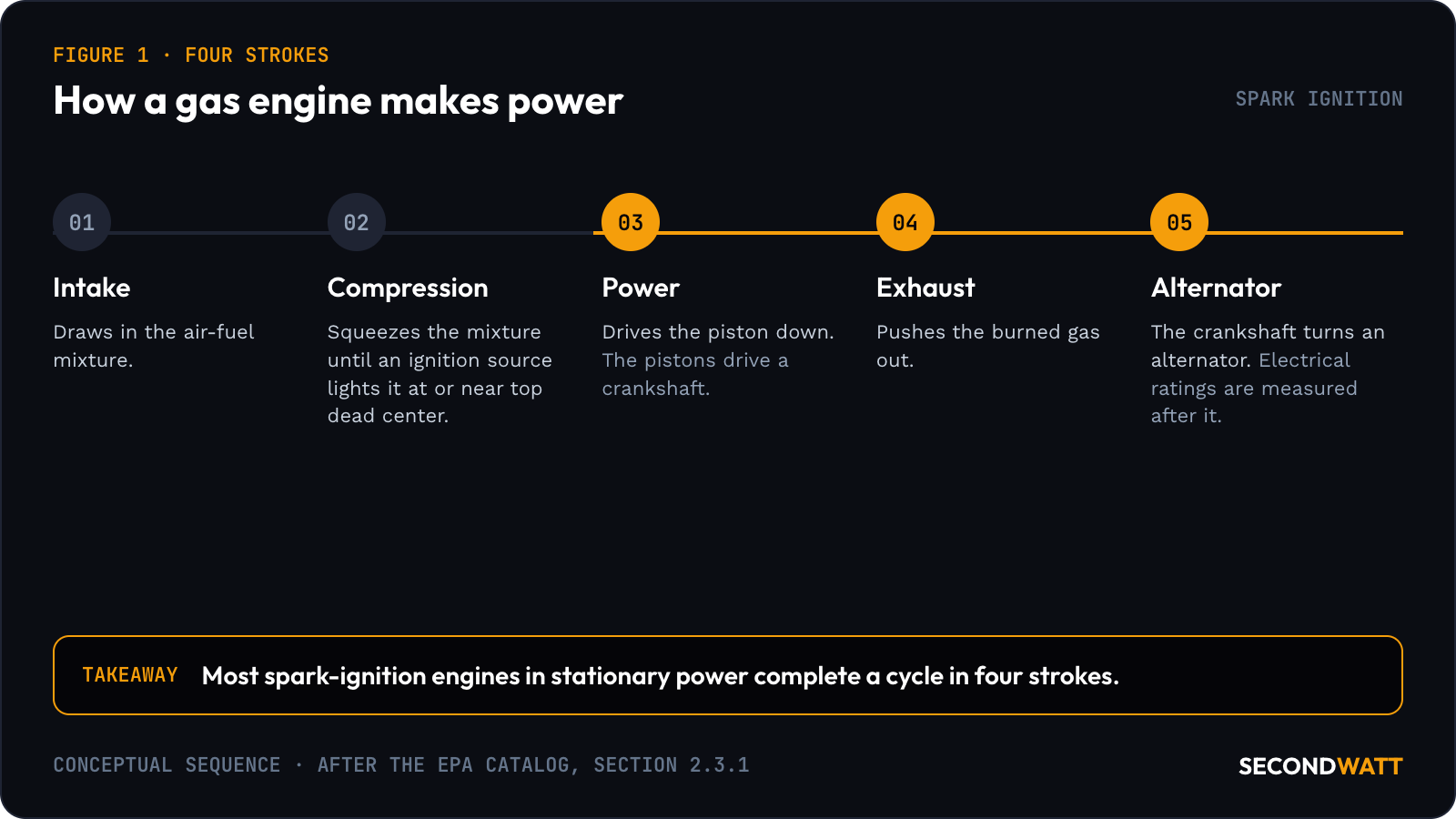
Most spark-ignition engines in stationary power complete a cycle in four strokes, as section 2.3.1 of the EPA catalog describes. Intake draws in the air-fuel mixture, and compression squeezes it until an ignition source lights it at or near top dead center. The power stroke drives the piston down, and the exhaust stroke pushes the burned gas out.
High-performance gas engines are turbocharged, and natural gas spark-ignition engines run compression ratios of 9:1 to 12:1.
With less air than complete combustion needs, an engine is rich burn; with more, lean burn. Lean mixtures lower peak cylinder temperatures and cut NOx, while 3-way catalysts need stoichiometric or rich-burn combustion. Tuning a lean-burn engine for low NOx typically costs 1 to 1.5 points of efficiency, EPA notes.
Waukesha's VHP P9394GSI Series Five is a rich-burn V16, offered with Waukesha's emPact system and a 3-way (NSCR) catalyst, per its S5 sheet IWK-123055. The Wärtsilä 31SG is a four-stroke, spark-ignited, lean-burn generating set.
High-speed and medium-speed engines#
Table 2-3 of the EPA catalog puts high-speed engines at 1,000–3,600 rpm and medium-speed engines at 275–1,000 rpm. Lean-burn spark-ignition engines come in 0.15–3.0 MW ratings at high speed and 1.0–18 MW at medium speed. Medium-speed engines cost more but are generally more efficient.
Gas engine generator ratings at 60 Hz, each on its OEM's basis (OEM pages and data sheets as named in the text)#
| Model | Speed (as published) | 60 Hz output and basis | Electrical efficiency (as published) |
|---|---|---|---|
| Cat G3516 with Fast Response | High-speed block; rpm not stated | 1,500 ekW standby at 0.8 pf; sheet lists the same 1,500 ekW for continuous | Not published; 9,771 Btu/ekW-hr at 100% load with fan (EPA-certified standby data) |
| Cat G3520K | Engine 1,500 rpm; no gearbox listed | 2,552 ekW continuous at 1.0 pf, without pumps | 44.9–46.3% across two packages at two NOx levels |
| Cummins HSK78G C1600N6CD | Not stated | 1,600 kWe continuous | 43.2% ISO, pipeline gas |
| Cummins HSK78G C2000N6CD | Not stated | 2,000 kWe continuous | 43.5% ISO, pipeline gas |
| mtu 20V4000 GS L64FNER | Engine 1,500 rpm; gearbox 1,500–1,800 rpm | 2,520 kWel rated at pf 1.0, 480 V | 43.6% |
| Waukesha VHP P9394GSI S5 (engine) | 1,200 rpm (the 60 Hz genset's speed); sheet states no frequency | 2,500 bhp (1,864 kWb) at the crankshaft | Engine rating; 6,974 Btu/bhp-hr (LHV) |
| Waukesha VHP9504GSI S5 genset | 1,200 rpm | 1,785 kWe continuous at 0.8 pf | Not published; about 34.9% from fuel data (LHV) |
| Jenbacher J620 Fast Start | Not stated | Rated 3,091 kW at generator terminals | Up to 43.0% |
| Jenbacher J620 | Not stated | Rated up to 3,485 kW at terminals, natural gas | Up to 45.5% |
| Jenbacher J624 | Not stated | Rated up to 4,477 kW at terminals, natural gas | Up to 46.8% |
| Jenbacher J920 FleXtra | Not stated | Rated 9,542 kW at generator terminals | Up to 48.7% |
| Wärtsilä 20V34SG | 720 rpm | Rated 9,388 kW at generator terminals, pf 1.0 | 48.8% |
| Wärtsilä 34SG power optimised (20V) | 720 rpm | Rated 10,368 kW at generator terminals, pf 1.0 | 47.5% |
| Bergen B36:45V20 | 720 r/min | Rated 11,280 kW at pf 1, with two engine-driven pumps | 48.9% nominal |
| Wärtsilä 31SG (20V) | 720 rpm | Rated 11,377 kW at generator terminals, pf 1.0 | 51.6% |
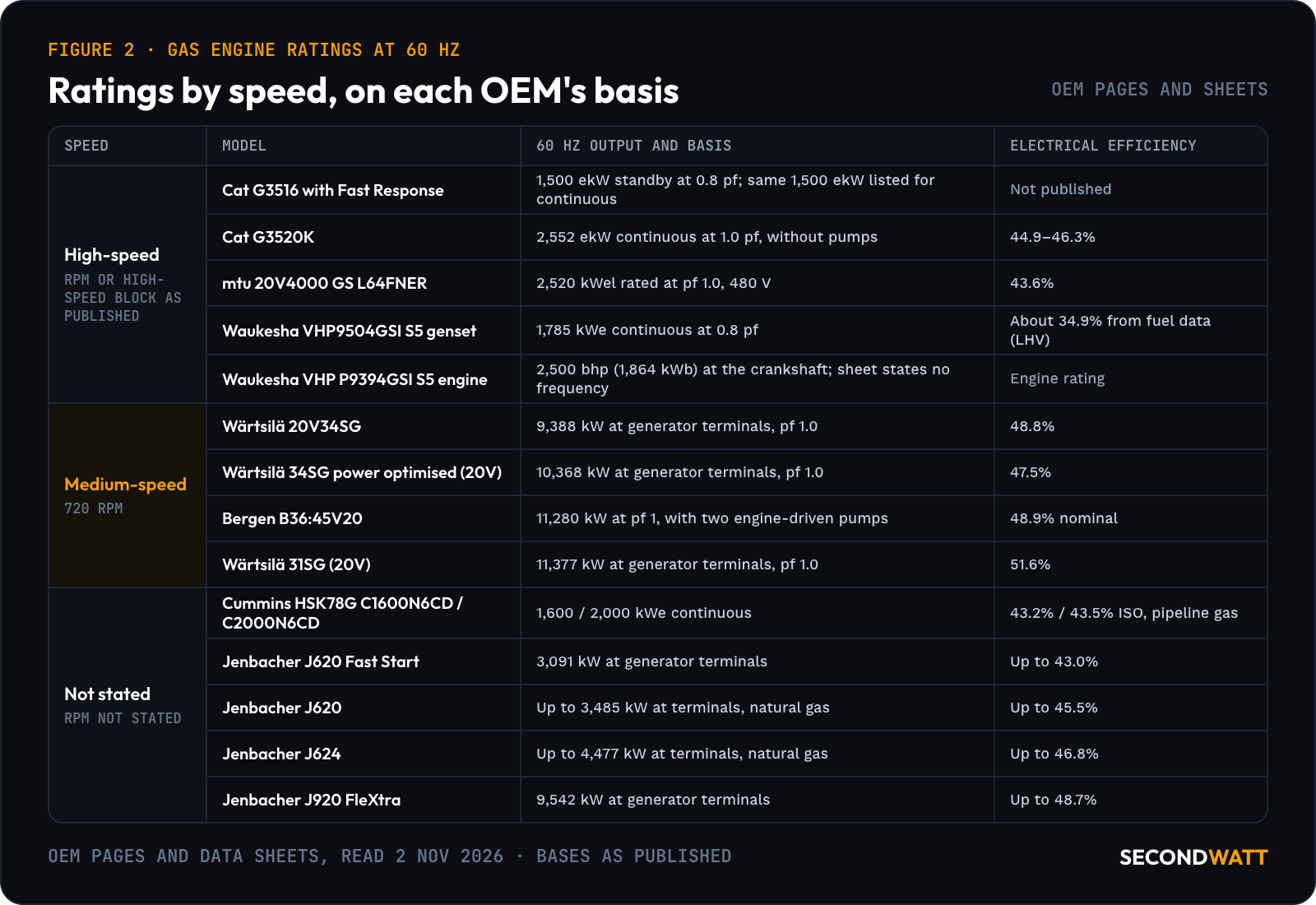
Caterpillar's G3516 with Fast Response page, spec sheet LEHE20847-07 and G3520K 60 Hz sheet LEHE22852-01, dated 11/25, show that both models use a high-speed block design. The HSK78G rows are from Cummins' series page and the mtu 20V4000 L64 row from mtu sheet 3237291, Edition 01/24.
A 60 Hz alternator at 1,500 rpm would need 4.8 poles (120 × 60 ÷ 1,500), so the G3520K and mtu figures are engine speeds. Only mtu's sheet lists a gearbox, 1,500–1,800 rpm.
Jenbacher's pages for the J620, J620 Fast Start, J624 and J920 FleXtra give outputs at the generator terminals at full load, with energy input to DIN ISO 3046 and DIN 6271 and a +5% tolerance. Wärtsilä's ratings for the 31SG, 34SG and 34SG power optimised assume 100 kPa, 25 °C suction air and 30% relative humidity, without engine-driven pumps.
The B36:45V20 rating on Bergen's B36:45V page includes two engine-driven pumps. Pumps move the number: the 60 Hz G3520K is rated 2,552 ekW continuous without pumps and 2,536 ekW with them.
1,785 kWe — Waukesha's 60 Hz continuous rating for the VHP9504GSI S5 genset, built on the P9394GSI engine that Waukesha rates at 1,864 kWb at the crankshaft.
Worked example, crankshaft against terminals, from the two Waukesha sheets at 1,200 rpm and the same fuel input of 17,435,000 Btu/hr:
1,785 kWe ÷ 1,864 kWb = 0.958, so about 4.2% of shaft power does not reach the terminals.
The VHP9504GSI S5 genset sheet, IWK-123039, lists 95.9% generator efficiency, and 1,864 × 0.959 = 1,788 kWe, within 3 kW of the rating.
Efficiency and heat rate#
Natural gas engine efficiency runs from about 28% (LHV) for engines under 50 kW of output to 46% (LHV) for the largest high-performance lean-burn engines, in EPA's 2017 catalog. Several current OEM ratings in the table are higher, though most do not state a heating-value basis. That basis matters: EPA puts HHV about 10% above LHV for natural gas.
Appendix B.8 of NIST SP 811 gives one kWh as 3,600,000 J and one Btu (IT) as 1,055.056 J, so one kWh equals 3,412.14 Btu. Heat rate in Btu/kWh is 3,412.14 divided by efficiency, as the heat rate guide shows for turbines.
Worked example, Wärtsilä 31SG at 60 Hz, at the generator terminals on Wärtsilä's reference conditions:
3,412.14 ÷ 0.516 = 6,613 Btu/kWh, from the published efficiency.
6,971 kJ/kWh ÷ 1.055056 = 6,607 Btu/kWh, from the published heat rate.
The gap is rounding in the 51.6%: 3,600 ÷ 6,971 = 51.64%. An efficiency-optimized 31SG is listed at 52.1% and 6,907 kJ/kWh, or 6,547 Btu/kWh.
51.6% — Wärtsilä's published electrical efficiency for the standard 31SG at 60 Hz, at the generator terminals on its own reference conditions, with a heat rate of 6,971 kJ/kWh.
The G3520K high-efficiency package at 1.0 g/bhp-hr NOx lists 46.3% genset efficiency and 7,474 Btu/ekW-hr at 100% load with fan. Converted, 3,412.14 ÷ 7,474 = 45.7%, so the two do not invert to each other. The fuel rows are stated with fan; the efficiency row states no fan condition.
Part load costs fuel. On the same package, fuel rises from 7,474 Btu/ekW-hr at 100% load to 7,668 at 75% and 8,526 at 50%: 8,526 ÷ 7,474 = 1.14, or 14% more fuel per kWh at half load.
Multi-engine plants#
Engine CHP facilities range from 30 kW to 30 MW of capacity, many of the larger ones made of multiple units, according to the EPA catalog. The J920 FleXtra is offered as a modular, multiple-engine plant, and Caterpillar's optional EMCP 4.4 control parallels generator sets.
Unit size decides how much one engine outage removes. Worked example, a 30 MW requirement at 60 Hz from the table's ratings:
30,000 ÷ 11,377 = 2.6, so three Wärtsilä 31SG units rated 34,131 kW in total; one unit is 33% of the installed engines.
30,000 ÷ 2,552 = 11.8, so twelve Cat G3520K units rated 30,624 kW; one unit is 8.3%.
Prepackaged blocks are on the power blocks page and in the mtu 20V4000 power block guide; site supply is in the behind-the-meter guide.
Start time and load steps#
Reciprocating engines have the fastest start-up of the five CHP technologies in EPA's catalog, at 10 seconds.
The G3516 with Fast Response can start and accept load from a cold start "as quickly as 6.5 to 7.5 seconds" and accept and recover from a 100% block load, says a Caterpillar release of 5 January 2022. The release states no time to full output.
The J620 fast-start version provides full load in under 45 seconds, INNIO says in a 29 October 2019 release. The J920 FleXtra can provide 10.6 MW, its 50 Hz rating, in 2 minutes from the start, depending on site conditions, Jenbacher says.
Wärtsilä's 31SG reaches the grid in 30 seconds on either start, and full load in under 5 minutes on a regular start or under 2 on a fast one. The 34SG power optimised reaches the grid in under 2 minutes on a regular start and 30 seconds on a fast one.
Current mtu Series 4000 gas gensets offer a 120-second fast start, Rolls-Royce says in a 2 October 2025 release. From 2026, the release adds, a new 60 Hz 20-cylinder L64 will be able to deliver its full output of 2.8 MW in 45 seconds. The HSK78G is listed with a 30% load step at G1 and four steps to load.
Gas quality, hydrogen and emissions#
The methane number is a calculated value for a gas's detonation tendency, and manufacturers may calculate it differently, the EPA catalog notes. Heavier hydrocarbons such as propane, ethane and butane lower it. Running low-methane-number fuels in natural gas engines requires retarded ignition timing and other adjustments to avoid knock.
OEMs tie ratings to it. The 60 Hz HSK78G models rated 1,600, 1,800 and 2,000 kWe continuous carry minimum methane numbers of 55, 60 and 70 on Cummins' page. The mtu 60 Hz sheet references methane number 72 or higher at standard conditions and 80 or higher for hot-ambient ratings. Bergen's data use a reference natural gas of methane number 80.
Hydrogen limits differ by model. Caterpillar's pages list the G3516 with Fast Response for hydrogen blends up to 5% and the G3520K for up to 25%. The 31SG is capable of hydrogen blending, Wärtsilä says, without giving a share. Hydrogen-containing fuels may require special measures, generally above 5% hydrogen by volume, EPA notes.
Subpart JJJJ of 40 CFR Part 60 covers owners and operators of stationary spark-ignition engines that commence construction after June 12, 2006, where the engine was manufactured on or after a set date. For a maximum engine power of 500 HP and up, that is July 1, 2007 (January 1, 2008 for lean-burn engines of 500 to under 1,350 HP). It is July 1, 2008 under 500 HP, and January 1, 2009 for emergency engines over 25 HP. Construction commences on the date the owner or operator orders the engine.
Under 40 CFR 60.4230, JJJJ also covers owners and operators of engines modified or reconstructed after June 12, 2006. It excludes engines being tested at a test cell or stand. Temporary replacement units at a stationary source for under a year, properly certified to the applicable nonroad standards, need meet no other provisions of the subpart.
For non-emergency natural gas engines of 500 HP or more manufactured on or after July 1, 2010, JJJJ Table 1 lists 1.0 g/HP-hr NOx, 2.0 CO and 0.7 VOC, or 82, 270 and 60 ppmvd at 15% oxygen. Non-certified engines may comply in either unit. New or reconstructed non-emergency lean-burn engines with a site rating of 250 brake HP or more at a major source that meet ZZZZ Table 2a need not meet Table 1's CO standards.
On the rich-burn Waukesha VHP9504GSI S5, NOx is 12.02 g/bhp-hr engine-out and 0.15 catalyst-out, per its sheet.
Subpart ZZZZ of 40 CFR Part 63 covers hazardous air pollutants (HAP) from stationary RICE at major and area sources. It excludes engines being tested at a test cell or stand and certain existing residential, commercial and institutional emergency engines at area sources.
Under 40 CFR 63.6585, a major source is a plant site that emits or has the potential to emit 10 tons or more a year of any single HAP or 25 tons or more of any combination. Oil and gas production facilities are judged per surface site, and other sources are area sources.
A new or reconstructed spark-ignition engine at an area source meets ZZZZ by meeting JJJJ, with no further ZZZZ requirements. At a major source, that route covers only the engines in 63.6590(c)(2)–(7), including new or reconstructed four-stroke lean-burn engines with a site rating under 250 brake HP and four-stroke rich-burn engines of 500 brake HP or less. A change in ownership does not make an existing stationary RICE new or reconstructed; the emissions permitting guide covers permits.
Maintenance and overhaul intervals#
Oil, filters, coolant and spark plugs are typically changed every 500 to 2,000 hours, according to EPA's catalog. A top-end overhaul, generally recommended between 8,000 and 30,000 hours, rebuilds the cylinder heads and turbocharger. A major overhaul after 30,000 to 72,000 hours replaces pistons and liners.
Published intervals reach that range's top or beyond:
- The HSK78G's 80,000-hour major overhaul cycle is the industry's longest, Cummins claims.
- The mtu Series 4000 natural gas generators run 84,000 hours before overhaul, Rolls-Royce says.
- Jenbacher major overhauls fall at 60,000 or 80,000 operating hours depending on engine type and version, says Clarke Energy, a Jenbacher distributor.
- The VHP Series Five has 4,000-hour spark plug and oil change intervals, Waukesha says.
Hours since the last top-end and major overhaul are the first records to request on a used engine; the used natural gas generator checks cover the rest.
FAQ: reciprocating gas engines#
What is the difference between a gas engine and a diesel generator?#
Ignition. A gas engine lights a pre-mixed charge with a spark plug; a diesel compresses air until injected fuel ignites, typically at compression ratios of 12:1 to 17:1. Commercial and industrial standby systems more typically use diesel, EPA says. For the new or reconstructed engines listed in its § 63.6590(c), Subpart ZZZZ points spark-ignition engines to Subpart JJJJ and compression-ignition engines to Subpart IIII; the Tier 4 cost analysis covers the diesel side.
Do faster engines need overhauls sooner?#
Generally, yes. Table 2-5 of the EPA catalog, drawing on SFA Pacific, gives representative major overhaul intervals for natural gas engines in baseload service. They run more than 60,000 hours at 720 rpm, 40,000–72,000 at 900 rpm, 48,000–60,000 at 1,200 rpm, 30,000–50,000 at 1,500 rpm and 30,000–36,000 at 1,800 rpm. Higher-speed engines tend to have higher wear rates, EPA explains.
What do standby, prime and continuous mean on a gas genset?#
Three ratings appear in EPA's catalog: standby, the maximum output for a short duration, usually under 100 hours; prime, unlimited running with varying load at 80 to 85% of standby; and baseload, continuous full load at 70 to 75% of standby. Caterpillar defines its continuous rating as non-varying load for unlimited time. The prime power guide compares the terms.
Are gas engines used for data center backup power?#
Some are built for it. Data centers are among the G3516 with Fast Response's listed applications, and Caterpillar's release calls it compatible with NFPA 110 Level 1 Type 10. The HSK78G's NFPA 110 Level and Type are still to be determined on Cummins' page, so ask each OEM for its own statement. The gas turbine vs gas engine comparison weighs the two for data centers.
What is a RICE engine?#
RICE stands for reciprocating internal combustion engine, EPA's term in the title of Subpart ZZZZ. The subpart defines a stationary RICE as any internal combustion engine that uses reciprocating motion to convert heat energy into mechanical work and is not mobile. Subpart JJJJ's title names stationary spark ignition internal combustion engines instead.
Sourcing gas engines#
SecondWatt publishes equipment research and helps buyers source power equipment; it earns a fee when a sale it arranges closes. If you are buying, send a request that names the output basis, frequency, gas methane number and start time you need, so offers can be compared like for like. If you own gas gensets leaving service, the generator seller page explains how SecondWatt works with owners.