Cummins HSK78G
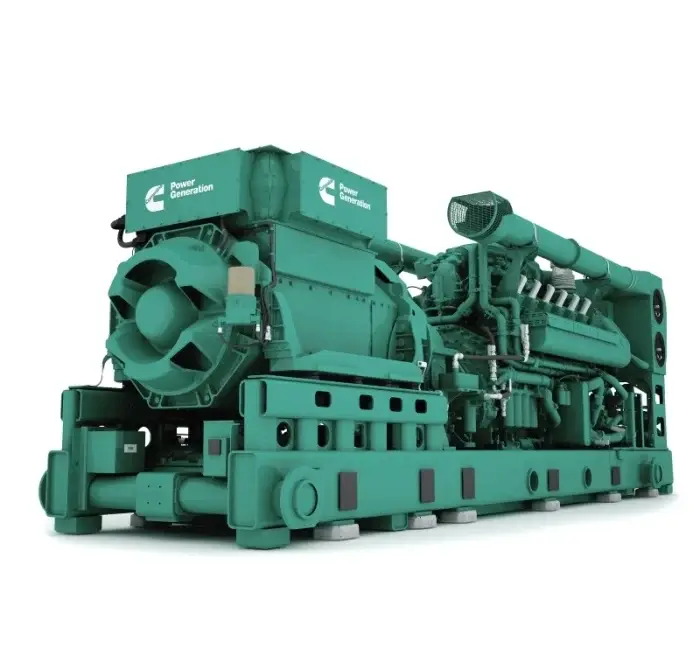
Lean-burn 78-litre V12 base load gas genset that meets Subpart JJJJ NOx without aftertreatment
Cummins HSK78G is one of 23 gas engines tracked in the SecondWatt catalogue, each with specifications, lead times and indicative secondary-market pricing.
Cummins HSK78G specs: 1,600 to 2,000 kWe at 60 Hz, 43.5% electrical efficiency, 0.5 g/hp-hr NOx without aftertreatment, and overhaul intervals.
The Cummins HSK78G is a lean-burn spark-ignited V12 natural gas generator set rated for base load continuous power at unlimited hours. At 60 Hz it ships as three packages: C1600N6CD at 1,600 kWe, C1800N6CD at 1,800 kWe and C2000N6CD at 2,000 kWe, quoted alongside kVA figures of 2,000, 2,250 and 2,500. Dividing 1,600 kWe by 2,000 kVA gives 0.8, so the packages are rated at 0.8 power factor. The same three ratings exist at 50 Hz as the N5CD variants. The engine is a Cummins design rather than a converted diesel, and the displacement coincidence with the QSK78 diesel misleads people who know the K-series. HSK78G measures 190 mm bore by 230 mm stroke across twelve cylinders for 78 litres. The QSK78 diesel reaches nearly the same swept volume with eighteen cylinders of 170 mm by 190 mm. The prefix change from QSK to HSK is Cummins marking a separate platform, and no figure carries between them. What distinguishes this unit in North America is emissions. Cummins rates NOx as low as 250 mg/Nm3, which it states as 0.5 g/hp-hr, against the 40 CFR 60 Subpart JJJJ ceiling of 1.0 g/HP-hr for non-emergency spark-ignition engines. That is roughly a two-fold compliance margin with no catalyst in the exhaust. Every rich-burn Waukesha in this category needs a three-way catalyst simply to reach the same line.
Why it matters
It clears the federal spark-ignition NOx standard on a stock tune, at 0.5 g/hp-hr against a 1.0 g/HP-hr limit, which most engines in this class do not. That removes selective catalytic reduction from the capital budget and shortens air permitting, which in a non-attainment county is the difference between a project that proceeds and one that does not.
Who buys it
Behind-the-meter developers building 10 to 12 MW blocks from five or six units where the utility interconnection queue is the binding constraint, plus cogeneration operators who can use the 47.1 percent thermal recovery. This is a prime and continuous duty machine, not an NFPA 110 standby set, and that distinction is what separates this category from the small gaseous standby gensets it is often confused with.
Role in the data center
Continuous behind-the-meter generation where interconnection timing rather than capital cost is the constraint. Five or six C2000N6CD units make a 10 to 12 MW block that can be ordered without an interconnection agreement, and the native Subpart JJJJ compliance removes the selective catalytic reduction line from the permitting critical path.
Key specifications
| Electrical output, 60 Hz | 1,600 / 1,800 / 2,000 kWe, base load continuous |
|---|---|
| Apparent power, 60 Hz | 2,000 / 2,250 / 2,500 kVA at 0.8 power factor |
| Electrical efficiency, 60 Hz | 43.2 to 43.6 percent |
| Electrical efficiency, 50 Hz | 43.8 to 44.3 percent |
| Thermal efficiency, cogeneration | 47.1 percent at 250 mg/Nm3 NOx |
| Cylinders and configuration | V12, cast iron cylinders |
| Bore | 190 (7.48) mm (in) |
| Stroke | 230 (9.06) mm (in) |
| Displacement | 78 (4,778) litres (cu in) |
| NOx | 250 (0.5) or 500 (1.2) mg/Nm3 (g/hp-hr) |
| Methane number required | 55 / 60 / 70 at 1,600 / 1,800 / 2,000 kWe MN |
| Mid-life overhaul | 40,000 operating hours |
| Full overhaul | 80,000 operating hours |
| Service interval | 2,000 operating hours minimum |
| Genset dry weight | 23,100 to 29,000 kg |
| Duty rating | Base load (continuous), unlimited hours duty |
Technical summary
Electrical output 60 Hz: 1,600 / 1,800 / 2,000 kWe (2,000 / 2,250 / 2,500 kVA at 0.8 pf), base load continuous. Electrical output 50 Hz: same three ratings as C1600N5CD / C1800N5CD / C2000N5CD. Electrical efficiency: 43.2 to 43.6 percent at 60 Hz; 43.8 to 44.3 percent at 50 Hz. Thermal efficiency in cogeneration: 47.1 percent at 250 mg/Nm3 NOx on pipeline gas. Engine: V12, cast iron, bore 190 mm (7.48 in), stroke 230 mm (9.06 in), 78 litres (4,778 cu in). Aspiration: four-cycle, turbocharged, low-temperature aftercooled. NOx: 250 mg/Nm3 (0.5 g/hp-hr) or 500 mg/Nm3 (1.2 g/hp-hr) as ordered. Methane number required: 55 MN at 1,600 kWe, 60 MN at 1,800 kWe, 70 MN at 2,000 kWe. Fuel flexibility: to 40 MN on flare gas and 273 BTU/scf without derate. Maintenance: 2,000-hour service, 40,000-hour mid-life, 80,000-hour full overhaul. Genset envelope: 6,900 to 8,700 mm long, 2,200 to 2,300 mm wide, 2,600 to 2,800 mm high. Genset dry weight: 23,100 to 29,000 kg depending on configuration.
Major variations
Three ratings at each frequency, distinguished by the C-number rather than by an engine change: C1600, C1800 and C2000, suffixed N6CD at 60 Hz and N5CD at 50 Hz. NOx is an ordering option at either 250 or 500 mg/Nm3, with the lower setting carrying the published 47.1 percent cogeneration thermal efficiency. Methane number requirement rises with rating, from 55 MN at 1,600 kWe to 70 MN at 2,000 kWe.
Compatibility and dependencies
Requires a gas analysis before selection, because the methane number requirement is rating-dependent. A site that can supply only 55 MN gas can take the 1,600 kWe package but not the 2,000 kWe package from the identical engine. Two coolant circuits exist, the jacket and the low-temperature aftercooler, and both need chemistry management.
Pricing and availability
Comparable secondary-market band: 2000–3150 $ per kW installed project cost. Trend: stable The category prices by quote rather than by listing, so no trend line can be published. What can be said is that value in this class tracks hours since overhaul rather than build year, so the 40,000-hour and 80,000-hour marks are the two points where a unit's worth steps down. Lead time, new: No published lead time. Cummins does not state one and dealer pages do not give a figure in weeks or months.. Lead time, used or refurbished: Dealer stock of 2024 and 2025 units was visible at four North American Cummins dealers on 2026-08-31, but none carried a published availability date.. Warranty, used: Independent support arrangements common on Waukesha do not have a Cummins equivalent for this platform..
Lifecycle and maintenance
Cummins publishes three intervals: a 2,000-hour minimum service interval, a 40,000-hour mid-life overhaul and an 80,000-hour full overhaul. On continuous base load a 2,000-hour interval falls roughly every twelve weeks, so a five-unit 10 MW block generates about twenty service events a year. That maintenance labour is the honest counterweight to the part-load efficiency and modularity arguments that favour reciprocating engines over turbines. Resale value in this category tracks hours since major far more closely than calendar age, so the hour meter and the overhaul ledger set the price, not the build year.
Thermal and emissions profile
Cummins rates NOx as low as 250 mg/Nm3 at 5 percent O2, stated as 0.5 g/hp-hr, with a 500 mg/Nm3 (1.2 g/hp-hr) option. Converting the 250 figure gives about 45 ppmvd at 15 percent O2, against the 40 CFR 60 Subpart JJJJ ceiling of 1.0 g/HP-hr or 82 ppmvd for non-emergency spark-ignition natural gas engines. The engine therefore meets the federal standard natively, with no selective catalytic reduction and no three-way catalyst. The 500 mg/Nm3 option converts to about 90 ppmvd and does not clear 82, so the ordered NOx setting decides US compliance. Cummins publishes no CO or formaldehyde figure, and formaldehyde drives NESHAP RICE, so a site in a non-attainment area still needs a stack test rather than a datasheet.
Common failure points
- Detonation from low methane number gas — audible knock under load, controller-commanded derate, piston crown and ring-land damage
- Cylinder head and valve seat recession — compression loss, widening exhaust temperature spread between cylinders, output fading below nameplate
- Turbocharger and aftercooler degradation — slow load acceptance, low boost, rising exhaust temperature
- Ignition system and spark plug fouling — misfire, unstable kWe output, elevated CO at the stack
- Alternator bearing and winding degradation — bearing noise, falling insulation resistance, winding temperature rise
- Lubricating oil consumption drift — shortening top-up intervals with no visible external leak
Inspection checklist
Hours since new: against the 40,000-hour mid-life and 80,000-hour full overhaul marks, from the ledger and not a verbal figure. Hours since last top-end work: the 2,000-hour service interval means continuous base load runs about 4 service events a year. Oil analysis trend: at least the last 4 samples, with wear metals plotted rather than read individually. Compression across all 12 cylinders: a spread beyond roughly 10 percent points at head or ring wear. Turbocharger shaft play and boost pressure: logged against the commissioning baseline at 100 percent load. Aftercooler core and coolant-side fouling: inspected with the turbocharger as 1 system, never separately. Spark plug and ignition coil hours: against the 2,000-hour interval, since low hours with no records means missed service.
Procurement channels
New units move through the Cummins dealer network, with 2024 and 2025 C1600, C1800 and C2000 stock observed at dealers in Nova Scotia, Newfoundland, North Dakota and Missouri. There is no meaningful secondary market yet, which is consistent with a platform introduced in 2019. Buyers should expect a quoted price and should ask for the NOx setting and methane number requirement in writing at quotation.
Regional notes
North American channel confirmed. The 60 Hz N6CD packages are the North American variants and Cummins lists North America in product availability. The 50 Hz N5CD packages are not applicable to a North American grid without reapplication.