
Natural gas generators for data centers at the 50 MW scale can be built from two very different building blocks: a large aeroderivative turbine such as the GE Vernova LM6000, or a block of small gas engine sets, here the mtu 20V4000 GS in a ten-unit, 25 MW package. The turbine route needs a second machine as its spare, so on published ratings it installs more than twice its load.
The engine route spreads the load across twenty-one sets, so its spare adds little. The engines also lose less efficiency at part load, while the Sprint turbine's rating depends on demineralized water.
This article works one scenario both ways: a 50 MW load, one spare unit, natural gas, simple cycle, 60 Hz. The family-level trade-offs are covered in the gas engines vs gas turbines comparison. Integrated engine scopes are cataloged under power blocks.
Key Takeaways
- Engines add far less spare capacity. At N+1, two LM6000 PF+ Sprint units give 113.8 MW ISO net; twenty-one sets, about 52.9 MW gross at 95 °F: unlike bases.
- The engine block holds efficiency at half load. Seller data shows 41.0% at half load against 43.4% at full load, a 2.4-point drop.
- Water shapes the turbine case. SPRINT output comes from demineralized water sprayed to cool the combustion air, while the LM6000VELOX DLE option uses no water for NOx control.
- Start claims differ by package. GE lists a 5-minute fast start for the LM6000 PF+ Sprint; Rolls-Royce announced the 2026 60 Hz 20V4000 at 45 seconds to full output.
- The block's quoted dates cover ten units. Supplier-quoted: first engine-generator into packaging December 2027; ten units and E-house complete April to May 2028. This plant needs twenty-one.
Natural gas generators for data centers: two ways to build 50 MW#
The scenario is a data center that needs 50 MW at the plant's output with one generating unit out of service. That is N+1: enough units to carry the load, plus one spare. The data center redundancy guide explains the vocabulary.
Route one uses the GE LM6000 in its PF+ Sprint configuration. One turbine is larger than the whole load, so the spare is a second turbine. Route two uses mtu 20V4000 GS gas sets, packaged ten at a time in the mtu 20V4000 25 MW block. The engine itself has its own 20V4000 L64 dossier.
The two ratings sit on different bases. The LM6000 figure is net output at ISO conditions, with inlet and exhaust losses included and balance of plant excluded. The engine figure is gross output at 95 °F and 328 ft, before the block's auxiliary load. Every comparison below carries that mismatch, and a site study would put both on the same site-net basis.
The two building blocks#
The table sets the published figures side by side, with their documents.
The building blocks compared (GE Vernova GEA35743 09/2025 and product pages; Baker Hughes LM6000PF+ page; mtu brochure 16120795, edition 01/21; Rolls-Royce release; seller datasheet as published by SecondWatt)#
| Item | GE LM6000 PF+ Sprint | mtu 20V4000 GS set (25 MW block) |
|---|---|---|
| Rating basis | Simple-cycle net, ISO conditions, natural gas, inlet and exhaust losses included, balance of plant excluded; 50/60 Hz | Gross at 95 °F, 328 ft, 79 °F maximum dew point, application group 3A, before auxiliary load; 60 Hz |
| Output per unit | 56.9 MW | 2,518 kWe (brochure: 2,521 kW at 60 Hz) |
| Units per block | 1 | 10 (25.18 MW gross) |
| Electrical efficiency, full load | 41.0% (LHV) | 43.4% (brochure: 43.6%) |
| Heat rate | 8,328 Btu/kWh (LHV) | 7,877 Btu/kWh (LHV, recomputed from seller fuel input) |
| Exhaust temperature | 496 °C / 925 °F (LM6000PF+ power generation, 52.5 MWe, Baker Hughes) | 777 °F at full load (seller) |
| Stated start | 5-minute fast start (GE) | Fast start capability, 0 to 100% load in less than 120 s (brochure); 45 s to 2.8 MW for the 2026 60 Hz version (Rolls-Royce) |
| NOx | DLE: no water, 15 or 25 ppm (GE, LM6000VELOX) | Engine-out below 500 mg/Nm³ at 5% O₂ dry (brochure); SCR and oxidation catalyst per unit (seller) |
| Water | SPRINT sprays demineralized water "into the inlet of the LPC and HPC (if installed)" (GE) | Radiator cooling, rated to 110 °F at 2,500 ft (packager scope document) |
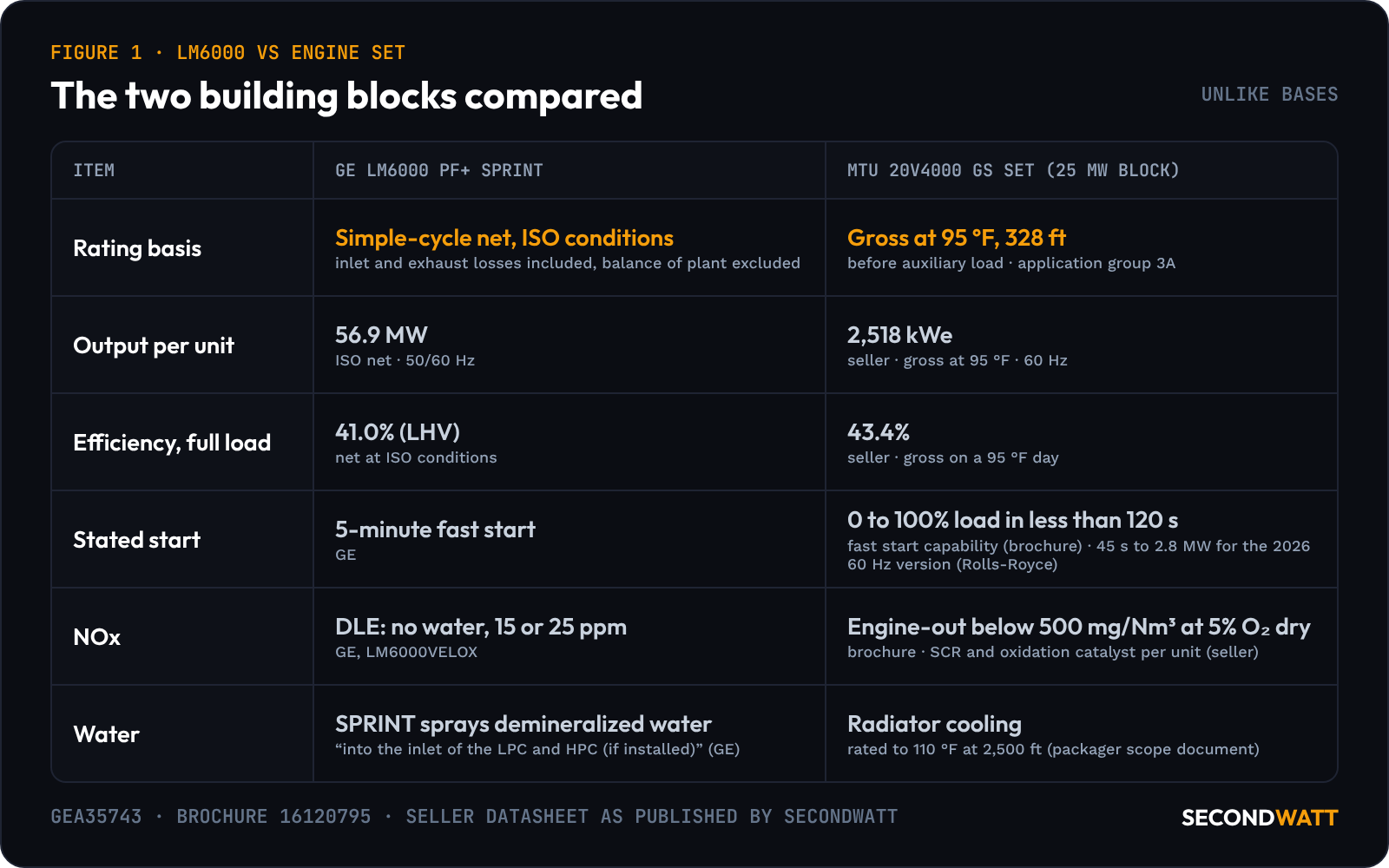
The LM6000 column is the simple-cycle ISO net rating from GE Vernova's LM6000 fact sheet, except the exhaust cell. That cell belongs to another rating, which the Baker Hughes LM6000PF+ page gives as 52.5 MWe for the LM6000PF+ in power generation. That rating is at the generator terminals, at 15 °C and 60% relative humidity, with no inlet or exhaust losses. The same page lists a possible additional 4 MW of output with the SPRINT option.
The 2,518 kWe rating and the load points are the seller's project datasheet figures, as SecondWatt's 25 MW block article reports them.
The mtu Series 4000 gas brochure lists 2,521 kW at 60 Hz and 43.6%, with all data at maximum load and a power factor of 1.0. The current mtu 60 Hz sheet for the NOx < 1 g/bhp-hr version, edition 01/24, lists the 20V4000 GS L64FNER at 2,516 kWel and 43.3% at power factor 1.0. The sheet states them for hot ambient conditions it does not define.
The efficiency row reads in the engines' favor, but the bases differ: the turbine's 41.0% is net at ISO conditions, and the engine's 43.4% is gross on a 95 °F day, before the block's own auxiliary load.
Installed capacity at N+1, worked#
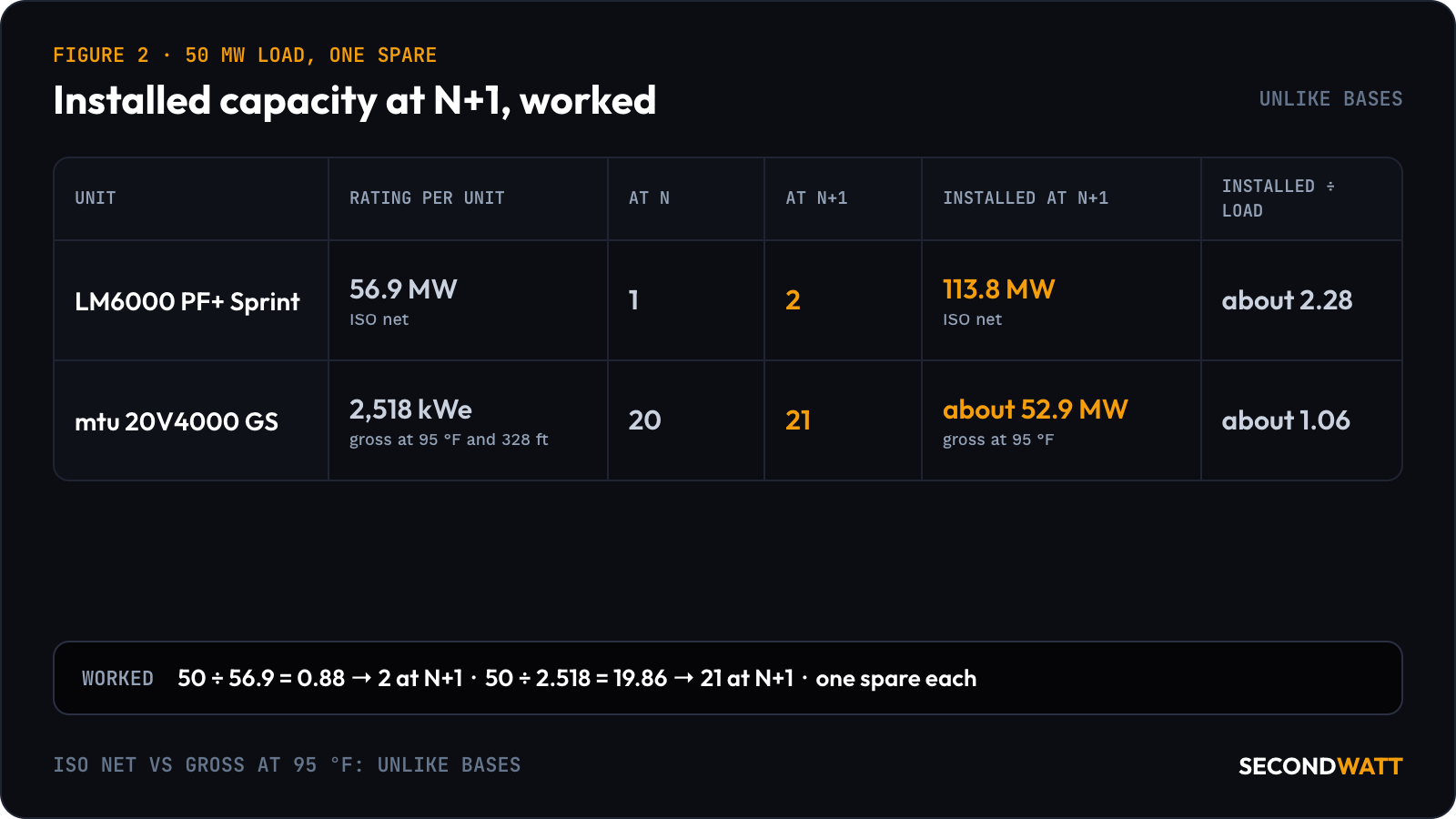
Each unit's published rating sets how many units carry 50 MW; one spare is then added. The LM6000 side uses ISO net output; the engine side uses gross output at 95 °F and 328 ft. These are unlike bases, so the result compares plant shapes rather than site capacity.
LM6000 PF+ Sprint: 50 ÷ 56.9 = 0.88, so 1 unit at N and 2 at N+1. Installed: 2 × 56.9 = 113.8 MW ISO net.
mtu 20V4000 GS: 50 ÷ 2.518 = 19.86, so 20 units at N and 21 at N+1. Installed: 21 × 2.518 = 52.878 MW, about 52.9 MW gross at 95 °F.
2,518 kWe — the seller's gross 60 Hz rating for one mtu 20V4000 GS set at 95 °F and 328 ft, as SecondWatt's 25 MW block article publishes it.
The turbine plant installs about 2.28 times its load (ISO net), because the spare is half the plant. The engine plant installs about 1.06 times its load (gross at 95 °F), because the spare is one set in twenty-one. One turbine trip removes 56.9 MW of ISO net rating; one engine trip removes 2.518 MW gross.
The site derate then works on both, with very different headroom. One LM6000 still carries 50 MW if its site net output stays within 12.13% of the ISO rating. Twenty engines carry 50 MW only at 2.5 MW each, 0.715% under the 2,518 kWe gross figure. Twenty sets give 50.36 MW gross, so auxiliary load or hot-day loss above 0.36 MW in total adds a running unit.
The seller publishes no net figure for the block, according to the 25 MW block article. Radiator fans, pumps, SCR and controls draw from the block's own output.
On the 2026 engine, the arithmetic shifts. At the 2.8 MW (60 Hz) that Rolls-Royce announced as the engine's full output, 50 ÷ 2.8 = 17.86 gives 18 sets at N and 19 at N+1, or 53.2 MW. The release states no ambient or rating basis for the 2.8 MW. The 100 MW sizing article works the same reserve logic for a larger plant.
Part load and phased demand#
A phased campus energizes in stages, so a plant sized for the full load runs below its rating until the last halls come online.
The seller's performance data for the block's engine gives 43.4% electrical efficiency at full load, 42.5% at three-quarter load and 41.0% at half load (1,259 kWe). The drop from full to half load is 2.4 points, or 5.53% in relative terms. Those figures are in the 25 MW block article.
Section 2.4.1 of the September 2017 EPA Catalog of CHP Technologies compares engines and turbines at part load. At 50 percent load, a typical lean-burn natural gas engine's efficiency is approximately 8 to 10 percent less than at full load. Gas turbines typically experience efficiency decreases of 15 to 25 percent at half load. The same section says multiple engines may be preferable to one large unit where significant load reductions are expected on a regular basis.
The mechanism differs by machine. Section 3.4.3 of the same EPA catalog explains that a gas turbine reduces output by lowering its turbine inlet temperature, which also reduces efficiency. Emissions generally increase at part load, especially at half load and below. The LM6000 fact sheet gives plant turndown for combined cycle only: 37.0% minimum load for a 1x1 plant and 18.0% for a 2x1.
Take an illustrative first phase of 12.5 MW. That is 22.0% of one LM6000 PF+ Sprint's ISO net rating. On the engine side, five sets run at 99.3% of their gross rating each, or ten run at 49.6%. The part-load article sets out which minimum-load figures to ask a turbine supplier for.
Hot days, altitude and water#
Both machines lose output as the air gets hotter and thinner, but from different reference points. The EPA catalog notes in sections 2.4.2 and 3.4.4.1 that gas turbines are rated at ISO conditions of sea level and 59 °F, and engines generally at 77 °F. The block's 2,518 kWe already sits at 95 °F and 328 ft.
A nominal 7.5 MW Solar Taurus 70, EPA's turbine example, drops to 80 percent of its ISO-rated power at 100 °F, with efficiency down 8 percent. For engines, the EPA catalog says efficiency and power fall by approximately 4 percent per 1,000 feet above 1,000 feet, and about 1 percent per 10 °F above 77 °F. Those are general figures. Each site needs the maker's own curve, as the derating article explains for turbines.
No derated block figure is published for any other site, so the engine maker's performance curve is applied to the buyer's stated conditions before a firm number exists, per the block article. The block's radiators are rated to 110 °F at 2,500 ft.
Water is where the two diverge most. GE Vernova's SPRINT page explains that SPRINT raises LM6000 output by cooling the combustion air. Demineralized water is atomized with compressor bleed air and sprayed "into the inlet of the LPC and HPC (if installed)", the low- and high-pressure compressors. As ambient temperature rises, the system produces higher incremental output.
So the 56.9 MW rating belongs to a configuration that sprays demineralized water, and that water has to reach the turbine. The SPRINT water article covers what to request: flow, quality and the output without SPRINT. Combustion is a separate choice: GE Vernova's LM6000 page says the LM6000VELOX comes with either a DLE or a water-injected SAC combustor.
The engine block is cooled by radiators. The gas turbine water article puts turbine water uses in data center terms.
Start time, NOx and footprint#
Start claims are vendor statements, and each applies to a named package. GE's fact sheet lists a fast start capability of 5 minutes in simple cycle for the LM6000 PF+ Sprint. Aeros like the LM6000 take "around five minutes to ramp up from start-up to full power," on GE Vernova's LM6000 page. Neither states the start conditions.
The Baker Hughes LM6000PF+ is "able to start in less than five minutes and reach full power in 10 minutes or less," in a passage on the 53.8 MW, 42% rating its page lists for mechanical drive. The page does not tie that start to the 52.5 MWe power-generation rating. The statements cover different packages in different words, so a buyer should ask which definition the contract carries.
With their fast start capability, current mtu Series 4000 gas sets go from 0 to 100% load in less than 120 seconds, per the mtu brochure. A 2 October 2025 Rolls-Royce release says the 2026 20-cylinder Series 4000 L64 engine for the 60 Hz market will be able to deliver its full output of 2.8 MW in 45 seconds. The release adds that it needs no gearbox.
45 seconds — the time Rolls-Royce announced for its 2026 60 Hz 20V4000 gas engine to deliver its full 2.8 MW output, against the 120-second fast-start capability of current Series 4000 gas gensets.
NOx control follows the same split. GE Vernova's fast power page says the LM6000VELOX's DLE option uses no water and "can be 15 or 25 ppm," with no oxygen basis stated. Baker Hughes lists the LM6000PF+ below 25 ppm. The brochure lists its Series 4000 gas sets below 500 mg/Nm³ at 5% O₂ dry, and the seller states that each block unit carries an SCR and an oxidation catalyst.
Stack outlet guarantees after the catalyst are not defined, per the block article. The air permit is written against outlet numbers for the plant at its site. The emissions permitting guide covers that process for turbine plants.
Footprint figures are for packages only. On GE's LM6000 page, the LM6000VELOX package measures 20.43 × 4.1 m, 14.38 m high, with a largest lift of 71,000 kg for the generator. Each block engine enclosure is approximately 10 × 48 × 12 ft, per the seller's figures on the 25 MW block page.
Schedule and supply routes#
The seller's schedule gives two supplier-quoted dates: the first engine-generator received into packaging in December 2027, and ten units and the E-house complete in April to May 2028. Every other span in the seller's schedule is planning logic, per the 25 MW block article.
Those quoted dates cover one ten-unit block. The 50 MW case needs twenty-one sets, so eleven more units, another block plus one, need their own quoted schedule.
On the turbine side, GE Vernova's Q2 2026 results show its gas power equipment backlog and slot reservation agreements grew from 100 to 116 GW in the second quarter of 2026. GE expects 20 GW of annual gas turbine output in the third quarter of 2026 and 24 GW in 2028. The OEM backlog article explains why those figures are not a delivery date for any one order.
One customer project gives a sense of timing. GE's LM6000 page says Lincoln Electric System in Nebraska is adding two LM6000VELOX packages, about 100 MW of flexible capacity once the units are operational in 2029. That is one utility's project date, not a quoted lead time.
Used and refurbished equipment is the other route for both technologies.
For turbines, the LM6000 variants guide lists what to confirm before comparing offers, from exact variant to service records. The condition labels article sets out what zero-hour, overhauled and refurbished each establish. For engines, the used natural gas generator checks list the records to request. Price per kW is covered separately in the LM6000 price-per-kW guide.
FAQ: LM6000 or engine blocks#
Is an LM6000 more efficient than gas engines?#
In combined cycle it is, on GE's figures and unlike bases: a 1x1 LM6000 PF+ Sprint combined-cycle plant lists 54.9% net efficiency at 75.8 MW, on the same ISO basis as its simple-cycle rating. In simple cycle the table's figures favor the engines, again on unlike bases.
How many gas engine sets replace one LM6000?#
On published ratings, 56.9 ÷ 2.518 = 22.6, so twenty-three sets match one PF+ Sprint. That sets ISO net against gross at 95 °F. Against Baker Hughes' 52.5 MWe for the LM6000PF+ in power generation, at the generator terminals at 15 °C, 52.5 ÷ 2.518 = 20.85, or twenty-one sets.
Can engine blocks run as prime power for a data center?#
This block can, in grid-parallel operation as quoted. Its stated fit case is a site needing 20 to 25 MW at prime or continuous duty, grid-parallel, on pipeline gas that meets a methane number of 80, with power in 2028. Its 2,518 kWe rating is for unrestricted heavy duty, the engine maker's application group 3A, according to the seller datasheet in the 25 MW block article.
As quoted, the base block cannot run the site if the utility feed is lost. Island operation and black start are options that need their own engineering, controls and a black-start source or battery interface (buyer scope). Continuous power supply is one data center use Rolls-Royce names for its fast-start mtu gas gensets. The prime power guide explains the rating terms.
Which needs more maintenance?#
The engine plant has more machines to service: twenty-one sets against two turbines. Baker Hughes lists borescope, hot section and major inspections for the LM6000PF+ at 8,000, 25,000 and 50,000 hours. The turbine is designed to extend them to 10,000, 30,000 and 60,000 hours, subject to a check against the operating profile.
The mtu brochure lists 84,000 operating hours to major overhaul for the Series 4000 gas range, a vendor figure. See the turbine maintenance intervals article and the gas engine guide.
Which needs higher gas pressure?#
The turbine, by a wide margin on EPA's general figures. Table 1-3 of the EPA Catalog of CHP Technologies puts fuel pressure at 100 to 500 psig, with a compressor, for gas turbines and 1 to 75 psig for reciprocating engines. Gas reaches the block at 2.4 to 3.6 psi at its DN100 inlet, per the seller's fuel specification on the 25 MW block page. The fuel requirements guide covers turbine gas conditioning.
Sourcing turbines or engine blocks#
SecondWatt publishes equipment research and helps buyers source power equipment; it earns a fee when a sale it arranges closes. Buyers can request equipment with the site-net load, redundancy target, site ambient and elevation, water supply, gas pressure and target energization date, and owners of LM6000 or other turbines can sell a gas turbine through SecondWatt.