
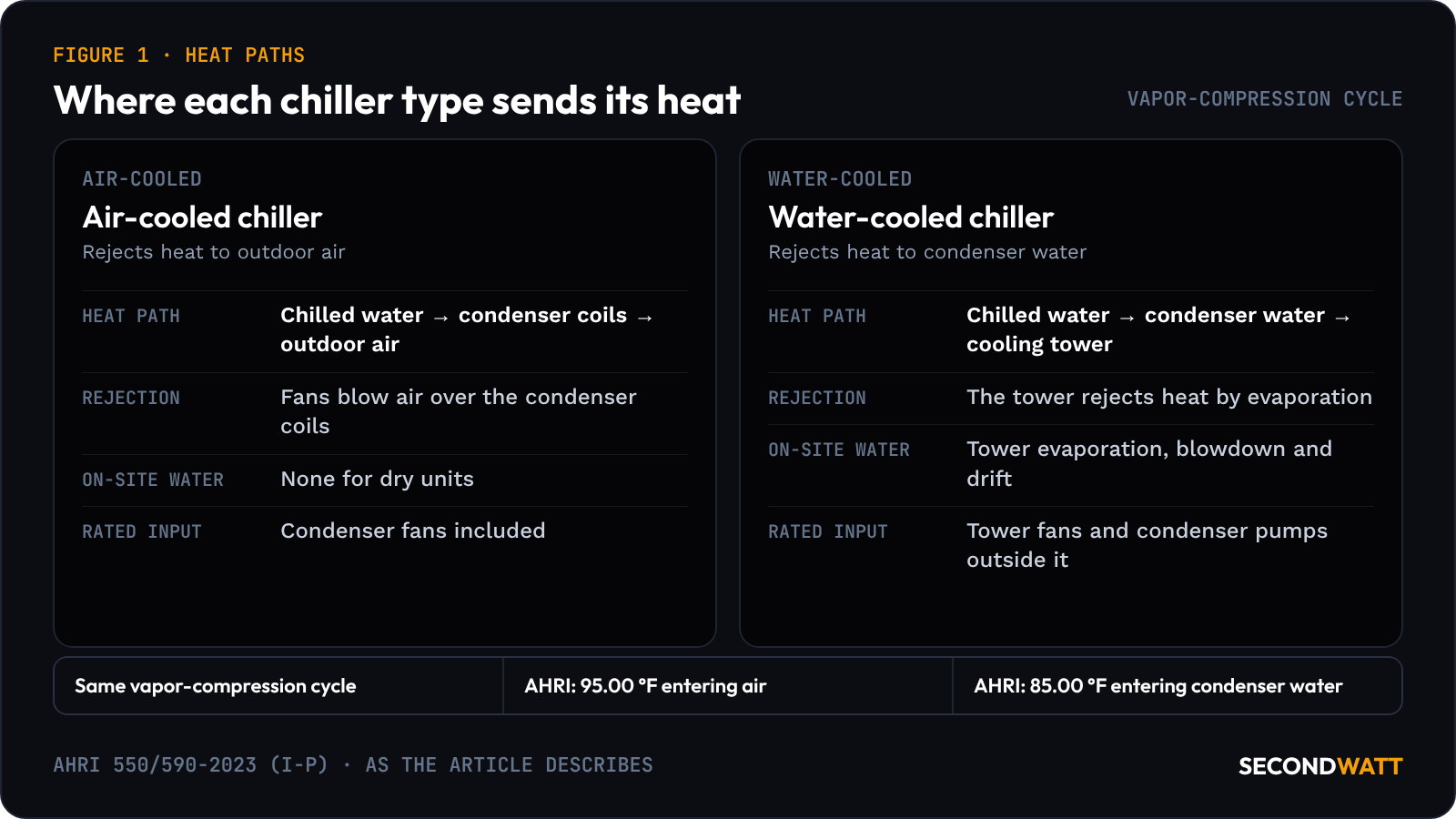
An air-cooled chiller and a water-cooled chiller make chilled water the same way: a vapor-compression cycle pulls heat out of the water loop. The difference is where the condenser sends that heat. An air-cooled unit blows outdoor air across condenser coils. A water-cooled unit hands the heat to condenser water, and a cooling tower rejects it by evaporation.
That one difference drives the trade-offs. Water-cooled chillers carry lower full-load kW per ton, but their cooling towers consume water. Dry air-cooled chillers use no water to reject heat, but they sit outdoors and draw more power per ton at their rating points.
Neither type is right everywhere; the site's water, climate and space decide. The chillers hub lists the models discussed here.
Key Takeaways
- Each type is rated at its own standard conditions. AHRI 550/590 (I-P) rates air-cooled chillers at 95.00 °F entering air and water-cooled ones at 85.00 °F entering condenser water.
- A water-cooled rating leaves the tower out. Rated input includes auxiliary power such as fans, so air-cooled ratings carry condenser fans; tower fans and condenser pumps sit outside water-cooled ratings.
- At code-minimum ratings, water-cooled draws about 47% of air-cooled power. Washington's energy code (Path A) allows about 1.188 kW/ton full-load air-cooled (10.100 EER) and 0.560 for centrifugals from 300 tons.
- The energy a tower saves costs water. In a 1,000-ton example at those minimums, water-cooled saves about 5.50 GWh a year but needs about 18.7 million gallons of make-up water.
- Adiabatic operation falls outside AHRI's chiller rating standard. Chillers are excluded when the condenser is actively adiabatically cooled, so adiabatic free-cooling ratings rest on each maker's stated conditions.
What an air-cooled chiller and a water-cooled chiller are#
Both are water-chilling packages, as section 3.2.17 of AHRI Standard 551/591-2026 (SI) defines them. They are factory-made assemblies that use a vapor-compression cycle "to remove heat from water and reject the heat to a cooling medium, usually air or water." The cooling medium is what separates the two types in a chilled water system.
AHRI's ACCL program page says an air-cooled package transfers heat "from a cold water fluid circulating system to the air." Trane's Ascend ACR page describes fans that blow air over the condenser coils and dissipate the heat into the atmosphere. Johnson Controls' YVAM operation guide describes the YORK YVAM's condenser sections as microchannel flat aluminum tube and fin, each with two speed-controlled fans.
AHRI's WCCL program page says a water-cooled package transfers heat "from a cold water fluid circulating system to a warm water fluid circulating system." That warm loop runs to a cooling tower. DOE FEMP's Best Management Practice #10 notes that cooling towers reject heat "through the process of evaporation" and therefore, by design, use significant amounts of water.
Compressor types and capacity ranges#
The five families below span screw and centrifugal designs, with and without magnetic bearings. Each capacity is the maker's own, with region or series where documents differ.
Five chiller families: compressor, capacity and refrigerants (OEM documents: York YVAM page, engineering guide 160.88-EG1 (526) 05/2026 and operation guide; Trane RLC-PRC049K-EN 04/2022 and US page; Carrier 19MV page; Daikin CAT-641 11/2025; Vertiv MKA4L0UKAFCze Rev. 4-05/2024 and SL-71060 R09/24)#
| Model | Heat rejection | Compressor | Capacity or range as the OEM states it | Refrigerants (OEM) |
|---|---|---|---|---|
| YORK YVAM | Air-cooled | Single-stage centrifugal, magnetic bearings, permanent-magnet motor | 250 to 500 tons capacity (880 to 1,750 kW), 60 Hz, single compressor (engineering guide); 250 to 475 TR capacity (880 to 1,670 kW) on York's product page | R-134a and R-1234ze (engineering guide) |
| Trane Sintesis RTAF | Air-cooled | Helical-rotary screw | 115 to 520 nominal tons at 60 Hz (catalog); 115 to 500 tons (US page) | R-134a or R-513A (catalog); R-513A (US page) |
| Vertiv Liebert AFC | Air-cooled; chiller and free-cooling versions, with adiabatic kits in the EMEA range | Inverter screw (EMEA); screw with optional inverter compressors (North America) | 650 to 2,200 kW cooling capacity (EMEA brochure, 50 Hz data); 900 to 1,800 kW cooling capacity (North America datasheet headline; its preliminary 60 Hz table rows list 1,247 to 1,958 kW nominal cooling capacity) | R134a, R513A, R1234ze (EMEA); R513A, R1234ze, R515B (North America) |
| Carrier AquaEdge 19MV | Water-cooled | Two-stage back-to-back centrifugal; magnetic bearings on select models | 150 to 700 tons capacity (527 to 2,461 kW) | R-513A, R-515B, R-1234ze(E) |
| Daikin Magnitude WME-C | Water-cooled | Single-stage, direct-drive magnetic-bearing centrifugal; single, dual or quad compressors | 250 to 3,000 tons cooling capacity (900 to 10,500 kW) | R-513A, R-515B |
Rows come from York's YVAM page and engineering guide 160.88-EG1, Trane's Sintesis catalog RLC-PRC049K-EN and US Sintesis page, the Carrier 19MV specifications page, Daikin catalog CAT-641, and Vertiv's EMEA brochure and North America datasheet.
Scroll compressors appear in air-cooled ranges too: Carrier's 30RB page shows the AquaSnap 30RB using them across 60 to 300 tons.
Of the two Vertiv documents, only the EMEA brochure mentions adiabatic pads; check which regional version an offer describes.
How chiller efficiency is rated#
Chiller efficiency is usually quoted three ways. kW/ton is electrical input per ton of cooling, and lower is better. COP is cooling output divided by electrical input, both in kW. EER is Btu/h of cooling per watt of input.
Appendix B.9 of the NIST Guide to the SI gives one ton of refrigeration as 12,000 Btu/h, or 3.516853 kW of cooling capacity. So COP ≈ 3.51685 ÷ kW/ton, and kW/ton = 12 ÷ EER.
Ratings in kW/ton and EER follow the I-P edition, ANSI/AHRI 550/590-2023, whose Table 4 sets the standard rating conditions. Chilled water enters at 54.00 °F and leaves at 44.00 °F for both types. Water-cooled units see condenser water entering at 85.00 °F and leaving at 94.30 °F. Air-cooled units see 95.00 °F entering dry-bulb air, at sea-level pressure.
The SI edition, AHRI 551/591-2026, rates at 30.00 °C (86.0 °F) entering condenser water, so the two editions' points are not exact conversions.
The air-cooled condenser has to reject heat into warmer air than the water a tower supplies. Table 4 shows it: chillers rated without a condenser assume 125.00 °F saturated discharge for air-cooled and 105.00 °F for water-cooled. A higher condensing temperature means more compressor lift and more kW per ton. As a general rule in Daikin's WME-C catalog 632-5, dated 01/2024, a 1 °F drop in entering condenser water temperature cuts chiller energy by 2%.
0.52 kW/ton — the full-load figure the Carrier AquaEdge 19MV achieves or beats at AHRI conditions, a COP of 3.51685 ÷ 0.52 ≈ 6.76; Carrier notes its claims may not apply to every model.
Carrier's 2024 19MV brochure states that rated figure, and the 19MV's IPLV of under 0.31 kW/ton (COP 11.3), "at AHRI conditions."
Code minimums put both types on one basis. Under Path A, Washington State's energy code requires air-cooled chillers to reach at least 10.100 EER at full load, which is 12 ÷ 10.100 ≈ 1.188 kW/ton. On the same path, water-cooled centrifugals of 300 tons or more may draw no more than 0.560 kW/ton at full load, according to Table C403.3.2(3) of WAC 51-11C-403323, effective 7 September 2024. The table's footnote calls it a replica of ASHRAE 90.1 Table 6.8.1-3.
Air-cooled values apply at the referenced test procedure's standard rating conditions; centrifugal limits shift for nonstandard rating conditions, within Section C403.3.2.4's range. A chiller must meet both its full-load and IPLV requirement, and Path B trades a looser full-load limit for a tighter IPLV.
Section 3.2.16 of the AHRI standard says Total Input Power includes auxiliary power such as fans and excludes integral pumps. An air-cooled rating therefore carries its condenser fans. A water-cooled rating covers the package, while the tower fans and condenser pumps sit outside it.
Air-cooled vs water-cooled chiller comparison#
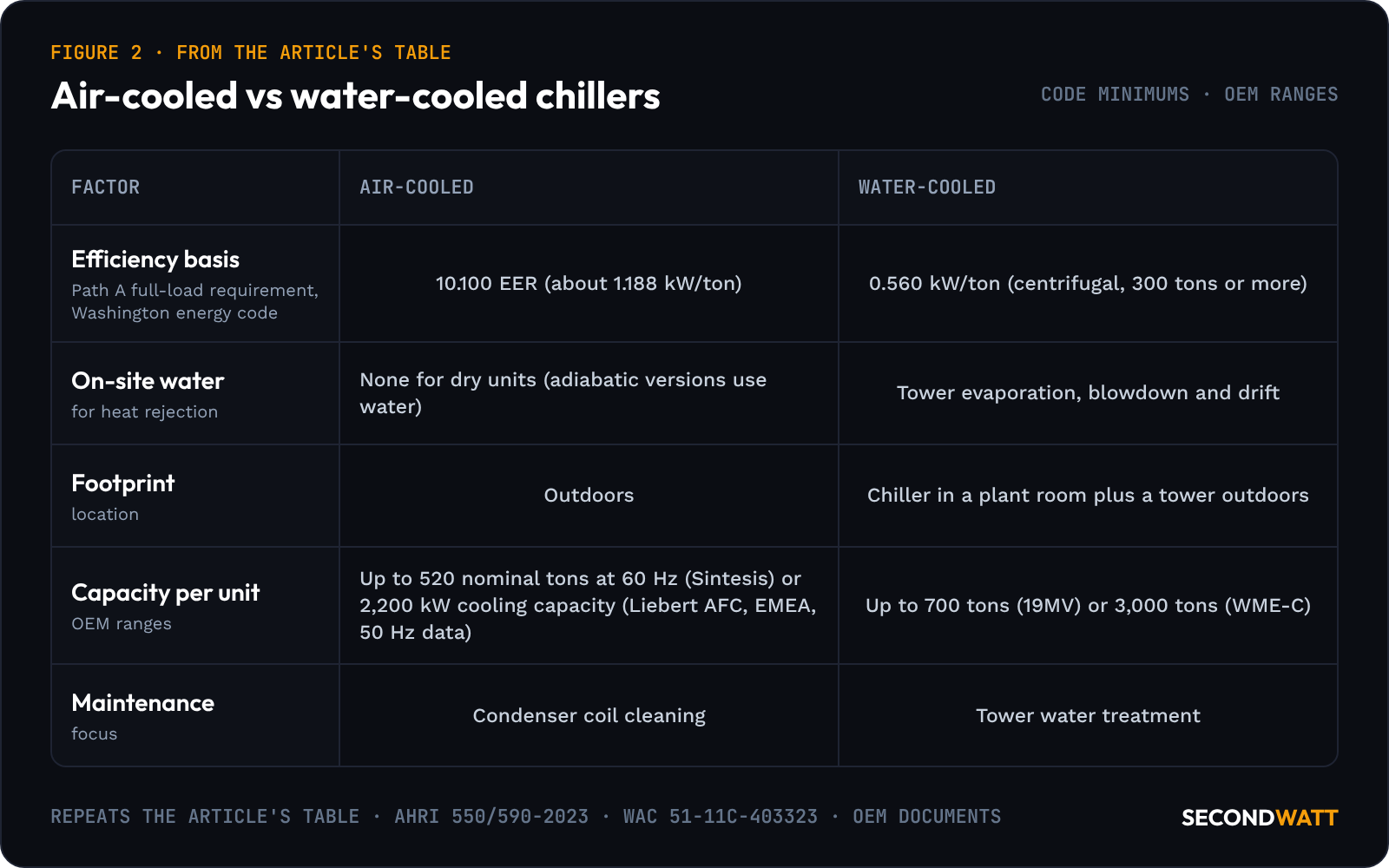
The table compares both types.
Air-cooled vs water-cooled chillers: rating basis, water, space and upkeep (AHRI 550/590-2023 (I-P); WAC 51-11C-403323; OEM documents as listed above; DOE FEMP BMP #10; 10 NYCRR 4-1.4)#
| Factor | Air-cooled | Water-cooled |
|---|---|---|
| AHRI standard rating basis (I-P) | 95.00 °F entering air; zero condenser fouling allowance | 85.00 °F entering, 94.30 °F leaving condenser water; 0.000250 h·ft²·°F/Btu tower fouling allowance |
| What rated input power covers | All unit components, condenser fans included (integral pumps excluded) | Chiller package (integral pumps excluded); tower fans and condenser pumps are outside it |
| Path A full-load requirement (Washington energy code) | 10.100 EER (about 1.188 kW/ton) | 0.560 kW/ton (centrifugal, 300 tons or more) |
| On-site water for heat rejection | None for dry units (adiabatic versions use water); YVAM marketed with "zero water consumption" | Tower evaporation, blowdown and drift |
| Location and footprint | Outdoors; a 557-ton Liebert AFC CH3175 is 13,386 × 2,362 × 2,896 mm, 11,680 kg estimated dry | Chiller in a plant room (many 19MV models fit through a 72 × 80 in double door fully assembled) plus a tower outdoors |
| Capacity per unit (OEM ranges) | Up to 520 nominal tons at 60 Hz (Sintesis catalog) or 2,200 kW cooling capacity in one frame (Liebert AFC, EMEA, 50 Hz data) | Up to 700 tons (19MV) or 3,000 tons (WME-C) |
| Noise data | YVAM 65 dBA at 10 m at full load; Liebert AFC 78.9 to 83.1 dB(A) at 1 m (North America) | 19MV under 82 dBA (distance not stated) |
| Cold-weather free cooling | Integral free-cooling coils on units such as the Liebert AFC | Waterside economizer heat exchanger using cold tower water |
| Maintenance focus | Condenser coil cleaning | Tower water treatment; in New York, a maintenance program and plan under ASHRAE 188-2015 |
The YVAM's "zero water consumption" is a claim Johnson Controls makes in its One design, any location feature. Trane's July 2026 catalog AC-PRC005E-EN says the Ascend ACR's transverse modular coils give easy access for coil cleaning.
Tower water needs a treatment program. Typical programs include corrosion and scaling inhibitors along with biological fouling inhibitors, according to FEMP's Best Management Practice #10. New York required owners to obtain or update a maintenance program and plan for each cooling tower by 1 September 2016, and requires one before a newly installed tower first starts up. Under 10 NYCRR 4-1.4(a), effective 6 July 2016, the plan follows section 7.2 of ANSI/ASHRAE 188-2015, on legionellosis risk management.
Daikin's catalog 632-5 says a waterside economizer uses a heat exchanger outside the chiller when cold tower water is on hand. It adds that these systems are commonly used for ASHRAE 90.1 compliance. Daikin's CAT-641 catalog says that in inverted duty (condenser entering water below evaporator leaving water), the WME-C needs no waterside economizer.
The water-for-energy trade, worked#
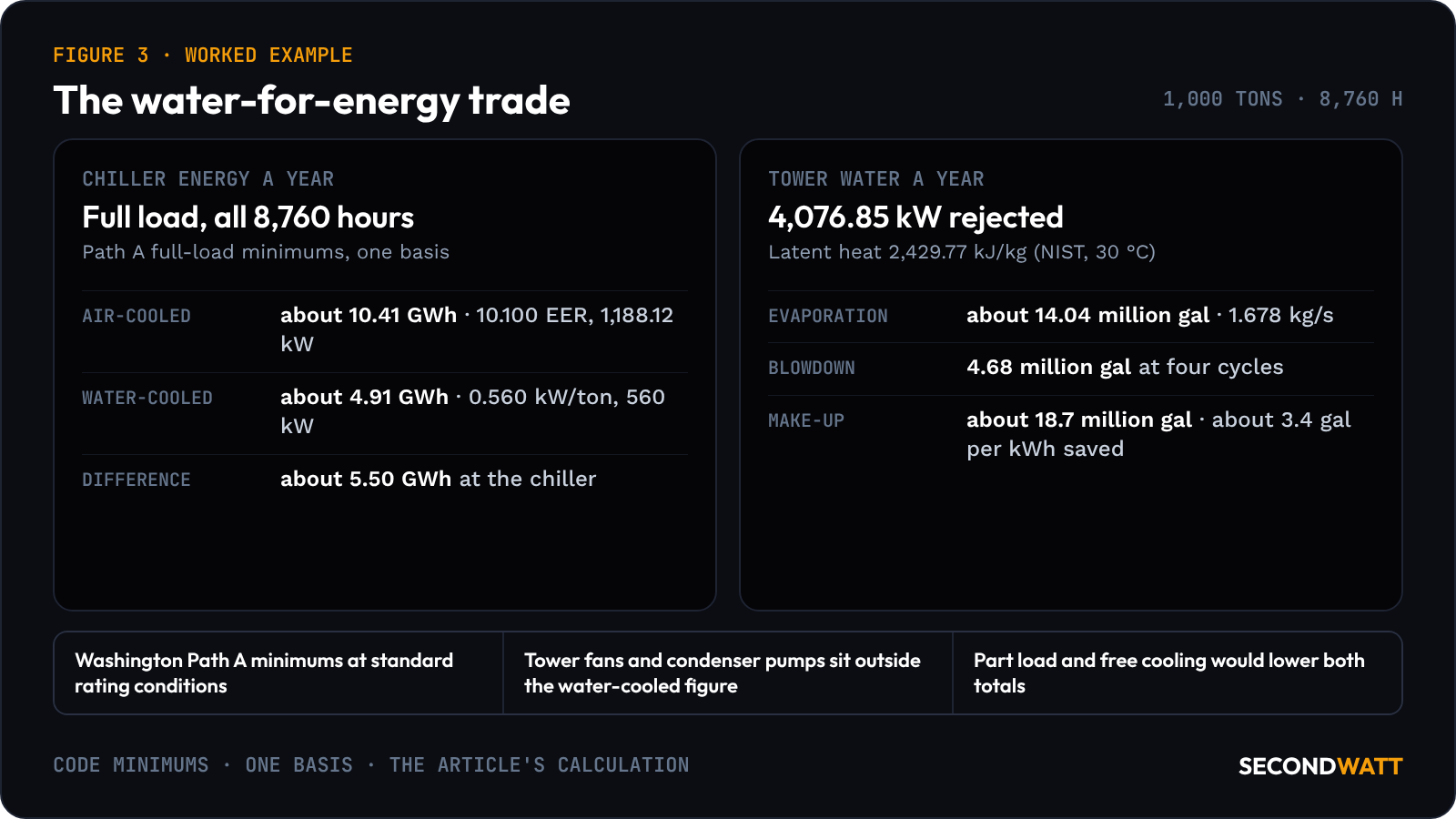
This example sets those Path A full-load minimums against the water a cooling tower evaporates. Both come from one code table at standard rating conditions. It assumes, for illustration, full load for all 8,760 hours; part load, free cooling and better-rated chillers would lower both totals.
The load is 1,000 tons: 1,000 × 3.51685 = 3,516.85 kW of cooling.
Air-cooled, at 10.100 EER: 1,000 tons × 12 ÷ 10.100 ≈ 1,188.12 kW of input at full load. Over 8,760 hours that is about 10.41 GWh.
Water-cooled, at 0.560 kW/ton: 560 kW of input at full load × 8,760 hours = 4,905,600 kWh, about 4.91 GWh.
The difference is about 5.50 GWh a year at the chiller. Tower fans and condenser pumps sit outside the water-cooled figure and narrow that gap.
The tower rejects the cooling load plus the chiller's input: 3,516.85 + 560 = 4,076.85 kW. Water's latent heat of vaporization at 30 °C, from the NIST Chemistry WebBook's saturation properties of water, is 2,555.5 − 125.73 = 2,429.77 kJ/kg. If all of that heat leaves as evaporation, the tower evaporates 4,076.85 ÷ 2,429.77 ≈ 1.678 kg/s.
Over 8,760 hours that is about 52.9 million kg. At NIST's 995.61 kg/m³ and 3.785411784 L per US gallon, it comes to about 14.04 million gallons a year.
1% — of recirculating water flow, approximately, is a cooling tower's typical evaporation rate for every 10 °F of temperature drop it achieves.
For this tower's heat load, the approximation from section 6.3 of EPA's October 2012 WaterSense at Work lands within 5% of the latent-heat result. Blowdown comes on top. EPA defines cycles of concentration as make-up water divided by blowdown, and make-up as evaporation plus drift, blowdown, leaks and overflows. Ignoring drift and leaks, blowdown equals evaporation ÷ (cycles − 1).
Many systems operate at two to four cycles, according to FEMP's Best Management Practice #10. At four cycles, blowdown is 14.04 ÷ 3 = 4.68 million gallons, and make-up is about 18.7 million gallons a year. That is about 3.4 gallons of make-up water per kWh of chiller energy saved in this example.
Free cooling and adiabatic options#
Free cooling lets outdoor air or cold tower water carry the load while compressors slow or stop. The Liebert AFC's free-cooling coils use outdoor air as the primary source of cooling. Vertiv's EMEA brochure says that in some models the full free-cooling temperature, below which the compressors can switch off, can be above 10 °C.
Adiabatic pads extend those hours. On the EMEA Liebert AFC, the pads pre-cool the air entering the coils, so the unit runs more hours in free cooling. At 29 °C inlet and 20 °C leaving water, free cooling runs up to around 32 °C ambient, Vertiv says. In its Safe Mode, mechanical cooling alone carries full load during water shortages.
Adiabatic operation sits outside AHRI's standard: section 2.2.3 of AHRI 551/591-2026 excludes water-chilling packages "when the Condenser is actively adiabatically-cooled." Compare adiabatic units on each maker's printed conditions, and ask every bidder for the same ones.
Free-cooling coils also cost something at design ambient. At 95 °F ambient, 82 to 66 °F fluid, 30% ethylene glycol and 60 Hz, Vertiv's North America sheet lists the chiller-only CH3175 at 557 tons capacity and 474 kW input (EER 14.1). The free-cooling FH3175 lists 547 tons capacity and 490 kW input (EER 13.4). Vertiv marks the data preliminary.
One design skips the coils. A May 2023 Johnson Controls release says the YVAM's magnetic bearings run very efficiently at low lift. As a result, the YVAM needs no free cooling coils to perform like air-cooled chillers with integral water-side economizers.
Choosing a chiller type for a data center site#
Water availability is the first check. A water-cooled plant needs make-up water every hour it runs, plus treatment and a discharge route for blowdown. Where water is scarce or contested, an air-cooled plant removes that demand. A site that also runs gas turbines has their water consumption to budget too.
Climate sets the efficiency gap and the free-cooling hours. Hot outdoor air raises an air-cooled unit's condensing temperature, and cold months add free-cooling hours on either type.
The checks that settle most site decisions:
- Space: roof or yard area for air-cooled units, or a plant room plus tower area for water-cooled.
- Unit size against redundancy: smaller units give finer N+1 steps; see data center redundancy.
- Supply temperature: warmer leaving water reduces lift and improves efficiency, according to Daikin catalog 632-5.
- Liquid cooling: check the supply temperature that CDUs and direct liquid cooling need against each chiller's operating envelope.
- Used units: check condition records and the rating basis; see buying used chillers.
Johnson Controls' March 2025 European launch markets the YVAM for chilled water from +15 °C to 30 °C, which it says covers cold air aisles through immersion and direct liquid cooling. A standard rating at 44.00 °F leaving water does not describe operation at those temperatures. Ask for an NPLV or an application rating at the site's own leaving water temperature. The liquid cooling hub covers the rack side.
FAQ: air-cooled and water-cooled chillers#
Which is more efficient, an air-cooled or a water-cooled chiller?#
Water-cooled, when both sit at code minimums, though the gap narrows at part load. Under Washington's Path A, air-cooled chillers of 150 tons or more need a part-load (IPLV) rating of at least 14.000 EER, about 0.857 kW/ton (12 ÷ 14.000). Centrifugals of 400 tons or more may draw up to 0.500 kW/ton part-load (IPLV) on the same path. That is a gap of about 0.357 kW/ton, against about 0.628 at full load.
Under section 5.4.3 of AHRI 551/591-2026, IPLV weights efficiency at 100, 75, 50 and 25% load by 1, 42, 45 and 12%, based on common building types and weather in 29 US cities. NPLV is for units not designed or selected to operate at standard conditions.
How much water does a water-cooled chiller plant use?#
Make-up water rises with load and compressor heat, and falls as cycles of concentration rise. FEMP's Best Management Practice #10 says raising cycles from three to six cuts make-up water by 20%. Section 6.3 of EPA's WaterSense guidance says drift can run 0.05 to 0.2% of the flow through the tower, and modern drift eliminators can cut it below 0.005%.
Can air-cooled chillers serve a large data center?#
Yes, with several units. At top-of-range nominal capacity, a 1,000-ton load needs two 520-ton Sintesis units (60 Hz), or two 2,200 kW Liebert AFC frames (EMEA, 50 Hz data): 3,516.85 ÷ 2,200 ≈ 1.6. A single 3,000-ton WME-C covers 1,000 tons on its own. Each rating sits on its maker's basis, so treat these counts as rough, and add a unit for N+1 either way.
What does a magnetic-bearing chiller change?#
It removes the oil system. Daikin's CAT-641 catalog says the WME-C's oil-free design removes mechanical wear and the need for oil maintenance, with energy savings up to 40% compared with traditional centrifugal chillers. Johnson Controls' 2023 release says the YVAM's lubrication-free design reduces the costs of routine maintenance. Both savings claims are the makers' own.
Are low-GWP refrigerants required for new chillers?#
In the US, EPA's Technology Transitions rule says no person may manufacture or import stand-alone chillers for comfort cooling that use a regulated substance, or a blend containing one, with a global warming potential of 700 or greater. That restriction took effect on 1 January 2025. Installing comfort cooling chiller systems with such refrigerants, or having one installed as designer, owner or operator, is barred from the same date.
Under 40 CFR 84.54, self-contained products and systems for data center, information technology equipment facility and computer room cooling follow from 1 January 2027. Section 84.54(e) counts assembling a system for the first time from used or new components as an installation, upon charging to full charge. Under 40 CFR 84.56, equipment in existence in the US before 27 December 2020 is exempt.
Sourcing chillers#
SecondWatt publishes equipment research and helps buyers source power equipment; it earns a fee when a sale it arranges closes. Buyers can request equipment and state the heat-rejection type, capacity and leaving water temperature they need, and ask for every offer on one rating basis. Owners with chillers to place can start at sell equipment.