mtu Series 4000 20V4000 L64 gas
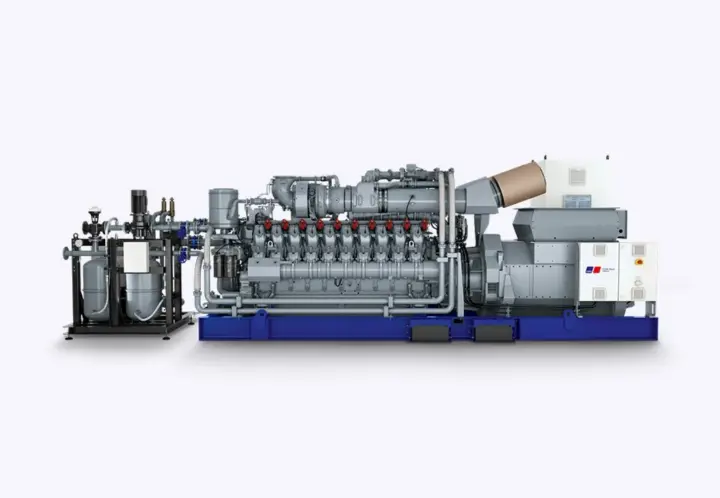
A packaged 2,521 kW gas genset rising to 2.8 MW in 2026, with a 45-second start to full load
mtu Series 4000 20V4000 L64 gas is one of 23 gas engines tracked in the SecondWatt catalogue, each with specifications, lead times and indicative secondary-market pricing.
mtu Series 4000 20V4000 L64 gas generator set: 2,521 kW at 60 Hz rising to 2.8 MW in 2026, 45-second start and 84,000 hours to major overhaul.
This is a gas engine, not a diesel. The mtu Series 4000 name is better known for diesel, and the 16V4000 diesel genset is covered separately under generators. The L64 gas configuration is a different fuel, a different cylinder count and a different duty, so do not read across from the diesel sheet. The current brochure rates the 20V4000 GS (L64) at 2,521 kW at 60 Hz and 2,535 to 2,538 kW at 50 Hz, with electrical efficiency up to 44.4% and total combined heat and power efficiency of 90.0 to 90.3%. Bore is 170 mm, stroke 210 mm, rated speed 1,500 rpm. Dry weight is 21,000 kg in a 6,600 by 2,000 by 2,400 mm package, and a container version is offered. In October 2025 Rolls-Royce announced a 2026 version at 2.8 MW with a 45-second start to full load, described as a solution for the 60 Hz market, primarily North America. The arithmetic supports the claim: performance is stated as ten percent above the previous version, and 2,521 multiplied by 1.10 is 2,773 kW, which rounds to the 2.8 MW headline. Existing Series 4000 gas sets carry a 120-second fast start. Rolls-Royce also publishes 84,000 operating hours lifetime to major overhaul, an interval its large-bore gas engine competitors do not publish. It is a vendor claim.
Why it matters
It is the only purpose-built data center gas product among the large-bore and European makers, and the only one at generator-yard scale. The 45-second start from 2026 is a capability no competing medium-speed gas engine claims. The published 84,000 hour overhaul interval is also the only one in this class a buyer can model from.
Who buys it
Data center operators who want gas prime or continuous power in a package rather than an erected plant, and grid operators buying fast-responding capacity. At 2.8 MW it fits a conventional generator yard, which none of the 9 to 19 MW medium-speed engines do. Rolls-Royce names data centers, emergency power, continuous supply and peak-load grid stability.
Role in the data center
Unlike the medium-speed engines it competes with, this unit arrives as a package and can sit in a conventional generator yard. A container version is offered. That makes it the only gas engine in this class that competes with a diesel standby set on installation terms rather than requiring an engineered plant. Rolls-Royce markets it for data centers, emergency power, continuous supply and grid stability at peak load.
Key specifications
| Electrical output, 60 Hz | 2,521 kW |
|---|---|
| Electrical output, 50 Hz | 2,535 to 2,538 kW |
| Electrical output, 2026 version | 2.8 MW at 60 Hz |
| Electrical efficiency | up to 44.4 % |
| Total CHP efficiency | 90.0 to 90.3 % |
| Bore x stroke | 170 x 210 mm |
| Rated speed | 1,500 rpm |
| Start to full load, 2026 version | 45 seconds |
| Start to full load, current sets | 120 seconds |
| Dimensions L x W x H | 6,600 x 2,000 x 2,400 mm |
| Dry weight | 21,000 kg |
| NOx, engine-out | below 500 mg/Nm3 at 5% O2 dry |
| Methane number required | 72 standard, 80 hot and humid MN |
| Lifetime to major overhaul | 84,000 operating hours (vendor claim) |
Technical summary
Electrical output: 2,521 kW at 60 Hz, 2,535 to 2,538 kW at 50 Hz, per the current brochure. 2026 version: 2.8 MW at 60 Hz, ten percent above the previous version, per Rolls-Royce. Electrical efficiency: up to 44.4%, with the Series 4000 gas range spanning 42.8 to 44.4%. Total CHP efficiency: 90.0 to 90.3%. Configuration: 20-cylinder V, bore 170 mm, stroke 210 mm; rated speed 1,500 rpm. Start to full load: 120 seconds on current sets, 45 seconds on the 2026 version. Dimensions: 6,600 x 2,000 x 2,400 mm; dry weight 21,000 kg; container version available. NOx: below 500 mg/Nm3 at 5% O2 dry, engine-out, equal to 90.4 ppmvd at 15% O2. Methane number: 72 standard, 80 required for hot and humid conditions. Overhaul: 84,000 operating hours lifetime to major overhaul, a vendor claim. Gearbox: the latest version removes the gearbox the earlier 60 Hz package required.
Major variations
The Series 4000 gas range ships as 8V, 12V, 16V and 20V in the L64 configuration, rating 997 kW, 1,506 kW, 2,012 kW and 2,521 kW at 60 Hz. A container version is offered across the range. The most important variation is generational rather than mechanical. The 2026 20V4000 raises output about ten percent to 2.8 MW, cuts start time from 120 seconds to 45, and removes the gearbox. Two units badged 20V4000 L64 can differ on all three points.
Pricing and availability
Comparable secondary-market band: 2000–3150 $ per kW installed. Trend: stable The hour meter sets the price in this category, not the year. An engine three years from a major overhaul is worth materially less than an older unit fresh out of one. There is no observed used market at this size, so no used band can be quoted. Lead time, new: No published lead time and no dated order for this engine. Rolls-Royce announced the 2026 version in October 2025 for 2026 availability, which is a product launch interval rather than an order-to-delivery quotation and should not be read as one.. Lead time, used or refurbished: No used market observed for the gas configuration, so no used lead time can be stated..
Lifecycle and maintenance
Rolls-Royce publishes 84,000 operating hours lifetime to major overhaul for the Series 4000 gas range. Wartsila and Bergen publish no equivalent interval for their large-bore gas engines, and it is a vendor claim. At continuous duty that is roughly 9.6 years of running. The number is genuinely useful because it makes remaining life computable from an hour meter, which is how condition is priced in this category. Wartsila and Bergen publish nothing equivalent, so an mtu package is the only unit in this class a buyer can assess against a published interval rather than a negotiated service agreement.
Thermal and emissions profile
mtu publishes NOx below 500 mg/Nm3 at 5% O2 dry, engine-out. Bergen quotes the same basis and Wartsila quotes 90 ppm at 15% O2; all three are the same number: 500 x 22.414/46 = 243.6 ppmv at 5% O2, then x (20.9-15)/(20.9-5) = 0.3711 gives 90.4 ppmvd at 15% O2. 40 CFR 60 Subpart JJJJ caps non-emergency spark-ignition natural gas engines of 500 HP or more, built on or after 1 July 2010, at 82 ppmvd at 15% O2. At 90.4 ppmvd the engine is above that ceiling and needs selective catalytic reduction for non-emergency duty. Emergency-standby duty sits under a different Table 1 row, so the permit path depends on how the set is operated. Total CHP efficiency of 90.0 to 90.3% is published, which matters where the heat has a buyer.
Common failure points
- Generation misidentification at purchase — A unit bought as a fast-start set delivers 120-second rather than 45-second start, or arrives with a gearbox
- Gas quality and methane number — Knock, retard and derate on a site running hotter and more humid than the specification assumed
- SCR catalyst and urea dosing system — Stack NOx exceeds the permit for non-emergency duty
- Gearbox on pre-2026 60 Hz packages — Noise, vibration and a parasitic loss between the 1,500 rpm engine and the alternator
- Cylinder heads and exhaust valves — Widening exhaust temperature spread across the 20 cylinders
- Lubricating oil condition — Rising iron, chromium and viscosity between oil changes
Inspection checklist
Hours against the 84,000 hour lifetime to major overhaul: the only published interval in this class, so compute remaining life directly. Confirm which generation the package is: the 2026 version runs 45-second start and no gearbox, earlier 60 Hz packages used one. Gearbox condition on any pre-2026 60 Hz package: a 1,500 rpm engine driving an 1,800 rpm alternator has a serviceable gearbox. Hours since top-end and head change-out: record per-bank hours across all 20 cylinders. Oil analysis trend across the last 12 samples: rising iron and chromium indicate liner and ring wear. Cylinder liner wear at top ring reversal: measure against the 170 mm nominal bore. Turbocharger shaft play and compressor wheel erosion: record the reading as a trend across at least 2 outages. Charge air cooler fouling: falling charge pressure shows up as efficiency below the 44.4% figure.
Procurement channels
Rolls-Royce Solutions America and the established mtu distributor network. This is the deepest North American channel among large-bore gas engine makers, and the only one that resembles a conventional dealer footprint rather than a direct project sale. Specify the generation on the order. The 2026 version at 2.8 MW with a 45-second start and no gearbox is a different machine from the brochure unit at 2,521 kW with a 120-second start.
Regional notes
Rolls-Royce describes the 2026 20V4000 as a 45-second fast-start solution for the 60 Hz market, primarily North America. The brochure publishes both 50 Hz and 60 Hz ratings. Rated speed is 1,500 rpm, which is why earlier 60 Hz packages carried a gearbox.