Caterpillar G3520K
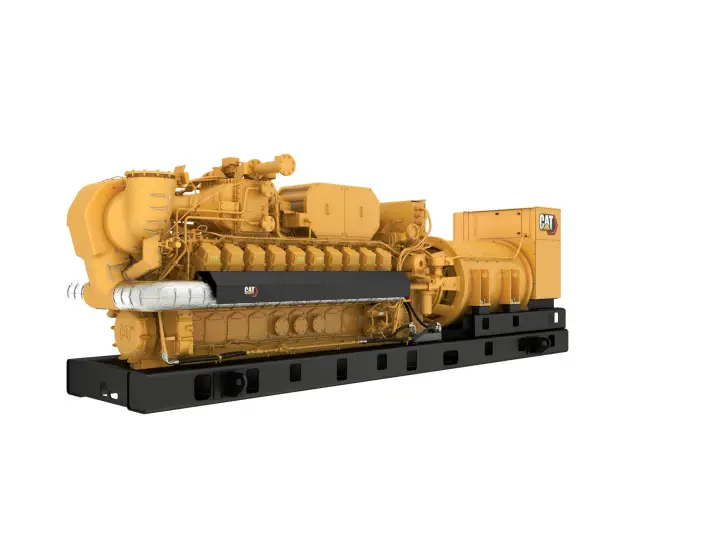
2,552 ekW continuous at up to 46.3 percent electrical efficiency, on a 1.00 g/bhp-hr NOx tune that sits exactly on the Subpart JJJJ ceiling
Caterpillar G3520K is one of 23 gas engines tracked in the SecondWatt catalogue, each with specifications, lead times and indicative secondary-market pricing.
Caterpillar G3520K: 2,552 ekW continuous at 1.0 pf, 60 Hz, up to 46.3 percent electrical efficiency. Specs, used pricing and inspection points.
The Cat G3520K is a 2,552 ekW continuous gas generator set rated at 1.0 power factor for 60 Hz, or 2,536 ekW with the pumps option, inside a published band of 2,552 to 2,567 kW. It is the highest-efficiency machine Caterpillar publishes in this scope: 45.3 to 46.3 percent electrical in the High Efficiency build and 44.9 to 45.8 percent in the High Response build. Fuel consumption at full load runs 7,474 to 7,638 Btu/ekW-hr on High Efficiency, the lowest published full-load heat rate in the Caterpillar G3500 gas range. The engine is a 170 mm bore by 215 mm stroke unit of 97.6 L. That is the long-stroke H-series block, not the 190 mm-stroke block used by the G3520C, so the K suffix here does not mean what the K suffix means on the CG line. Compression ratio is 10.5 on High Response or 11.0 on High Efficiency, and dry weight is 23,700 kg in a 7,375 by 1,830 by 2,463 mm package. Caterpillar names the G3520K on its own natural gas campaign page for electric power alongside the G3516 FAST RESPONSE, the CG170B-20 and the CG260-16, and that page names data centers explicitly. POWER Magazine also names the G3520K at 2.5 MW per unit among the machines data center developers are using to avoid three-to-seven-year interconnection queues.
Why it matters
Heat rate compounds. At a high capacity factor, the roughly 1,100 Btu/ekW-hr gap between this set and a G3520C becomes the dominant line in a twenty-year fuel budget, which is exactly the kind of difference undiscounted comparisons hide. It is also one of only four models Caterpillar names on its own data center gas page.
Who buys it
Developers building multi-megawatt behind-the-meter plants who are optimising fuel cost across a high capacity factor rather than buying a standby asset. Industrial and municipal continuous-duty buyers. Anyone whose economics turn on heat rate, because the published 7,474 Btu/ekW-hr at full load is the number that separates this set from the rest of the Caterpillar gas range.
Role in the data center
Continuous behind-the-meter prime power in multi-unit plants at roughly 2.5 MW per set. Caterpillar names the G3520K on its own data center gas campaign page, and POWER Magazine names it at 2.5 MW per unit among the machines developers are using to bypass interconnection queues. The trade against the G3516 FAST RESPONSE is duty and response. This set is optimised for fuel cost at a high capacity factor; the G3516 is optimised for a cold start in under eight seconds.
Key specifications
| Continuous rating | 2,552 (3,145) ekW (kVA) at 1.0 pf, 60 Hz |
|---|---|
| Continuous rating with pumps | 2,536 (3,125) ekW (kVA) at 1.0 pf |
| Published rating band | 2,552 to 2,567 kW |
| Electrical efficiency, High Efficiency build | 45.3 to 46.3 percent at 1.0 pf |
| Electrical efficiency, High Response build | 44.9 to 45.8 percent at 1.0 pf |
| Heat rate at 100 percent load, High Efficiency | 7,474 to 7,638 Btu/ekW-hr |
| Heat rate at 100 percent load, High Response | 7,556 to 7,655 Btu/ekW-hr |
| Bore | 170 mm (6.7 in) |
| Stroke | 215 mm (8.5 in) |
| Displacement | 97.6 L (5,956 cu in) |
| Compression ratio | 10.5 High Response or 11.0 High Efficiency ratio |
| NOx | 246 (0.50) or 504 (1.00) mg/Nm3 (g/bhp-hr) |
| Dimensions | 7,375 x 1,830 x 2,463 mm |
| Dry weight | 23,700 (52,250) kg (lb) |
| Subpart JJJJ NOx ceiling for this class | 1.0 g/HP-hr or 82 ppmvd at 15 percent O2 regulatory limit |
Technical summary
Continuous rating: 2,552 ekW (3,145 kVA) at 1.0 power factor, 60 Hz. Continuous rating with pumps: 2,536 ekW (3,125 kVA). Published rating band: 2,552 to 2,567 kW. Electrical efficiency: 45.3 to 46.3 percent High Efficiency; 44.9 to 45.8 percent High Response. Heat rate at 100 percent load: 7,474 to 7,638 Btu/ekW-hr High Efficiency. Bore and stroke: 170 mm by 215 mm; displacement 97.6 L (5,956 cu in). Compression ratio: 10.5 High Response or 11.0 High Efficiency. NOx: 246 mg/Nm3 (0.50 g/bhp-hr) or 504 mg/Nm3 (1.00 g/bhp-hr). Dimensions: 7,375 by 1,830 by 2,463 mm. Dry weight: 23,700 kg (52,250 lb). Engine speed: the 60 Hz sheet lists 1,500 rpm, which does not reconcile with 60 Hz; see the variations note.
Major variations
Two build variants are published: High Efficiency at 11.0 compression, reaching 46.3 percent electrical, and High Response at 10.5 compression. Each is also quoted with and without pumps, a 16 ekW difference between 2,552 and 2,536 ekW. One Caterpillar document inconsistency is worth knowing before purchase. Caterpillar's 60 Hz H-series and K-series sheets list an engine speed of 1,500 rpm, and the CG170 brochure lists 1,500 rpm alongside both 50 and 60 Hz outputs. A 1,500 rpm machine on a synchronous alternator produces 50 Hz on four poles, not 60 Hz. The pattern appears on at least three separate Caterpillar documents, so it is not a single typo. A resale listing describes a 60 Hz G3520H at 1,800 rpm, but a reseller listing is not a substitute for the OEM specification; confirm engine speed on the nameplate.
Configurations and options
The K suffix on the G3500 line marks the long-stroke 170 by 215 mm block at 97.6 L, shared with the G3520H rather than with the 190 mm-stroke G3520C. On the CG line the K suffix means something entirely different, a lube-oil and maintenance-interval revision at lower electrical efficiency. Caterpillar's broader gas range spans 20 to 4,500 kW and supports pipeline natural gas, low energy fuels, propane and hydrogen blends up to 25 percent depending on model.
Compatibility and dependencies
The G3516 and the 3516B diesel share the Cat 3500 block. Caterpillar publishes 170 mm bore, 190 mm stroke, 69 L and a V16 layout on both. They are not the same engine: the diesel is a 14.0:1 compression-ignition unit with electronic unit injection, while the gas set is spark-ignited with a gas fuel train and a different emissions package. What carries across is parts overlap, shared service tooling and a Cat technician base already fluent in the 3500 platform. What does not carry across is ratings, duty, overhaul intervals or the emissions rule. Diesel sets fall under 40 CFR 60 Subpart IIII for compression ignition; this one falls under Subpart JJJJ for spark ignition.
Pricing and availability
Comparable secondary-market band: 151.9–310.4 $ per kW. Trend: rising Condition in this category is dominated by hours to overhaul, not by model year or cosmetic state. A 40,000-hour engine three years from a major is worth materially less than an older unit fresh out of one, and the resale boards rarely publish hours at all. That is why the used spread is so wide. Ask for hours since major and hours since top-end before any other question, and treat a listing without an hour meter reading as unpriceable. Lead time, new: The only dated model-specific schedule on the public record is the Monarch alliance: announced 28 January 2026 with G3516 deliveries running September 2026 through August 2027, which puts first units at roughly eight months from announcement at 2 GW scale. Global Power Supply publishes 26 to 39 weeks for natural gas gensets of 70 to 500 kW in 2026 and no band at all above 500 kW, which is the range the G3520K occupies. Do not extrapolate it upward. Caterpillar publishes no lead time for any gas genset and Cat dealer pages do not quote one.. Lead time, used or refurbished: No published lead time exists for used G3520 units. Availability rather than build time is the constraint, and the used G3520 fleet reaching the open market carries high hours..
Lifecycle and maintenance
Caterpillar publishes no MTBF and no overhaul interval in hours for the G3520K. The only Cat-published maintenance figure in this product line is up to 4,000 operating hours on the CG170 series. MWM publishes 48,000 to 80,000 hours to major overhaul on the CG-series engines Caterpillar also owns, and those are MWM figures on different engines rather than Caterpillar figures on this one. The useful field anchor is the resale market, where Caterpillar gas sets transact at 37,000 to 62,000 hours and still hold value. Treat hours to overhaul as the asset's real clock.
Thermal and emissions profile
Caterpillar publishes the G3520K at two NOx points: 246 mg/Nm3, equal to 0.50 g/bhp-hr, and 504 mg/Nm3, equal to 1.00 g/bhp-hr. The 1.00 g/bhp-hr figure is exactly the 40 CFR 60 Subpart JJJJ ceiling for lean-burn natural gas non-emergency spark-ignition engines at or above 500 HP, which the rule sets at 1.0 g/HP-hr or 82 ppmvd at 15 percent O2. A set ordered on the 504 mg/Nm3 tune therefore meets the federal rule natively but with zero margin. The 246 mg/Nm3 option is a different engine-out tune, not aftertreatment. Selective catalytic reduction becomes a capital line item when a local permit rather than the federal rule governs, which is the usual case in a non-attainment area. Caterpillar publishes no carbon monoxide or formaldehyde figure; formaldehyde falls under NESHAP RICE.
Common failure points
- Detonation from low methane number gas — Knock under load, rising exhaust temperature, controller retarding timing
- Spark plugs and ignition coils — Misfire, rough running, rising carbon monoxide, output derate
- Charge-air and aftercooler fouling — Charge air temperature climbing and heat rate drifting off the 7,474 Btu/ekW-hr baseline
- Exhaust valve and seat recession — Compression falling on one cylinder, exhaust temperature spread widening, hard starting
- Emissions drift past Subpart JJJJ — Annual stack test returns NOx above 1.0 g/HP-hr or 82 ppmvd at 15 percent O2
- Turbocharger bearing failure — Oil in the charge air, surge, sudden loss of boost and output
Inspection checklist
Hours since major overhaul: the dominant price driver; ask before model year or cosmetic state. Hours since top-end: the sibling CG-series calls cylinder head work at 16,000 to 40,000 hours. Nameplate duty: this set is rated continuous, which is not interchangeable with prime or standby. Power factor: the 2,552 ekW rating is quoted at 1.0 pf, so do not read it as 2,552 ekW at 0.8 pf. Build variant: confirm High Efficiency at 11.0 compression or High Response at 10.5. With-pumps or without-pumps rating: the difference is 16 ekW, 2,552 against 2,536. Stroke on the data plate: 215 mm confirms the H-series block; 190 mm means it is a G3520C. Heat rate verified under load: expect 7,474 to 7,638 Btu/ekW-hr at full load on High Efficiency. NOx tune: 246 mg/Nm3 at 0.50 g/bhp-hr or 504 mg/Nm3 at 1.00 g/bhp-hr; it decides aftertreatment.
Procurement channels
New units go through Cat dealers and Cat dealer pages price as Request a Quote. Named dealers holding gas stock include Quinn, Hawthorne, Empire, Western States, Cleveland Brothers, Carter, Stowers, Foley, Holt, Milton, Mustang, Ring Power, Toromont, Wheeler and Boyd CAT. The used channel is quote-driven and deep in Texas and western Canada. DEPCO Power Systems publishes more numbers than anyone else; Industrial Motor Power, Power Generation Enterprises, McKain, Powersafe, Collicutt, Lenmark, NineX, Aaron Equipment and Worldwide Power Products carry inventory but mostly withhold price. Price opacity is the defining feature here.
Regional notes
Offered at 60 Hz for North America on the LEHE22852-01 sheet. Confirm frequency and voltage on the nameplate, because the Caterpillar gas resale channel mixes in 400 V and 3,300 V export machines. Caterpillar's own claim for the Cat dealer network is 24/7 service, 99 percent parts availability and a 24-hour response guarantee. That is a Caterpillar claim rather than a measured figure. It is still the commercial argument that matters most in this category, because every large competitor is European or thinner on the ground in North America.