Wartsila 20V34SG
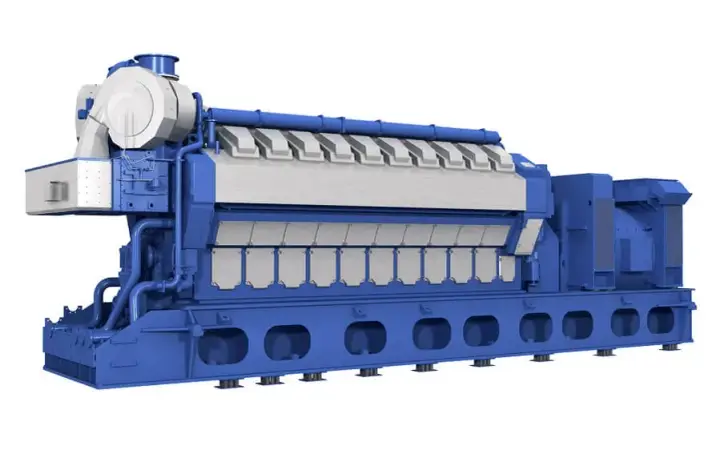
The 9,388 kW lean-burn V20 behind the first 412 MW data center order for a Wartsila gas engine
Wartsila 20V34SG is one of 23 gas engines tracked in the SecondWatt catalogue, each with specifications, lead times and indicative secondary-market pricing.
Wartsila 20V34SG lean-burn gas engine: 9,388 kW at 60 Hz, 48.8% electrical, 7,374 kJ/kWh heat rate, 90 ppmvd NOx and the SCR requirement explained.
The Wartsila 20V34SG is a 20-cylinder, 340 mm bore, lean-burn spark-ignited gas engine rated 9,388 kW at 60 Hz and 9,795 kW at 50 Hz. Wartsila quotes those figures at ISO 3046-1 reference conditions of 100 kPa ambient pressure, 25 C suction air and 30% relative humidity, with a plus or minus 5% tolerance. This is a continuous power-plant rating at generator terminals, not an ISO 8528 standby rating. Comparing it against a diesel standby number is a category error. Electrical efficiency is 48.8% at 60 Hz, giving a published heat rate of 7,374 kJ/kWh. That recomputes: 3,600 divided by 0.488 is 7,377 kJ/kWh, within 3 kJ/kWh of the published figure, so the efficiency and heat rate on the leaflet are internally consistent. In Imperial units 7,374 kJ/kWh is 6,989 BTU/kWh on a lower-heating-value basis. In April 2026 Wartsila announced 40 of these engines for a 412 MW plant in Ohio, the 34SG's first data center application and the company's fourth US data center order. Wartsila states the plant will operate off-grid and avoid long interconnection delays common to the US market. That sentence, from the manufacturer rather than an analyst, is the clearest statement of why large-bore reciprocating gas is being bought in 2026. The engine weighs 136 tonnes dry and measures 13,142 by 3,350 by 4,573 mm before its alternator, foundation, radiators, gas train and stack.
Why it matters
This is the engine that put Wartsila's 34SG platform into the data center market, and at 9,388 kW at 60 Hz it sets the block size for a whole class of off-grid campus. It also carries the category's defining constraint: at 90 ppmvd engine-out NOx it cannot meet the federal 82 ppmvd ceiling without selective catalytic reduction.
Who buys it
Hyperscale and colocation developers building behind-the-meter generation because the utility interconnection queue is the binding constraint. Also independent power producers buying flexible capacity to firm renewables, and industrial sites with a use for the recovered heat. Nobody buys one: the Ohio plant takes forty.
Role in the data center
Nobody buys one 20V34SG. The Ohio project buys forty to reach 412 MW, and Wartsila states the plant will operate off-grid rather than wait in the interconnection queue. The unit of design is the multi-engine block, sized for N+1 or better, with the engine count set by the redundancy scheme rather than by the load alone. Balance of plant matters as much as the engine: gas supply and pressure, SCR and urea, radiators or a cooling loop, exhaust stacks and the switchgear that parallels the sets. Duty is continuous or prime, not NFPA 110 standby.
Key specifications
| Electrical output, 60 Hz | 9,388 kW continuous |
|---|---|
| Electrical output, 50 Hz | 9,795 kW continuous |
| Electrical efficiency, 60 Hz | 48.8 % |
| Heat rate, 60 Hz | 7,374 kJ/kWh |
| Bore x stroke | 340 x 400 mm |
| Cylinder configuration | 20 cylinders, V |
| Speed | 720 (60 Hz) / 750 (50 Hz) rpm |
| Dimensions L x W x H | 13,142 x 3,350 x 4,573 mm |
| Dry weight | 136 tonnes |
| NOx, engine-out | 90 ppm at 15% O2 dry |
| Methane number required | above 80 MN |
| Rating reference conditions | 100 kPa, 25 C, 30% RH ISO 3046-1 |
Technical summary
Electrical output: 9,388 kW at 60 Hz, 9,795 kW at 50 Hz, continuous at generator terminals. Rating basis: ISO 3046-1, 100 kPa, 25 C suction air, 30% relative humidity, plus or minus 5%. Electrical efficiency: 48.8% at 60 Hz, 48.9% at 50 Hz. Heat rate: 7,374 kJ/kWh at 60 Hz, 7,363 kJ/kWh at 50 Hz. Configuration: 20-cylinder V, bore 340 mm, stroke 400 mm. Speed: 720 rpm at 60 Hz, 750 rpm at 50 Hz. Dimensions: 13,142 x 3,350 x 4,573 mm; dry weight 136 tonnes. NOx: 90 ppm at 15% O2 dry, engine-out before aftertreatment. Gas quality: methane number above 80. Start: under 2 minutes fast start to full load; 30 seconds to grid connection. Fuels: natural gas, biogas, synthetic methane, hydrogen blending capable.
Major variations
The 34SG platform ships in 12V, 16V and 20V. At 60 Hz those rate 5,580 kW, 7,491 kW and 9,388 kW. A separate power optimised tuning of the 20V raises output to 10,368 kW at 60 Hz while giving up 1.3 points of electrical efficiency. A 34SG-LPG variant exists for liquefied petroleum gas. Specifying a 34SG without naming the cylinder count and the tuning does not specify the machine.
Pricing and availability
Comparable secondary-market band: 2000–3150 $ per kW installed. Trend: stable The hour meter sets the price in this category, not the year. An engine three years from a major overhaul is worth materially less than an older unit fresh out of one. There is no used market at this size. Lead time, new: No published lead time at this time.
Lifecycle and maintenance
Wartsila publishes no time-between-overhaul for the 34SG on any product page or leaflet. That is how this class is sold. Maintenance is priced inside a long-term service agreement negotiated with the plant, so the interval is a commercial term rather than a catalog specification. Wartsila's data center page markets exactly that: maintenance and operational support, continuous remote monitoring, and full responsibility for plant operations. A buyer cannot compute total cost of ownership for this engine from its nameplate. Ask for the overhaul schedule and the parts-basket price in the same conversation as the engine price.
Thermal and emissions profile
Wartsila publishes NOx at 90 ppm at 15% O2 dry, engine-out and before aftertreatment. Bergen and mtu publish 500 mg/Nm3 at 5% O2 for the same class, and they are the same number once converted: 500 x 22.414/46 = 243.6 ppmv at 5% O2, then x (20.9-15)/(20.9-5) = 0.3711 gives 90.4 ppmvd at 15% O2. 40 CFR 60 Subpart JJJJ caps non-emergency spark-ignition natural gas engines of 500 HP or more, built on or after 1 July 2010, at 82 ppmvd at 15% O2. At 90 ppmvd this engine is above the federal ceiling, so selective catalytic reduction is required to sell it in the United States at all. Treat SCR as a capital line item, not an accessory. Ozone non-attainment areas push BACT or LAER far below the NSPS floor and add urea handling.
Common failure points
- Gas quality and methane number — Knock, ignition retard and automatic derate when delivered gas drops below methane number 80
- SCR catalyst and urea dosing system — Stack NOx climbs toward the 90 ppmvd engine-out figure and the permit limit is exceeded
- Cylinder heads and exhaust valves — Rising exhaust temperature spread between cylinders and falling compression on one bank
- Charge air cooler fouling — Charge air temperature above the 25 C rating reference and progressive output derate
- Turbocharger — Falling charge pressure, surge at part load, audible change on ramp
- Lubricating oil condition — Rising iron, chromium and viscosity in oil analysis between changes
Inspection checklist
Hours since major overhaul: Wartsila publishes no interval for the 34SG, so demand the service agreement schedule and the actual hour meter. Hours since top-end and head change-out: record per-bank hours across all 20 cylinders, not the engine total alone. Oil analysis trend across the last 12 samples: rising iron and chromium indicate liner and ring wear. Cylinder liner wear at top ring reversal: measure against the 340 mm nominal bore and Wartsila's published limit. Turbocharger shaft play and compressor wheel erosion: a 340 mm bore engine shows fouling in charge pressure first. Charge air cooler fouling: compare charge air temperature against the 25 C suction air reference in the rating basis. Spark plug and ignition coil hours: log the current set across all 20 cylinders and the replacement interval used.
Procurement channels
Direct from Wartsila. The 34SG page states plants are delivered both as EPC and Equipment Delivery contracts, so the engine can be bought as equipment rather than only as part of a turnkey plant. Equipment Delivery is a transaction with a unit count. Wartsila North America, Inc. carries the channel, with a named North America business development contact on the data center solutions page. There is no dealer network in the sense that Caterpillar has one, and no secondary market at this size.
Regional notes
Both 50 Hz and 60 Hz ratings are published, and the 60 Hz figure is the lower of the two at 9,388 kW against 9,795 kW. North American channel is confirmed through Wartsila North America, Inc. and four US data center orders totalling over 1.6 GW.