Waukesha VGF L36GL
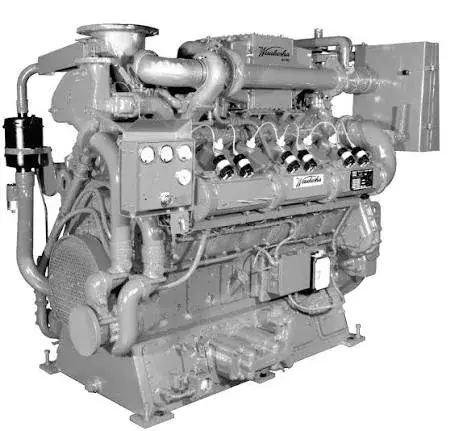
Lean-burn 36-litre V12 rated 460 to 660 kWb, with an eightfold NOx advantage over its rich-burn twin
Waukesha VGF L36GL is one of 23 gas engines tracked in the SecondWatt catalogue, each with specifications, lead times and indicative secondary-market pricing.
Waukesha VGF L36GL specs: 620 to 880 BHP and 460 to 660 kWb, 36 litre V12, 2.00 g/bhp-hr NOx, plus how it differs from the rich-burn L36GSI.
The INNIO Waukesha VGF L36GL is a lean-burn spark-ignited V12 stationary gas engine rated 620 to 880 BHP, or 460 to 660 kWb, at speeds up to 1,800 rpm. It displaces 2,193 cubic inches or 36 litres on a 5.98 by 6.5 inch bore and stroke, and is ordered in either a low compression ratio of 8.7 to 1 or a high compression ratio of 11 to 1. The rating is an engine rating at the crankshaft; INNIO quotes the packaged VGF generator set line separately at 350 to 1,250 kVA. The reason this model exists alongside the L36GSI is emissions, and the gap is the single most useful number in the VGF family. L36GL publishes NOx at 2.00 g/bhp-hr at 1,800 rpm. The L36GSI, an identical V12 on the identical 36 litre block and identical bore and stroke, publishes 16.00 g/bhp-hr. That is eight times the NOx from the same displacement, and no figure may be carried between the two. Lean-burn brings better fuel consumption as well. The L36GL runs 7,114 Btu/bhp-hr at 1,800 rpm and 6,902 at 1,500 rpm, against the L36GSI's 7,389 and 7,245. Dividing 2,545 Btu/bhp-hr by those figures gives 35.8 and 36.9 percent brake thermal efficiency for the lean-burn engine against 34.4 percent for the rich-burn at 1,800 rpm.
Why it matters
It is the lean-burn answer inside a family better known for rich-burn engines, and the eightfold NOx difference against its own twin is the clearest demonstration in the gas engine class that a suffix letter changes permitting outcomes. At 2.00 g/bhp-hr it still sits about twice the federal limit, so it reduces the aftertreatment problem rather than removing it.
Who buys it
Sites that need continuous gas generation in a 0.5 MW block and cannot accept rich-burn emissions or the catalyst that goes with them, including landfill gas, digester gas and distributed cogeneration operators. The VGF family shares one cylinder module across F18, H24 and L36, so operators running more than one size gain real parts commonality. This is continuous and prime duty, not NFPA 110 standby.
Role in the data center
A half-megawatt continuous block for sites where capacity is added in fine increments or where a landfill or digester gas stream sets the scale. It reduces the aftertreatment burden relative to the rich-burn VHP engines without eliminating it, since 2.00 g/bhp-hr is still about twice the federal limit.
Key specifications
| Output range | 620 to 880 BHP (460 to 660 kWb) BHP (kWb), engine rating |
|---|---|
| Cylinders | V12 cylinders |
| Displacement | 2,193 (36) cu in (litres) |
| Bore and stroke | 5.98 x 6.5 (152 x 165) in (mm) |
| Compression ratio | LCR 8.7:1 or HCR 11:1 ratio, selected at order |
| Heat rate at 1,800 rpm | 7,114 (10,008) Btu/bhp-hr (kJ/kWh) |
| Heat rate at 1,500 rpm | 6,902 (9,760) Btu/bhp-hr (kJ/kWh) |
| Brake thermal efficiency | 35.8 at 1,800 rpm; 36.9 at 1,500 rpm percent, computed from 2,545 Btu/bhp-hr |
| NOx at 1,800 rpm | 2.00 (820 at 5 percent O2) g/bhp-hr (mg/Nm3) |
| NOx at 1,500 rpm | 2.4 (982 at 5 percent O2) g/bhp-hr (mg/Nm3) |
| Rich-burn sibling NOx for contrast | 16.00 (L36GSI, identical block) g/bhp-hr |
| Dimensions | 88 x 61.97 x 73.11 (2,235 x 1,574 x 1,857) in (mm) |
| Dry weight | 11,200 (5,171) lb (kg) |
| VGF packaged genset line | 350 to 1,250 kVA, genset rating |
Technical summary
Output: 620 to 880 BHP (460 to 660 kWb) at speeds up to 1,800 rpm, engine rating at the crankshaft. Cylinders and displacement: V12, 2,193 cu in (36 litres). Bore and stroke: 5.98 x 6.5 in (152 x 165 mm), shared across the VGF F18, H24 and L36 models. Compression ratio: low compression 8.7:1 or high compression 11:1, selected at order against the site gas. Heat rate: 7,114 Btu/bhp-hr (10,008 kJ/kWh) at 1,800 rpm; 6,902 (9,760) at 1,500 rpm. Brake thermal efficiency: 35.8 percent at 1,800 rpm and 36.9 percent at 1,500 rpm, computed from 2,545 Btu/bhp-hr. NOx: 2.00 g/bhp-hr (820 mg/Nm3 at 5 percent O2) at 1,800 rpm; 2.4 (982) at 1,500 rpm. Rich-burn sibling: L36GSI at 16.00 g/bhp-hr on the identical block, eight times higher. Dimensions: 88 x 61.97 x 73.11 in (2,235 x 1,574 x 1,857 mm). Dry weight: 11,200 lb (5,171 kg). VGF packaged genset line: 350 to 1,250 kVA across 6, 8, 12 and 16 cylinder models.
Major variations
The defining split is the suffix: GL is lean-burn at 2.00 g/bhp-hr and GSI is rich-burn at 16.00 g/bhp-hr, on an identical V12 36 litre block with identical bore and stroke. Within the GL model, compression ratio is an ordering choice between LCR 8.7:1 and HCR 11:1, matched to the site gas. Speed selection at 1,800 or 1,500 rpm changes both heat rate and NOx.
Configurations and options
Lean-burn operation rules out a three-way catalyst, so aftertreatment options are an oxidation catalyst and selective catalytic reduction rather than the emPact NSCR system used on the rich-burn VHP engines. Packaged VGF generator sets are rated in kVA and sold separately from the bare engine, across 6, 8, 12 and 16 cylinder models from 350 to 1,250 kVA.
Compatibility and dependencies
The VGF family shares a single cylinder module at 152 by 165 mm across the F18 inline 6, H24 inline 8 and L36 V12, which is a genuine parts commonality argument verifiable from the three data sheets. Compression ratio must be matched to site gas at order because it cannot be changed in the field. INNIO publishes no methane number requirement, so a gas analysis is a precondition of the LCR or HCR decision.
Pricing and availability
Comparable secondary-market band: 2000–3150 $ per kW installed project cost. Trend: stable Value in this category steps down at overhaul milestones rather than by calendar year, so the hour meter and overhaul ledger set the price rather than the build date. Lead time, new: No published lead time from INNIO.. Lead time, used or refurbished: VGF units were in dealer stock on 2026-08-31 at Kraft Power and Collicutt Energy Services, including a new 2023 VGF48GL, but no availability dates are published..
Lifecycle and maintenance
INNIO publishes no overhaul or service interval for the L36GL specifically. The nearest published figure in the family is the 24,000-hour top end overhaul that INNIO states for the VGF F18GL fitted with new GL cylinder head assemblies, and that figure belongs to the F18GL rather than to this engine. Because the VGF family shares a common cylinder module at 152 by 165 mm, head practice is related across F18, H24 and L36, but the interval has not been published for the L36 and should not be assumed. Value tracks hours since major overhaul rather than build year.
Thermal and emissions profile
INNIO publishes NOx at 2.00 g/bhp-hr, equivalently 820 mg/Nm3 at 5 percent O2, at 1,800 rpm and 2.4 g/bhp-hr at 1,500 rpm. Converting the 820 figure gives roughly 148 ppmvd at 15 percent O2 against the 40 CFR 60 Subpart JJJJ ceiling of 1.0 g/HP-hr or 82 ppmvd for non-emergency spark-ignition engines, including the lean-burn 500 to 1,350 HP band. At 620 to 880 BHP this engine sits in that band and runs about twice the limit uncontrolled, so aftertreatment is still required. Lean-burn combustion rules out a three-way catalyst, which needs stoichiometric operation, leaving an oxidation catalyst plus selective catalytic reduction as the route. The rich-burn L36GSI on the same block publishes 16.00 g/bhp-hr, eight times higher. No CO or formaldehyde figure is published.
Common failure points
- Detonation on high compression units — knock under load, piston crown and ring-land damage, controller derate
- Cylinder head and valve seat recession — compression loss, exhaust temperature spread widening, output fading below 880 BHP
- Turbocharger and aftercooler wear — slow load acceptance, low boost, rising exhaust temperature
- Ignition system and spark plug fouling — misfire, unstable output, rising CO and unburned hydrocarbons
- Wrong compression ratio for the site gas — persistent knock on an HCR unit, or lost output and poor efficiency on an LCR unit
- Alternator bearing and winding degradation — bearing noise, falling insulation resistance, winding temperature rise
Inspection checklist
Suffix is GL and not GSI: the L36GSI is the same 36 litre V12 at 16.00 g/bhp-hr against this engine's 2.00, an 8-fold difference. Compression ratio as ordered: LCR 8.7:1 or HCR 11:1, because the wrong ratio for the site gas is not a field change. Hours since major overhaul: INNIO publishes no interval for this model, so the operator's own ledger is the benchmark. Hours since top-end work: recorded per cylinder head across all 12 cylinders rather than as 1 engine figure. Oil analysis trend: at least the last 4 samples, with wear metals plotted rather than read individually. Compression across all 12 cylinders: a spread beyond roughly 10 percent indicates head or ring wear. Turbocharger shaft play and boost pressure: logged against the commissioning baseline at 100 percent load. Aftercooler core and coolant-side fouling: inspected with the turbocharger as 1 system, never separately.
Procurement channels
VGF units trade through the same North American dealer network as the VHP family, built on Waukesha's installed base in gas compression and landfill gas. Dealers holding VGF stock on 2026-08-31 included Kraft Power Corp and Collicutt Energy Services. Marketplaces to work are Surplus Record, Machinio, IPS, Depco Power Systems, Genset Services, Worldwide Power Products, Collicutt and Penn Detroit, plus eBay and GovPlanet for smaller units.
Regional notes
North American channel confirmed. INNIO publishes 60 Hz ratings for the packaged VGF line, and the sibling VGF24GL generator set sheet gives 390 to 425 kWe continuous at 60 Hz and 1,800 rpm against 325 to 360 kWe continuous at 50 Hz and 1,500 rpm, which is the clearest published demonstration that the line is dual-frequency.