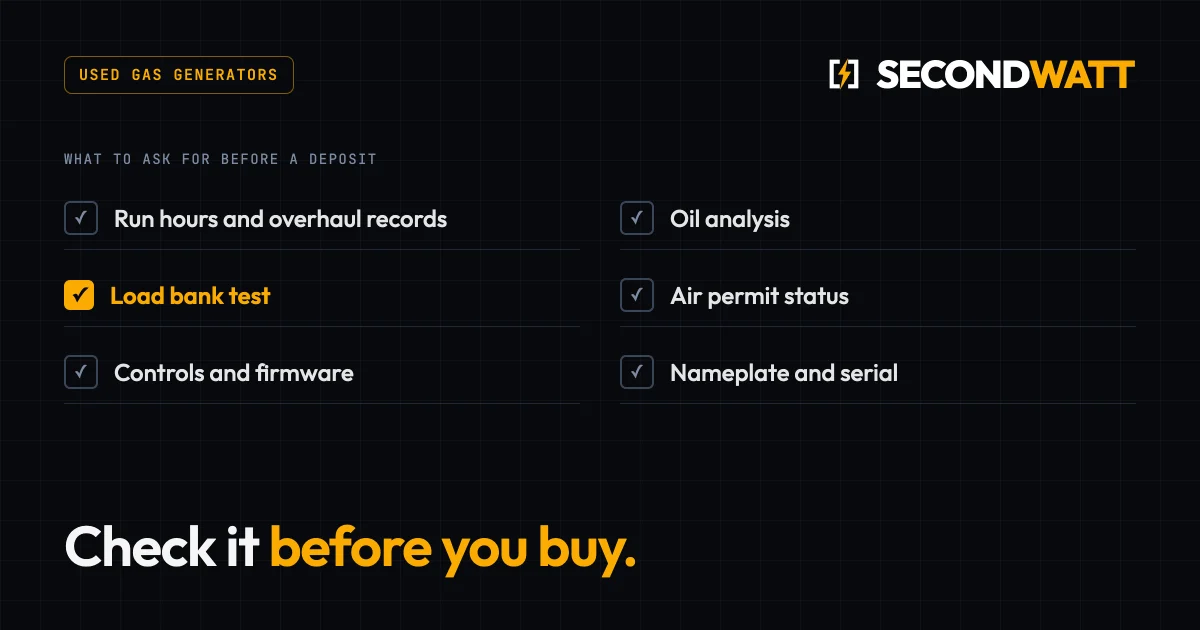
Used natural gas generators are bought on their fuel match and emissions status as much as on their hours. A gas engine is rated for a minimum methane number, a gas supply pressure and a site altitude and temperature. The same unit that ran at full output on one site's gas can lose output, or need a different engine build, on yours.
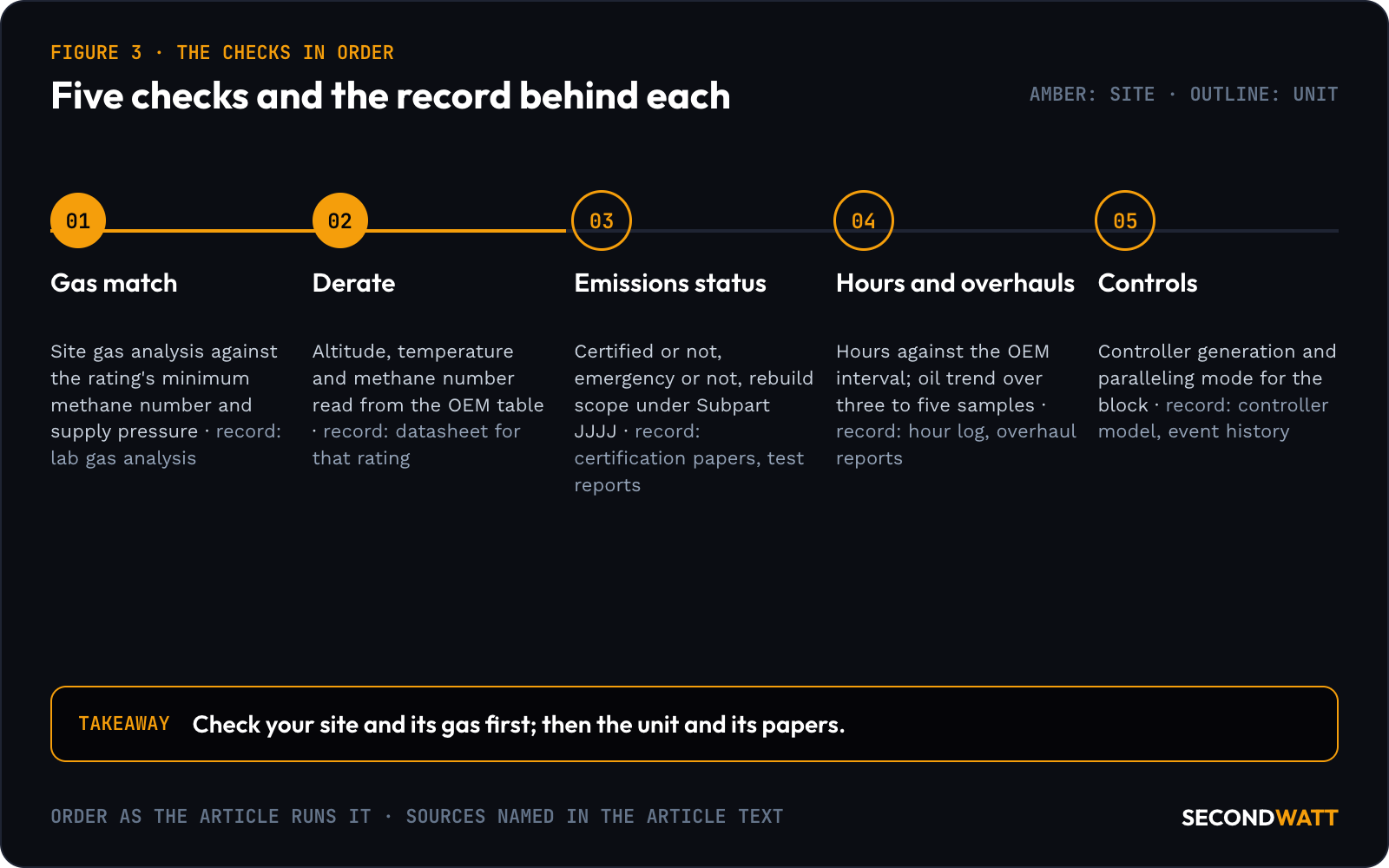
So the checks run in a set order. First, three questions go to your own site: what the gas analysis says about methane number, what pressure the supply holds at full load, and what the altitude and air temperature at the intake are. Then come the seller's answers: build date and emissions paperwork under the US federal rule, hours against the overhaul interval, controls, and the records behind each.
If the gas or pressure falls short, look for a different rating or build, or agree a derated output before purchase.
Key Takeaways
- Check the gas before the engine. Methane number, supply pressure at rated load, and site altitude and temperature are each compared with the datasheet for that exact rating.
- Derate is calculable where tables exist. A Cummins C1400N6C rated 1,400 kWe continuous at 60 Hz drops to about 1,078 kWe off-grid at 2,000 m and 30 °C.
- Emissions status starts with the nameplate date. Under US 40 CFR 60 Subpart JJJJ, manufacture date, certification papers and test reports document a used engine's status.
- Ask for the OEM's overhaul interval. mtu publishes 84,000 operating hours to major overhaul for Series 4000 gas units; Jenbacher states 60,000–80,000 for gas engines generally.
- Seven records decide the purchase. Hour and run logs, oil-analysis trend, overhaul records, certification papers, emissions test reports, controller event history and the previous site's gas analysis.
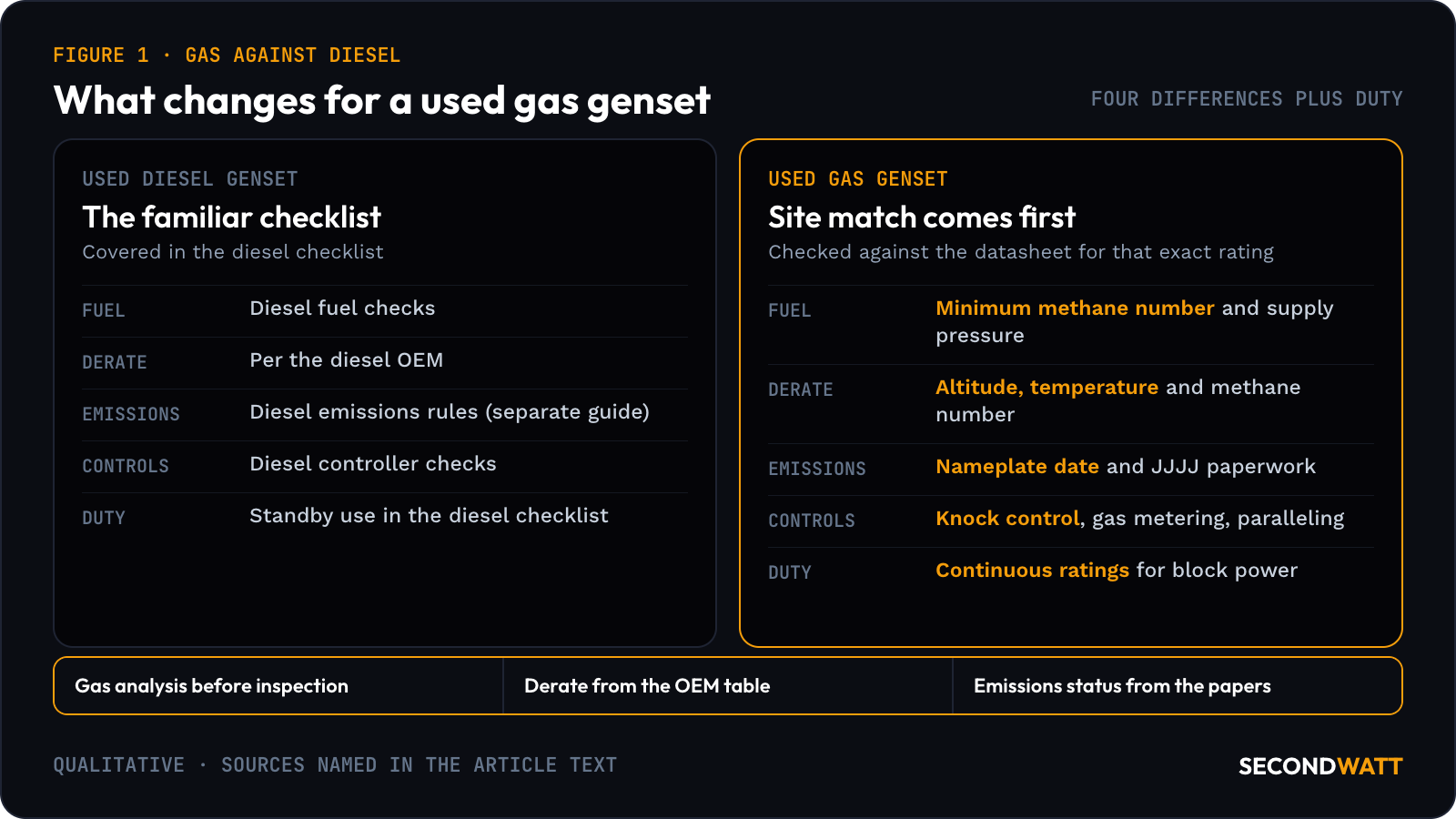
Used natural gas generators against used diesel: four differences#
The first difference is fuel sensitivity. Cummins and mtu ratings name a minimum methane number, such as the "Minimum Methane Index 78" on the Cummins C1400N6C's December 2019 data sheet D-6452. The Cat G3500 sheets cited below state none, so ask Caterpillar for the figure on your gas. The second difference is derate, which the Cummins sheet tabulates by altitude, temperature and methane number.
The third is the emissions regime. Gas engines built within its dates fall under 40 CFR 60 Subpart JJJJ, a different rule from those in the diesel procurement guide. The fourth is controls, such as the "automatic knocking control" and electronic gas metering valve on the mtu Series 4000 gas sets.
Duty sits alongside these. The Cat, Cummins and Waukesha gas sheets below state continuous ratings, while a standby rating assumes short annual running. The separate standby configuration on Caterpillar's 04/20 G3516C sheet LEXE1551-01, 1,561 ekW at 60 Hz, carries the note "Typical operation is 200 hours per year". Rating terms are in the rating definitions, the case for gas over diesel is in the capacity and cost comparison, and engines against turbines in the technology comparison.
The two-part checklist: site match first, then unit condition (document for each row)#
| Part | Check | What to ask for | Checked against |
|---|---|---|---|
| Site match | Methane number | Site gas analysis, rated by the engine OEM's own method | Minimum methane number on the rating's datasheet (e.g. Cummins D-6452, mtu 3237291) |
| Site match | Supply pressure | Pressure held at rated load at the unit's inlet | Supply pressure range on the datasheet (e.g. Cummins D-6452) |
| Site match | Altitude and temperature | Site elevation and intake air temperature | OEM derate table for that rating (e.g. Cummins D-6452) |
| Site match | Combined derate | OEM figure for altitude, heat and site gas together | OEM application engineering for that rating |
| Unit condition | Emissions status | Nameplate date, certification papers or performance test reports | 40 CFR 60.4230, 60.4243 and 60.4245 (eCFR) |
| Unit condition | Hours and overhauls | Hour-meter record, overhaul reports | OEM interval (e.g. mtu Series 4000: 84,000 h) |
| Unit condition | Oil condition | Three to five oil samples in sequence | Cat S·O·S guide PEGJ0046-02 |
| Unit condition | Controls | Controller model and paralleling mode | OEM controller literature (e.g. Cummins PowerCommand 3.3) |
Start with your gas: methane number, pressure and the rating it fits#
Methane number describes how likely a fuel is to knock, on a scale of 0–100. Cummins's 18 Feb 2021 PowerHour says lower values "may require power derate and/or timing changes", and high-quality pipeline gas is typically 80–90 MN. Each OEM computes it its own way: Cummins through its Gas Analysis Tool, mtu as a "referenced methane number". So send the site gas analysis to the OEM of each candidate model.
The minimum differs by build. On the 01/24 edition of mtu's sheet 3237291, the 20V4000 GS L64 FNER is rated 2,520 kWe at 60 Hz and power factor 1.0 for a methane number of 72 or more. The hot-ambient version needs 80.
For gas at 60 or more, mtu lists a different engine, the 20V4000 GS L32 ER, at 1,948 kWe at 50 Hz and power factor 1.0. It appears only on the 01/24 edition of mtu's 50 Hz sheet 3234731.
At the other end, Caterpillar's K series page claims the G3500K sets "can run down to methane NR 60 without derate".
Pressure is the second site question: the C1400N6C asks for 0.2–0.46 bar (2.9–6.7 psi) at the shutoff-valve inlet, a capability that "will vary depending on fuel quality and site conditions". The Cummins deck puts it as "Volume and pressure must be available at RATED load, not static pressure".
Required pressure across gas engines generally runs from under 500 mbar to 12 bar, on the range Jenbacher publishes in its engine and turbine comparison. The turbine version of this problem is in the turbine fuel guide.
Derate: altitude, temperature and fuel quality#
Where an OEM publishes derate tables, as Cummins does for the C1400N6C, output can be worked out before purchase. One table covers on-grid soft-start operation and another off-grid operation, both read by altitude and air-filter inlet temperature. A third covers methane number, read by the low-temperature cooling circuit's inlet temperature.
1,050 kWe — what the same C1400N6C delivers on methane number 54 gas with a 50 °C low-temperature circuit inlet, using the 0.75 multiplier.
Worked example (Cummins C1400N6C, 1,400 kWe continuous, 60 Hz):
- On-grid soft start at 2,000 m and 30 °C: 1,400 × 0.79 = 1,106 kWe.
- Off-grid at the same site: 1,400 × 0.77 = 1,078 kWe.
- Methane number 69 with a 50 °C low-temperature circuit inlet: 1,400 × 0.90 = 1,260 kWe.
- Methane number 54 at the same temperature: 1,400 × 0.75 = 1,050 kWe.
Each line reads one table, and each multiplier is applied "as the percent load factor" in the sheet's own procedure. A site with both altitude and low-methane gas therefore goes on the request list as a combined figure from the OEM. The altitude table assumes the low-temperature return runs 10 °C above the air-filter inlet, to a 50 °C maximum. For low barometric conditions, the sheet says to add 150 m (500 ft) to site altitude before reading the table.
Emissions status for a used stationary gas engine#
For owners, § 60.4230(a)(4) brings an engine under Subpart JJJJ if its construction commenced after 12 June 2006 and it was manufactured on or after a set date. The dates are 1 July 2007 for 500 HP or more, 1 January 2008 for lean-burn engines of 500–1,350 HP, and 1 January 2009 for emergency engines. Engines modified or reconstructed after 12 June 2006 are covered too. A genset rated 0.5–3 MW needs an engine above 500 HP, about 373 kW of shaft output.
Six checks go on the request list.
- Nameplate date. An earlier engine never modified or reconstructed falls outside the owner provisions of § 60.4230(a)(4); separately, § 60.4236(b) bars installing an engine of 500 HP or more after 1 July 2009 unless it meets § 60.4233, but § 60.4236(e) excepts an engine "removed from one existing location and reinstalled at a new location". Other federal and state rules can apply either way.
- Table 1 limits. Non-emergency natural gas engines of 500 HP or more face 2.0 g/HP-hr NOx, 4.0 CO and 1.0 VOC if made from 1 July 2007 (1 January 2008 for lean-burn engines of 500–1,350 HP), and 1.0, 2.0 and 0.7 from 1 July 2010. Emergency engines of 130 HP or more made from 1 January 2009 face 2.0, 4.0 and 1.0.
- Certified or not. Under § 60.4245(a), a certified engine needs the manufacturer's certification documentation on file. A datasheet line such as the C1400N6C's "This rating is EPA NSPS Certified" is where that trail starts.
- Maintained to the instructions. For natural gas engines, § 60.4243(b)(1) applies the rule in (a)(2): a certified engine not maintained to the manufacturer's emission-related written instructions "will be considered a non-certified engine".
- Test history. A non-certified engine above 500 HP needs an initial performance test, then testing "every 8,760 hours or 3 years, whichever comes first" under § 60.4243(b)(2)(ii).
- Emergency or non-emergency. Under § 60.4243(d), emergency engines are limited to 100 hours a year for maintenance and testing, of which 50 may be non-emergency. Those 50 hours "cannot be used for peak shaving or non-emergency demand response", outside the narrow grid-dispatch case in (d)(3)(i). Beyond that, an engine "must meet all requirements for non-emergency engines", so a unit papered to the emergency row needs the non-emergency limits covered before prime duty.
8,760 hours or 3 years — the retest interval, whichever comes first, for a non-certified natural gas engine above 500 HP under 40 CFR 60.4243(b)(2)(ii).
Rich-burn engines add a catalyst check. INNIO Waukesha's 2023 sheet IWK-123040-EN describes the VHP7104GSI as a rich-burn set "supplied with 3-way catalyst". Section 60.4243(g) expects an air-to-fuel ratio controller with that catalyst. A specific unit's status is established from its own documents during diligence; the permit process is in the emissions permitting guide.
Hours, overhauls and spark plugs#
Hours mean little without the manufacturer's interval. The figure mtu publishes for Series 4000 gas units, on its Series 4000 gas page, is "84.000 oH / Lifetime to major overhaul (TBO)". For gas engines generally, Jenbacher states an overhaul interval of 60,000–80,000 operating hours.
For the Cat G3500 and Cummins QSK60G, ask the seller for the interval schedule from the operation and maintenance manual and the report for each overhaul done against it.
Spark plugs are one place a fuel mismatch shows. Cummins's 08/17 sheet D-6204 says running a C1100N6C outside its methane-number capability region "will result in reduced efficiency and shorter spark plug life". A unit that ran on gas near its methane-number limit should come with plug-change and knock records. The turbine version of the remaining-life question is in the turbine remaining-life guide.
Controls, paralleling and the block context#
In a multi-unit block, controller generation decides how a used unit joins it. The Cummins QSK60G series carries PowerCommand 3.3 as standard, "including full paralleling capability in grid or load share mode".
Mixed generations in one block need switchgear that talks to each, which the paralleling switchgear guide covers; block layouts are on the power-block hub and the mtu 20V4000 gas block. Island operation also changes derate: the C1400N6C off-grid table is equal or lower at every condition, and lower at altitude and heat.
The models you will actually meet#
Each platform below has a SecondWatt dossier, linked from the model name; the wider gas-engine category and generator category hold the rest.
Gas gensets in the 1–3.5 MW range: electrical output with rating basis, power factor and frequency, displacement, controller (OEM documents, revision noted)#
| Model | Output and rating basis | Displacement | Controller | Document |
|---|---|---|---|---|
| Cat G3516C | 1,660 ekW continuous, 60 Hz, 0.8 pf | 69.0 L | ADEM A3, EMCP 4 | LEXE1551-01 (04/20) |
| Cat G3520H | 2,490 ekW continuous, 60 Hz, 0.8 pf (without pumps) | 97.5 L | ADEM A4, EMCP 4 | LEXE1552-03 (06/23) |
| Cat G3520K | 2,552 ekW continuous, 60 Hz, 1.0 pf | 97.6 L | ADEM A6, Cat ECS | LEHE22852-01 (11/25) |
| Cummins QSK60G | 1,400 kWe continuous, 60 Hz, 1.0 pf (C1400N6C) | 60 L | PowerCommand 3.3 | D-6452 (Dec 2019) |
| Jenbacher J620 | Up to 3,509 kW output at 50 Hz and 3,485 kW output at 60 Hz, rating type unstated | — | — | J620 product page |
| mtu 20V4000 GS L64 | 2,520 kWe at 60 Hz, rated power at 1.0 pf, rating type unstated | 4.77 L per cylinder, 20 cylinders | MMC | 3237291 (Edition 01/24) |
| Waukesha VHP L7044GSI | 1,200 kW continuous, 60 Hz, heat-exchanger cooling (VHP7104GSI set; 1,150 kW with radiator) | 115 L | ESM 2 | IWK-123040-EN (2023) |
Two cautions apply. Jenbacher's published J620 data ranges are "calculated considering various gas quality levels and ambient conditions", so the "up to" figures are a ceiling; ask for the natural-gas rating sheet for the unit's own build. The Waukesha L7044GSI engine sheets give brake power in kWb, so compare kWe only with kWe, at the same power factor.
The records to request for used natural gas generators#
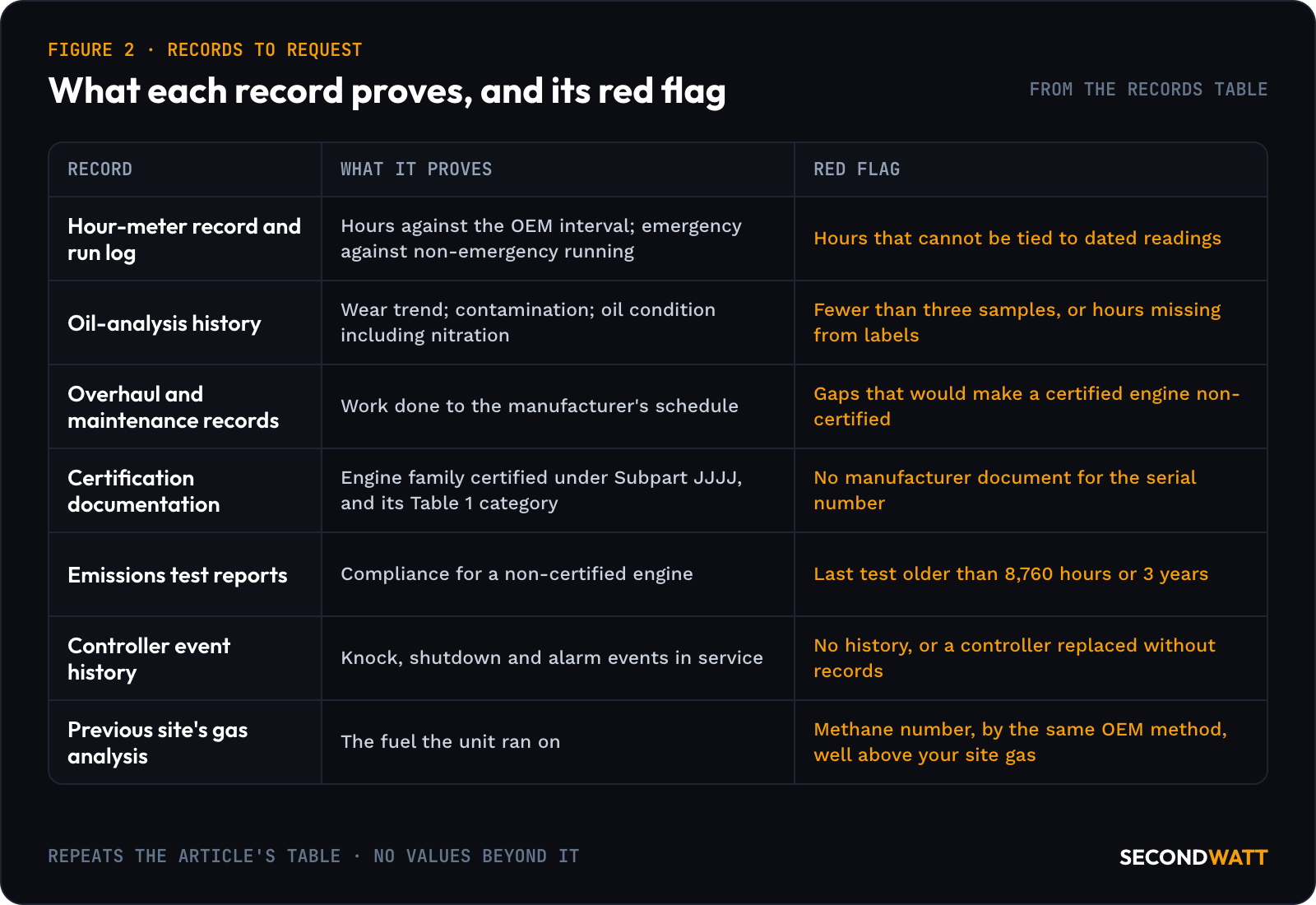
Records for a used gas genset: document, what it proves, red flags#
| Record | What it proves | Red flag |
|---|---|---|
| Hour-meter record and run log | Hours against the OEM interval; emergency against non-emergency running | Hours that cannot be tied to dated readings |
| Oil-analysis history | Wear trend; contamination; oil condition including nitration | Fewer than three samples, or hours missing from labels |
| Overhaul and maintenance records | Work done to the manufacturer's schedule | Gaps that would make a certified engine non-certified |
| Certification documentation | Engine family certified under Subpart JJJJ, and its Table 1 category | No manufacturer document for the serial number |
| Emissions test reports | Compliance for a non-certified engine | Last test older than 8,760 hours or 3 years |
| Controller event history | Knock, shutdown and alarm events in service | No history, or a controller replaced without records |
| Previous site's gas analysis | The fuel the unit ran on | Methane number, by the same OEM method, well above your site gas |
Oil trends need history. Caterpillar's S·O·S guide PEGJ0046-02 says "Three to five oil samples are needed to establish a compartment trend", and oil and equipment hours must be correct. The same guide says nitration "is generally a problem only in natural gas engines".
Acceptance comes before title passes. Run a load test on your own gas at the derated output you calculated, and record knock and controller events during it. The standby-diesel version of this list is in the diesel checklist; new-unit lead times are in the lead-times guide.
FAQ: used gas generators#
Does an overhaul change the engine's emissions status?#
It can. Under § 60.4248, reconstruction above 75% of the fixed capital cost of a comparable new facility, or all-new components on an old block, brings a new date of manufacture.
For natural gas engines made before the Table 1 dates and then modified or reconstructed, § 60.4233(f)(4) sets 3.0 g/HP-hr NOx, 4.0 CO and 1.0 VOC. Under § 60.4243(i), compliance is shown by a certified engine or a performance test "within 60 days after the engine commences operation".
Can an emergency-rated unit earn grid revenue?#
Only in one narrow case. Under § 60.4243(d)(3)(i), its 50 non-emergency hours can supply power under a financial arrangement only when the local balancing authority or distribution operator dispatches it to avert voltage collapse or line overloads. The dispatching entity is recorded.
What should an emissions test report show?#
It should show three separate test runs, each lasting at least one hour "within 10 percent of 100 percent peak (or the highest achievable) load", under § 60.4244. Under § 60.4245(d), a copy of each test must be submitted within 60 days after it is completed.
Can a gas genset run on propane if the pipeline isn't ready?#
Under § 60.4243(e), propane is allowed as an alternative fuel "solely during emergency operations", up to 100 hours a year with records kept. The rule's emergency examples in § 60.4248 center on power "when electric power from the local utility … is interrupted". So for interim running while a pipeline is built, check whether the certificate covers propane or plan a performance test on it. Caterpillar's claim that its K series runs at full rated power on propane describes engine capability, separate from that rule.
Running the checks in order#
SecondWatt publishes equipment research and helps buyers source power equipment; it earns a fee when a sale it arranges closes. If you are sourcing gas gensets, send your site gas analysis, elevation and duty through a request for quote, and the gas match comes first. If you own gas gensets with their records in order, the seller page sets out how SecondWatt works with owners.