An owner who needs to sell surplus equipment such as a generator, gas turbine, transformer or switchgear lineup has five routes. They are an auction, a dealer purchase or consignment, a broker, a procurement intermediary and, for some lots, a recycler. The right one depends on four things about the asset: its value, the quality of its records, how soon it must go, and how many units are in the lot.
Much of each route's economics can be read before the first phone call. Ritchie Bros and Purple Wave publish their buyer fees and removal rules. One Cat dealer publishes its consignment commission, and a wind-turbine broker publishes its commission scale.
Key Takeaways
- Value, records, urgency and quantity choose the channel. A documented single unit, a lot that must clear a site, and a lot needing PCB answers suit different routes.
- Auction buyers pay a published fee. Purple Wave adds 10%; Ritchie Bros (US and Mexico, events from 1 Aug 2026) charges 10%, then 5.5%, capped at USD 4,125.
- Dealer consignment can leave the unit with the owner. Carter Machinery keeps it in the owner's possession until sale; Quinn Company invites owners to keep machines working meanwhile.
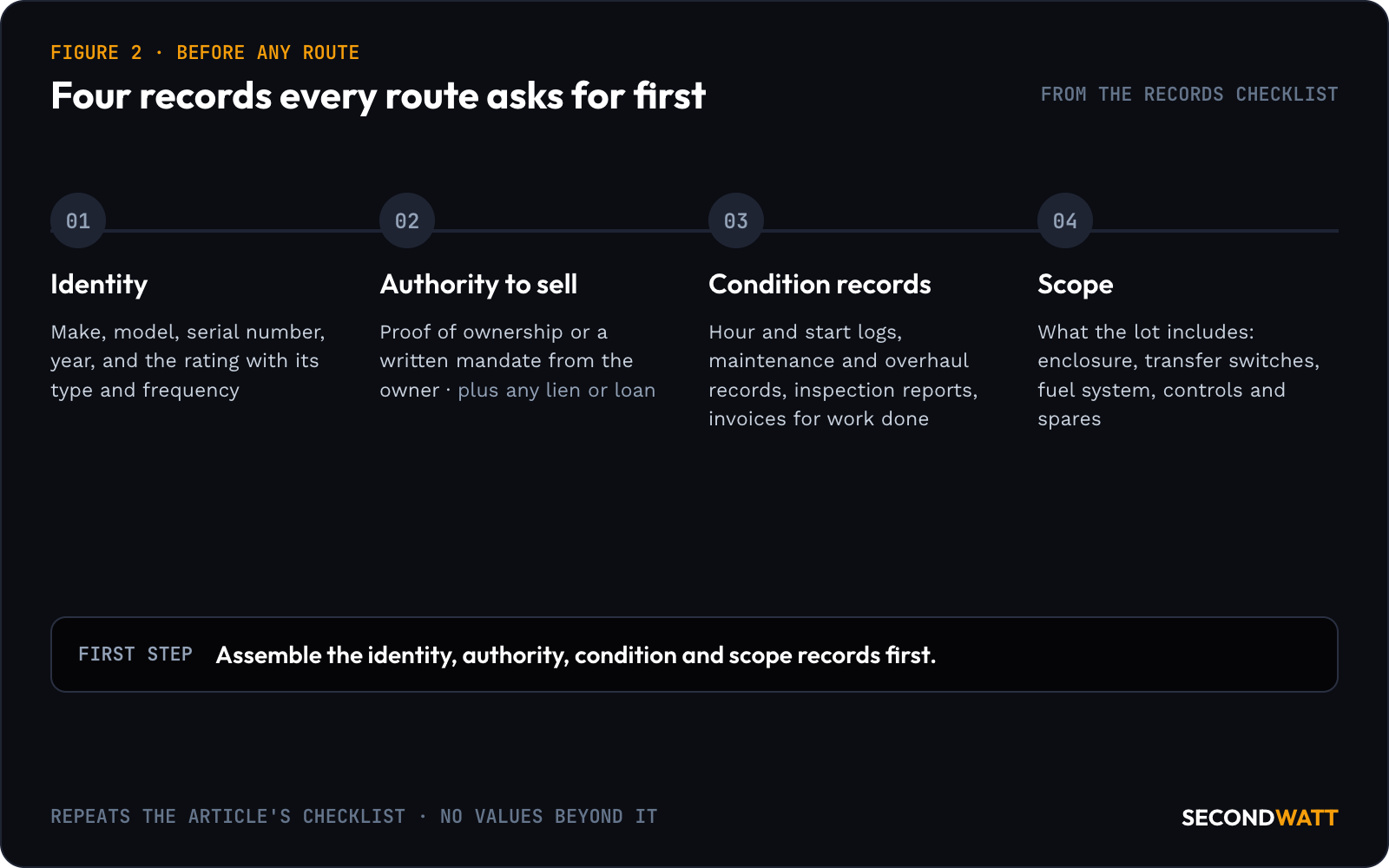
- Every channel asks for the same four things first. Equipment identity, authority to sell including any lien, condition records, and the scope of what the lot includes.
- Old transformers need a PCB answer first. Under US federal rule 40 CFR 761.2, mineral-oil equipment made before 2 July 1979 must be assumed PCB-contaminated unless its concentration is established.
Four characteristics that decide where to sell surplus equipment#
Value matters because fees scale differently. The Ritchie Bros buyer fee takes a smaller share of larger bids, and the wind-turbine broker's commission falls as the lot grows. Record quality matters because buyers price what they can check, and a dealer or intermediary can only present what the owner can document.
Urgency separates a route that pays on purchase from one that waits for a buyer. Quantity changes both fees and logistics, from a single genset to a decommissioned plant. Confidentiality is a fifth test for some owners, because an auction lists the lot publicly.
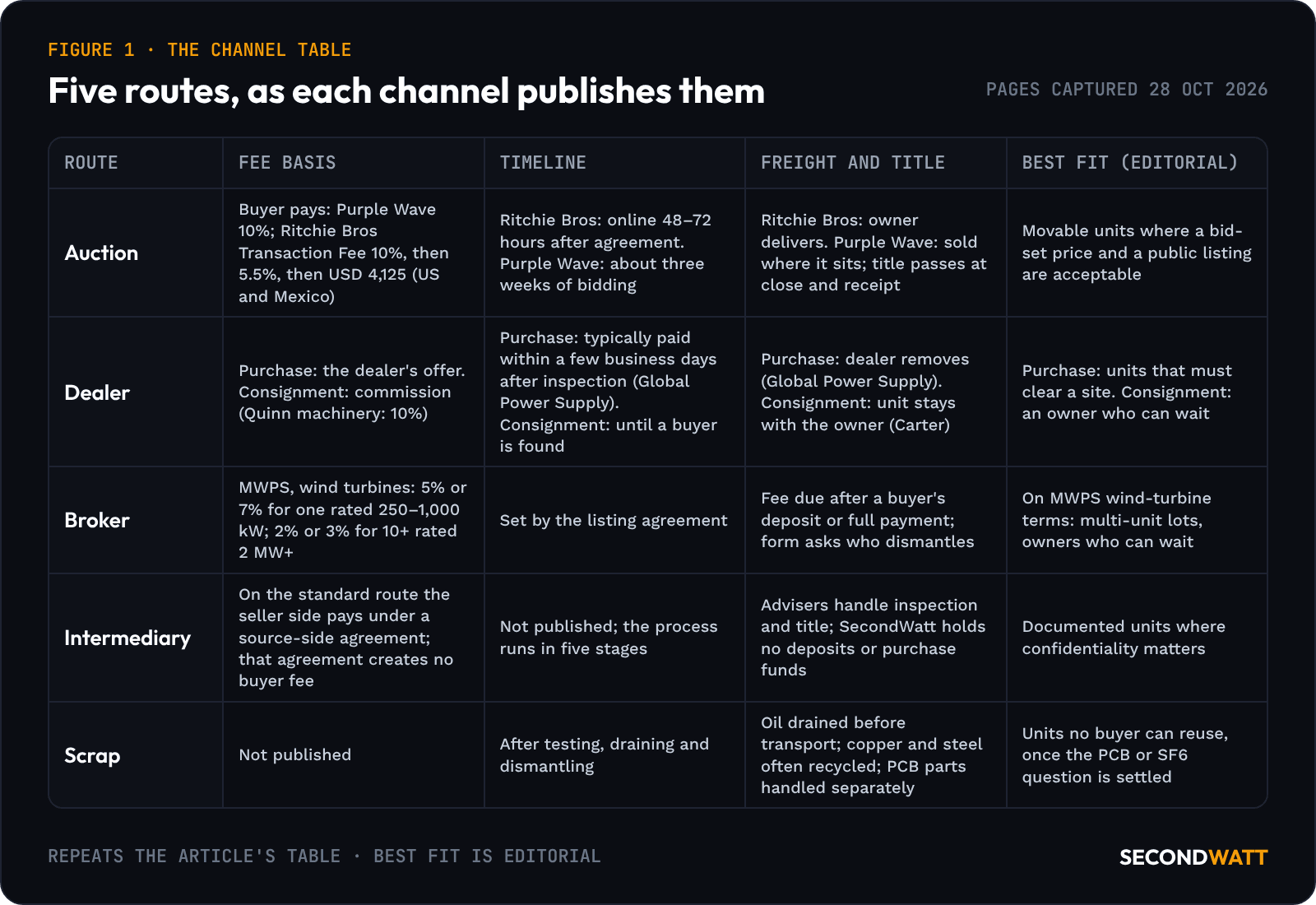
Five routes compared: fee basis, timeline, freight and title as each channel publishes them, with an editorial best-fit column#
| Route | Fee basis as published | Timeline as published | Freight, removal and title | Best fit (editorial) |
|---|---|---|---|---|
| Auction (Ritchie Bros, Purple Wave) | Buyer pays: Purple Wave 10% premium; Ritchie Bros Transaction Fee 10% to USD 30,000 (minimum USD 100), 5.5% to USD 75,000 (minimum USD 3,000), USD 4,125 above (US and Mexico, events from 1 Aug 2026). Ritchie Bros seller cost: options worked out with a representative | Ritchie Bros: online 48–72 hours after agreement; delivery ideally 3 weeks before sale. Purple Wave: about three weeks of bidding | Ritchie Bros site sales: owner delivers to its location and insures on site; IronPlanet sells from the owner's location. Purple Wave: sold where it sits, buyer pays loading, title and risk pass at close and receipt | Movable units where a bid-set price and a public listing are acceptable |
| Dealer purchase or consignment (Global Power Supply, Carter Machinery, Quinn Company, Finning) | Purchase: the dealer's offer. Consignment: commission (Quinn Company machinery program: 10%, brochure 02/22) | Purchase: payment typically within a few business days after inspection (Global Power Supply). Consignment: until a buyer is found | Purchase: dealer removes, loads and transports (Global Power Supply). Consignment: unit stays with the owner (Carter Machinery); owner retains ownership (Global Power Supply) | Purchase: documented units that must clear a site by a date. Consignment: an owner who can wait and wants to set the price |
| Broker (MWPS, used wind turbines) | Seller-paid commission agreed before listing, due only after a buyer's deposit or full payment: 5% exclusive or 7% non-exclusive for one turbine rated 250–1,000 kW; 2% or 3% for 10+ turbines rated 2 MW+ | Set by the listing agreement | Submission form records whether the seller will or can dismantle, or the buyer must | On MWPS's wind-turbine terms: multi-unit lots, where the rate falls, and owners who can wait for a buyer |
| Procurement intermediary (SecondWatt) | On the standard route the seller side pays under a source-side agreement, explained before any introduction, and that agreement creates no buyer fee | Not published; the process runs in five stages | Inspection, title and funding run through each side's advisers; SecondWatt holds no deposits or purchase funds | Documented units where confidentiality matters and the owner can show authority to sell |
| Scrap and recycling | Not published | After testing, draining and dismantling | Oil drained and contained before transport; copper windings and steel cores often recycled; PCB-contaminated parts handled separately | Units no buyer can reuse, once the PCB or SF6 question is settled |
$4,125 — the Ritchie Bros Transaction Fee ceiling for US and Mexico events from 1 Aug 2026, reached exactly at a USD 75,000 bid because 5.5% × 75,000 = 4,125.
Above USD 75,000, the buyer's fee stays flat however high the bid goes.
What every channel needs from you first#
Intake forms differ in wording and agree on substance. "Year, make and model" head the Ritchie Bros list on its About our auctions page, followed by serial number, usage, titles, lien information and "Invoices for any work done on the items". Make, model, year, hours, condition, location, damage and "an existing loan or lien" go on Purple Wave's sell form. Manufacturer, model, kW rating, age and condition open the generator form at Global Power Supply.
Those requests sort into four records:
- Identity: make, model, serial number, year, and the rating with its type and frequency, such as kW standby at 60 Hz.
- Authority to sell: proof of ownership or a written mandate from the owner, plus any lien or loan. On Purple Wave's form, the seller confirms ownership or "authority to sell it, and there are no undisclosed liens".
- Condition records: hour and start logs, maintenance and overhaul records, inspection reports and invoices for work done.
- Scope: what the lot includes, such as enclosure, transfer switches, fuel system, controls and spares.
For a turbine, the records list is longer; documentation for a turbine sale covers it, and why hours and starts records matter explains how they set remaining life. For standby gensets, what a buyer will check shows which of these records a buyer reads first.
Auction: published buyer fees, seller terms and timelines#
An auction sells to the highest bidder on a set date. Both houses publish a charge that bidders pay on top of the winning bid. Under its terms and conditions, updated 24 Jan 2025, Purple Wave runs a "no-reserve internet auction service" and adds a buyer's premium to "the Buyer's winning bid at auction". Ritchie Bros charges its Transaction Fee "to the successful bidder", on a buyer fee schedule that varies by region and event.
10% — the buyer's premium Purple Wave adds to every winning bid, under its terms updated 24 Jan 2025.
At Ritchie Bros, seller cost is worked out case by case. Its answer to "How much does it cost to sell?" is that a representative will work out options "to fit your specific situation".
Freight and insurance can fall to the seller. Ritchie Bros "does not provide transportation of assets from your yard to ours", according to its seller FAQ. The same FAQ says "Only the legal owner can insure a piece of equipment". Purple Wave sells "as is" without warranty, and the seller must have the item at the location named in the auction details.
Dealer purchase or consignment#
A dealer either buys the unit or sells it for the owner. On its generator purchasing page, Global Power Supply offers an outright buyback, a trade-in credited toward a replacement or future purchase, and consignment. Under consignment, it "markets your asset while you retain ownership". It buys commercial and industrial generators along with transfer switches, enclosures and fuel systems.
On a purchase, the dealer takes on the logistics. Global Power Supply's crews "handle equipment removal, loading, and transportation from your site to our facility". Payment "is typically issued within a few business days following inspection", in the dealer's own description. The price is the dealer's offer, so any resale margin sits inside that offer.
Finning, a Cat dealer, also buys. The sell option on its used equipment solutions page offers "lien searches performed on your behalf, and quick payments upon delivery". Finning purchases "select used equipment outright".
Consignment trades time for control. Carter Machinery's consignment page tells owners, "You control the sale price of your machinery". The unit "stays in your possession until a sale is made". The same page invites owners to consign or sell used generators.
Quinn Company, another Cat dealer, publishes "Only 10% consignment commission" for used machines it consigns, in a consignment program brochure dated 02/22. It also tells owners to "Keep your machine working while Quinn works to sell it".
Broker: representation for a commission#
A broker markets the owner's equipment for a commission and does not buy it. MWPS, a used wind-turbine broker, charges the seller a commission "agreed upon with you (the seller) before we start listing". Under MWPS's commission terms, nothing is due "unless a successful sale has been achieved and a buyer has made either a deposit or full payment".
The rate depends on exclusivity and lot size. For one turbine rated 250–1,000 kW, MWPS asks 5% exclusive or 7% non-exclusive. For a wind park of 10 or more turbines rated 2 MW or more, its published commission rates are 2% or 3%. Its stated factors are the number of units and "the equipment's total current market value".
Dismantling comes up at submission. The MWPS submission form asks whether the seller will dismantle, can dismantle, or the buyer must. It also asks for an asking price in euros and whether a service history exists.
Procurement intermediary#
SecondWatt is a power intelligence and equipment procurement platform for data center power. On the seller side, an owner or authorized representative submits the equipment and its relationship to it, and the submission creates no public listing. Each opportunity then moves through five stages: establish fit, agree the relationship, establish the basis for an introduction, make a controlled introduction, and coordinate diligence and the transaction.
Commercial arrangements are addressed at the second stage, agree the relationship. On the standard route the seller side pays under a source-side agreement, explained before any introduction, and that agreement creates no buyer fee. A buyer who wants SecondWatt to act for it signs a separate procurement engagement.
Before an introduction, each side receives a Transaction Readiness Summary. Every check in it is labeled Directly confirmed, Document reviewed, Reported or Pending. SecondWatt holds no deposits or purchase funds; payments follow the transaction documents. The full sequence is in how SecondWatt works.
Scrap and recycling for transformer and switchgear lots#
For transformers and breakers, the first question on any route is PCB content. Under US federal rule 40 CFR 761.3, a "PCB Transformer" contains 500 ppm PCBs or more. "PCB-Contaminated Electrical Equipment", which includes transformers, circuit breakers and switches, contains at least 50 ppm and under 500 ppm. A transformer under 50 ppm is a "Non-PCB Transformer", unless it was converted from a higher class and has not yet been reclassified.
Where the concentration is not established, § 761.2, titled "PCB concentration assumptions for use", sets the default. Circuit breakers, and transformers with under 3 lb of fluid, may be assumed below 50 ppm. Equipment made after 2 July 1979 may be assumed non-PCB. Mineral-oil equipment made before that date must be assumed PCB-contaminated, and pole-top and pad-mounted distribution transformers made before it must be assumed mineral-oil filled.
A transformer made before 2 July 1979 that holds 3 lb or more of fluid other than mineral oil must be assumed a PCB Transformer. So must one whose date and fluid type are both unknown. Concentration may be established by testing. The alternative is the manufacturer's label or documentation plus service records showing the PCB concentration of every fluid used since manufacture.
For units that go to scrap, a recycler describes the work as draining, dismantling and sorting. In a 30 Jul 2025 post, Okon Recycling says "Copper windings, steel cores, and other valuable materials can often be recycled". It adds that "PCB-contaminated components require special handling". Category context for both classes is on the transformer hub and the switchgear hub.
Gas-insulated switchgear adds SF6. ABB personnel "can extract the contaminated SF6 from switchboards and breakers" and send it to refurbishment plants, according to ABB's own description of its SF6 Services Program. Ask the OEM or recycler who recovers the gas before a lineup is cut up.
Choosing by asset: three worked placements#
These examples are illustrative lots, placed using only the terms above.
A data center retires three diesel gensets, each rated 2,000 kW standby at 60 Hz, with full service records and a date by which the pad must be clear. A documented, multi-unit lot on a deadline points to a dealer purchase on the terms above. If the date can slip, consignment keeps the units and the price with the owner. The generator category shows the models such a lot is compared against.
A single gas-turbine generator package with overhaul reports and borescope records is high-value and well documented. A negotiated sale fits: a broker on an agreed commission (the published rates above are MWPS's, for wind turbines), or an intermediary on the seller-paid route. Moving the package is its own project, scoped in the turbine relocation guide, and the wider fleet sits on the gas turbine hub.
A substation clear-out yields 1970s pad-mount transformers and a medium-voltage switchgear lineup. Test results, or labels with full service records, come first, sorted into the PCB classes above. Units a buyer can reuse can go to a dealer or intermediary, and buyers will check them as set out in the pad-mount transformer checklist and the switchgear lineup guide. Units no buyer can reuse go to a recycler with their results.
FAQ: selling surplus power equipment#
Can I offer the same unit through two channels at once?#
Under a non-exclusive agreement on MWPS's wind-turbine terms, yes: the owner can "also appoint other 3rd parties to promote and market your equipment". Non-exclusive costs more: "usually 1.5% - 2% higher" in MWPS's wording, and 2 points and 1 point in the two rate examples above.
What happens if an auction buyer never collects the unit?#
It depends on the house. At Ritchie Bros, buyers pay storage of USD 25 per day on US lots left past the removal deadline (schedule effective for events from 1 Jan 2024). Risk passes to the buyer once the deadline is missed, under Purple Wave's terms of 24 Jan 2025. After an abandonment notice, Purple Wave may resell items with a purchase price of USD 2,000 or more, and ownership of items below USD 2,000 reverts to the seller.
What happens to a loan or lien on the equipment?#
It depends on the channel. On Purple Wave sales, its team "manages payment, liens, and title work through closing", and Finning runs lien searches when it buys from an owner. For a financed or leased unit, the finance or lease agreement sets what the lender or lessor must approve, so read it before choosing a route.
Do the hours shown on a listing carry weight with buyers?#
Less than the records behind them. Listed hours are "representations of what is observable on the service meter" under Purple Wave's terms, with no buyer recourse if they differ. A dated hour log and maintenance history give buyers something to check.
Picking a route and preparing the records#
SecondWatt publishes equipment research and helps buyers source power equipment; it earns a fee when a sale it arranges closes. Assemble the four records first, then read the published terms of the routes that fit your lot. If you own surplus generators, gas turbines, transformers or switchgear with those records in hand, the seller page sets out how SecondWatt works with owners.