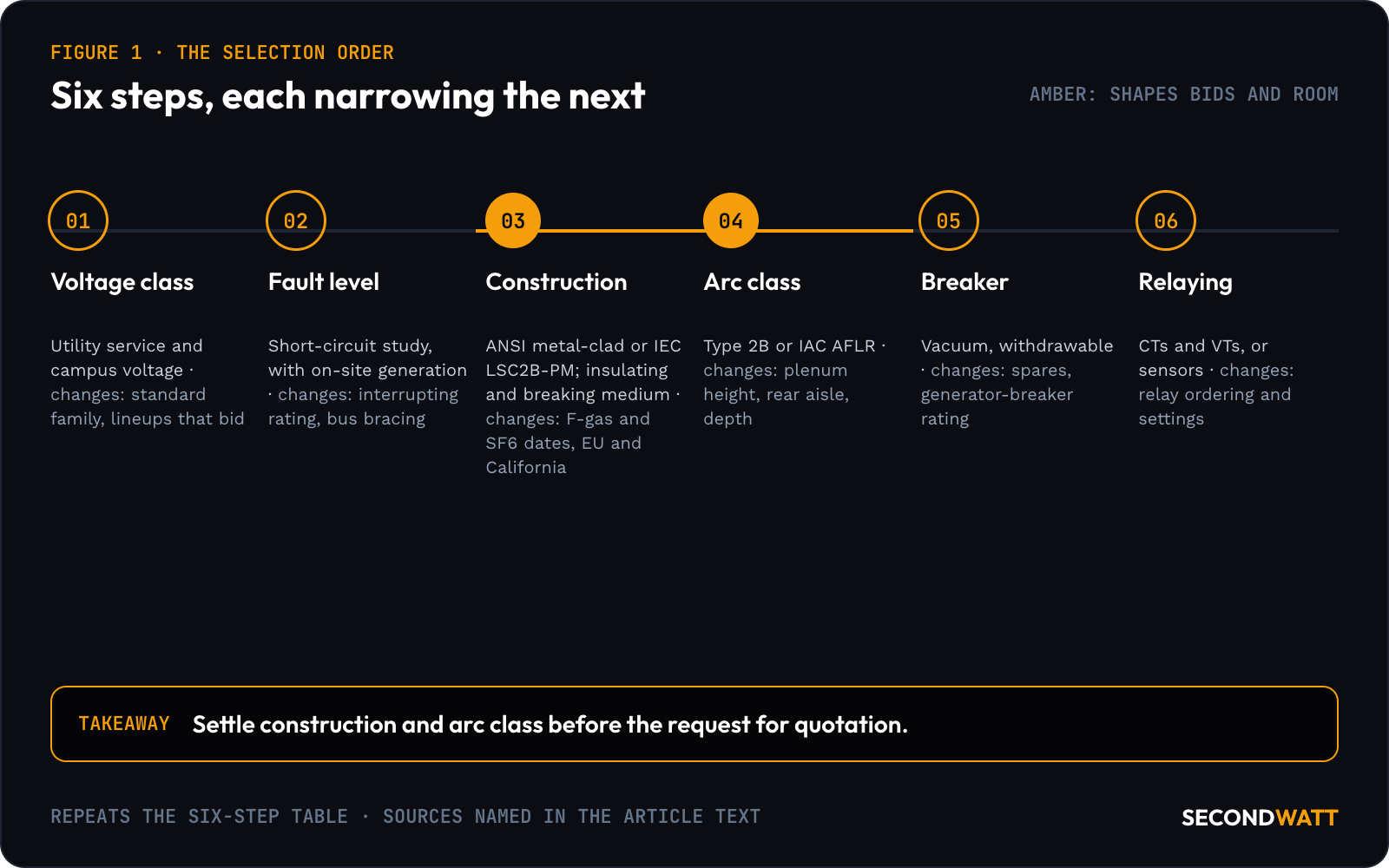
A medium voltage switchgear lineup is selected in a fixed order: voltage class, fault level, construction, arc class, breaker and relaying. Each step narrows the next. Voltage class and fault level come from the utility and the short-circuit study. Construction and arc class decide which lineups can bid and how the electrical room is built, so they belong in the specification before the request for quotation goes out.
Medium voltage, for switchgear, starts above 1,000 V, so a 400 V board is low-voltage gear. The table below sets out the six steps; the sections after it give the standard edition behind each step and the public ratings of named lineups.
Key Takeaways
- Select in a fixed order. Six steps run from voltage class to relaying, and each choice limits the options at the next one.
- Medium voltage starts above 1 kV. IEEE C37.20.1-2026 covers gear at 1,000 V ac and below; IEC 62271-200:2021 covers above 1 kV to 52 kV.
- Arc class sets room space. Arc-resistant gear can add a plenum above the lineup or a rear aisle behind it, in Eaton and Schneider documents.
- The compared lineups span 15–38 kV. Their maximum short-circuit ratings run from 25 kA to 63 kA, from OEM documents and product pages.
- Generation-connected lineups add three decisions. A generator-breaker standard, bus bracing for generator fault current, and the grounding method are settled before the order.
Medium voltage switchgear selection in six steps#
Six-step MV lineup selection: step, what decides it, an example answer from the cited lineups, what it changes downstream, governing document (editions as listed by IEEE and IEC)#
| Step | What decides it | Example answer from the cited lineups | What it changes downstream | Governing document |
|---|---|---|---|---|
| 1. Voltage class | Utility service and campus distribution voltage | 4.16 kV or 13.8 kV on 5 kV- or 15 kV-class gear (Powell), or 24 kV IEC gear | Which standard family and which lineups bid | C37.20.2-2025; IEC 62271-200:2021 |
| 2. Fault level | Short-circuit study, including on-site generation | 25, 36, 50 or 63 kA at 13.8 kV (Powell) | Breaker interrupting rating and bus bracing | C37.04-2018 |
| 3. Construction | Standard named in the specification; insulating and breaking medium | ANSI metal-clad drawout, or IEC LSC2B-PM withdrawable | EU: F-gas MV distribution switchgear cannot be put into operation from 1 Jan 2026 up to 24 kV, or from 1 Jan 2030 above 24 kV to 52 kV, subject to derogations. California: SF6 equipment acquisition phases out from 1 Jan 2025 to 1 Jan 2031, by voltage, siting and short-circuit rating | C37.20.2-2025; C37.20.3-2023; IEC 62271-200:2021; EU 2024/573 Art. 13(9); 17 CCR § 95352 |
| 4. Arc class | Who works near the gear; whether the rear is accessible | Type 2B (Eaton) or IAC AFLR (Schneider, Siemens) | Plenum height, rear aisle and lineup depth | C37.20.7-2024; IEC 62271-200 IAC |
| 5. Breaker | Duty, maintenance access, generator switching | Vacuum, withdrawable | Spares strategy; generator-breaker rating where it applies | C37.04-2018; IEC/IEEE 62271-37-013 |
| 6. Relaying | Protection scheme and communications | CTs and VTs, or sensors such as low-power instrument transformers | Relay ordering and settings work | OEM documents for the chosen lineup |
What medium voltage switchgear covers on a data-center site#
IEEE C37.20.1-2026 covers metal-enclosed low-voltage power circuit breaker switchgear at "1000 V ac and below", with rated maximum voltages from 254 V to 1,058 V ac. Boards in that range are covered in the low-voltage switchgear guide.
Above that line, three documents set the classes a buyer meets. IEEE C37.20.2-2025 covers metal-clad switchgear with rated maximum voltages "from 4.76 kV to 48.3 kV" and main bus ratings of 1,200 A to 4,000 A. Published on 30 June 2026, it supersedes the 2022 edition.
IEEE C37.20.3-2023 covers metal-enclosed interrupter switchgear "Rated above 1 kV AC up to and Including 48.3 kV AC". IEC 62271-200:2021, edition 3.0, covers metal-enclosed assemblies for "rated voltages above 1 kV and up to and including 52 kV". Its consolidated edition 3.1 with Amendment 1 followed in June 2024.
The main components follow C37.20.2's description: circuit breakers, main bus, incoming and outgoing connections, and the associated control, instruments, metering, relaying, protective and regulating devices. On a data-center campus, this gear does the jobs Eaton lists for its VacClad-W lineup: control and distribution, main-main and main-tie-main automatic transfer, main service disconnect and switching. Model-level records sit in the switchgear category.
Fault level, continuous current and interrupting rating#
Three ratings come out of the system study. Continuous current follows the load and the bus arrangement. Short-circuit rating follows the fault current the system can deliver at the bus, from the utility, on-site generation and motors. IEEE C37.04-2018, the active rating standard for ac breakers above 1,000 V and amended by C37.04a-2025, structures ratings including continuous current, short-circuit current, insulation and transient recovery voltage.
Rating a lineup therefore means reading two numbers from the study: the highest load current through each bus and the highest available fault current at it. The lineup's continuous rating must meet or exceed the first, and its interrupting and short-time ratings must meet or exceed the second. Topology moves the second number; parallel sources and closed ties are covered in the redundancy guide.
Ratings come in steps, so the study result is rounded up to the next step the lineup offers. Powell tabulates its 15 kV PowlVac ratings in publication 01077 Rev. 8. A 13.8 kV breaker comes at 25, 36, 50 or 63 kA symmetrical interrupting, with 1,200 to 4,000 A continuous. Fans are required above 3,000 A.
IEC lineups state a short-time withstand current for a stated duration, plus a peak. The duration is 3 s for the ZS2, MCSeT and NXAIR below, and 1 s for the 8DJH. A breaker's peak making capacity is 2.5 times the short-time current at 50 Hz and 2.6 times at 60 Hz, in Schneider's MCSeT user guide.
104 kA — the peak making capacity a 40 kA lineup needs on a 60 Hz system, at 2.6 times its short-time current (calculated).
Construction: metal-clad, metal-enclosed, air- or gas-insulated#
Construction is the step where ANSI and IEC language part ways. Under C37.20.2, metal-clad means drawout electrically operated breakers, with instruments, main bus and incoming and outgoing connections isolated by "grounded metal barriers". Metal-enclosed interrupter gear under C37.20.3 holds interrupter switches, selector switches, power fuses or breakers. IEC 62271-200 covers both air-insulated and "fluid-filled" compartments; OEM catalogs such as Schneider's and Siemens's grade IEC compartmentation by loss-of-service-continuity category (LSC2B) and partition class (PM).
Construction types compared: standard, compartments, voltage range in scope, switching device and maintenance access#
| Construction | Standard and edition | Compartments | Voltage range in the standard's scope | Switching device | Maintenance access, footprint example |
|---|---|---|---|---|---|
| Metal-clad (ANSI) | IEEE C37.20.2-2025 | Grounded metal barriers around instruments, main bus and connections | 4.76–48.3 kV rated maximum | Drawout circuit breaker | Eaton VacClad-W 5–15 kV indoor: 36 in wide, 96.25 in deep |
| Metal-enclosed interrupter (ANSI) | IEEE C37.20.3-2023 | Per the assembly design | Above 1 kV to 48.3 kV ac | Interrupter switches, fuses or breakers | Per OEM layout |
| Air-insulated, metal-enclosed (IEC) | IEC 62271-200 (scope from the 2021 edition; PIX declares to the 2011 edition) | Air-insulated; LSC2B with PM partitions in MCSeT, PIX and NXAIR | Above 1 kV to 52 kV | Withdrawable vacuum breaker in LSC2B-PM designs | Schneider PIX: IAC AFL as standard, so it can be wall-mounted to cut depth |
| Gas-insulated, metal-enclosed (IEC) | IEC 62271-200 (scope from the 2021 edition) | Fluid-filled sealed vessel; SF6 in Siemens 8DJH | 8DJH: up to 24 kV | Switching devices inside a sealed vessel | 8DJH: panels extended without gas work on site |
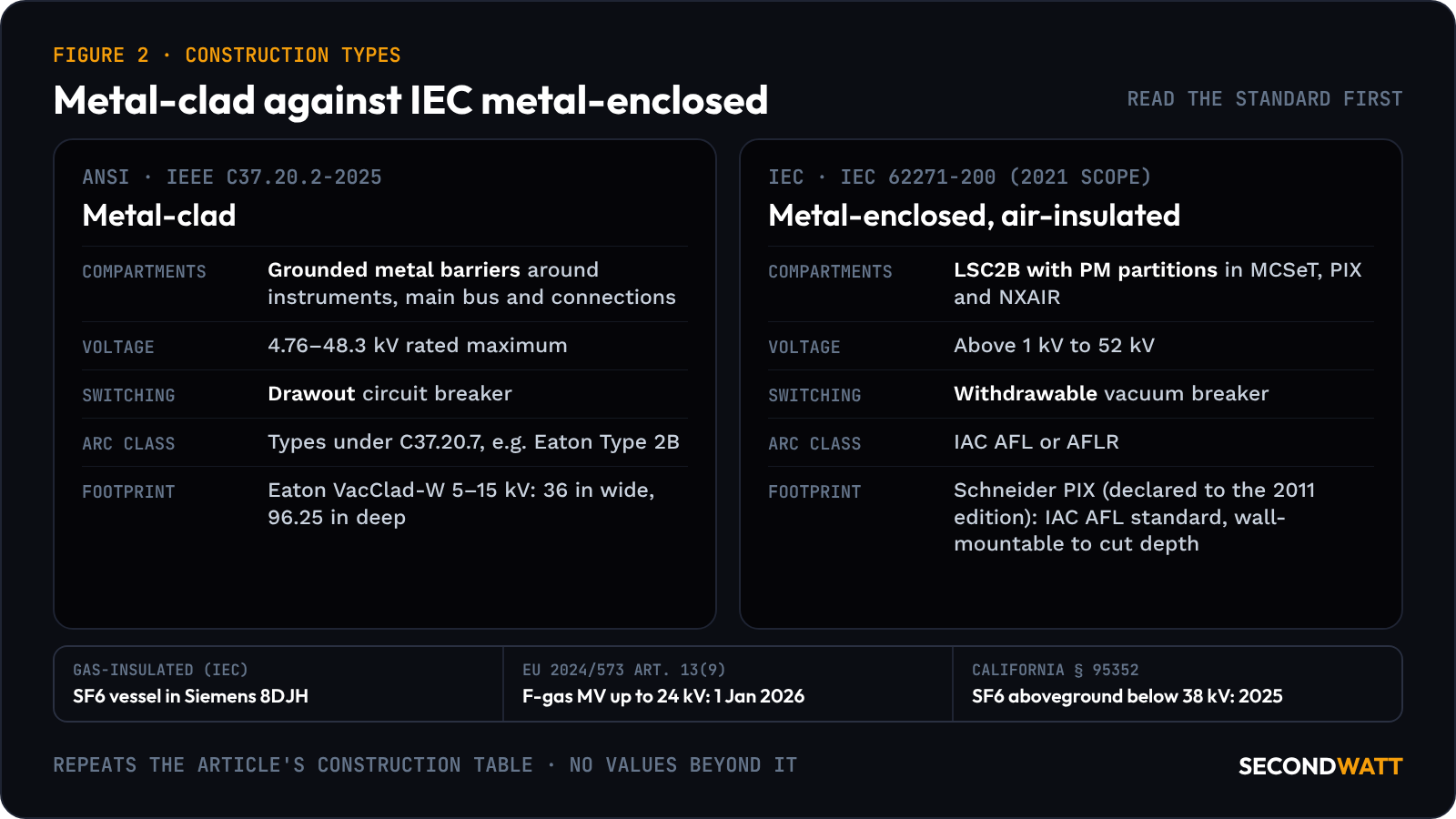
Gas insulation saves space, in Siemens's description of its 8DJH, and carries a regulatory cost. The Siemens 8DJH gas-insulated secondary-distribution switchgear fills its vessel with SF6. Siemens's 2022 catalog HA 40.2 lists the gas at a global warming potential of 22,800 and a leakage rate under 0.1% a year. Annex I of Regulation (EU) 2024/573 puts SF6 higher, at 24,300.
Air-insulated lineups avoid the insulating gas: the ABB UniGear ZS2 reaches 36 kV in air, though ABB lists it with "Fully interchangeable vacuum and SF6 gas circuit breaker".
In the EU, Article 13(9) of Regulation (EU) 2024/573 applies to switchgear "using, or whose functioning relies upon, fluorinated greenhouse gases in insulating or breaking medium". It bars putting such gear into operation from 1 January 2026 for medium-voltage primary and secondary distribution up to and including 24 kV, and from 1 January 2030 above 24 kV up to and including 52 kV. The regulation was published in the Official Journal on 20 February 2024.
Derogations decide whether a given order is caught. Article 13(14) disapplies paragraph 9 where the operator can show the order was placed before 11 March 2024. Articles 13(11) and 13(12) set procurement-based derogations, keyed to the bids received and the medium's global warming potential.
California's amended rule, 17 CCR § 95352, bars anyone from acquiring SF6 gas-insulated equipment for use in the state from set dates. It took effect on 1 January 2022, after a CARB rulemaking.
From 1 January 2025 the bar covers aboveground equipment below 38 kV, belowground equipment up to 38 kV below 25 kA, and equipment above 38 kV up to 145 kV below 63 kA. Aboveground 38 kV equipment follows from 1 January 2028, and belowground equipment up to 38 kV at 25 kA or more from 1 January 2031.
Exceptions cover approved exemptions, equipment acquired after a failure, warranty replacements, and equipment purchased before the date that enters California within 24 months. Replacement parts are outside the dates.
Arc-resistant switchgear: types, accessibility and room design#
Arc-resistant construction is tested, then classified. IEEE C37.20.7-2024 covers testing switchgear "Rated Up to 52 kV for Internal Arcing Faults". It was published in March 2025 as a recommended practice, superseding the 2017 edition, which was titled a guide.
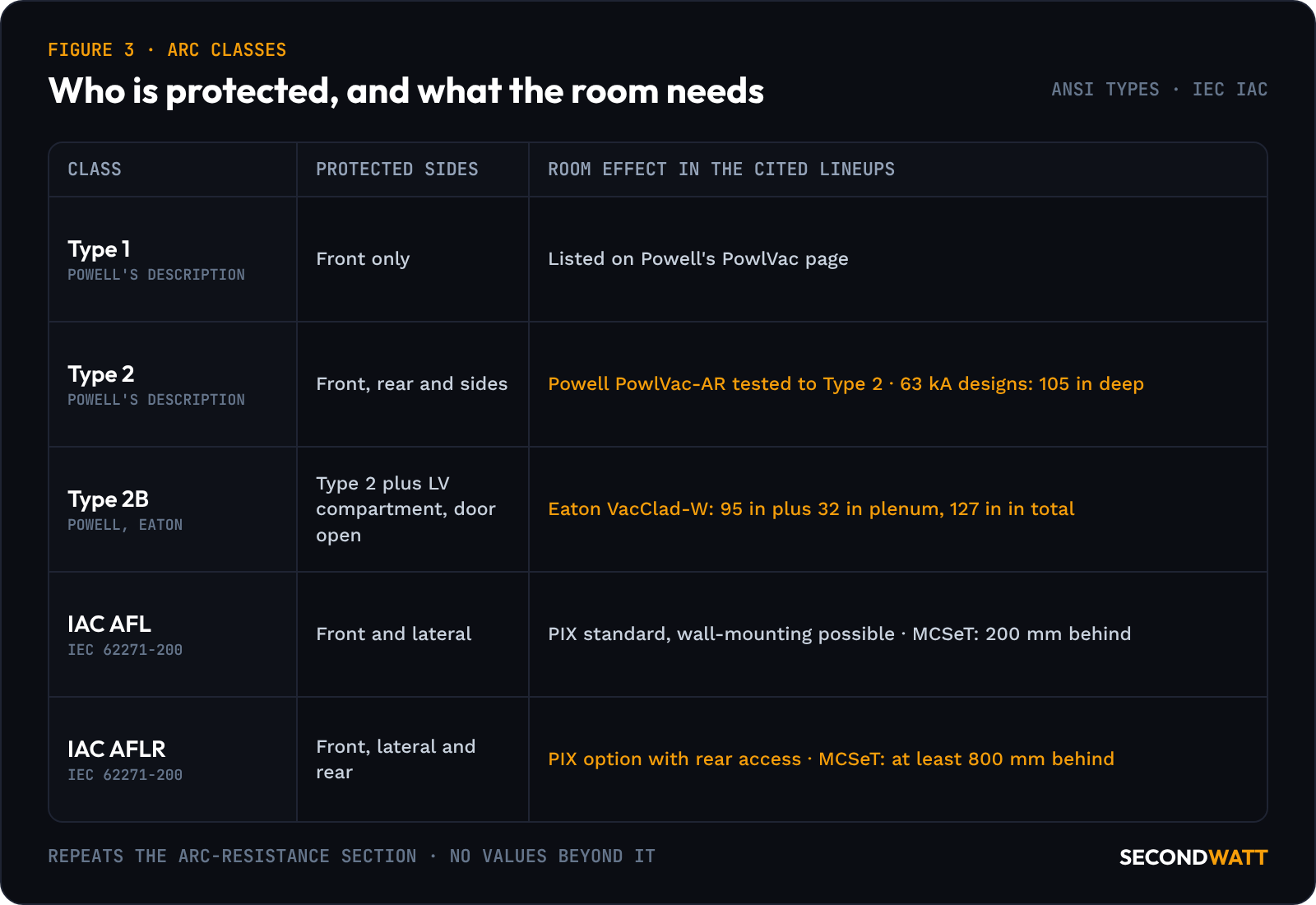
ANSI lineups state a type. In the wording of Powell's 2018 PowlVac-AR brochure, Type 1 protects at the front only and Type 2 at the front, rear and sides. Type 2B adds the low-voltage control compartment with its door open.
PowlVac-AR is tested to C37.20.7 Type 2 in that brochure, while Powell's current PowlVac page lists Type 1, Type 2B and Type 2C designs. The Eaton VacClad-W arc-resistant design is "certified to Type 2B per IEEE C37.20.7", according to Eaton's product page.
IEC lineups state an internal arc classification. The code letters name the accessible sides: A for access restricted to authorized personnel, then F, L and R for front, lateral and rear, with a test current and duration. The Schneider PIX is IAC AFL as standard, with AFLR as an option when the room has rear access. Its January 2023 catalog, NRJCAT20023EN, declares both IAC and LSC2B-PM against IEC 62271-200:2011.
The class changes the room. Behind an MCSeT lineup, Schneider's January 2026 civil guide sets 200 mm of space for AFL and at least 800 mm, about 31.5 in (calculated), for AFLR. Powell's 63 kA PowlVac-AR designs are 105 in deep.
127 in — the height of Eaton's arc-resistant VacClad-W with its plenum: 95 in of gear plus 32 in on top (calculated).
Breakers, generator connections and the relaying interface#
Vacuum is the breaking medium named in the Eaton, Powell, Schneider and Siemens documents below, from the Siemens NXAIR to the circuit-breaker panels of the gas-insulated 8DJH. Article 13(9) covers the insulating and the breaking medium together, so a lineup stays outside it only when both are free of F-gases, as with vacuum breakers in air.
Withdrawable designs rack the breaker out of its cell for maintenance while the rest of the lineup stays energized. Powell's 2,000 A and 3,000 A PowlVac breakers fit a 1,200 A cell, so one spare rating covers several cells. Fixed designs such as the 8DJH mount the switching devices inside the sealed vessel.
The Schneider MCSeT is LSC2B-PM, the IEC category that, in Schneider's catalog, keeps the busbar and cable compartments energized while the breaker compartment is accessed. Its January 2026 user guide still requires the whole cubicle to be de-energized before any door is opened. The site's switching procedure therefore decides how much of the category's service continuity is used.
A lineup that collects on-site generation adds three decisions. A breaker that switches a generator falls under IEC/IEEE 62271-37-013, the standard C37.04-2018 names for generator circuit breakers. Schneider states its EvoPacT HVX breaker is certified to the 2015 edition "for generator circuit breaker up to 40 kA".
Generators also add fault current at the bus, and Powell offers PowlVac-AR main bus rated to 174 kA peak "for generator applications". Grounding is the third, with integrated high-resistance grounding among Powell's options.
Synchronizing and load-sharing controls sit in paralleling gear, covered in the paralleling switchgear guide. Block sizes and N+1 layouts for turbine plants are in the 100 MW turbine sizing guide.
The relaying interface is where the switchgear and protection engineers meet: the lineup supplies the current and voltage signals, the relay space and the communications. Siemens offers low-power instrument transformers for NXAIR, paired with SIPROTEC 5 relays. Eaton offers ohmic voltage sensing in place of conventional voltage transformers, and ABB lists IEC 61850 communication for UniGear ZS1 protection devices. So the sensor type is settled with the lineup order, before relay settings start.
Named lineups compared#
The table lists each lineup's maximum public ratings. ANSI ratings are rated maximum voltages and symmetrical interrupting currents; IEC ratings are rated voltages and short-time withstand currents, so compare like with like.
Documented MV lineups: voltage class, continuous current, short-circuit rating, arc class and insulation (OEM public ratings)#
| Lineup | Standard basis | Max voltage | Max bus current | Max short-circuit rating | Arc classification | Insulation and breaker | Document |
|---|---|---|---|---|---|---|---|
| ABB UniGear ZS1 | IEC (CSA also listed) | 24 kV | 4,000 A | 63 kA short-time (single busbar) | IAC A-FLR | Air; withdrawable VD4 breaker | ABB ZS1 product page; breaker from the UniGear portfolio page |
| ABB UniGear ZS2 | IEC | 36 kV | 3,150 A | 31.5 kA, 3 s | IAC A FLR, 31.5 kA, 1 s | Air; interchangeable VD4 vacuum or HD4 SF6 breaker | ABB UniGear portfolio page; IAC and breakers from ZS2 manual 1YTW571780-012 Rev. K |
| Schneider MCSeT | IEC | 24 kV | 4,000 A to 17.5 kV; 3,150 A at 24 kV (both with forced cooling) | 40 kA, 3 s to 17.5 kV; 31.5 kA at 24 kV | IAC AFLR, to 40 kA, 1 s | Air; EvoPacT HVX vacuum, withdrawable | Schneider user guide BQT6904800-03 (January 2026) |
| Schneider PIX | IEC | 24 kV | 4,000 A to 17.5 kV (forced cooling); 3,150 A at 24 kV (on request) | 40 kA to 17.5 kV; 31.5 kA at 24 kV | IAC AFL standard, AFLR option, 40 kA, 1 s | Air; EvoPacT HVX vacuum, withdrawable | NRJCAT20023EN (January 2023) |
| Eaton VacClad-W 5–15 kV | IEEE C37.20.2 | 15 kV | 3,000 A natural cooling; 4,000 A forced | 63 kA rms symmetrical | Type 2B per C37.20.7 (arc-resistant design) | VCP-W vacuum breaker, drawout | Eaton product page |
| Siemens NXAIR (40 kA version) | IEC | 17.5 kV | 4,000 A | 40 kA, 3 s | IAC A FLR, 1 s | Air; vacuum breaker | Siemens NXAIR profile (June 2026) |
| Siemens 8DJH | IEC | 24 kV | 630 A | 25 kA, 1 s to 17.5 kV; 20/21 kA at 24 kV | IAC A FL or FLR, 21 kA, 1 s (option) | SF6 vessel; switching devices fixed | Siemens HA 40.2 (2022) |
| Powell PowlVac 5–15 kV | ANSI C37.20.2 | 15 kV class (13.8 kV nominal) | 3,000 A; 4,000 A fan-cooled | 63 kA symmetrical | Type 1, Type 2B and Type 2C designs | Vacuum breaker, drawout | Powell 01077 Rev. 8; Powell PowlVac page |
| Powell PowlVac 38 kV | ANSI | 38 kV (27 or 38 kV systems) | 1,200–3,000 A main bus | 40 kA interrupting (KEMA-qualified) | Standard or arc-resistant construction | Vacuum breaker | Powell PowlVac page |
Schneider's UK range page marks the older MCSet 24 kV range "Discontinued". The MCSeT row comes from Schneider's January 2026 user guide for MCSeT with the EvoPacT HVX breaker.
Lead time and cost drivers#
Lead times for critical US data-center electrical components stood at 18 to 36 months in April 2026, in a Wood Mackenzie analysis. The same release projected hyperscale MV switchgear demand rising from 786 to 4,698 units between 2025 and 2030, about six times (calculated).
Demand also shows in one switchgear maker's order book, reported in Powell's Q3 FY2026 release of 3 August 2026. Powell's backlog stood at $2.4 billion on 30 June 2026, up 69% from $1.4 billion a year earlier, in nominal dollars. Its book-to-bill ratio for the quarter was 3.0. One of the quarter's orders was for a data center "with a value exceeding $400 million related to a behind-the-meter design of on-site generation assets".
Fixing the six choices before the RFQ means every quotation prices the same lineup. Price follows the same choices: voltage class, short-circuit rating, construction, arc class and any SF6-free requirement each move the quote. Dollar figures by voltage class are in the switchgear pricing guide. Maintenance intervals for a lineup once installed are in the switchgear maintenance field guide.
FAQ: medium voltage switchgear#
Can a lineup be made arc-resistant after it is ordered?#
Plan it into the order, because arc classification belongs to a tested design. An IEC internal arc test has five criteria, from doors staying shut to the enclosure staying grounded, as Schneider's PIX catalog sets them out. PIX reaches AFLR by adding "additional elements", and the 8DJH lists its internal arc classification as an option.
Does SF6-free switchgear change the maintenance plan?#
F-gas-free gear, insulated with air and breaking in vacuum, carries none of the gas duties EU Regulation 2024/573 attaches to F-gas switchgear. Fluorinated alternatives need their own check: Annex I lists the fluorinated nitrile heptafluoroisobutyronitrile at a GWP of 2,750. Hitachi Energy's product page says its 420 kV EconiQ GIS ELK-3 uses a fluoronitrile mixture.
For F-gas gear in the EU, Article 5 requires leak checks on equipment holding 5 tonnes of CO2 equivalent or more of Annex I gases. At SF6's 24,300, that is about 0.21 kg of gas (calculated). Switchgear is exempt if it has a labeled tested leakage rate below 0.1% a year, a pressure or density monitor with an automatic alert, or less than 6 kg of Annex I gases.
Article 8 requires recovery to be done by certified people. From 1 January 2035, Article 13(7) requires SF6 servicing to use reclaimed or recycled gas, with narrow exceptions.
How do IEC-rated lineups fit a US data center?#
Check the frequency and the label. The Schneider and Siemens IEC catalogs cited here list 50/60 Hz ratings, and the 60 Hz peak factor of 2.6 applies at a US site. Eaton and Powell offer UL and CSA labels on their ANSI lineups; ABB lists CSA alongside IEC for UniGear ZS1. Read "metal-clad" with care: the Siemens NXAIR profile uses it for IEC partition class PM, while a US specification means C37.20.2 construction.
When is a used MV lineup worth evaluating?#
When it matches the voltage class, fault level and arc class the six steps produce. Inspection is in the used MV lineup guide.
The SF6 rules treat moved equipment differently from new purchases. Under Article 13(10), moving EU-operated switchgear to another EU site is not "putting into operation". Under § 95352(a)(2), SF6 equipment present in California and reported to CARB for a data year before its phase-out date stays outside the acquisition bar.
Specifying in the right order#
SecondWatt publishes equipment research and helps buyers source power equipment; it earns a fee when a sale it arranges closes. If you are specifying a lineup, send the voltage class, fault level, construction and arc class through a request for quote, and the six steps frame the search. If you own surplus MV switchgear with its test records, the seller page sets out how SecondWatt works with owners.