ABB UniGear ZS2 36 kV air-insulated switchgear
Manufacturer: ABB
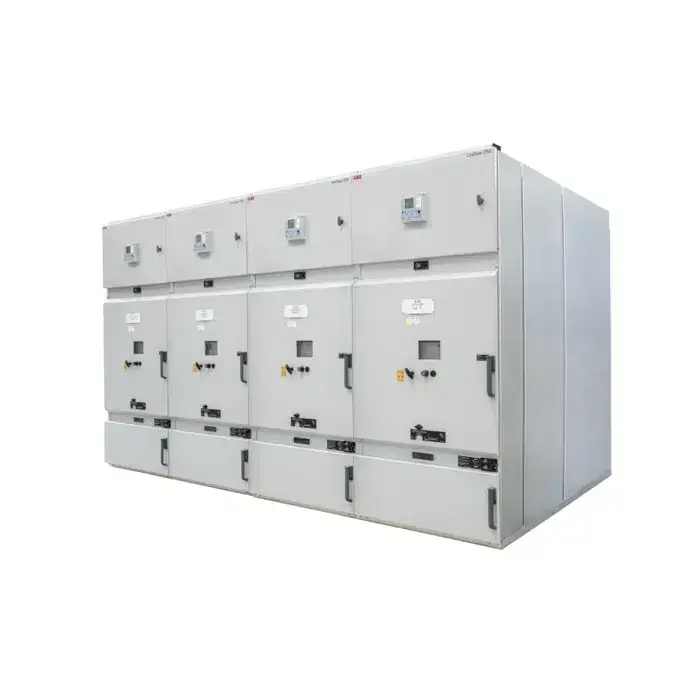
ABB UniGear ZS2, the 36 kV metal-clad line whose class carries the longest switchgear lead times of all
This model is part of SecondWatt’s switchgear research catalogue. Specifications and price observations are included where supported by sources. Equipment availability and commercial terms require confirmation.
ABB UniGear ZS2 dossier: 36 kV metal-clad switchgear at 2,500 A and 31.5 kA, cancelled-project surplus evidence, 78-104 week leads, inspection points.
UniGear ZS2 is ABB's air-insulated, metal-clad switchgear for the 36 kV class, built with arc-proof construction to IEC 62271-200 and withdrawable vacuum breakers. Two ABB documents state the envelope differently: the ZS2 catalogue (Cat_UniGear ZS2-En) gives 36 kV, 2,500 A and 31.5 kA, while ABB's current UniGear portfolio page gives up to 36 kV, up to 3,150 A and up to 31.5 kA/3 s as of August 2026. The 40.5 kV class belongs to the separate UniGear ZS3.2, not to ZS2.
The 36-38 kV class is the chokepoint of the whole switchgear market: new-build leads run 78-104 weeks, the longest of any class, which makes project surplus disproportionately valuable. Exactly one documented surplus event is public: a Salvex lot of 5 unused ZS2 panels with critical spares (36 kV service at 33 kV, 50 Hz, 1,250 A busbar), sold as-is-where-is with the listing now closed and no price shown, a textbook cancelled-project lot.
No other ZS2 listing, priced or unpriced, was public in August 2026. For US buyers the line is IEC-spec and 50/60 Hz configuration must be verified panel by panel.
Why it matters
At 78-104 week new-build leads, a crated 36 kV lineup with spares is nearly irreplaceable inventory: whoever finds it first controls a project schedule. ZS2's single documented surplus lot shows such inventory exists, and no marketplace tracks 36 kV-class surplus systematically.
Who buys it
Utilities and industrial plants distributing at 33-36 kV specify ZS2, with renewables collection and large-campus intake the growth duties. Surplus buyers are EPCs hunting cancelled-project lots to beat two-year leads; the Salvex lot shows such inventory exists but clears through auction channels, not dealer shelves.
Role in the data center
Campus intake and renewables-collection switching at 33-36 kV on IEC-market projects, sitting between the utility connection and the step-down transformers feeding hall-level distribution. Because this class carries the longest new-build lead times in switchgear, a crated surplus lot functions as schedule insurance rather than a cost saving.
Key specifications
| Voltage class, ZS2 catalogue | 36 kV |
|---|---|
| Current ceiling, ZS2 catalogue | 2,500 A |
| Short-circuit rating, ZS2 catalogue | 31.5 kA |
| Construction standard | IEC 62271-200 (arc-proof) |
| Observed surplus lot | 5 unused panels + spares, 1,250 A, 50 Hz |
| Class lead time (new) | 78-104 weeks |
| Portfolio page | IEC AIS primary switchgear UniGear ZS2 |
| Current ceiling, ABB UniGear portfolio page (Aug 2026) | 3,150 A |
| Short-time withstand, ABB UniGear portfolio page (Aug 2026) | 31.5 kA / 3 s |
| 40.5 kV sibling | UniGear ZS3.2, up to 40.5 kV (48 kV on request), 3,150 A, 31.5 kA/4 s |
Technical summary
Voltage: 36 kV. Current: 2,500 A per the ZS2 catalogue; up to 3,150 A per ABB's current UniGear portfolio page as of August 2026. Short-circuit: 31.5 kA (stated as 31.5 kA/3 s on the portfolio page). Construction: arc-proof metal-clad to IEC 62271-200 with withdrawable vacuum breakers. Observed surplus lot: 5 unused panels, 1,250 A busbar, 50 Hz, with spares. Class lead time: 78-104 weeks new (38 kV specialty band). Siblings: UniGear ZS1 up to 24 kV; UniGear ZS3.2 up to 40.5 kV, 48 kV on request.
Major variations
Feeder, incomer, bus-tie and metering panels on the 36 kV platform, in 50 Hz and 60 Hz builds, with internal arc classification assigned per configuration and stated in the catalogue rather than as a single family figure. Within the wider UniGear range ZS1 covers 24 kV and below at up to 4,000 A and 63 kA, while ZS3.2 covers 40.5 kV (48 kV on request) at 3,150 A and 31.5 kA/4 s. Buyers sourcing '36 to 40 kV UniGear' surplus are usually looking at two different products with different panel dimensions.
Configurations and options
Panel duty, incomer, feeder, bus-tie or metering, and the busbar rating are what set price and length on a 36 kV lineup, along with the withdrawable vacuum breaker rating, the relay package and the 50 Hz or 60 Hz build. ABB's own documents disagree on the current ceiling: the ZS2 catalogue Cat_UniGear ZS2-En gives 36 kV, 2,500 A and 31.5 kA, while ABB's current UniGear portfolio page gives up to 36 kV, up to 3,150 A and 31.5 kA/3 s, so a used panel has to be read off its own nameplate rather than a family datasheet. Internal arc classification is assigned per configuration in the catalogue rather than as one family figure.
Compatibility and dependencies
At the 36 kV class the room is usually the binding constraint: panel dimensions, cable trench depth, breaker withdrawal envelope and the internal arc exhaust path all differ from ZS1, and UniGear ZS3.2, which covers 40.5 kV, is a different panel with different dimensions again. Bus rating and the 31.5 kA/3 s withstand have to match the upstream transformer and network contribution. A documented surplus lot of five unused panels was built for 33 kV service at 50 Hz with a 1,250 A busbar, which is the level of detail any lot needs checked before purchase: voltage, frequency, busbar rating and spares content, panel by panel.
Pricing and availability
Trend: rising The drivers that do carry dates are category-level rather than model-level. Electrical Trader's 2026-04-01 review puts medium-voltage switchgear up 50% since 2021, and Terrapin Construction Group reported on 2026-06-10 that 38 kV-class new-build lead times run 78-104 weeks, roughly 2.5 times pre-pandemic norms, with no meaningful improvement since 2023. Lead time, new: 78-104 weeks (38 kV class). Lead time, used or refurbished: Auction-lot dependent. Warranty, used: 1-year typical from reconditioning dealers.
Lifecycle and maintenance
Metal-clad MV switchgear routinely serves 40+ years: vacuum interrupters rated for 10,000-30,000 operations far outlast the mechanical duty standby service imposes, so lineup life is governed by insulation condition and relay/controls vintage. Breakers recondition readily and trade as units, while lineups modernize in place with digital relays and retrofit breakers. ANSI/NETA MTS acceptance testing at purchase plus PD surveys in service are the condition gates.
Thermal and emissions profile
Switchgear produces no combustion emissions; the regulatory profile is electrical safety and materials. NFPA 70B became a standard in its 2023 edition, making maintenance programs mandatory rather than recommended, and arc-flash rules (NFPA 70E) govern work practices. LV air-insulated gear carries no F-gas exposure, and construction standards (UL 891, UL 1558, IEEE C37.20.1) plus arc-resistant options under IEEE C37.20.7 define the safety envelope buyers should verify.
Common failure points
- Vacuum interrupters — Loss of vacuum ends interrupting capability with no external sign
- Insulation tracking and PD — Partial discharge across dusty or damp insulation progressing to flashover
- Racking and interlocks — Damaged racking screws and defeated interlocks from forced operation
- Protection relays — Obsolete or drifted relays mis-operate under fault
- Instrument transformers — CT/VT failures disable metering and protection inputs
- Space heater failure — Condensation-driven tracking in unheated outdoor or humid gear
Inspection checklist
Vacuum integrity: hipot test each interrupter per OEM procedure (e.g., 36 kV test on 15 kV class). Insulation resistance: megger bus and breakers at 2,500-5,000 V; compare to ANSI/NETA MTS tables. Contact resistance: micro-ohm each pole; investigate imbalance beyond 50% between phases. Partial discharge: ultrasonic and TEV survey; investigate any reading 6 dB above baseline. Contact erosion: measure vacuum interrupter erosion marks against the OEM wear allowance. Racking mechanism: cycle connect/test/disconnect positions 3 times each; verify interlocks and shutters. Mechanism timing: verify open/close times; closing beyond 5 cycles flags mechanism trouble. Bus insulation: inspect epoxy and boots for tracking or corona; clean and torque joints. Instrument transformers: verify CT/VT ratios, insulation, and fusing.
Procurement channels
New units come through ABB. The only observed secondary flow is auction: the documented Salvex lot of five unused panels with spares, sold as-is-where-is. No dealer-shelf ZS2 inventory was listed in August 2026, and 36 kV-class surplus generally clears through private and auction channels rather than published dealer listings, so buyers need to be watching auction feeds rather than dealer catalogs.
Regional notes
An IEC line built to IEC 62271-200 and produced in 50 Hz and 60 Hz versions, with no ANSI/IEEE equivalent. North American projects at this voltage generally specify 38 kV ANSI gear instead, so a 50 Hz ZS2 lot is a European or Middle Eastern asset unless the frequency and standards build are verified panel by panel. The 36-38 kV class carries the longest new-build lead times in switchgear, 78-104 weeks per Terrapin Construction Group's 2026-06-10 figures, which is what makes crated surplus at this voltage worth chasing across regions at all.