Siemens SENTRON 3WL air circuit breaker (phase-out October 2026)
Manufacturer: Siemens
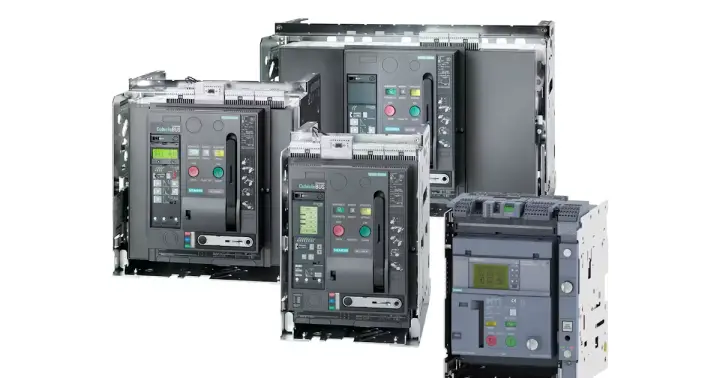
Siemens SENTRON 3WL air breakers, 630-6,300 A workhorses entering their aftermarket era as production ends
This model is part of SecondWatt’s switchgear research catalogue. Specifications and price observations are included where supported by sources. Equipment availability and commercial terms require confirmation.
Siemens SENTRON 3WL dossier: 630-6,300 A air breakers priced 5,000-14,999 USD used as October 2026 phase-out lands, retrofit economics, inspection.
SENTRON 3WL is Siemens AG's long-running LV air circuit breaker family, 630-6,300 A in IEC 60947-2 and UL 1066 builds with ETU trip units, and it is the category's live transition story: Siemens has announced phase-out with production ending October 2026 and 3WA as the designated successor and retrofit path. The owner is Siemens AG Smart Infrastructure, not Siemens Energy.
The used market is already priced and deepening: a used 3WL1112 1,250 A 4-pole unit at 5,000 USD, a new-surplus 3,200 A electrically-operated unit at 12,500 USD, and a 4,000 A-class WL breaker at 14,999 USD, with trip-unit modules trading separately near 1,250 USD. US-market WL breakers (the ANSI-built siblings from Siemens' Grand Prairie line) share cubicle ecosystems and dealer channels.
Every phase-out follows the same arc: spares demand rises as production ends, reconditioners stock up, and prices firm until the retrofit wave (3WA conversion kits) caps them. The 22%-off-curve NETA finding for aged LV breakers makes injection testing the non-negotiable acceptance step on every used 3WL.
Why it matters
An announced end date converts a commodity breaker into a scarcity asset on a schedule: October 2026 is the category's clearest tradable catalyst. The observed 5,000-14,999 USD band will move as that date passes.
Who buys it
Owners of 3WL-equipped switchboards, a fleet spanning two decades of data centers, hospitals, and plants, buy spares ahead of the production stop; reconditioners build inventory; retrofit-averse operators lock in identical replacements while they exist. Price-driven buyers weigh used 3WL against 3WA retrofit economics.
Role in the data center
Main and feeder ACBs across two decades of Siemens-equipped LV switchboards; the spares and retrofit decision now sits on every such lineup's maintenance plan.
Key specifications
| Current range | 630-6,300 A |
|---|---|
| Standards | IEC 60947-2; UL 1066 (WL) |
| Phase-out | production ends October 2026 |
| Successor | SENTRON 3WA + retrofit kits |
| Observed used 1,250 A 4P | 5,000 USD |
| Observed new-surplus 3,200 A | 12,500 USD (EO, unused) |
| Observed 4,000 A class | 14,999 USD |
| Trip-unit module comp | ~1,250 USD (ETU, separate) |
| Manufacturer | Siemens AG Smart Infrastructure |
Technical summary
Range: 630-6,300 A, three frame sizes Standards: IEC 60947-2; UL 1066 (US WL siblings) Trip units: ETU series, withdrawable and fixed builds Phase-out: production ends October 2026 Successor/retrofit: SENTRON 3WA with conversion kits Observed used: 3WL1112 1,250 A 4P at 5,000 USD Observed new-surplus: 3,200 A EO unit at 12,500 USD Observed 4,000 A class: 14,999 USD Acceptance rule: injection test (22% of aged LV breakers off-curve per NETA)
Major variations
Three frames, IEC 3WL versus US-built WL siblings, fixed versus withdrawable, ETU trip tiers, and 3P/4P builds. Cubicle compatibility is the retrofit variable: 3WA kits reuse 3WL cubicles, which anchors the retrofit-versus-spares decision.
Configurations and options
Three frames cover 630-6,300 A, and the order variables that set price are the frame, fixed or withdrawable construction, 3-pole or 4-pole, and the ETU trip tier with its protection functions and metering. Build standard is the other axis: IEC 60947-2 3WL panels against the US-built WL siblings from Siemens' Grand Prairie line under UL 1066. On used stock the trip unit is priced separately in practice, with ETU modules observed trading near 1,250 USD, so a breaker offered without its trip unit is not the same purchase. Cubicle compatibility is what decides the money, because 3WA retrofit kits reuse existing 3WL cubicles.
Compatibility and dependencies
The cubicle governs: a 3WL seats in its own cradle, and the alternative to an identical used unit is a new 3WA plus a Siemens retrofit kit engineered to reuse that cubicle. Trip-unit generation and its communications determine what the site power monitoring system can read. Interrupting rating has to be coordinated with the available fault current at the board rather than taken from the family ceiling, and the listing standard has to match the board, since an IEC 60947-2 3WL is not a substitute for a UL 1066 WL in an ANSI lineup. Acceptance is not optional on aged units: NETA's published field data records 22% of tested low-voltage power breakers off their time-current curves, which makes injection testing the gate.
Pricing and availability
Published price range: $5,000 – $14,999. Trend: up Circuit breakers are up 47% since 2021 category-wide, and the 3WL's announced end date adds a scarcity kicker: new-surplus 3,200 A units at 12,500 USD already trade near half-frame-size used Masterpact levels. Expect firming through the October 2026 production stop, then a cap as 3WA retrofit kits absorb demand. Lead time, new: Orderable until October 2026; then retrofit/spares only. Lead time, used or refurbished: 1-4 weeks (dealer and eBay stock). Warranty, used: 1-year typical from reconditioning dealers.
Lifecycle and maintenance
LV power circuit breakers serve 30-40 years on 3-5 year maintenance cycles per ANSI/NETA MTS and NFPA 70B, with mechanism lubrication and injection testing the critical items. A deep reconditioning ecosystem (Relectric, NAS, Bay Power, Bullock) tests to NETA specifications and warrants units for 1 year. OEM trip-unit retrofit programs (Eaton PXR, ABB EntelliGuard R, Siemens 3WA retrofit) extend installed platforms past electronics obsolescence, which sustains used-breaker values.
Thermal and emissions profile
Switchgear produces no combustion emissions; the regulatory profile is electrical safety and materials. NFPA 70B became a standard in its 2023 edition, making maintenance programs mandatory rather than recommended, and arc-flash rules (NFPA 70E) govern work practices. LV air-insulated gear carries no F-gas exposure, and construction standards (UL 891, UL 1558, IEEE C37.20.1) plus arc-resistant options under IEEE C37.20.7 define the safety envelope buyers should verify.
Common failure points
- Mechanism springs and lubrication — Slow trips, trip-free on close, failure to latch on aged units
- Trip unit electronics — Nuisance trips or no-trip from aged or obsolete electronics
- Contacts and arc chutes — Overheating and interruption failure from eroded contacts or cracked chutes
- Secondary wiring — Control faults from damaged secondary disconnects and aux switches
- Provenance and counterfeits — Counterfeit or mis-labeled breakers fail catastrophically under fault
- Cassette and racking wear — Misalignment and cluster contact damage on worn cradles
Inspection checklist
Mechanism — exercise open/close 10+ cycles; verify the charge/close/trip sequence completes and the mechanism latches on every close; treat any failure to latch on close as a finding and check it against the OEM acceptance procedure Trip curve — primary injection test; NETA field data shows 22% of LV power breakers off their published curves Secondary injection — verify all 4 protection functions (LSIG) against settings; record as-found/as-left values Contact resistance — micro-ohm test each pole; investigate readings above 1.5x sister poles Insulation resistance — megger at 1,000 V per ANSI/NETA MTS acceptance tables Contact wear — inspect arcing contacts and wear indicators against the OEM replacement limit Arc chutes — remove and inspect for cracks, erosion, and metal splatter; replace damaged chutes Lubrication — verify mechanism grease condition; dried lubricant is the leading slow-trip cause on 20+ year units Racking — exercise draw-out mechanism through connect/test/disconnect; verify shutter operation Auxiliary wiring — verify secondary disconnects, charging motor voltage (24-125 V options), and aux contacts Trip unit vintage — identify electronics generation; obsolete trip units reprice the breaker toward core value Counterfeit screen — verify serial numbers with the OEM; counterfeit LV breakers documented since the 2007 CPSC recall Ratings match — confirm frame, sensor/rating plug, and interrupting rating (kA at 480 V) against the application Listing match — verify cassette/cradle compatibility and UL 1066 or UL 489 listing matches the switchgear type Records — factory test report, service history, and injection results; missing records reprice toward as-is
Procurement channels
eBay (INMATETO and peers), Surplus Record's Siemens breaker listings, and reconditioning dealers; trip-unit modules trade separately. Injection testing at acceptance is mandatory on aged units.
Regional notes
Two builds that share a family name: IEC 60947-2 3WL panels for international markets and the US-built WL siblings from Siemens' Grand Prairie line listed to UL 1066, sharing cubicle ecosystems and dealer channels in North America. The build has to be read off the nameplate rather than the model designation. The owner is Siemens AG, Smart Infrastructure, Electrical Products; Siemens Energy AG has been a separate listed company since September 2020 and has never sold this line. Production ends in October 2026, after which both markets are served by spares, reconditioned stock and 3WA retrofit.