Hitachi Energy EconiQ eco-efficient high-voltage switchgear portfolio
Manufacturer: Hitachi Energy
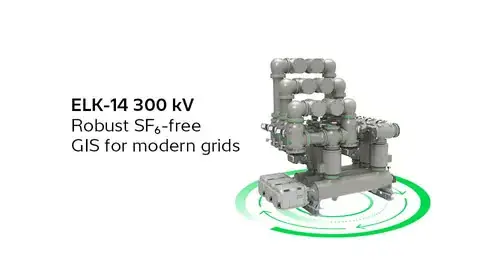
Hitachi Energy EconiQ, the eco-efficient high-voltage portfolio from 72.5 kV that replaces SF6 with a C4-FN mixture
This model is part of SecondWatt’s switchgear research catalogue. Specifications and price observations are included where supported by sources. Equipment availability and commercial terms require confirmation.
Hitachi Energy EconiQ: eco-efficient high-voltage switchgear from 72.5 kV upward on C4-FN fluoronitrile chemistry, with the F-gas timeline and context.
EconiQ is Hitachi Energy's eco-efficient portfolio label, and in switchgear it covers high-voltage equipment from 72.5 kV upward, including the SF6-free circuit breakers and gas-insulated switchgear the company has scaled to 420 kV and above. Hitachi Energy applies the EconiQ switchgear label to transmission-class products; its medium-voltage SF6-free answer runs through other platforms entirely, so a search for EconiQ at distribution voltages lands in the wrong part of the portfolio.
The chemistry matters to the category: EconiQ high-voltage switchgear uses a fluoronitrile (C4-FN) based mixture, the technology GE and Hitachi cross-licensed in 2021, which is a different philosophy from Siemens clean air, Schneider pure air, and Eaton's air-plus-vacuum approach. Those three paths are the whole SF6-free landscape, and EconiQ anchors the third.
No secondary market exists at any voltage: EconiQ is new-build transmission equipment sold to grid owners, engineered into its substation and gas-recovered at end of life rather than resold.
Why it matters
EconiQ's C4-FN chemistry is one of three competing approaches to SF6 replacement, and a buyer planning an SF6 transition needs both the voltage class and the chemistry right before comparing vendors. It also sets buyer expectations correctly: a campus specifying SF6-free medium-voltage gear is shopping Siemens blue, Schneider AirSeT, Eaton Xiria or ABB, not EconiQ.
Who buys it
Transmission owners and utilities replacing SF6 high-voltage switchgear buy EconiQ, driven by the EU F-gas dates that reach the 52-145 kV classes from 2028 and above 145 kV from 2032. Data center campuses meet it only at transmission-voltage interconnects built by or with the utility, which means the specification decision usually sits on the utility's side of the meter rather than the owner's.
Role in the data center
Transmission-side equipment at utility interconnects rather than owner-procured campus gear. A campus meets EconiQ through the utility's own SF6-free transition programme, which matters when a project's interconnect schedule depends on the utility's equipment availability at 115 kV and above.
Key specifications
| Voltage scope | 72.5 kV and above (HV) |
|---|---|
| Portfolio placement | transmission-class switchgear label; Hitachi MV SF6-free products use other platforms |
| Insulation chemistry | fluoronitrile (C4-FN) mixture |
| Cross-license | GE/Hitachi C4-FN agreement (2021) |
| Product types | SF6-free HV breakers and GIS |
| Competing approaches | clean air / pure air / air+vacuum |
| Secondary market | none |
| Regulatory driver | EU F-gas 2024/573 HV dates 2028-2032 |
| Scaled voltage reach | 420 kV and above |
| EU F-gas dates for this class | 2028 for 52-145 kV; 2032 above 145 kV |
Technical summary
Portfolio scope: high-voltage switchgear, 72.5 kV and above, scaled to 420 kV and beyond. Insulation approach: fluoronitrile (C4-FN) based mixture. Cross-license history: GE and Hitachi agreement, 2021. Product types: SF6-free high-voltage circuit breakers and gas-insulated switchgear. Voltage placement: EconiQ switchgear is a transmission-class label; Hitachi Energy's medium-voltage SF6-free products sit outside it. Competing SF6-free approaches: clean air (Siemens), pure air (Schneider), air plus vacuum (Eaton). Regulatory driver: EU F-gas Regulation 2024/573 dates of 2028 for 52-145 kV and 2032 above 145 kV. Market: new-build transmission equipment with no secondary market.
Major variations
EconiQ spans high-voltage circuit breakers, gas-insulated switchgear and related eco-efficient equipment across transmission voltage classes from 72.5 kV upward, with the portfolio scaled to 420 kV and above. Hitachi Energy's medium-voltage SF6-free offerings sit outside the EconiQ switchgear label and use different platforms, so the family should not be read as a distribution-voltage range. Within EconiQ the variation that matters commercially is voltage class and whether a given class has reached series production, because the F-gas dates arrive class by class.
Configurations and options
EconiQ is a portfolio label applied across Hitachi Energy's eco-efficient high-voltage equipment rather than a single orderable model, so what is specified is a voltage class and an equipment type, high-voltage circuit breakers or gas-insulated switchgear, inside a transmission substation design. Configuration follows the substation one-line: bay count, busbar arrangement and instrument-transformer content are engineered rather than chosen from a catalogue. The variable that decides whether a given duty can be met at all is whether the relevant voltage class has reached series production, because the portfolio has scaled class by class from 72.5 kV up to 420 kV and above.
Compatibility and dependencies
Insulation is a fluoronitrile, C4-FN, based mixture, the chemistry Hitachi and GE cross-licensed in 2021, and it is not interchangeable with the clean air used by Siemens, the pure air used by Schneider or the air-plus-vacuum approach Eaton takes at medium voltage. That matters operationally because gas handling equipment, filling procedures and technician qualification are chemistry-specific. Everything else follows transmission-substation practice: the equipment is engineered into its bay, its protection integrates with the substation control system, and its delivery date is usually the gating item on an interconnect. A campus meets this equipment through the serving utility rather than buying it.
Pricing and availability
Trend: rising Lead time, new: Transmission-project scheduled. Lead time, used or refurbished: No secondary market. Warranty, used: 1-year typical from reconditioning dealers.
Lifecycle and maintenance
Gas-insulated switchgear targets 35-40 year service from sealed-for-life compartments with minimal maintenance: density monitoring, PD surveys, and mechanism service. Sealed tanks cannot be repaired in the field, so gas loss or internal fault usually ends the asset. EU F-gas and CARB rules add end-of-life SF6 recovery and reporting obligations that must be priced into any SF6 unit, while SF6-free designs (clean air, dry air, C4-FN mixtures) remove that liability entirely.
Thermal and emissions profile
Switchgear produces no combustion emissions, and SF6-free designs remove the category's one regulatory exposure: instead of SF6 (GWP 24,300), these units insulate with clean air, dry air, or pure air at GWP below 1 and interrupt in vacuum. That satisfies EU F-gas Regulation 2024/573, which bars new SF6 MV switchgear from the EU market from 2026, and California's CARB phase-out of new SF6 equipment acquisitions from 2025. Buyers avoid gas handling, leak reporting, and end-of-life recovery costs entirely.
Common failure points
- Gas leakage — Density alarms and lockout; insulation margin lost as pressure falls
- Partial discharge in compartments — PD at spacers, particles, or terminations progressing to internal fault
- Operating mechanism — Spring and motor failures on switch and breaker drives
- Cable terminations — Tracking in cable boxes and poorly seated plug-in connectors
- Density monitor drift — False alarms or missed low-gas conditions from drifted gauges
- End-of-life gas liability — SF6 recovery and reporting costs land on the owner at decommissioning
Inspection checklist
Gas density: verify density monitors against nameplate fill (150 kPa class systems); alarm thresholds intact. Leak rate: review gas top-up logs; leakage above 0.5% per year fails modern acceptance. Gas quality: test SF6 moisture and decomposition before transfer; SO2 presence flags internal arcing. F-gas compliance: verify EU 2024/573 and CARB status; new SF6 MV gear is barred from the EU market from 2026. Partial discharge: UHF or acoustic survey per IEC 60270 practice; PD is the dominant latent defect. Vacuum interrupters: hipot test breaking units; interruption is vacuum even in gas-insulated designs. Mechanism: exercise and verify spring charge; check counters against 10,000-operation class ratings. Terminations: inspect cable boxes for tracking; verify stress cones and plug-in connectors seated.
Procurement channels
Hitachi Energy transmission channels only, with no secondary market at any voltage: this equipment is engineered into its substation and gas-recovered at end of life rather than resold.
Regional notes
Transmission-class equipment from 72.5 kV upward, so the applicable rules are utility interconnection standards rather than the ANSI or IEC distribution switchgear standards used at campus voltages. EU Regulation 2024/573 bars new SF6 high-voltage switchgear in the 52-145 kV classes from 2028 and above 145 kV from 2032, which is the schedule driving European utility adoption; the equivalent US pressure is state-level, led by California's phase-out of new SF6 equipment from 2025. There is no EconiQ medium-voltage switchgear line, and Hitachi Energy's SF6-free answer at distribution voltages runs on other platforms.