Hitachi Energy ELK gas-insulated switchgear family (72.5 kV and above)
Manufacturer: Hitachi Energy
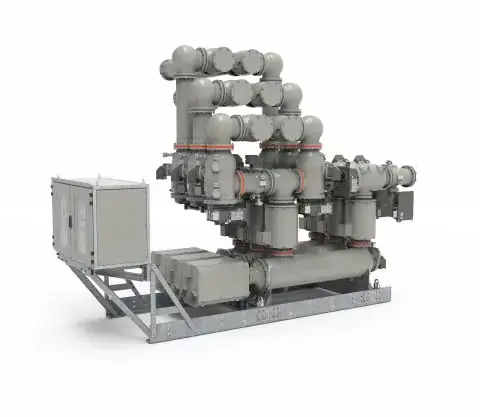
Hitachi Energy ELK high-voltage GIS, the transmission-class family whose ELK-04 covers up to 170 kV
This model is part of SecondWatt’s switchgear research catalogue. Specifications and price observations are included where supported by sources. Equipment availability and commercial terms require confirmation.
Hitachi Energy ELK dossier: high-voltage GIS from 72.5 kV with ELK-04 to 170 kV, campus interconnect relevance, F-gas timeline, inspection checklist.
ELK is Hitachi Energy's high-voltage gas-insulated switchgear family, spanning transmission voltage classes from 72.5 kV upward, with ELK-04 covering up to 170 kV and larger members reaching the highest transmission classes. This is substation equipment for transmission owners, not distribution switchgear, and it sits a full voltage tier above the medium-voltage distribution switchgear most campus projects specify.
The relevance to data centers is real but indirect: campuses taking 115-170 kV service meet ELK inside the utility's or their own interconnect substation, where GIS wins on footprint. The F-gas timeline reaches this class too, EU rules bar new SF6 HV switchgear in 52-145 kV classes from 2028 and above 145 kV from 2032, which is why Hitachi's EconiQ C4-FN portfolio exists alongside it.
No secondary market exists: HV GIS is engineered into its substation, sealed for life, and decommissioned with gas recovery rather than resold. For a buyer scoping a transmission-served campus, the relevant questions are class, lead time and F-gas exposure rather than sourcing.
Why it matters
Transmission-voltage interconnects are the gating item on multi-hundred-megawatt campus projects, and GIS is what makes them fit on constrained sites. With F-gas dates arriving class by class and no secondary supply at all, developers have to lock interconnect equipment early or not at all.
Who buys it
Transmission owners, utilities, and hyperscale campuses building their own 115-230 kV interconnect substations specify ELK; footprint constraints and urban siting drive the GIS choice. There is no used channel, so schedule risk sits entirely in new-build lead times.
Role in the data center
Interconnect substation switchgear for campuses taking 115-170 kV transmission service, where the gas-insulated footprint is what makes the substation fit an available parcel. It sits at the boundary between the transmission network and the campus step-down transformers, and its lead time is usually the gating item on the whole project schedule.
Key specifications
| ELK-04 voltage ceiling | 170 kV |
|---|---|
| Family scope | 72.5 kV and above |
| Construction | sealed GIS, engineered per substation |
| EU F-gas date (52-145 kV) | 2028 |
| EU F-gas date (>145 kV) | 2032 |
| SF6-free sibling | EconiQ C4-FN HV portfolio |
| Secondary market | none |
| Data center relevance | 115-170 kV campus interconnects |
| Product family | ELK high-voltage gas-insulated switchgear |
| Configuration basis | engineered per substation one-line |
Technical summary
Family: ELK high-voltage GIS. Voltage scope: 72.5 kV and above (transmission classes). ELK-04: up to 170 kV. Construction: sealed gas-insulated, engineered per substation. Application: transmission substations, urban and space-constrained sites. F-gas dates (EU): 52-145 kV from 2028; above 145 kV from 2032. SF6-free path: Hitachi EconiQ (C4-FN) portfolio. Secondary market: none (sealed, engineered, gas-recovered at end of life).
Major variations
ELK family members scale by voltage class from 72.5 kV through the highest transmission ratings, with ELK-04 covering up to 170 kV and the members above it serving 245 kV and beyond. Configurations are engineered per substation one-line rather than selected from a catalog, so bay count, busbar arrangement and instrument-transformer content all vary by project. The SF6-free path for the same duties runs through Hitachi's EconiQ C4-FN portfolio, which is the variant question a buyer specifying today actually faces.
Configurations and options
ELK is configured to a substation one-line rather than ordered from a rating table: bay count, busbar arrangement, disconnector and earthing-switch content, and instrument-transformer complement all follow the single-line diagram. The family member is selected by voltage class, with ELK-04 covering up to 170 kV and larger members serving the classes above. The specification decision that matters commercially today is the insulation medium, since the SF6-free path for the same duties runs through Hitachi Energy's EconiQ C4-FN portfolio and carries a different gas-handling regime for the life of the asset.
Compatibility and dependencies
High-voltage gas-insulated switchgear is engineered into its substation, so the dependencies are the substation itself: the transmission line or cable terminations, the step-down transformers it feeds, the protection and control system the bays report into, and civil works sized around the GIS building. Sealed compartments are not field-repairable and gas density monitoring is continuous. Because no surplus channel exists to fall back on, interconnect equipment has to be locked into the project schedule at feasibility stage; on a transmission-served campus this is usually the item that sets the energisation date. End-of-life handling is certified gas recovery rather than resale.
Pricing and availability
Trend: rising Lead time, new: Transmission-project scheduled (multi-year typical). Lead time, used or refurbished: No secondary market. Warranty, used: 1-year typical from reconditioning dealers.
Lifecycle and maintenance
Gas-insulated switchgear targets 35-40 year service from sealed-for-life compartments with minimal maintenance: density monitoring, PD surveys, and mechanism service. Sealed tanks cannot be repaired in the field, so gas loss or internal fault usually ends the asset. EU F-gas and CARB rules add end-of-life SF6 recovery and reporting obligations that must be priced into any SF6 unit, while SF6-free designs (clean air, dry air, C4-FN mixtures) remove that liability entirely.
Thermal and emissions profile
The regulatory story is the insulation gas: SF6 carries a global warming potential of 24,300 and an atmospheric lifetime near 3,200 years. EU Regulation 2024/573 bars placing new SF6 switchgear at or below 24 kV on the EU market from 2026-01-01, extends to 52-145 kV classes from 2028, above 24 to 52 kV from 2030, and above 145 kV from 2032. California's CARB rule phases out acquisition of new SF6 gas-insulated equipment from 2025 on a staged schedule. Legacy SF6 gear remains legal to operate but faces stranded-asset discounts and end-of-life gas recovery obligations.
Common failure points
- Gas leakage — Density alarms and lockout; insulation margin lost as pressure falls
- Partial discharge in compartments — PD at spacers, particles, or terminations progressing to internal fault
- Operating mechanism — Spring and motor failures on switch and breaker drives
- Cable terminations — Tracking in cable boxes and poorly seated plug-in connectors
- Density monitor drift — False alarms or missed low-gas conditions from drifted gauges
- End-of-life gas liability — SF6 recovery and reporting costs land on the owner at decommissioning
Inspection checklist
Gas density: verify density monitors against nameplate fill (150 kPa class systems); alarm thresholds intact. Leak rate: review gas top-up logs; leakage above 0.5% per year fails modern acceptance. Gas quality: test SF6 moisture and decomposition before transfer; SO2 presence flags internal arcing. F-gas compliance: verify EU 2024/573 and CARB status; new SF6 MV gear is barred from the EU market from 2026. Partial discharge: UHF or acoustic survey per IEC 60270 practice; PD is the dominant latent defect. Vacuum interrupters: hipot test breaking units; interruption is vacuum even in gas-insulated designs. Mechanism: exercise and verify spring charge; check counters against 10,000-operation class ratings. Terminations: inspect cable boxes for tracking; verify stress cones and plug-in connectors seated.
Procurement channels
Hitachi Energy transmission channels only, with no used listings at any price: high-voltage GIS is engineered into its substation, sealed for life, and decommissioned with gas recovery rather than resold. Interconnect equipment therefore has to be locked into the project schedule at feasibility stage, because there is no surplus channel to fall back on if a delivery date slips.
Regional notes
Transmission-class equipment for 72.5 kV and above, procured under utility interconnection rules and utility technical specifications rather than campus switchgear standards, and configured for the local system voltage and frequency as part of substation design. EU Regulation 2024/573 bars new SF6 high-voltage switchgear at 52-145 kV from 2028 and above 145 kV from 2032, which is why the EconiQ C4-FN path exists alongside ELK for European work. In North America the comparable pressure is state-level, led by California's phase-out of new SF6 equipment from 2025.