A GSU transformer, or generator step-up transformer, takes a generator's terminal voltage up to the voltage of the bus it feeds: a campus collection bus or the utility interconnection. It connects directly to the generator. So the generator sets its MVA rating and low-voltage winding, and the grid sets its high-voltage winding, its taps and much of its impedance.
The US Department of Energy's July 2024 report on large power transformer resilience describes large power transformers as "highly customized devices" with site-specific voltages. Every Siemens Energy power transformer is "custom-engineered", in Siemens Energy's own product description. So the specification comes before the order.
Delivery is where projects wait. Published GSU lead times have run to years since 2024. So write the first-pass specification while the generators are still being chosen, and decide the spare question on purpose.
Key Takeaways
- The generator sets the MVA; the grid sets the voltage. Ten Cat G3520H continuous sets (60 Hz, 0.8 power factor) need a 31.1 MVA top rating, calculated from generator kVA.
- Impedance is a fault-current decision. A transformer can feed up to 100% ÷ %Z times rated current into a fault: 12.5 times at 8% impedance, about 6.6 times at 15.1%.
- Specify cooler redundancy if full output needs the fans. Fan-cooled units typically carry a fans-off and a fans-on rating, so a fan or pump failure can limit generation.
- GSU lead times ran near three years in mid-2025. GSUs averaged 144 weeks in Wood Mackenzie's Q2 2025 survey, as POWER reported it, so the order date drives the schedule.
- A used GSU is judged on its test report and oil history. Ask which results were measured on its serial number, and for the in-service gas trend.
What a GSU transformer does, and how it differs from a UAT or substation transformer#
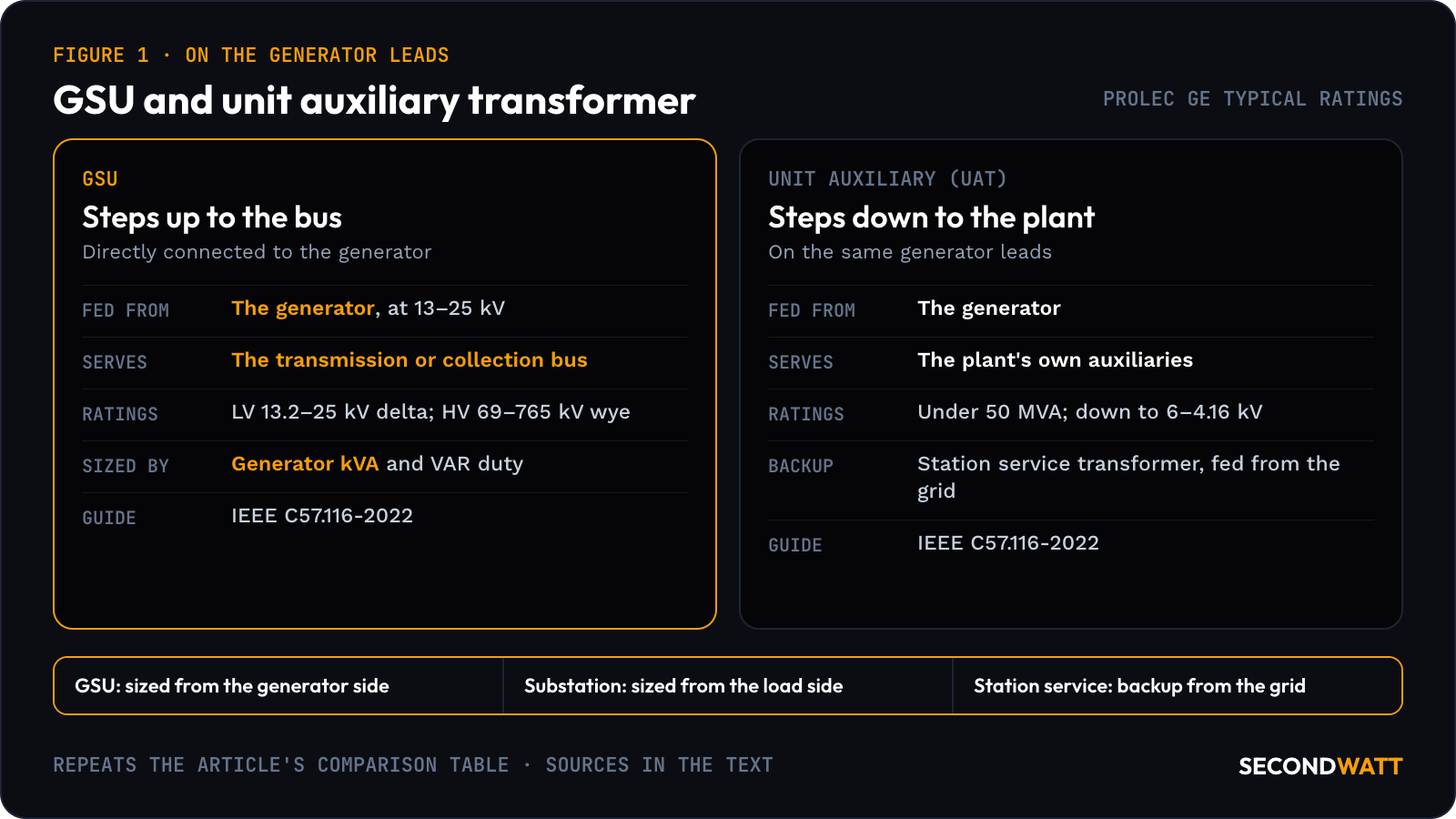
A GSU is "a transformer directly connected to a generator". In the typical configuration on Prolec GE's GSU page, generator voltage of 13–25 kV is stepped up to match the transmission system. That configuration uses a delta low-voltage winding and a wye high-voltage winding. GSUs are "often operated day and night at full load", in Hitachi Energy's own description of its GSU line.
A unit auxiliary transformer (UAT) sits on the same generator leads and steps power down to run the plant's own auxiliaries. A station service transformer does that job from the grid side, as backup. Selecting and applying both the GSU and the UAT is the subject of IEEE C57.116-2022, the guide for transformers directly connected to generators.
A substation transformer serving a data center is sized from the load side, the subject of the data-center transformer selection guide; the GSU is sized from the generator side.
GSU, unit auxiliary and station service transformers compared (Prolec GE GSU product page)#
| Transformer | Fed from | Serves | Typical ratings on the Prolec GE page |
|---|---|---|---|
| GSU | The generator, at 13–25 kV | The transmission or collection bus | LV 13.2–25 kV delta; HV 69–765 kV wye |
| Unit auxiliary (UAT) | The generator | The plant's own auxiliaries | Under 50 MVA; steps generator voltage down to 6–4.16 kV |
| Station service | The grid, at 69 kV and above | Backup supply to the plant | Under 50 MVA; LV 6–16 kV |
What sets the GSU: generator rating, grid voltage and site#
The transformer carries apparent power, so it is sized in MVA from the generator's kVA. The Cat G3520H continuous gas genset is rated 2,490 ekW (3,113 kVA) at 60 Hz and 0.8 power factor, without pumps, on Cat's data sheet LEXE1552-03. The 3,113 kVA is what the GSU carries. Turbine curves carry a basis too: 50 Hz and power factor 0.9 is the performance-curve basis in Siemens's 2015 SGT-750 brochure.
In mtu's specification, edition 01/24, the 20V4000 GS L64 is rated 2,520 kWe at 60 Hz, rating type unstated. That rating is "at nominal voltage, power factor = 1,0". Ask the packager for its alternator kVA.
The grid adds a reactive duty. Under Power Engineering's criteria for a spare GSU, published 10 Dec 2021, a GSU must carry its units' full MW output without exceeding its top MVA rating. It must do so while the units meet their power-factor obligations at the point of interconnection and hold terminal voltage between 95% and 105%. The interconnection agreement's VAR requirement is therefore a sizing input.
The low-voltage winding matches the generator, and the G3520H sheet lists output voltages from 440 V to 13,800 V. The high-voltage winding matches the export bus.
Site conditions set the rating basis, such as a "65°C rise above 40°C ambient" on one 50 Hz utility GSU, in JPS's 2021 specification. Another unit, Fayetteville PWC's ODAF-cooled GSU, is rated 33.333 MVA at 55°C rise and 37.34 MVA at 65°C rise. Ambient, altitude and loading above nameplate are covered by IEEE C57.91-2025, the loading guide. "Overload conditions are not required" for a standard Prolec GE GSU, so size for full output at the site's worst ambient.
Impedance, fault current and the protection interface#
Impedance decides how much fault current the transformer lets through. In TSEWG TP-1, dated 16 Jul 2008, a transformer at 10% impedance can supply 10 times its rated current into a short circuit. One at 4% can supply 25 times. Voltage regulation worsens as impedance rises, so the choice trades voltage against fault duty.
For a GSU, the limits are the short-circuit ratings of the generator bus duct, breaker and auxiliary taps. In the same Power Engineering article, MVA, impedance, ratio and taps are then balanced through load-flow and short-circuit studies.
Two published utility specifications show the range. The 7.5 MVA, 69/6.9 kV JPS unit calls for 7.0–8.0%, or 12.5 times rated current at 8% (calculated). The 33.3 MVA, 67/13.8 kV unit in Fayetteville PWC's GSU summary lists 15.1%, or about 6.6 times (calculated).
The protection guide for three-phase power transformers above 5 MVA and 10 kV is IEEE C37.91-2021. At the specification level, name percent differential and time and instantaneous overcurrent protection. GE's Multilin T60 relay provides both, and GE's 2018 brochure describes it as compliant with C37.91. The transformer carries current transformers for them: multi-ratio C800 units on both windings in the Fayetteville summary.
In the Bureau of Reclamation's FIST 3-30, dated October 2000, a sudden pressure relay detects the pressure rise from internal arcing and operates before the pressure relief device. Buchholz relays are "found only on transformers with conservators".
Overexcitation matters on an islanded site. GE Vernova's GET-8434, from 2025, notes that core flux is proportional to voltage and inversely proportional to frequency. An islanded system can see a voltage rise on sudden load loss, and for almost all transformers, damage occurs at 1.25 pu volts-per-hertz. Settings belong to the protection engineer.
Cooling class, taps, vector group and grounding#
Cooling class decides how many ratings the nameplate carries. A fan-cooled unit typically has a fans-off and a fans-on rating, in Reclamation's FIST 3-30, which uses the older OA/FA labels. ONAN, ONAF and ODAF are standard on Prolec GE GSUs, according to Prolec GE's GSU data sheet. On Prolec GE's GSU page, larger units add pumps and heat exchangers.
The decision is which rating carries full generator output. The ONAN/ONAF JPS specification guarantees impedance "at base (ONAN) rating". If full output needs the fans, a fan or pump failure limits generation, so specify cooler redundancy.
Taps follow the voltage schedule. A de-energized tap changer on the high-voltage side is standard on Prolec GE GSUs, with a load tap changer where required. The JPS unit has an off-circuit changer at 2.5% per step, while the Fayetteville unit adds a 16-step load tap changer either side of nominal. Tap range comes from the VAR requirement and the 95–105% terminal-voltage window.
The vector group fixes the phase relationship with the grid. YNd1 is the most common GSU vector group, Power Engineering notes, and a wye primary gives the high-voltage system its ground reference. The JPS unit is YNd1 with the high-voltage side solidly grounded and the delta side ungrounded. A replacement must keep the same phasor relationship as the unit it replaces.
The first-pass GSU specification table#
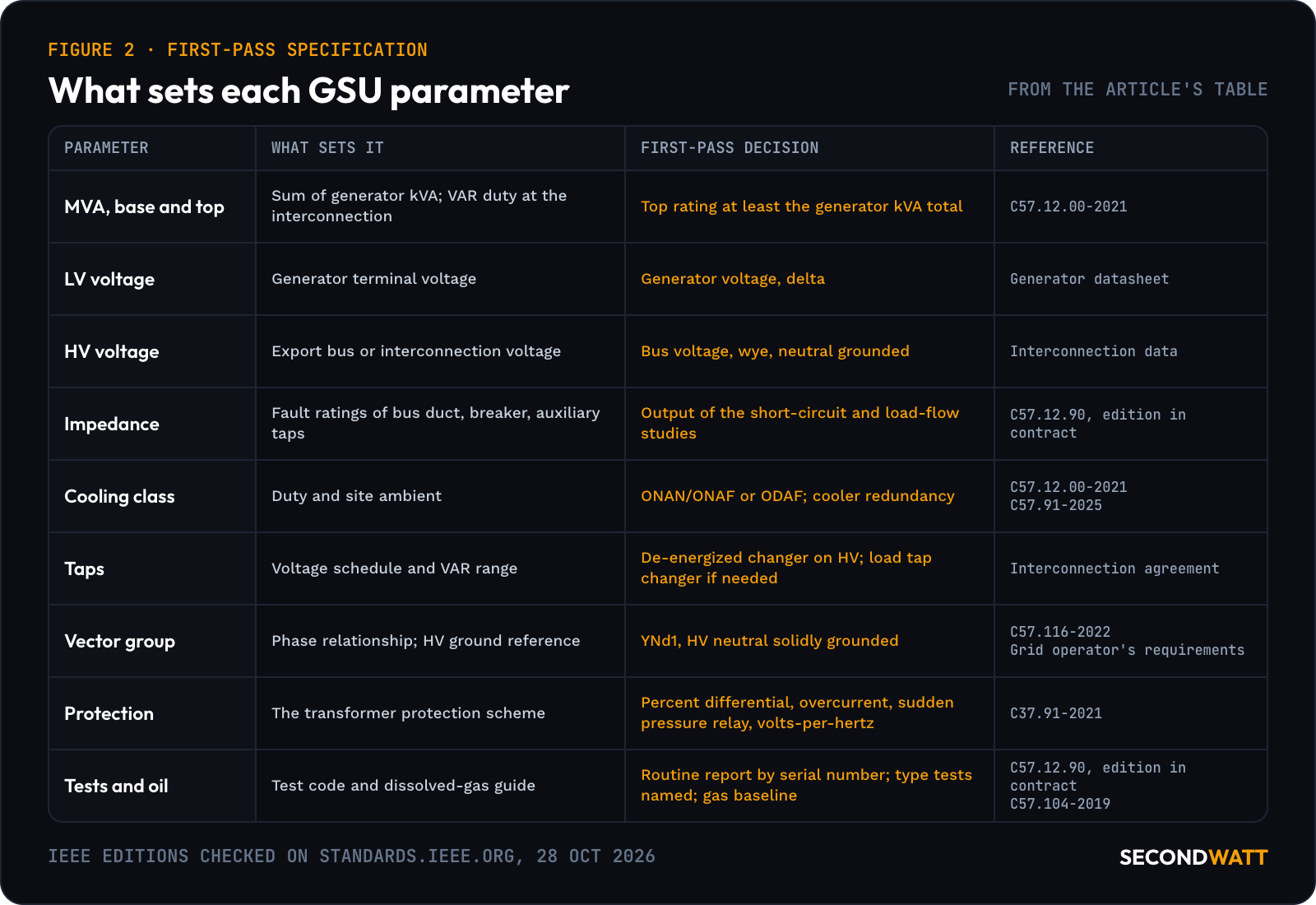
The generator, the grid and the site fill each row before any catalog opens.
First-pass GSU specification: parameter, what sets it, first-pass decision, reference document (IEEE editions as listed on standards.ieee.org)#
| Parameter | What sets it | First-pass decision for an on-site block | Reference document |
|---|---|---|---|
| MVA, base and top | Sum of generator kVA behind the GSU; VAR duty at the interconnection | Top rating at least the generator kVA total; state which cooling stage carries it | IEEE C57.12.00-2021 (general requirements) |
| LV voltage and connection | Generator terminal voltage | Generator voltage, delta | Generator datasheet |
| HV voltage and connection | Export bus or interconnection voltage | Bus voltage, wye with neutral grounded | Interconnection data |
| Impedance | Fault ratings of bus duct, generator breaker and auxiliary taps; voltage drop | Output of the short-circuit and load-flow studies | Measured under C57.12.90 (edition in contract) |
| Cooling class | Duty and site ambient | ONAN/ONAF or ODAF; cooler redundancy if full output needs it | C57.12.00-2021; C57.91-2025 (loading guide) |
| Taps | Voltage schedule and VAR range | De-energized changer on HV; add a load tap changer if the schedule needs it | Interconnection agreement |
| Vector group and grounding | Phase relationship with the grid; HV ground reference | YNd1, HV neutral solidly grounded | C57.116-2022 (transformer connections); grid operator's requirements |
| Protection interface | The transformer protection scheme | Percent differential, overcurrent, sudden pressure relay, Buchholz if conservator, volts-per-hertz; CTs to suit | C37.91-2021 (protection guide) |
| Tests and oil records | Test code and dissolved-gas guide | Routine test report by serial number; type tests named; dissolved-gas baseline at energization | C57.12.90 (edition in contract); C57.104-2019 |
IEEE C57.12.00-2021 sets general requirements for liquid-immersed transformers with a highest winding of 601 V or more. IEEE C57.12.90-2026, the test code, is an active "Approved Draft", board-approved on 25 September 2026 and superseding the 2021 edition. A used unit was tested to an earlier edition, so name the edition in the contract.
With the sheet filled in, compare candidates through the Prolec GE GSU dossier, the Hitachi Energy EconiQ power transformer, the WEG large power transformer and the Siemens Energy Sensformer.
Worked example: a 25 MW gas-engine block and a Frame-5-class turbine package#
Case A is ten Cat G3520H gensets on an assumed 4,160 V bus, each 2,490 ekW (3,113 kVA) continuous at 60 Hz and 0.8 power factor. Case B is one GE MS5001, a Frame 5 machine. A GE Power Systems brochure dated 05/02 rates it at 26,300 kW at ISO conditions on natural gas, at the generator terminals.
That brochure gives no generator power factor or frequency, so Case B runs at 0.9, the SGT-750 basis, and 0.8, the Cat basis. Its 13.8 kV terminal voltage is an assumption.
Example GSU sizing for two on-site generation cases (illustrative; inputs stated; outputs calculated)#
| Step | Case A: 25 MW gas-engine block | Case B: Frame-5-class turbine |
|---|---|---|
| Generator input | 10 × Cat G3520H, 2,490 ekW (3,113 kVA) continuous, 60 Hz, 0.8 pf | 1 × GE MS5001, 26,300 kW at ISO conditions, natural gas, generator terminals |
| Real power | 24.9 MW | 26.3 MW |
| Power factor basis | 0.8 (Cat sheet) | 0.9 or 0.8 (assumed; nameplate decides) |
| Apparent power = top-rating floor | 31.1 MVA | 29.2 MVA at 0.9; 32.9 MVA at 0.8 |
| LV voltage (assumed) | 4.16 kV | 13.8 kV |
| LV full-load current | About 4,320 A | About 1,375 A at 32.9 MVA |
| Fault current at 15.1% impedance, GSU alone | About 28,600 A (6.6 × rated) | About 9,100 A (6.6 × rated) |
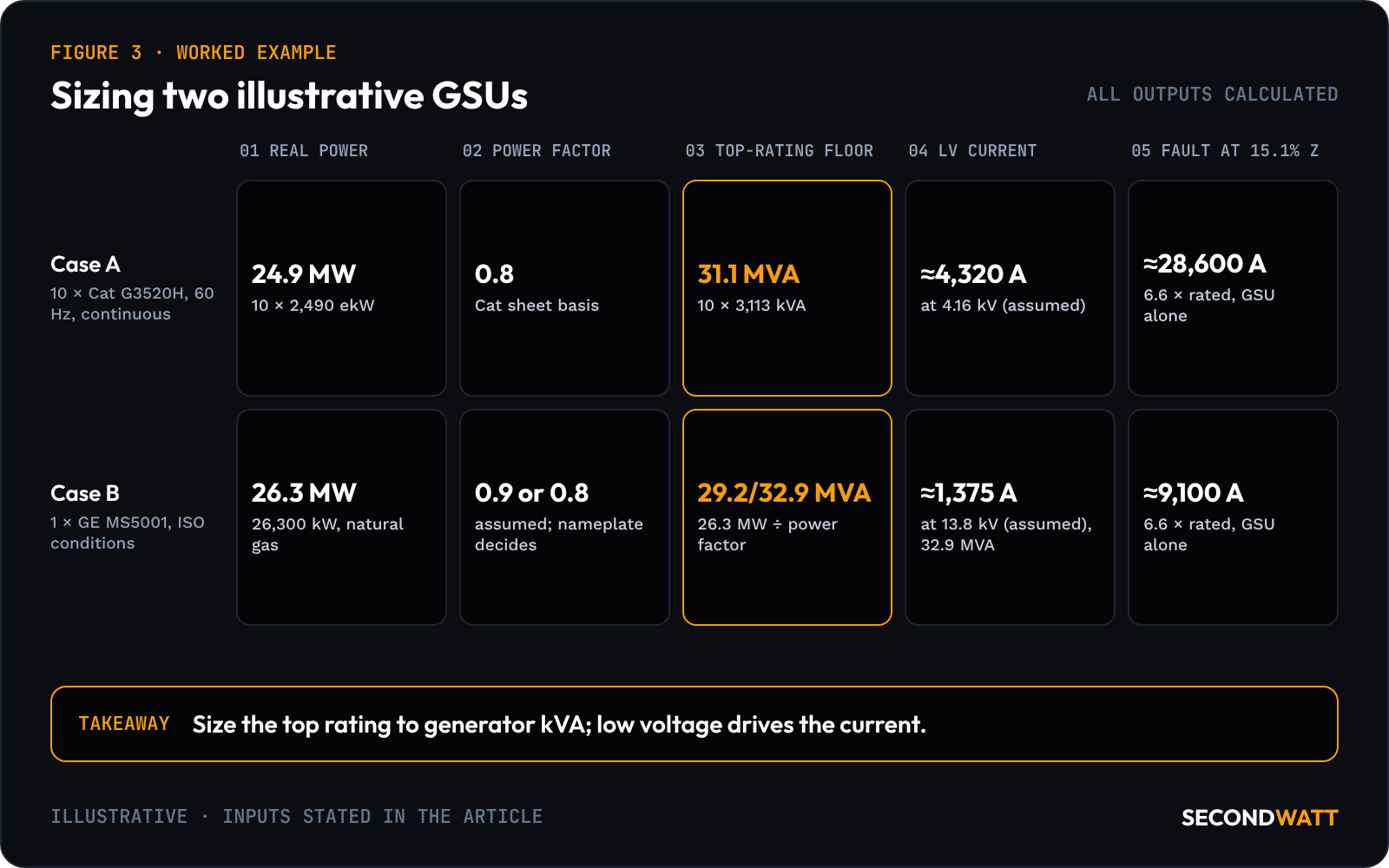
At the assumed 4.16 kV, the engine block carries more than three times the turbine case's current, which sets bus duct, breaker and current-transformer ratings. The same ten gensets ordered at 13.8 kV, an option on the Cat sheet, would carry about 1,300 A (calculated). The fault row assumes an infinite source behind the GSU, a ceiling for the GSU's share before generator contribution.
The turbine case turns on power factor.
3.7 MVA — the swing in the turbine case's top-rating floor between 0.9 power factor (29.2 MVA) and 0.8 (32.9 MVA), calculated from 26.3 MW.
ISO output is a standard-conditions figure, so read the generator nameplate MVA on the actual package; the GE Frame 5 dossier covers the platform.
A packaged block such as the mtu 20V4000 25 MW gas block needs its alternator kVA first. Larger sites repeat the sum per GSU; the 100 MW turbine sizing guide covers how units are grouped.
Lead time, cost drivers and the spare decision#
Published lead times differ in scope, so read each with its date.
Published lead-time markers for GSUs and large power transformers (scope and date as published)#
| Published | Source | Scope | Lead time |
|---|---|---|---|
| Dec 2021 | Power Engineering spare-GSU review | New GSU, procure and install, as of late 2021 | 52–70 weeks |
| 2 Apr 2024 | Wood Mackenzie | Large substation power and GSU transformers | 80–210 weeks |
| Jul 2024 | US Department of Energy report to Congress | Large power transformers, 100 MVA and above | 36 months commonly quoted; up to 60 months |
| 28 Oct 2024 | Wood Mackenzie | Large GSU and power transformers, average | Close to three years |
| 2 Jan 2026 | POWER's report of Wood Mackenzie's Q2 2025 survey | GSUs, average | 144 weeks |
Before the pandemic, a large transformer could be ordered with a lead time under a year, according to the DOE report. The 2025 figure comes from POWER's report; the 2024 markers come from Wood Mackenzie in April and Wood Mackenzie in October. The turbine side of the same schedule is in the turbine backlog and lead-times report.
Customization is what moves the date. Large GSU and power transformers "need to be custom designed to project requirements", Wood Mackenzie wrote in October 2024. The DOE report adds that impedance and safety equipment vary by jurisdiction. Electrical steel, copper conductor and insulation also weigh on price and availability, the report says.
Transport adds its own delay. In the DOE's account, the last 5 to 10 miles are "particularly expensive and challenging", and clearing a rail route can take over nine months.
A spare on hand turns a multi-year wait into weeks.
3–4 weeks — the expedited time to transport and energize an existing spare large power transformer of 100 MVA or more, with site preparation done concurrently, according to the DOE.
The 30 MVA-class units in the worked example are smaller, so treat that figure as indicative. Spares still need maintenance, and one stored beside its twin shares its risks.
In Power Engineering's criteria, a spare meant for several sites must match each one on rating, phasor relationship and VAR capability. It must also match on foundation, oil containment, firewall height, bushings and bus duct flanges. Prolec GE notes that single-phase GSU banks are typically ordered as four units, three plus a spare.
Buying a used or spare GSU: the records that matter#
A used GSU earns a place only when its nameplate matches your first-pass sheet. Check top MVA against generator kVA, low voltage against generator terminals and vector group against the grid. Then check impedance against your fault study, taps against the voltage schedule and frequency against the site. A gray-market spare may need custom transition boxes, Power Engineering notes.
Routine tests run on every unit; type tests may come from a transformer of the same design. One utility specification requires impulse and heat-run tests on its own unit, witnessed by the buyer. For the remaining tests, the JPS specification may accept certified type-test data from a same-design transformer "at its discretion". Ask which results were measured on this serial number, and compare the measured impedance with your study value.
Oil history shows how the unit has run since. Dissolved-gas results are read against IEEE C57.104-2019, the active interpretation guide. Reclamation's FIST 3-30 calls dissolved-gas analysis "by far the most important tool" for transformer health, with each result compared against earlier ones to show trends.
Timing matters for a unit sitting in a yard: the same FIST 3-30 says dissolved-gas analysis "is unreliable if the transformer is de-energized and has cooled". Ask for the in-service trend up to switch-off, then sample again after re-energization and a period of service.
The data-center transformer sizing guide covers the load side, and the used pad-mount checklist covers distribution class.
Records for a used or spare GSU: document, what it shows, red flag#
| Record | What it shows | Red flag |
|---|---|---|
| Nameplate and outline drawing | MVA by cooling stage, voltages, vector group, impedance, weight and footprint | Top rating below your generator kVA total, or a different phasor relationship |
| Test report, results on this serial number | Ratio, polarity, losses, impedance and dielectric results when new | No report for the serial number, or impedance outside your study range |
| Type-test reports | Results such as heat run from a transformer of the same design | No statement of which unit was tested |
| Dissolved-gas history | Gas trend and generation rate in service | A single sample, or only samples taken after the unit cooled |
| Event history | Through-faults, overloads, cooling problems, nearby lightning | Any of these with no follow-up test results |
| Storage and maintenance record | Care while idle, as for an in-service unit | Gaps in maintenance while stored |
FAQ: GSU transformers#
What does a GSU factory test report include?#
On Prolec GE's list, reports by serial number cover polarity and angular displacement, ratio, no-load loss and exciting current, load loss and impedance, and lightning impulse. Applied and induced voltage, insulation power factor, partial discharge, dissolved gas, temperature rise and zero phase sequence follow. The test code's scope also covers resistance measurement, short-circuit tests and audible sound level.
What changes for a 50 Hz export project?#
Flux rises as frequency falls, so a 60 Hz design at rated voltage on 50 Hz sees 1.2 times its design flux (60 ÷ 50, calculated). That is continuous overexcitation, close to the 1.25 pu level at which almost all transformers suffer damage, according to GE Vernova. Order for the project's frequency; the generator side is in the 50 Hz and 60 Hz compatibility guide.
Is a mobile substation a substitute for a spare GSU?#
It can cover an outage if its ratio, MVA and vector group match the generator and the bus. Mobile transformers are listed among the exclusions of IEEE C57.12.00-2021, so ask which standard the mobile unit was built and tested to. Check the Hitachi Energy mobile substation envelope against your sheet.
Who owns the GSU specification on an EPC project?#
Power Engineering lists inputs from several parties: generator data sheets, plant one-line diagrams, existing relay settings, and the utility's short-circuit contribution, voltage schedule and VAR requirements. The contract should name who assembles them and who approves the studies behind impedance and taps.
Writing the GSU into the schedule#
SecondWatt publishes equipment research and helps buyers source power equipment; it earns a fee when a sale it arranges closes. If you are sourcing a GSU for an on-site generation block, send the first-pass sheet, generator kVA and interconnection voltage through a request for quote. For the wider range of units, the transformer category holds the dossiers.