Cummins QSK60G
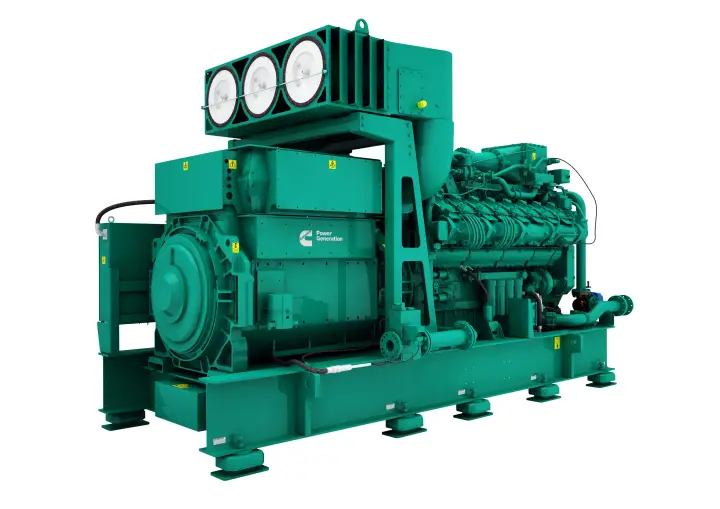
Miller-cycle lean-burn gas genset from 1,000 to 1,400 kWe at 60 Hz, built on the QSK60 platform
Cummins QSK60G is one of 23 gas engines tracked in the SecondWatt catalogue, each with specifications, lead times and indicative secondary-market pricing.
Cummins QSK60G specs: 1,000 to 1,400 kWe at 60 Hz, Miller-cycle lean burn, 250 mg/Nm3 NOx, and how it relates to the QSK60 diesel engine platform.
The Cummins QSK60G is a lean-burn spark-ignited natural gas generator set for continuous duty, cogeneration and peaking. At 60 Hz it spans roughly 1,000 to 1,400 kWe as packages C1000N6 through C1400N6C, and at 50 Hz roughly 995 to 1,540 kWe as C995N5C through C1540N5CC. Cummins describes it as a lean-burn engine using Miller cycle combustion with a full-authority electronic engine management system, in four-pole or six-pole direct drive. Product availability explicitly includes North America. The platform question matters for anyone already holding Cummins diesel equipment. QSK60G carries the QSK60 designation and sits in the Quantum QSK60 family, whose diesel form is a V16 of 159 mm bore by 190 mm stroke displacing 60.2 litres. Cummins does not publish the gas variant's bore, stroke or cylinder count, so the diesel sheet's dimensions should not be read as the gas engine's. One published figure needs care. Cummins gives ISO electrical efficiency across the model range as 33.7 to 43.8 percent, a ten-point spread. That is a range across packages, not a single engine's efficiency, and quoting the top of it as the QSK60G figure would misstate the machine by a wide margin. Obtain the per-package number before any total cost of ownership modelling.
Why it matters
It is the smaller of only two current Cummins gas series, and it clears the federal spark-ignition NOx standard at 250 mg/Nm3 without aftertreatment. For a site that already runs QSK60 diesel units, the shared platform means overlapping parts knowledge and service familiarity, which is a real procurement advantage that no specification sheet states directly.
Who buys it
Continuous and grid-parallel operators wanting finer capacity granularity than a 2 MW block gives, and cogeneration sites with existing Cummins service relationships. Buyers already running QSK60 diesel gensets gain a shared platform service base. This is continuous and peaking duty rather than NFPA 110 standby, which is the line that separates this category from small gaseous standby sets.
Role in the data center
Continuous behind-the-meter generation where a 1.0 to 1.4 MW increment suits the load better than a 2 MW block. The efficiency range published across the series means the specific package must be identified before it is modelled, since the difference between 33.7 and 43.8 percent changes fuel cost by roughly a third.
Key specifications
| Electrical output, 60 Hz | approximately 1,000 to 1,400 kWe, continuous |
|---|---|
| Electrical output, 50 Hz | approximately 995 to 1,540 kWe, continuous |
| ISO electrical efficiency | 33.7 to 43.8 (range across models) percent |
| Combustion cycle | Lean burn, Miller cycle combustion |
| NOx | 250 (0.5) mg/Nm3 (g/hp-hr) |
| Drive arrangement | Four-pole or six-pole direct drive configuration |
| Duty rating | Continuous duty, cogeneration and peaking duty |
| Engine management | Full-authority electronic control |
| North American availability | Listed by Cummins channel |
| QSK60 diesel platform bore | 159 mm (diesel sheet, not the gas variant) |
| QSK60 diesel platform stroke | 190 mm (diesel sheet, not the gas variant) |
| QSK60 diesel platform displacement | 60.2 litres (diesel sheet, not the gas variant) |
Technical summary
Electrical output 60 Hz: approximately 1,000 to 1,400 kWe as C1000N6 through C1400N6C, continuous duty. Electrical output 50 Hz: approximately 995 to 1,540 kWe as C995N5C through C1540N5CC. ISO electrical efficiency: 33.7 to 43.8 percent across the model range, not a single-engine figure. Combustion: lean burn using Miller cycle, with full-authority electronic engine management. NOx: as low as 250 mg/Nm3, stated by Cummins as 0.5 g/hp-hr. Drive arrangement: four-pole or six-pole direct drive depending on package. Duty: continuous duty, cogeneration and peaking; continuous grid-parallel applications. Product availability: North America, Europe, Asia Pacific, India, Latin America, Africa Middle East. Platform: QSK60 family; the diesel form is V16, 159 mm bore, 190 mm stroke, 60.2 litres.
Major variations
Packages are distinguished by C-number rather than by engine change, from C1000N6 to C1400N6C at 60 Hz and C995N5C to C1540N5CC at 50 Hz. Four-pole and six-pole direct drive arrangements exist depending on package. ISO electrical efficiency varies from 33.7 to 43.8 percent across the range, so the package designation carries more information than the model name.
Compatibility and dependencies
Shares the QSK60 platform with the Cummins QSK60 diesel series, which means overlapping service familiarity and dealer coverage. What does not carry across is any performance figure: the diesel sheet's 159 mm bore, 190 mm stroke and 60.2 litre displacement describe the diesel, and Cummins does not publish the gas variant's equivalents. Fuel system, ignition, aftertreatment and emissions have no diesel analogue at all.
Pricing and availability
Comparable secondary-market band: 2000–3150 $ per kW installed project cost. Trend: stable The category prices by quote rather than by listing, so no trend line can be published. Value in this class steps down at overhaul milestones rather than by calendar year, and the absence of a published overhaul interval for this variant makes that step harder to place than on the HSK78G. Lead time, new: No published lead time. Cummins does not state one and dealer pages do not give a figure.. Lead time, used or refurbished: No published figure..
Lifecycle and maintenance
Cummins publishes no service interval, mid-life overhaul or full overhaul figure for the QSK60G, which is a real gap against the HSK78G where all three are stated. A buyer should treat the absence as a question for the dealer rather than assume the HSK78G's 2,000, 40,000 and 80,000-hour figures apply, because the two are different platforms. Resale value in this category tracks hours since major overhaul rather than build year, so an undocumented overhaul history is a pricing problem as much as a technical one.
Thermal and emissions profile
Cummins states NOx as low as 250 mg/Nm3, which it gives as 0.5 g/hp-hr. Converting 250 mg/Nm3 at 5 percent O2 yields roughly 45 ppmvd at 15 percent O2, against the 40 CFR 60 Subpart JJJJ limit of 1.0 g/HP-hr or 82 ppmvd for non-emergency spark-ignition natural gas engines. The engine therefore meets the federal standard natively, without selective catalytic reduction. Lean-burn operation means a three-way catalyst is not applicable in any case, since that technology requires stoichiometric combustion. No CO or formaldehyde figure is published, and formaldehyde is the pollutant that drives NESHAP RICE, so a non-attainment site needs a stack test rather than a datasheet.
Common failure points
- Detonation from unsuitable gas quality — knock events logged by the controller, derate, piston and ring-land damage
- Cylinder head and valve seat recession — compression loss, exhaust temperature spread widening across the 16 cylinders, output fade
- Turbocharger and Miller-cycle boost deviation — lost output, poor load acceptance, efficiency falling toward the bottom of the published band
- Ignition system and spark plug fouling — misfire, unstable output, elevated CO
- Alternator bearing and winding degradation — bearing noise, falling insulation resistance, winding temperature rise
- Coolant circuit scaling — rising jacket or aftercooler temperatures with no load change
Inspection checklist
Hours since major overhaul: Cummins publishes no interval for this gas variant, so the operator's own policy is the only benchmark. Hours since top-end work: recorded per bank across the 16-cylinder layout rather than as a single engine figure. Oil analysis trend: at least the last 4 samples, with wear metals plotted rather than read individually. Compression across all 16 cylinders: a spread beyond roughly 10 percent indicates head or ring wear. Turbocharger shaft play and boost: logged at 100 percent load, since Miller cycle depends on correct boost timing. Aftercooler core and coolant-side fouling: checked with the turbocharger as 1 system, never separately. Spark plug and ignition coil hours: no published interval exists, so a unit with no ignition log is overdue by default.
Procurement channels
New units move through the Cummins dealer network. On the secondary side the traded Cummins gas units are the legacy QSV81 and QSV91 rather than the QSK60G, held by Aaron Equipment, PowerGen Enterprises, Industrial Marine Power and Central States Diesel, all quoting rather than listing.
Regional notes
North American channel confirmed: Cummins lists North America in product availability for this series. The 60 Hz N6 packages are the North American variants; the 50 Hz N5 packages are not applicable to a North American grid without reapplication.