Waukesha VHP Series Five P9394GSI S5
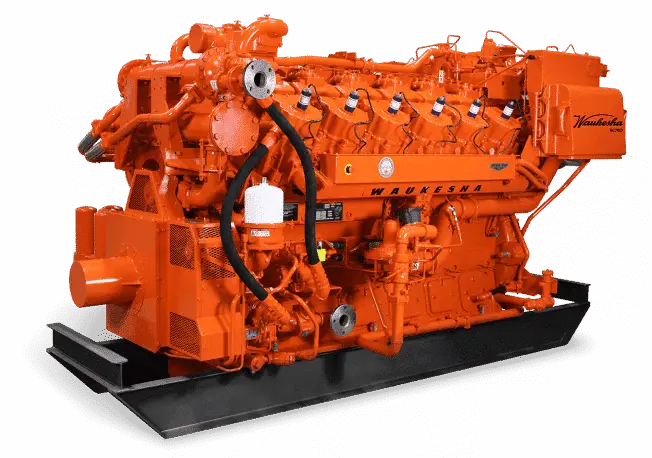
Rich-burn 154-litre V16 rated 1,864 kWb at 1,200 rpm, the largest current VHP, at 12.02 g/bhp-hr NOx uncontrolled and needing NSCR
Waukesha VHP Series Five P9394GSI S5 is one of 23 gas engines tracked in the SecondWatt catalogue, each with specifications, lead times and indicative secondary-market pricing.
Waukesha VHP P9394GSI S5 specs: 2,500 BHP and 1,864 kWb at 1,200 rpm, 154 litre V16, 12.02 g/bhp-hr NOx, plus used market channels and dealers.
The INNIO Waukesha VHP Series Five P9394GSI S5 is a rich-burn spark-ignited V16 stationary gas engine rated 2,500 BHP or 1,864 kWb at 1,200 rpm, and 2,085 BHP or 1,555 kWb at 1,000 rpm. It is the top of the current VHP engine line, whose published range is 490 to 2,500 BHP across 6, 12 and 16 cylinder configurations. These are engine ratings at the crankshaft, and INNIO quotes the packaged VHP generator set line separately at 1,094 to 2,238 kVA. The engine displaces 9,388 cubic inches or 154 litres across sixteen cylinders of 9.375 by 8.5 inches at 9.7 to 1 compression. It shares that bore and stroke exactly with the twelve-cylinder L7044GSI, so the two are the same cylinder module in different counts. Published brake specific fuel consumption is 6,974 Btu/bhp-hr at 1,200 rpm, which against 2,545 Btu/bhp-hr per brake horsepower gives 36.5 percent brake thermal efficiency, marginally better than the V12. One naming correction matters for anyone shopping used. P9394GSI is the current designation and P9390GSI is a different, legacy engine that still trades actively, with 2001 to 2012 units held by dealers and independent support offered by Cooper Machinery Services. The two designations differ by one digit and are not interchangeable, and a listing quoting one against the other's data sheet is a real risk in this family.
Why it matters
It delivers 32 percent more output than the L7044GSI from the identical bore and stroke, with a slightly better heat rate, which makes it the efficient choice within the VHP family. The offsetting fact is emissions and mass: 12.02 g/bhp-hr uncontrolled is roughly twelve times the federal limit, and the engine weighs 34,000 lb before packaging.
Who buys it
Operators needing the largest single-block VHP output, historically in gas compression and landfill gas and increasingly in behind-the-meter continuous generation. At 34,000 lb dry it is a foundation and rigging decision as much as an electrical one. This is continuous and prime duty rather than NFPA 110 standby, the distinction that defines this category.
Role in the data center
The largest single-block VHP option for continuous behind-the-meter generation, suited to sites where unit count matters more than unit mass. Permitting is the gating item rather than delivery, since a rich-burn engine running twelve times the federal limit uncontrolled draws scrutiny in any non-attainment county.
Key specifications
| Output at 1,200 rpm | 2,500 BHP (1,864 kWb) BHP (kWb), engine rating |
|---|---|
| Output at 1,000 rpm | 2,085 BHP (1,555 kWb) BHP (kWb), engine rating |
| Cylinders | V16 cylinders |
| Displacement | 9,388 (154) cu in (litres) |
| Bore and stroke | 9.375 x 8.5 (238 x 216) in (mm) |
| Compression ratio | 9.7:1 ratio |
| Heat rate at 1,200 rpm | 6,974 (9,867) Btu/bhp-hr (kJ/kWh) |
| Brake thermal efficiency | 36.5 percent, computed 2,545 / 6,974 |
| Fuel consumption at 1,200 rpm | 17,435 (5,110) Btu/hr x 1000 (kW) |
| NOx uncontrolled | 12.02 (5,155 at 5 percent O2) g/bhp-hr (mg/Nm3) |
| Aftertreatment | emPact with three-way NSCR catalyst system |
| Dimensions | 170 x 78 x 113 (4,318 x 1,981 x 2,870) in (mm) |
| Dry weight | 34,000 (15,422) lb (kg) |
| VHP packaged genset line | 1,094 to 2,238 kVA, genset rating |
Technical summary
Output: 2,500 BHP (1,864 kWb) at 1,200 rpm; 2,085 BHP (1,555 kWb) at 1,000 rpm, engine rating at the crankshaft. Cylinders and displacement: V16, 9,388 cu in (154 litres). Bore and stroke: 9.375 x 8.5 in (238 x 216 mm), identical to the V12 L7044GSI; compression ratio 9.7:1. Heat rate: 6,974 Btu/bhp-hr (9,867 kJ/kWh) at 1,200 rpm; 6,982 (9,878) at 1,000 rpm. Brake thermal efficiency: 36.5 percent at 1,200 rpm, computed as 2,545 divided by 6,974. Fuel consumption: 17,435 Btu/hr x 1000 (5,110 kW) at 1,200 rpm. NOx: 12.02 g/bhp-hr (5,155 mg/Nm3 at 5 percent O2) at 1,200 rpm, uncontrolled rich-burn. Aftertreatment: emPact emission control system with a three-way non-selective catalytic reduction catalyst. Dimensions: 170 x 78 x 113 in (4,318 x 1,981 x 2,870 mm). Dry weight: 34,000 lb (15,422 kg). VHP line power range: 490 to 2,500 BHP across 6, 12 and 16 cylinder configurations.
Major variations
P9394GSI S5 is the current Series Five engine; P9390GSI and P9390G are the legacy designations and are not the same engine. Speed selection at 1,200 or 1,000 rpm changes output from 2,500 to 2,085 BHP and shifts the heat rate slightly. The packaged generator set is sold separately from the bare engine and is rated in kVA rather than kWb.
Configurations and options
emPact emission control with three-way NSCR catalyst, effectively mandatory for United States non-emergency service. The bare engine and the packaged generator set are distinct products with distinct ratings. Voltage class on packaged Waukesha units observed in the market ranged from 480 V to 12,470 V, which changes the switchgear scope substantially.
Compatibility and dependencies
Rich-burn operation locks this engine to stoichiometric control and a three-way catalyst, so it cannot be converted to lean-burn to chase efficiency or lower uncontrolled NOx. The 34,000 lb dry weight and 170 inch length drive foundation, rigging and building access decisions early. INNIO publishes no methane number requirement, so a gas analysis is a precondition of selection rather than a commissioning formality.
Pricing and availability
Comparable secondary-market band: 2000–3150 $ per kW installed project cost. Trend: stable The one Waukesha family with published used pricing is the legacy VHP F2895GSIU, with three priced used listings spanning $48.75 to $266.00 per kWe and a median of $126.47. It describes that legacy family only and must not be read across to the Series Five P9394GSI. Lead time, new: No published lead time from INNIO.. Lead time, used or refurbished: Used P9390GSI units were in dealer stock on 2026-08-31, including 2001, 2007 and 2012 units at Sargents Equipment in Illinois, but no availability dates are published.. Warranty, used: Cooper Machinery Services support for the P9390GSI and P9390G is independent and explicitly not sponsored, authorized or endorsed by INNIO Waukesha Gas Engines Inc..
Lifecycle and maintenance
INNIO publishes no overhaul or service interval on the Series Five P9394GSI sheet, the same gap as on the L7044GSI and a real difference from Cummins. The used market gives an indirect picture from the closely related legacy P9390GSI, where dealer listings show 2007 units at 20,757 and 22,504 hours and a 2012 unit at 1,747 hours still trading. Those are vendor-stated hour meters rather than verified figures. Value in this family tracks hours since major overhaul rather than build year, so the overhaul ledger and the per-head history set the price far more than the nameplate date.
Thermal and emissions profile
INNIO publishes NOx at 12.02 g/bhp-hr, equivalently 5,155 mg/Nm3 at 5 percent O2, at 1,200 rpm with no aftertreatment. Converting gives roughly 932 ppmvd at 15 percent O2 against the 40 CFR 60 Subpart JJJJ ceiling of 1.0 g/HP-hr or 82 ppmvd for non-emergency spark-ignition natural gas engines. That is about twelve times the federal limit, so the engine cannot be permitted in the United States on a stock tune. Rich-burn combustion is what makes the remedy available, since a three-way non-selective catalytic reduction catalyst only functions at stoichiometric, and INNIO supplies it as emPact. No CO or formaldehyde figure is published, and formaldehyde drives NESHAP RICE, so a non-attainment site needs a stack test.
Common failure points
- Three-way NSCR catalyst degradation — NOx drifting back toward the uncontrolled 12.02 g/bhp-hr figure with no change in how the engine runs
- Cylinder head and valve seat recession — compression loss, widening exhaust temperature spread across 16 cylinders, output fading below 2,500 BHP
- Detonation on low methane number gas — knock under load, piston crown and ring-land damage, controller-commanded derate
- Turbocharger and aftercooler wear — slow load acceptance, low boost, rising exhaust temperature
- Ignition system and spark plug fouling — misfire, unstable output, elevated CO at the stack
- Alternator bearing and winding degradation — bearing noise, falling insulation resistance, winding temperature rise
Inspection checklist
Designation is P9394GSI and not the legacy P9390GSI: 1 digit separates two different engines with different data sheets. Series Four versus Series Five: the two carry different published figures, so the series must be established first. Hours since major overhaul: INNIO publishes no interval for this model, so the operator's overhaul ledger is the only benchmark. Hours since top-end work: recorded per cylinder head across all 16 cylinders rather than as 1 engine figure. Oil analysis trend: at least the last 4 samples, with wear metals plotted rather than read individually. Compression across all 16 cylinders: a spread beyond roughly 10 percent points at head or ring wear. Turbocharger shaft play and boost pressure: logged against the commissioning baseline at 100 percent load. Aftercooler core and coolant-side fouling: inspected with the turbocharger as 1 system, never separately.
Procurement channels
Waukesha's installed base in gas compression and landfill gas is what makes this family procurable used. Named dealers holding Waukesha gas stock on 2026-08-31 include Collicutt Energy Services, Kraft Power Corp, DEPCO Power Systems, Sargents Equipment, Field Engine LLC, Generator Source, Savona Equipment and Powersafe Energy. Marketplaces worth working are Surplus Record, Machinio, IPS, Genset Services, Worldwide Power Products, Penn Detroit, eBay and GovPlanet. Cooper Machinery Services supplies independent parts and overhaul for the legacy P9390 variants.
Regional notes
North American channel confirmed and among the strongest in this category. Frequency must still be checked per unit rather than per model, because 1,000 rpm 50 Hz Waukesha units sit in United States dealer yards alongside 1,200 rpm 60 Hz units.