Wartsila 31SG
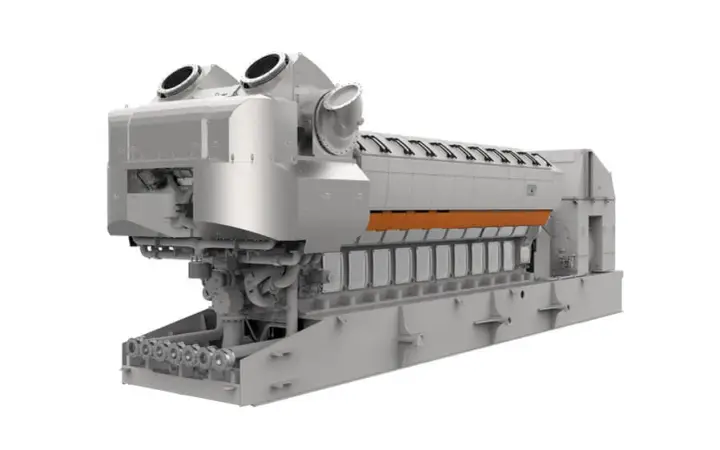
The efficiency leader of the large-bore gas class at 51.6% electrical and 6,971 kJ/kWh, rated 11,377 kW continuous at 60 Hz
Wartsila 31SG is one of 23 gas engines tracked in the SecondWatt catalogue, each with specifications, lead times and indicative secondary-market pricing.
Wartsila 31SG lean-burn gas engine: 11,377 kW at 60 Hz, 51.6% electrical efficiency, 6,971 kJ/kWh heat rate, plus the SCR requirement for US sites.
The Wartsila 31SG is a 20-cylinder, 310 mm bore lean-burn gas engine rated 11,377 kW at 60 Hz and 11,777 kW at 50 Hz. At 51.6% electrical efficiency at 60 Hz it is among the most efficient reciprocating gas engines sold anywhere. Published heat rate is 6,971 kJ/kWh at 60 Hz. The arithmetic checks: 3,600 divided by 0.515 is 6,990 kJ/kWh against a published 6,986 at 50 Hz. Efficiency and heat rate on the Wartsila pages are internally consistent to within 4 kJ/kWh. Converted to Imperial, 6,971 kJ/kWh is 6,607 BTU/kWh on a lower-heating-value basis. The efficiency gap against the 34SG is worth stating in operating terms rather than as a datasheet number. At 51.6% against 48.8%, the 31SG burns about 5.4% less gas for the same kilowatt-hour. On an 11 MW engine running continuously that is the dominant line in the twenty-year cost model, and it is why an efficiency-led buyer starts here. The engine is 14,412 by 3,893 by 5,090 mm and weighs 182 tonnes dry. It requires methane number above 80 and gas of lower heating value above 28 MJ/Nm3.
Why it matters
At 51.6% electrical it sets the efficiency ceiling a buyer should measure every other reciprocating gas quotation against. It also carries the category constraint unchanged: 90 ppmvd engine-out NOx against a federal 82 ppmvd ceiling means selective catalytic reduction is required regardless of how efficient the engine is.
Who buys it
Baseload and high-capacity-factor buyers where fuel dominates the cost model: off-grid data center campuses, independent power producers, and island or weak-grid systems paying a premium for delivered gas. The higher the running hours, the more the 51.6% figure decides the purchase against a cheaper engine.
Role in the data center
Wartsila lists the 31SG in its medium-bore 6 to 13 MW data center family alongside the 34SG. At 11,377 kW at 60 Hz a 400 MW campus needs about 35 engines before redundancy. This is the engine to specify where the plant runs hard. A campus at high capacity factor pays for the efficiency premium in fuel within the first years; a peaking or firming plant may not. Duty is continuous, not NFPA 110 standby, and the design unit is the multi-engine block sized for N+1 or better.
Key specifications
| Electrical output, 60 Hz | 11,377 kW continuous |
|---|---|
| Electrical output, 50 Hz | 11,777 kW continuous |
| Electrical efficiency, 60 Hz | 51.6 % |
| Heat rate, 60 Hz | 6,971 kJ/kWh |
| Bore x stroke | 310 x 430 mm |
| Cylinder configuration | 20 cylinders, V |
| Speed | 720 (60 Hz) / 750 (50 Hz) rpm |
| Dimensions L x W x H | 14,412 x 3,893 x 5,090 mm |
| Dry weight | 182 tonnes |
| NOx, engine-out | 90 ppm at 15% O2 dry |
| Methane number required | above 80 MN |
| Gas lower heating value | above 28 MJ/Nm3 |
Technical summary
Electrical output: 11,377 kW at 60 Hz, 11,777 kW at 50 Hz, continuous at generator terminals. Rating basis: ISO 3046-1, 100 kPa, 25 C suction air, 30% relative humidity, plus or minus 5%. Electrical efficiency: 51.6% at 60 Hz, 51.5% at 50 Hz. Heat rate: 6,971 kJ/kWh at 60 Hz, 6,986 kJ/kWh at 50 Hz. Configuration: 20-cylinder V, bore 310 mm, stroke 430 mm. Speed: 720 rpm at 60 Hz, 750 rpm at 50 Hz. Dimensions: 14,412 x 3,893 x 5,090 mm; dry weight 182 tonnes. NOx: 90 ppm at 15% O2 dry, engine-out before aftertreatment. Gas quality: methane number above 80, lower heating value above 28 MJ/Nm3. Tunings: standard, power optimised, efficiency optimised, plus a Balancer variant.
Major variations
Four tunings are marketed: standard, power optimised, efficiency optimised and Balancer. The figures above are for the standard tuning. Wartsila's own documents disagree on the others: the 31SG leaflet places 11,779 kW against efficiency optimised and 10,790 kW against standard, while the product page places 11,777 kW against standard. Confirm the tuning and its rated output on the quotation rather than from either document alone.
Pricing and availability
Comparable secondary-market band: 2000–3150 $ per kW installed. Trend: stable The hour meter sets the price in this category, not the year. An engine three years from a major overhaul is worth materially less than an older unit fresh out of one. There is no used market at this size. Lead time, new: No published lead time. Derived from dated announcements across this class: about 14 to 21 months from order to first power, from three projects across Wartsila and Bergen. That is an observed range from press releases, not a manufacturer quotation.. Lead time, used or refurbished: No used 31SG is listed in any public channel as of August 2026, so no used lead time applies..
Lifecycle and maintenance
Wartsila publishes no time-between-overhaul for the 31SG. Maintenance is priced inside a long-term service agreement, so the interval is a commercial term rather than a catalog specification. Ask for the overhaul schedule and the parts-basket price in the same conversation as the engine price. On an efficiency-led purchase there is a second reason to care. Efficiency decays with liner, turbo and valve condition, so the 51.6% figure that justified the premium is only held by the maintenance regime. Treat measured heat rate as a condition indicator over the asset life.
Thermal and emissions profile
Wartsila publishes NOx at 90 ppm at 15% O2 dry, engine-out and before aftertreatment. Bergen and mtu publish 500 mg/Nm3 at 5% O2 for the same class, and they are the same number once converted: 500 x 22.414/46 = 243.6 ppmv at 5% O2, then x (20.9-15)/(20.9-5) = 0.3711 gives 90.4 ppmvd at 15% O2. 40 CFR 60 Subpart JJJJ caps non-emergency spark-ignition natural gas engines of 500 HP or more, built on or after 1 July 2010, at 82 ppmvd at 15% O2. At 90 ppmvd this engine is above the federal ceiling, so selective catalytic reduction is required to sell it in the United States at all. Treat SCR as a capital line item, not an accessory. Ozone non-attainment areas push BACT or LAER far below the NSPS floor and add urea handling.
Common failure points
- Gas quality below specification — Knock, retard and derate when delivered gas falls under methane number 80 or 28 MJ/Nm3 lower heating value
- SCR catalyst and urea dosing system — Stack NOx rises toward the 90 ppmvd engine-out figure and the permit limit is breached
- Cylinder heads and exhaust valves — Widening exhaust temperature spread across the 20 cylinders and falling compression
- Turbocharger — Falling charge pressure and a measurable fall in electrical efficiency below 51.6%
- Charge air cooler fouling — Charge air temperature above the 25 C rating reference with progressive derate
- Lubricating oil condition — Rising iron, chromium and viscosity between oil changes
Inspection checklist
Confirm the tuning on the nameplate: the 31SG ships as standard, power optimised, efficiency optimised and Balancer. Hours since major overhaul: Wartsila publishes no interval for the 31SG, so demand the service agreement schedule and the hour meter. Hours since top-end and head change-out: record per-bank hours across all 20 cylinders. Oil analysis trend across the last 12 samples: rising iron and chromium indicate liner and ring wear. Cylinder liner wear at top ring reversal: measure against the 310 mm nominal bore. Turbocharger shaft play and compressor wheel erosion: a 51.6% efficient engine has little margin for lost charge pressure. Charge air cooler fouling: compare charge air temperature against the 25 C suction air reference in the rating basis. Spark plug and ignition coil hours: log the current set across all 20 cylinders.
Procurement channels
Direct from Wartsila through Wartsila North America, Inc. Engine power plants are delivered both as EPC and Equipment Delivery contracts, so the engine can be bought as equipment rather than only as part of a turnkey plant. Name the tuning on the enquiry. The 31SG ships as standard, power optimised, efficiency optimised and Balancer, and the Wartsila leaflet and product page do not agree on which output belongs to which tuning.
Regional notes
Rated at both frequencies, 11,377 kW at 60 Hz and 11,777 kW at 50 Hz. North American channel is confirmed through Wartsila North America, Inc., four US data center orders above 1.6 GW in total, and filed testimony with the California Energy Commission.