Jenbacher J620
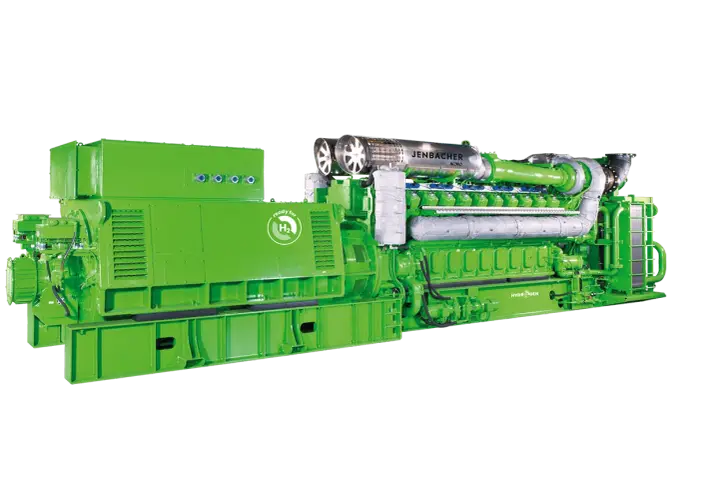
V20 lean-burn workhorse at 3,349 kW and 44.8%, named alongside the J624 in the 1.5 GW VoltaGrid order
Jenbacher J620 is one of 23 gas engines tracked in the SecondWatt catalogue, each with specifications, lead times and indicative secondary-market pricing.
Jenbacher J620 specs: 3,349 kW at 60 Hz, 44.8% electrical efficiency, NOx basis, 60,000 hour overhaul interval and used market observations.
The Jenbacher J620 is a V20 lean-burn gas engine rated up to 3,349 kW at 60 Hz with electrical efficiency up to 44.8%, equivalent to about 7,616 Btu/kWh on a lower heating value basis. At 50 Hz it is rated up to 3,509 kW at up to 45.8%. INNIO rates it on DIN ISO 3046 continuous at generator terminals with a plus 5% tolerance, which is a different standard from the ISO 8528 ratings used for diesel standby sets. It is the volume workhorse of the Type 6 family and the most commonly encountered Jenbacher on the North American resale market. INNIO named the J620 alongside the J624 in the February 2026 VoltaGrid order covering about 300 engines and 1.5 GW in 25 MW packages for delivery by 2028. Thermal output reaches 3,042 kW in combined heat and power service. Buyers who need transient response rather than heat rate should look at the J620 Fast Start instead, which trades 258 kW and about 1.8 efficiency points for start speed. The Type 6 platform was introduced in 1989, so this is a long-established design with a deep service population.
Why it matters
The J620 is the reference point the rest of the Type 6 family is measured against, and the baseline the Fast Start is derated from. At 3,349 kW and 44.8% it sits in the 3 MW block size that behind-the-meter campuses assemble from. Its long production history since the platform launched in 1989 means parts, service knowledge and used units are all more available than for newer models.
Who buys it
Combined heat and power hosts with a steady thermal load, district energy operators, and industrial sites running baseload behind the meter. Also data center and behind-the-meter developers assembling 25 MW blocks, since INNIO named it in the VoltaGrid order. It is the Jenbacher a buyer is most likely to find on the secondary market.
Role in the data center
Behind-the-meter prime power in 25 MW blocks. INNIO named the J620 alongside the J624 in the VoltaGrid order, which describes prime, backup and peaking power delivered from one system. Where the site needs transient response rather than heat rate, the J620 Fast Start is the variant built for it.
Key specifications
| Electrical output, 60 Hz | up to 3,349 kW |
|---|---|
| Electrical output, 50 Hz | up to 3,509 kW |
| Rating basis | DIN ISO 3046 continuous at generator terminals, +5% tolerance standard |
| Electrical efficiency, 60 Hz | up to 44.8 % |
| Electrical efficiency, 50 Hz | up to 45.8 % |
| Heat rate (computed) | about 7,616 Btu/kWh LHV |
| Thermal output | up to 3,042 kW |
| Cylinder configuration | V20 cylinders |
| Genset dimensions | 435 x 90 x 118 inches |
| Published NOx basis | 250 and 500 mg/Nm3 at 5% O2, dry mg/Nm3 |
| NOx converted to US reference | 45.2 and 90.4 ppmvd at 15% O2 |
| Major overhaul interval | up to 60,000 operating hours |
| Intermediate overhaul | 30,000 operating hours |
| Platform introduced | 1989 year |
| Production site | Jenbach, Tyrol, Austria (no North American assembly) location |
Technical summary
Electrical output: up to 3,349 kW at 60 Hz, DIN ISO 3046 continuous at generator terminals. Electrical output: up to 3,509 kW at 50 Hz. Electrical efficiency: up to 44.8% at 60 Hz, up to 45.8% at 50 Hz. Heat rate: about 7,616 Btu/kWh LHV, computed as 3,412.14 / 0.448. Thermal output: up to 3,042 kW. Configuration: V20-cylinder. Genset dimensions: 435 x 90 x 118 inches. Published NOx basis: 250 and 500 mg/Nm3 at 5% O2, dry. Major overhaul: up to 60,000 operating hours (Clarke Energy, distributor figure). Intermediate overhaul: 30,000 operating hours renewing pistons, main bearings and liners. Frequency: 50 Hz and 60 Hz both offered.
Configurations and options
SCR and oxidation catalyst are catalogued options. INNIO publishes no outlet NOx figure for its SCR option as of 31 August 2026. DOE gives 90-95% NOx reduction for SCR at 0.25 cents/kWh on non-fuel O&M. Hydrogen status, shipping versus announced: INNIO markets Jenbacher engines as Ready for H2, and in April 2026 demonstrated 100% hydrogen operation at 3 MW with the Net Zero Innovation Hub for Data Centers. That was a demonstration, not a shipment. Clarke Energy, an authorised distributor, describes 100% hydrogen as a future conversion whose cost and timeline require individual clarification. No catalogued hydrogen model, commercial availability date or derate figure is published, and this model's own specification block states no hydrogen capability.
Compatibility and dependencies
Pipeline natural gas figures are quoted here; biogas and other gases carry different ratings. CHP module and container builds need a thermal host to reach the published 3,042 kW thermal output.
Pricing and availability
Comparable secondary-market band: 2000–3150 $ per kW installed. Trend: rising In this category the hour meter sets used price, not the build year: a 40,000 hour engine approaching its 60,000 hour major is worth materially less than an older unit fresh out of one. Ask for hours since major and hours since top-end before comparing two asking prices. Lead time, new: INNIO publishes no unit lead time. The J620 is named in the February 2026 VoltaGrid order of about 300 engines delivering by 2028, so factory slots are committed well ahead.. Lead time, used or refurbished: Used J620 machines appear on MachineryTrader at call-for-price as of August 2026; no lead time or transaction timing is published..
Lifecycle and maintenance
Clarke Energy, an authorised INNIO distributor, gives Type 6 major overhaul at up to 60,000 operating hours. RS Motor, an independent service house, describes overhauls at 30,000 and 60,000 hours renewing pistons, main bearings and cylinder liners, with oil filter service every 1,000 to 2,000 hours and intermediate maintenance every 10,000 hours. Both are distributor or independent figures rather than INNIO-published ones. DOE gives 92% minimum availability for reciprocating engines as a class and non-fuel O&M between 1.3 and 2.0 cents/kWh depending on size. Because the J620 has been in production since the platform launched in 1989, service knowledge and parts availability are deeper than for newer Jenbacher models.
Thermal and emissions profile
INNIO publishes J620 performance against two NOx bases: 250 and 500 mg/Nm3 at 5% O2, dry. Converting with 22.414/46 for NO2 and the oxygen correction 5.9/15.9 gives 45.2 and 90.4 ppmvd at 15% O2. 40 CFR 60 Subpart JJJJ caps lean-burn natural gas engines at or above 500 HP at 1.0 g/HP-hr NOx, which is 82 ppmvd at 15% O2, with CO at 2.0 and VOC at 0.7 g/HP-hr. The low-NOx tune clears that natively at 55% of the limit, while the 500 mg/Nm3 tune sits 10.2% above it and needs SCR. Formaldehyde is excluded from the JJJJ VOC definition and is governed by NESHAP RICE Subpart ZZZZ instead. In a non-attainment area, New Source Review or a LAER determination will require SCR whichever tune is fitted, at about 0.25 cents/kWh on non-fuel O&M per DOE.
Common failure points
- Pistons, liners and main bearings — Rising blow-by and oil consumption as the 30,000 hour intermediate approaches
- Turbocharger — Output short of the 3,349 kW rating, especially at high ambient temperature
- Ignition system, plugs and coils — Misfire and measured efficiency below 44.8%
- Gas train and fuel quality — Detonation, knock retard and unplanned derate
- Heat exchangers on CHP builds — Thermal output below the 3,042 kW figure
- SCR catalyst and urea dosing — NOx creeping toward the 82 ppmvd permit ceiling
Inspection checklist
Hours since major overhaul: Type 6 majors land at up to 60,000 operating hours and set most of the residual value. Hours since top-end work: the 30,000 hour intermediate renews pistons, main bearings and cylinder liners. Intermediate maintenance log: the 10,000 hour service should appear at every interval without gaps. Oil and oil filter history: service falls due about every 1,000 to 2,000 running hours. Oil analysis trend: pull the last 5 samples for wear metals, viscosity and total base number. Compression and blow-by across all 20 cylinders: one weak bank on a V20 hides inside an average. Turbocharger condition: verify the unit still makes its 3,349 kW rating at 60 Hz on a witnessed load test. Aftercooler fouling and jacket water condition: check the coolant circuit for scale and past overheating.
Procurement channels
New units go through INNIO Jenbacher North America LLC, Houston, and its authorised distributors Clarke Energy, Enerflex, Northeast Energy Systems and Western Energy Systems. Used J620 machines are the most commonly listed Jenbacher on MachineryTrader, though every listed example was call-for-price as of August 2026. There is no North American assembly. The lead production site is Jenbach, Tyrol, Austria, so every unit sold into a US project is an import, against an order book already carrying about 2.6 GW of committed data center capacity through 2028. Treat freight, customs and tariff exposure as live line items.
Regional notes
Both frequencies are offered and the ratings differ, so confirm the build before comparing prices: 3,349 kW at 60 Hz against 3,509 kW at 50 Hz. A 50 Hz European unit imported into North America is a different machine. Installed base across the US and Canada is more than 1,000 Jenbacher engines and over 1.7 GW.