Waukesha VHP Series Five L7044GSI S5
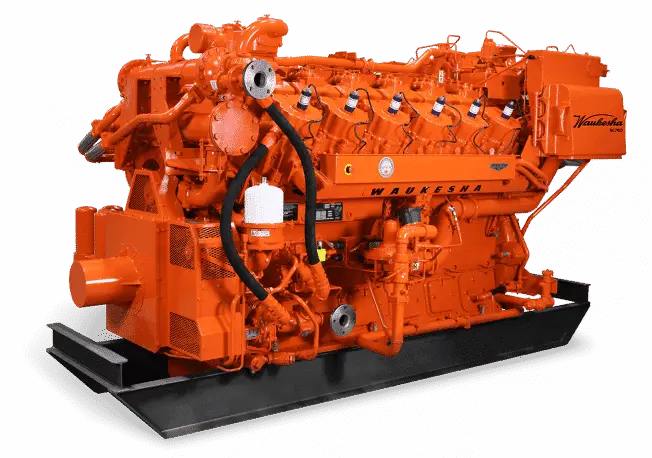
Rich-burn 115-litre V12 rated 1,417 kWb at 1,200 rpm, catalyst-dependent with a deep used market
Waukesha VHP Series Five L7044GSI S5 is one of 23 gas engines tracked in the SecondWatt catalogue, each with specifications, lead times and indicative secondary-market pricing.
Active buyer for this model
A buyer is currently searching for this model. If you have one available, list it and we'll handle the introduction.
Waukesha VHP L7044GSI S5 specs: 1,900 BHP and 1,417 kWb at 1,200 rpm, 115 litre V12, 11.3 g/bhp-hr NOx, plus the North American used market.
The INNIO Waukesha VHP Series Five L7044GSI S5 is a rich-burn spark-ignited V12 stationary gas engine rated 1,900 BHP or 1,417 kWb at 1,200 rpm, and 1,583 BHP or 1,180 kWb at 1,000 rpm. Those are engine ratings at the crankshaft. INNIO quotes the packaged VHP generator set line separately at 1,094 to 2,238 kVA, and the two numbers describe the same machines measured at different points. Any listing that mixes them overstates or understates the unit by a wide margin. The engine displaces 7,040 cubic inches or 115 litres across twelve cylinders of 9.375 by 8.5 inches, at a compression ratio of 9.7 to 1. Published brake specific fuel consumption is 7,155 Btu/bhp-hr at 1,200 rpm, which against the 2,545 Btu/bhp-hr thermodynamic equivalent of one brake horsepower gives 35.6 percent brake thermal efficiency. That is a shaft figure and the electrical figure at the terminals is lower by alternator and parasitic losses. The commercial case for this engine is the used market rather than the specification. Waukesha built a deep North American installed base in gas compression and landfill gas, and that fleet is what makes VHP units genuinely procurable secondhand. Cooper Machinery Services runs independent parts and overhaul support for the related P9390GSI, L7042GSI and F3521GSI, while INNIO offers its own reUp factory remanufacturing for the L7044GSI itself.
Why it matters
It is among the most liquid reciprocating gas engines in the North American secondary market, which matters when interconnection timing rather than capital cost is the binding constraint. The offsetting fact is emissions: at 11.3 g/bhp-hr uncontrolled it sits roughly ten times above the federal spark-ignition limit and cannot be permitted without a three-way catalyst.
Who buys it
Gas compression, oilfield and landfill gas operators historically, and increasingly behind-the-meter developers who need continuous duty capacity that can be bought used and delivered fast. This is a continuous and prime duty engine rather than an NFPA 110 standby set, which is the distinction that separates this category from the small gaseous standby gensets it gets confused with.
Role in the data center
Fast-delivery continuous capacity where a used unit can be bought and installed before an interconnection agreement would arrive. The catch is permitting: the three-way catalyst is a capital line item and a non-attainment county will scrutinise a rich-burn engine that runs ten times the federal limit uncontrolled.
Key specifications
| Output at 1,200 rpm | 1,900 BHP (1,417 kWb) BHP (kWb), engine rating |
|---|---|
| Output at 1,000 rpm | 1,583 BHP (1,180 kWb) BHP (kWb), engine rating |
| Cylinders | V12 cylinders |
| Displacement | 7,040 (115) cu in (litres) |
| Bore and stroke | 9.375 x 8.5 (238 x 216) in (mm) |
| Compression ratio | 9.7:1 ratio |
| Heat rate at 1,200 rpm | 7,155 (10,122) Btu/bhp-hr (kJ/kWh) |
| Brake thermal efficiency | 35.6 percent, computed 2,545 / 7,155 |
| NOx uncontrolled | 11.3 (4,802 at 5 percent O2) g/bhp-hr (mg/Nm3) |
| Aftertreatment | emPact with three-way NSCR catalyst system |
| Dimensions | 147 x 85 x 97.83 (3,734 x 2,159 x 2,485) in (mm) |
| Dry weight | 24,250 (11,000) lb (kg) |
| VHP packaged genset line | 1,094 to 2,238 kVA, genset rating |
| VHP line power range | 490 to 2,500 BHP across 6/12/16 cylinders |
Technical summary
Output: 1,900 BHP (1,417 kWb) at 1,200 rpm; 1,583 BHP (1,180 kWb) at 1,000 rpm, engine rating at the crankshaft. Cylinders and displacement: V12, 7,040 cu in (115 litres). Bore and stroke: 9.375 x 8.5 in (238 x 216 mm); compression ratio 9.7:1. Heat rate: 7,155 Btu/bhp-hr (10,122 kJ/kWh) at 1,200 rpm; 7,026 (9,940) at 1,000 rpm. Brake thermal efficiency: 35.6 percent at 1,200 rpm, computed as 2,545 divided by 7,155. Fuel consumption: 13,594 Btu/hr x 1000 (3,984 kW) at 1,200 rpm. NOx: 11.3 g/bhp-hr (4,802 mg/Nm3 at 5 percent O2) at 1,200 rpm, uncontrolled rich-burn. Aftertreatment: emPact emission control system with a three-way non-selective catalytic reduction catalyst. Dimensions: 147 x 85 x 97.83 in (3,734 x 2,159 x 2,485 mm). Dry weight: 24,250 lb (11,000 kg). Packaged VHP genset line: 1,094 to 2,238 kVA, quoted separately by INNIO.
Major variations
Series Four and Series Five are both in circulation and carry different spec sheets, with Series Five bringing the ESM2 engine management system. Observed variants of the Series Five include a Low Fuel Pressure System version, a MOB mobile version shared with the L5794GSI, and the reUp factory remanufactured version. A used listing giving only L7044GSI without a series is ambiguous and the series must be established before any figure is trusted.
Configurations and options
emPact emission control with three-way NSCR catalyst, which is effectively mandatory for United States non-emergency operation. Speed selection at 1,200 or 1,000 rpm changes both output and heat rate. Packaged generator sets are sold separately from the bare engine and are rated in kVA rather than kWb.
Compatibility and dependencies
Rich-burn operation ties this engine to a three-way catalyst and to stoichiometric control, which means it cannot be converted to lean-burn operation to chase efficiency. The compression ratio of 9.7:1 with no published methane number requirement makes a site gas analysis a precondition rather than a formality. Packaged units need switchgear matched to their voltage class, which in observed listings ranged from 480 V to 12,470 V across the Waukesha fleet.
Pricing and availability
Comparable secondary-market band: 2000–3150 $ per kW installed project cost. Trend: stable The one Waukesha family with published used pricing is the legacy VHP F2895GSIU, with three priced used listings spanning $48.75 to $266.00 per kWe and a median of $126.47. It describes that legacy family and must not be read across to the Series Five L7044GSI. Lead time, new: No published lead time from INNIO. INNIO also offers reUp factory remanufacturing for the L7044GSI and 42GSI S5, with no published turnaround.. Lead time, used or refurbished: Immediate in practice. Kraft Power Corp held four matched 1,350 kW VHP7044GSI units of 2022 at 480 V and 60 Hz, and Crusader Joint Ventures listed a new never-used 1.2 MW winterized package, both on 2026-08-31.. Warranty, used: Note that Cooper Machinery Services support is independent and explicitly not sponsored, authorized or endorsed by INNIO Waukesha Gas Engines Inc..
Lifecycle and maintenance
INNIO publishes no overhaul or service interval on the Series Five L7044GSI sheet, which is a genuine gap against Cummins where 2,000, 40,000 and 80,000-hour figures are stated. The used market gives an indirect answer: dealer listings show a 2002 Waukesha 7042GL still trading at 76,670 hours and 2007 P9390GSI units at 20,757 and 22,504 hours. Those are vendor-stated hour meters rather than verified figures, but they establish that 20,000 to 75,000 hours is ordinary territory for the family. Value tracks hours since major overhaul far more closely than build year, so the overhaul ledger sets the price.
Thermal and emissions profile
INNIO publishes NOx at 11.3 g/bhp-hr, equivalently 4,802 mg/Nm3 at 5 percent O2, at 1,200 rpm with no aftertreatment. Converting gives roughly 868 ppmvd at 15 percent O2 against the 40 CFR 60 Subpart JJJJ ceiling of 1.0 g/HP-hr or 82 ppmvd for non-emergency spark-ignition natural gas engines. The engine is therefore about ten times the federal limit on a stock tune and cannot be permitted in the United States without aftertreatment. Rich-burn combustion is what makes the fix available: a three-way non-selective catalytic reduction catalyst works only at stoichiometric, and INNIO supplies it as the emPact system. No CO or formaldehyde figure is published, and formaldehyde drives NESHAP RICE, so a non-attainment site needs a stack test.
Common failure points
- Three-way NSCR catalyst degradation — NOx drifting back toward the uncontrolled 11.3 g/bhp-hr figure while the engine runs normally
- Cylinder head and valve seat recession — compression loss, widening exhaust temperature spread, output fading below 1,900 BHP
- Detonation on low methane number gas — audible knock under load, piston crown and ring-land damage, controller derate
- Turbocharger and aftercooler wear — slow load acceptance, low boost, rising exhaust temperature
- Ignition system and spark plug fouling — misfire, unstable output, elevated CO at the stack
- Alternator bearing and winding degradation — bearing noise, falling insulation resistance, winding temperature rise
Inspection checklist
Series Four versus Series Five: the two carry different published spec sheets, and a Series Four sold on Series Five numbers is misrepresentation. Hours since major overhaul: INNIO publishes no interval for this model, so the operator's overhaul ledger is the only benchmark. Hours since top-end work: recorded per cylinder head across all 12 cylinders rather than as 1 engine figure. Oil analysis trend: at least the last 4 samples, with wear metals plotted rather than read individually. Compression across all 12 cylinders: a spread beyond roughly 10 percent points at head or ring wear. Turbocharger shaft play and boost pressure: logged against the commissioning baseline at 100 percent load. Aftercooler core and coolant-side fouling: checked with the turbocharger as 1 system, never separately.
Procurement channels
The deepest North American secondary channel in this category. Named dealers holding Waukesha gas stock on 2026-08-31 include Collicutt Energy Services, Kraft Power Corp, DEPCO Power Systems, Field Engine LLC, Generator Source, Savona Equipment, Regent Equipment Leasing, Powersafe Energy, Sargents Equipment and Crusader Joint Ventures. Marketplaces to work are Surplus Record, Machinio, IPS, Genset Services, Worldwide Power Products, Penn Detroit, eBay and GovPlanet. INNIO reUp is the factory remanufacturing route and Cooper Machinery Services is the main independent parts and overhaul alternative.
Regional notes
The North American channel is the deepest in the reciprocating gas class, built on Waukesha's installed base in gas compression and landfill gas. One trap: a 1,150 kW VHP7044GSI at 1,000 rpm, 400 V and 50 Hz was held by a New Jersey dealer. A 50 Hz unit in a US dealer yard is not usable on a 60 Hz site, so frequency must be confirmed per unit rather than per model.