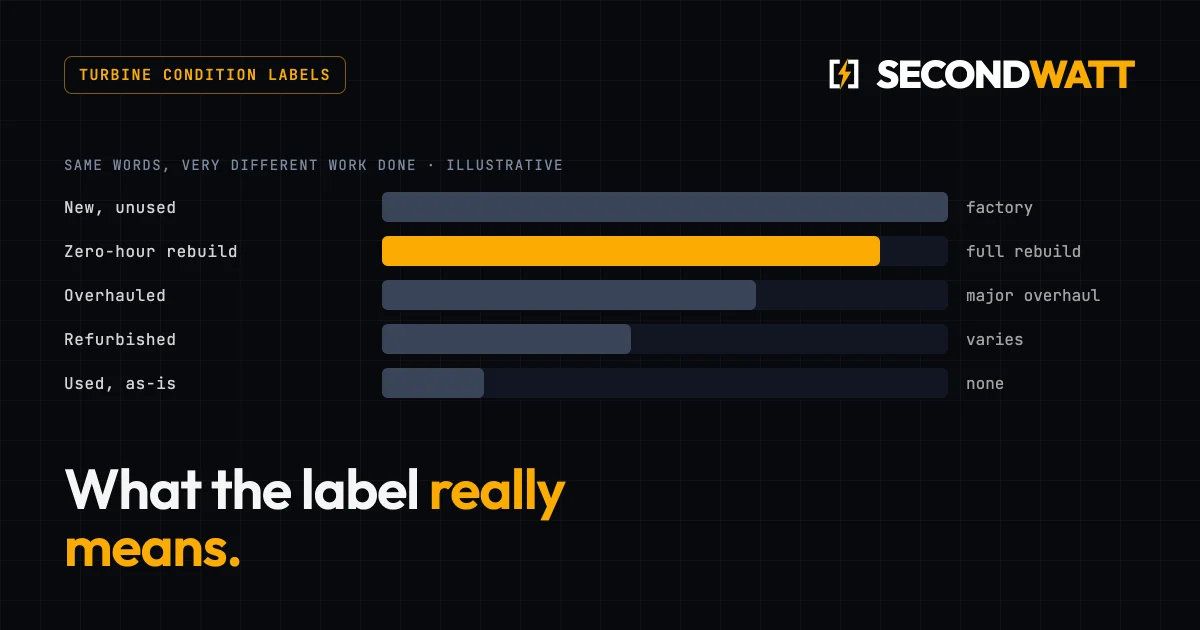
Zero-hour, overhauled, refurbished and used are claims about the work done on a gas turbine and the records kept of it. None of them is an industry-wide grade. The same word carries different weight depending on who wrote it: the original manufacturer, an independent overhaul shop or the seller.
That makes the engineer's job simple to state. Read a listing that promises a zero-hour overhaul on a gas turbine as a pointer to documents, then ask for those documents by serial number. A label backed by a matching work report, test record and warranty means what it says. A label without them is unknown until the records arrive.
Key Takeaways
- A label is a claim about work and records. The OEM, an independent shop and the seller each use the same words with different authority behind them.
- Aviation writes zero time into federal regulation. 14 CFR 91.421 ties it to a rebuild to new limits by the engine's maker or an approved agency, with a signed record.
- Overhaul levels have OEM names and scopes. GE Vernova's frame ladder runs combustion, hot gas path, major; Siemens' SGT-750 on-site ladder runs borescope, hot section, major overhaul.
- Refurbished is defined by each seller's scope. GE Vernova ties its refurbished exchange engines to a standard work scope; a dealer may also cover the package and controls.
- Three records decide acceptance and warranty. The work report naming the level, the test record for that serial, and the warranty document naming who stands behind it.
Who defines the words: OEM, shop or seller#
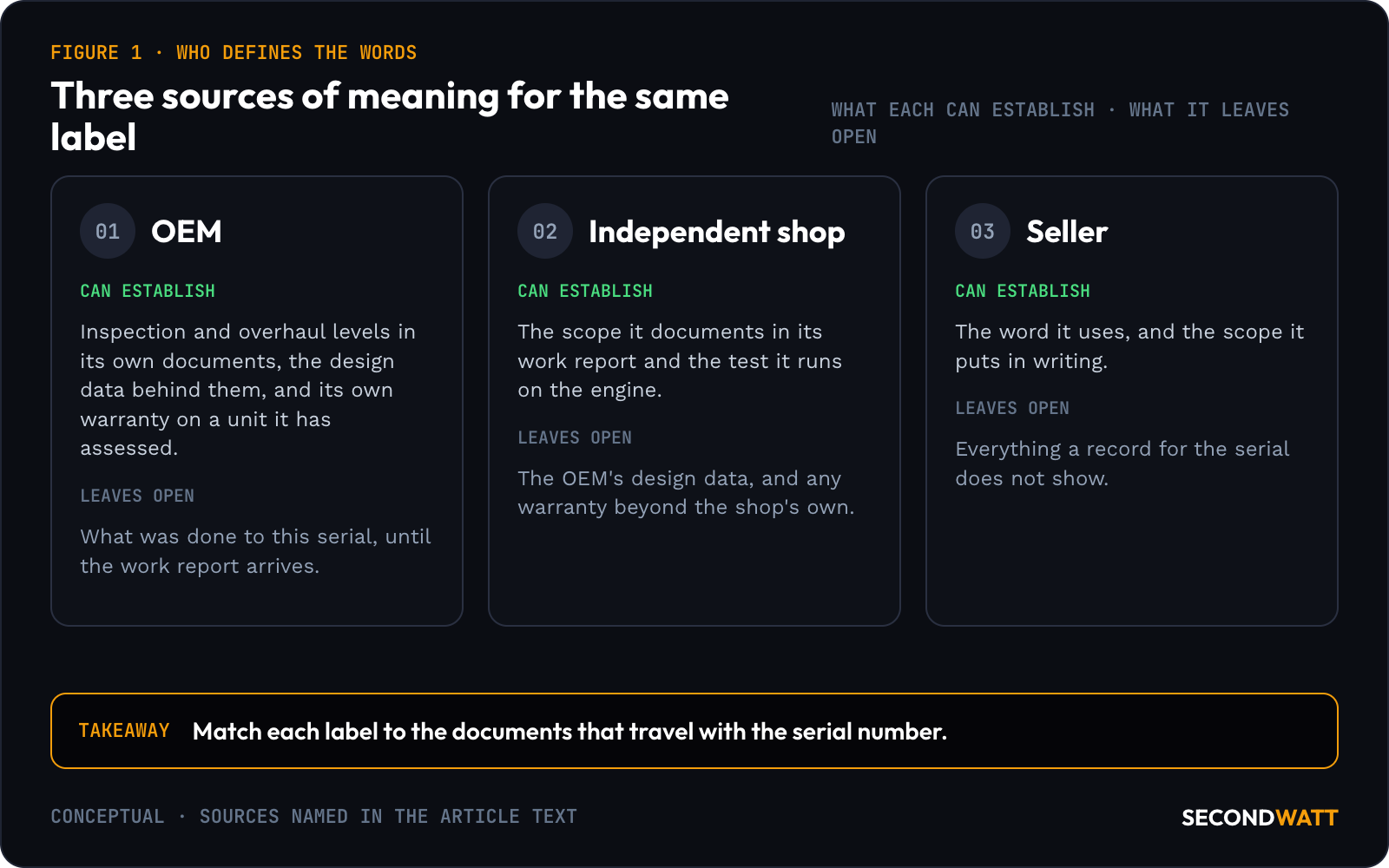
The OEM defines inspection and overhaul levels in its own maintenance documents. Solar Turbines claims the design data as an advantage, stating it keeps exclusive access to engineering specifications and applies current design improvements in each overhaul. That is a vendor claim, and it is the question to put to any shop.
An independent shop defines an overhaul by its own process and work report. Its word is as strong as the scope it documents and the test it runs. A seller may repeat one of the other two, or simply use the word. Even an OEM's pre-owned program puts the labels side by side: Solar Turbines lists used, unused, refurbished and low-hour equipment on one page, and only the record set separates them.
Aviation shows what a fixed definition looks like. US rules set out what an aircraft engine record may call overhauled or rebuilt, and Part 43 applies to aircraft with a US airworthiness certificate and their engines. An aeroderivative package on a power site carries no airworthiness certificate, so its label means what its documents show.
Zero-hour (zero-timed): what it means where it is defined#
The FAA writes the term into law. Under 14 CFR 91.421, an owner may start a new maintenance record, without previous operating history, for an engine rebuilt by its manufacturer or an agency the manufacturer approved. The party that grants zero time must enter a signed statement of the rebuild date, each change made under airworthiness directives, and service bulletin changes where the bulletin asks for the entry.
The same rule defines a rebuilt engine as a used engine that was completely disassembled, inspected, repaired, reassembled and tested to the tolerances and limits of a new engine. Three conditions sit inside that sentence: who did the work, to which standard, and with what signed record.
Apply those three tests to any industrial unit sold as zero-hour. Ask who reset the hours, and under what authority from the OEM. Ask whether parts reached new-part limits or only service limits.
Then ask for the signed statement that started the new record. A meter reading of zero hours since the last overhaul answers none of the three.
The label also has a boundary. Under 91.421 the new record belongs to the engine. A package's enclosure, generator, lube and fuel systems, inlet filtration and controls are separate equipment with their own history, so ask for their records separately. Zero-hour describes a rebuilt engine rather than a new one.
Overhauled: inspection levels, scope and the work report#
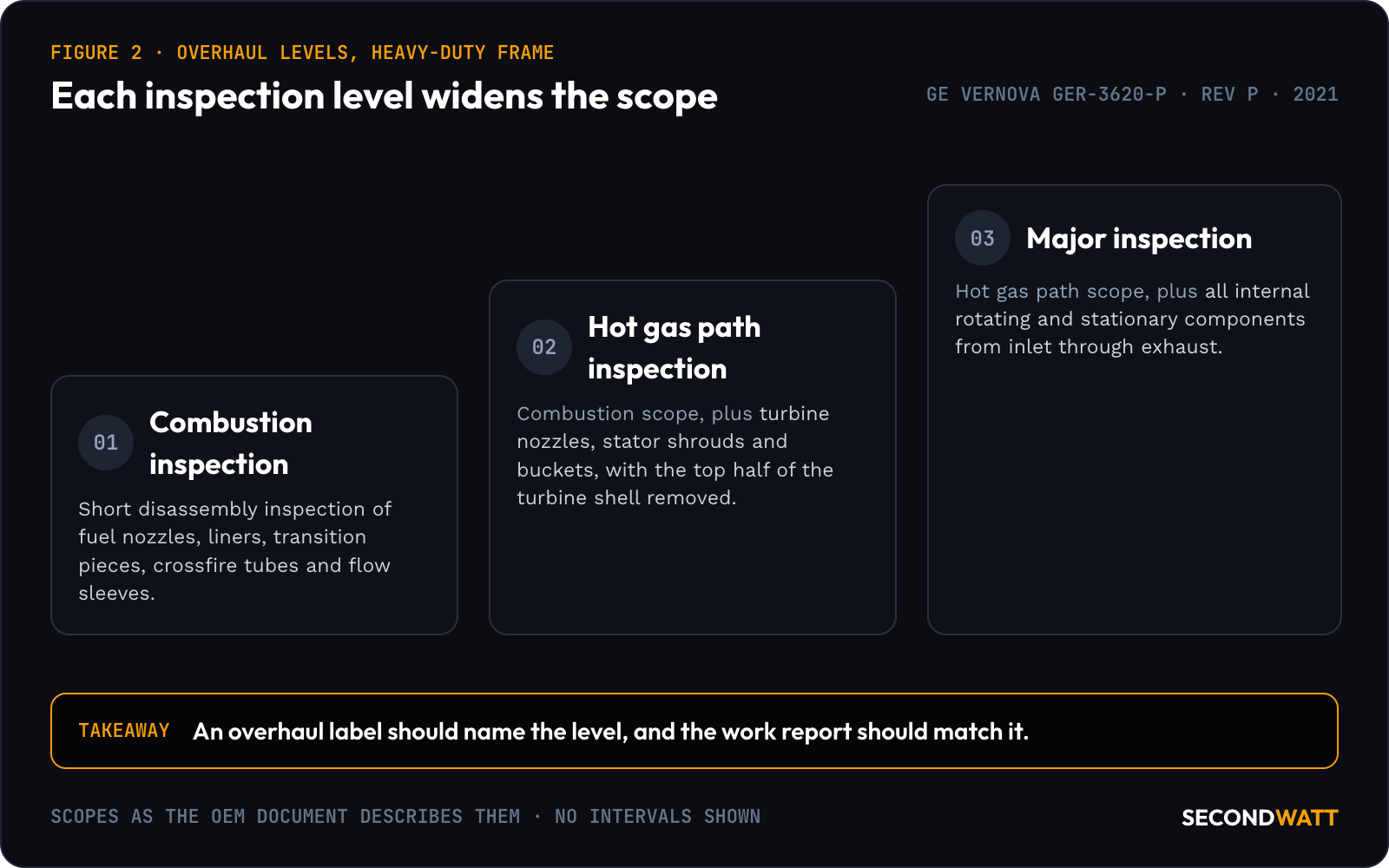
A gas turbine overhaul label should name a level the OEM recognizes, and each class of turbine has its own ladder. Rev P of GE Vernova's GER-3620-P, released March 2021, describes heavy-duty frame disassembly inspections. They progress from the combustion inspection to the hot gas path inspection to the major inspection, each including the scope of the one below it.
Aeroderivative shops are sorted by level. GE Vernova's Level 4 aero depots list hot sections, full overhaul and testing for the LM2500 and LM6000, with in-house Level 5 component repair at Avenza. Its Level-2 shops handle local maintenance. The industrial SGT-750 uses a three-level A, B, C ladder in Siemens' 2015 brochure; the on-site version ends in a major overhaul, while the off-site version replaces the B and C steps with gas-generator exchanges.
OEM inspection and overhaul levels by class (OEM documents, editions)#
| Class and example | Level, in the OEM's terms | Scope as the OEM describes it | Document |
|---|---|---|---|
| Heavy-duty frame (GE Vernova) | Combustion inspection | Short disassembly inspection of fuel nozzles, liners, transition pieces, crossfire tubes, spark plugs, flame detectors and flow sleeves | GER-3620-P, Rev P, 2021 |
| Heavy-duty frame (GE Vernova) | Hot gas path inspection | Combustion scope plus turbine nozzles, stator shrouds and buckets; top half of the turbine shell removed | GER-3620-P, Rev P, 2021 |
| Heavy-duty frame (GE Vernova) | Major inspection | All internal rotating and stationary components from inlet through exhaust | GER-3620-P, Rev P, 2021 |
| Aeroderivative LM2500, LM6000 (GE Vernova) | Level-2 shop; Level 4 depot; Level 5 component repair | Level 4: hot sections, full overhaul and testing in test cells | Aero Alliance depot page |
| Industrial SGT-750 (Siemens) | A, B and C inspections, on-site maintenance | A: borescope; B: hot section inspection; C: major overhaul (off-site, B and C are gas-generator exchanges) | SGT-750 brochure, Siemens AG 2015, PGDG-B10001-00-7600 |
The levels carry intervals too. The same 2015 brochure gives 34,000 operating hours between hot parts inspections and 68,000 between major overhauls for base-load SGT-750 operation. How those hours accumulate on a used unit is covered in how remaining life is counted.
34,000 operating hours — between hot parts inspections on a base-load SGT-750 in Siemens' 2015 brochure; a used unit's meter is read against that ladder, with the last level named.
The work report is what turns a level into evidence. It should name the level in the OEM's words, list each part as new, repaired or reused, and record the inspections done on it.
Independent depots publish their own process. One depot's five gates, as PROENERGY lists them: induction and disassembly, cleaning with fluorescent penetrant and dimensional inspection, component repair, assembly, and full-load performance testing. That is the shop's own account, and the report for your serial should show each gate.
Shop slot timing is a separate question from scope; the OEM backlog and lead times cover it.
Refurbished and reconditioned: defined by the seller's scope#
Refurbished carries whatever scope the seller attaches to it. Aeroderivative engine exchange at GE Vernova offers a new, refurbished or partial-life engine, and the refurbished units are its own engines brought to its standard, condition-based overhaul work scope. That is an OEM using the word with a defined scope behind it.
A dealer's refurbishment can reach further than the engine. One dealer's package refurbishment covers the gas generator and power turbine, lube oil and hydraulic systems, fuel skids, water injection, inlet air filters and control systems, according to USP&E. Each asset, it says, ships with service logs, inspection records, test results and OEM certificates. Those are the dealer's own terms, and they show what to ask any seller for.
Reconditioned and refurbished are also applied to generator sets, and the FAQ below covers what they mean on a 2 MW standby unit.
Used, low-hour, as-is: what the hours and starts tell you#
A used unit has no work claim at all, so its hours and starts become the record. In GER-3620-P, GE Vernova bases most of its heavy-duty maintenance requirements on independent counts of starts and hours, whichever limit is reached first. A low-hour unit with many starts can be closer to an inspection than its meter suggests. Ask for hours and starts together, dated, with the last inspection level named.
Low-hour is a description of that meter, nothing more. It says little without the operating profile, the storage history and the inspections done in between. For an aeroderivative, the LM2500 document checklist lists the records to request, and moving a unit adds its own work in relocation, transport and commissioning.
As-is has a legal meaning in US sales of goods. Under UCC § 2-316(3)(a), as adopted by the states, unless circumstances indicate otherwise, expressions like "as is" or "with all faults" exclude all implied warranties. That removes implied warranties only; any condition words written into the contract still need their records.
The label-to-records matrix#
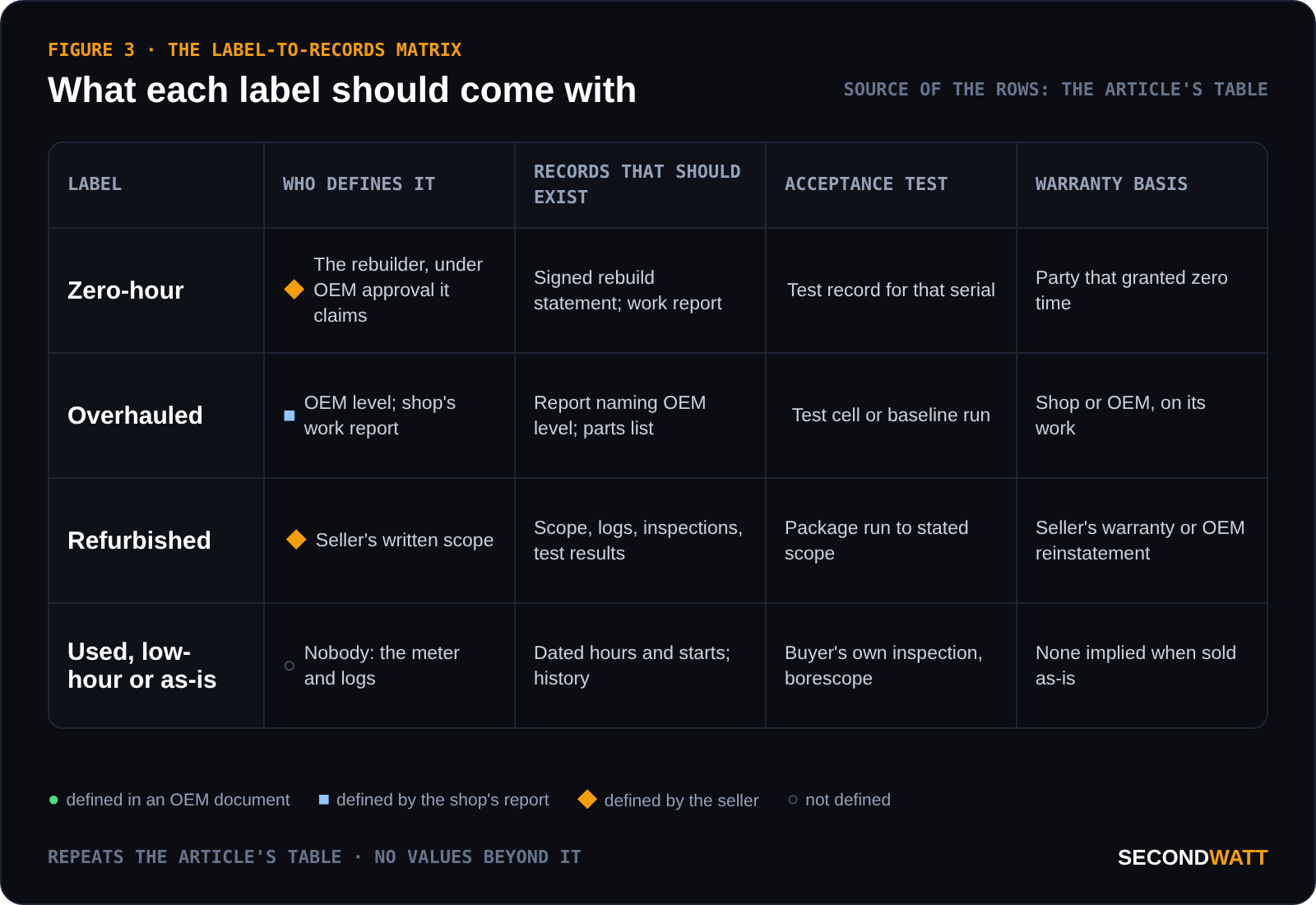
Each label maps to a record set. The matrix below is the checklist an engineer can hold against a seller's package, and the condition field on the LM6000, LM2500, Frame 5 and Taurus 60 dossiers is the place to apply it. The zero-hour row applies the 91.421 tests from above to an industrial engine.
Condition labels, who defines them, the records that should exist, the acceptance test expected and the warranty basis#
| Label | Who defines it | Records that should exist | Acceptance test expected | Warranty basis |
|---|---|---|---|---|
| Zero-hour | The rebuilder, with the OEM approval it claims | Signed statement of rebuild date; work report showing new-part limits; service bulletin record; engine serial | Test record for that engine serial after the rebuild | Written warranty from the rebuilder |
| Overhauled | OEM level names; the shop's work report | Work report naming the OEM level; parts list as new, repaired or reused; inspection results | Test-cell or string-test record, or baseline running data after reinstallation | Shop or OEM warranty on the work and parts it supplied |
| Refurbished | The seller's written scope | Scope document covering engine and package systems; service logs; inspection records; test results | Package run test to the seller's stated scope | The seller's written warranty, or OEM reinstatement where offered |
| Used, low-hour or as-is | Nobody; the meter and the logs | Dated hours and starts; operating and storage history; last inspection level and report | Buyer's own inspection, including borescope | None implied when sold as-is; otherwise as written in the contract |
The acceptance-test and warranty columns are SecondWatt's synthesis of the sections above.
3 records — decide what any label is worth: a work report naming the OEM level, a test record for that serial, and a warranty document naming its issuer.
What a label changes in the deal#
The label sets the inspection scope. A zero-hour or overhauled claim invites a check that the work report matches the engine in front of you: data plate, serial and borescope findings against the report's parts list. GER-3620-P notes that borescope inspection monitors internal components without removing casings. A used or as-is label shifts that work entirely to the buyer.
The label also shapes the acceptance test. Under GER-3620-P, baseline operating data belongs at startup of a new unit and after any major disassembly work: exhaust temperature against load, vibration, fuel flow, bearing temperatures, and startup and coast-down times. Write those parameters into the commissioning run, so the claimed work has a measured starting point on site.
Finally, the label decides who writes the warranty. Warranty reinstatement is part of Solar Turbines' pre-owned services. Warranty is listed on each of GE Vernova's aero exchange and repair options. A dealer's refurbishment carries the dealer's warranty, and an as-is sale carries no implied warranty.
Put the warranty issuer, term and scope in the RFQ checklist before any price is discussed. Sellers preparing a package can assemble the same records using the seller documentation guide.
FAQ: condition labels#
Who signs a test-cell or run report, and what should it contain?#
The facility that ran the test should sign and date it and name the engine serial. A full-load string test at one independent depot covers power output, heat rate, vibration and load, per PROENERGY's process page. A report with those values, the test conditions and the signatory gives the acceptance test on site something to compare against.
Does a condition label travel with the serial number?#
The label belongs to the serial the work was done on. Some owners keep their own engine through repair because of permitting requirements or to maintain the same engine serial number, as GE Vernova's repair options note. In an exchange the package receives a different engine, so match every record to the serial actually delivered.
Is an independent-shop overhaul worth less than an OEM overhaul?#
Judge it on the same three records as any overhaul: a work report matched to the OEM level it claims, a test record, and a named warranty issuer. Either kind of shop can carry a weak label if the report is thin.
What does "refurbished" mean on a 2 MW standby genset compared with a turbine?#
On a 2 MW standby (60 Hz) reciprocating genset, ask what was actually remanufactured: the engine, or exchanged components. Perkins Power Exchange components are brought back to original specification and carry the same 12-month warranty as new parts. A complete set still needs the engine's own records. The used 2 MW standby buyer checklist covers the records to request.
Matching the label to the records#
SecondWatt publishes equipment research and helps buyers source power equipment; it earns a fee when a sale it arranges closes. If you are buying, send a request with the condition basis you need written into it; the Transaction Readiness Summary you receive before an introduction labels each condition claim as directly confirmed, document reviewed, reported or pending. If you own a turbine and want to present it on its records, start at the gas turbine sell page.