Wartsila 34SG power optimised
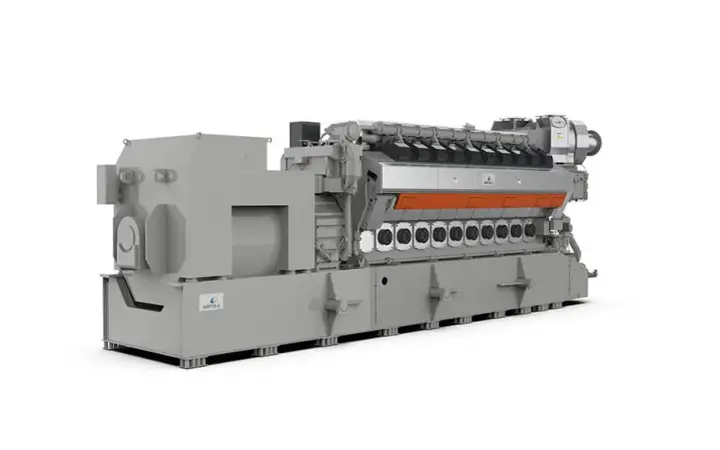
A 20V34SG retuned for 10,368 kW at 60 Hz, trading 1.3 efficiency points down to 47.5% for about 1 MW more output per engine
Wartsila 34SG power optimised is one of 23 gas engines tracked in the SecondWatt catalogue, each with specifications, lead times and indicative secondary-market pricing.
Wartsila 34SG power optimised gas engine: 10,368 kW at 60 Hz, 47.5% electrical, 7,586 kJ/kWh heat rate, and how it trades fuel efficiency for output.
The Wartsila 34SG power optimised is the 20-cylinder 34SG retuned for output rather than efficiency. It rates 10,368 kW at 60 Hz and 10,777 kW at 50 Hz, against 9,388 kW and 9,795 kW for the standard 20V34SG. The gain is roughly 1 MW per engine. It is paid for in fuel. Electrical efficiency drops to 47.5% at 60 Hz from 48.8% on the standard tune, and heat rate rises to 7,586 kJ/kWh from 7,374. On an engine running continuously that 1.3-point difference is a real operating cost, so the choice between the two tunings is a capital-versus-fuel trade rather than a preference. Wartsila positions this variant for balancing renewable generation, where the value is in megawatts available on demand rather than in fuel burned per kilowatt-hour. The same logic applies to a data center campus sized by peak block rather than by annual energy. Wartsila does not publish dimensions, dry weight, NOx or methane number on the power optimised page. Those figures should not be assumed to match the standard 34SG leaflet, because a retune can move them. The 412 MW Ohio project's 10.3 MW per engine sits between this variant's 60 Hz and 50 Hz ratings, which suggests a site-derated figure rather than a catalog one.
Why it matters
It is the clearest illustration in the gas engine class that a model designation is not a specification. Two engines badged 34SG differ by 980 kW and 1.3 efficiency points at 60 Hz. Any quotation, comparison or fit score that says only 34SG has not identified the machine being priced.
Who buys it
Developers sizing a campus by peak block who want fewer engines for a given megawatt target, and utilities buying renewable-firming capacity where availability matters more than heat rate. The trade only makes sense where the engine runs at moderate capacity factor; a baseload site should be looking at the standard tune or the 31SG.
Role in the data center
The same multi-engine logic as the standard 34SG, with fewer units for a given plant total. At 10,368 kW per engine at 60 Hz, a 400 MW block needs about 39 engines against 43 on the standard tune. That reduces civils, gas train count and switchgear bays, which is where the capital saving sits. Whether it beats the fuel penalty depends entirely on capacity factor, and that calculation belongs in the project model rather than in a datasheet comparison.
Key specifications
| Electrical output, 60 Hz | 10,368 kW continuous |
|---|---|
| Electrical output, 50 Hz | 10,777 kW continuous |
| Electrical efficiency, 60 Hz | 47.5 % |
| Electrical efficiency, 50 Hz | 47.6 % |
| Heat rate, 60 Hz | 7,586 kJ/kWh |
| Heat rate, 50 Hz | 7,560 kJ/kWh |
| Cylinder configuration | 20 cylinders, V |
| Speed | 720 (60 Hz) / 750 (50 Hz) rpm |
| Output gain over standard 20V34SG at 60 Hz | 980 kW |
Technical summary
Electrical output: 10,368 kW at 60 Hz, 10,777 kW at 50 Hz, continuous at generator terminals. Electrical efficiency: 47.5% at 60 Hz, 47.6% at 50 Hz. Heat rate: 7,586 kJ/kWh at 60 Hz, 7,560 kJ/kWh at 50 Hz. Configuration: 20-cylinder V. Speed: 720 rpm at 60 Hz, 750 rpm at 50 Hz. Positioning: balancing renewable power generation, per Wartsila. Delta against standard 20V34SG: plus 980 kW at 60 Hz, minus 1.3 efficiency points. Rating basis: continuous power-plant output, not an ISO 8528 standby rating.
Major variations
Within the 34SG platform: standard 12V, 16V and 20V, this power optimised 20V, and a 34SG-LPG variant. Wartsila applies the same tuning approach to the 31SG, which additionally offers an efficiency optimised version and a Balancer. The 31SG leaflet and the 31SG product page disagree on which output belongs to which tuning, so confirm any 31SG tuning figure on the quotation.
Pricing and availability
Comparable secondary-market band: 2000–3150 $ per kW installed. Trend: stable The hour meter sets the price in this category, not the year. An engine three years from a major overhaul is worth materially less than an older unit fresh out of one. There is no used market at this size. Lead time, new: No published lead time. Wartsila's 412 MW Ohio order ran from announcement on 16 April 2026 to a commercial operation date of early 2028, about 21 months. Treat that as an observed project duration for the 34SG platform rather than a quoted delivery for this tuning.. Lead time, used or refurbished: No used 34SG is listed in any public channel as of August 2026, so no used lead time applies..
Lifecycle and maintenance
Wartsila publishes no time-between-overhaul for any 34SG tuning. Maintenance is priced inside a long-term service agreement negotiated with the plant, so the interval is a commercial term rather than a catalog specification. There is a second reason to ask about it here specifically. An output-tuned engine runs at higher mean effective pressure than the standard tune, and a buyer should establish in writing whether the service interval, the parts basket and the warranty differ between the two tunings. Wartsila publishes nothing on that point either way.
Thermal and emissions profile
Wartsila publishes NOx at 90 ppm at 15% O2 dry, engine-out and before aftertreatment. Bergen and mtu publish 500 mg/Nm3 at 5% O2 for the same class, and they are the same number once converted: 500 x 22.414/46 = 243.6 ppmv at 5% O2, then x (20.9-15)/(20.9-5) = 0.3711 gives 90.4 ppmvd at 15% O2. 40 CFR 60 Subpart JJJJ caps non-emergency spark-ignition natural gas engines of 500 HP or more, built on or after 1 July 2010, at 82 ppmvd at 15% O2. At 90 ppmvd this engine is above the federal ceiling, so selective catalytic reduction is required to sell it in the United States at all. Treat SCR as a capital line item, not an accessory. Ozone non-attainment areas push BACT or LAER far below the NSPS floor and add urea handling.
Common failure points
- Tuning misidentification at purchase — A unit quoted as a 34SG delivers 9,388 kW rather than 10,368 kW, or the fuel bill runs 1.3 points worse than modelled
- Knock margin under poor gas — Retard and derate at a methane number that the standard tune tolerates
- SCR catalyst and urea dosing system — Stack NOx rises toward the 90 ppmvd engine-out figure and the permit limit is exceeded
- Turbocharger — Falling charge pressure and surge at part load on an engine tuned for higher output
- Charge air cooler fouling — Charge air temperature above the 25 C rating reference with progressive derate
- Cylinder heads and exhaust valves — Widening exhaust temperature spread across the 20 cylinders
Inspection checklist
Confirm the tuning on the nameplate: a standard 20V34SG and a power optimised unit are both badged 34SG and differ by 980 kW. Hours since major overhaul: Wartsila publishes no interval for the 34SG platform, so demand the service agreement schedule. Hours since top-end and head change-out: record per-bank hours across all 20 cylinders. Oil analysis trend across the last 12 samples: rising iron and chromium indicate liner and ring wear. Cylinder liner wear at top ring reversal: the 34SG platform bore is 340 mm nominal. Turbocharger shaft play and compressor wheel erosion: an output-tuned engine works the turbo harder than the standard tune. Charge air cooler fouling: compare charge air temperature against the 25 C suction air reference in the rating basis. Spark plug and ignition coil hours: log the current set across all 20 cylinders.
Procurement channels
Direct from Wartsila, through Wartsila North America, Inc. The 34SG platform is delivered both as EPC and Equipment Delivery contracts. Specify the tuning explicitly on the enquiry. A request for a 34SG quotation without naming standard, power optimised or the LPG variant will not return a comparable set of numbers.
Regional notes
Both frequencies are rated, with 60 Hz the lower at 10,368 kW against 10,777 kW at 50 Hz. North American channel is confirmed through Wartsila North America, Inc. and four US data center orders totalling over 1.6 GW.