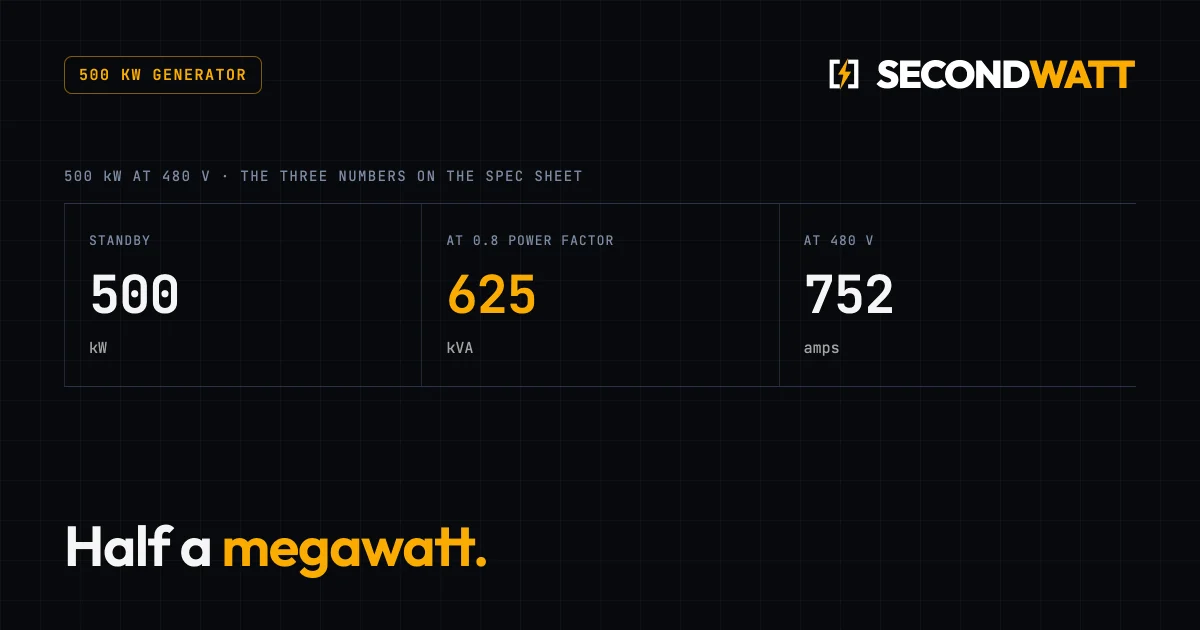
A 500 kW generator is named for its standby rating at 60 Hz: the output it supplies for the length of a utility outage. At 0.8 power factor that is 625 kVA, or about 752 A at 480 V (calculated). Prime, the rating for unlimited hours, is lower: 450–460 kW at 480 V on the sheets compared below.
One set can carry a small data hall, an edge site or a mechanical plant when three checks pass. The running load fits the rating's average-load term, the largest motor or block step fits the alternator, and the emissions certification matches the intended use.
Key Takeaways
- Read the rating basis before comparing sets. One Cat C15 package carries 500 ekW standby and 455 ekW prime at 60 Hz; only prime allows an overload.
- Low voltage multiplies the current. At 0.8 power factor, 500 kW standby is about 1,735 A at 208 V, 2.9 times the 601 A at 600 V (calculated).
- Generac's Tier 4 Final version burns more fuel. The SD500-T4 on an 18.1 L engine lists 36.5 gal/h at full standby load, about 17% above the 15.2 L emergency SD500.
- Use sets the US emissions standard. Emergency engines meet Tier 2 or 3; post-2014 non-emergency engines meet Tier 4. Both split at a 560 kW engine rating.
- On the Generac SD500, the alternator sets the largest motor step. At 480 V and a 30% voltage dip, motor-starting capability runs from 1,050 to 2,800 skVA across its alternators.
What a 500 kW generator rating means#
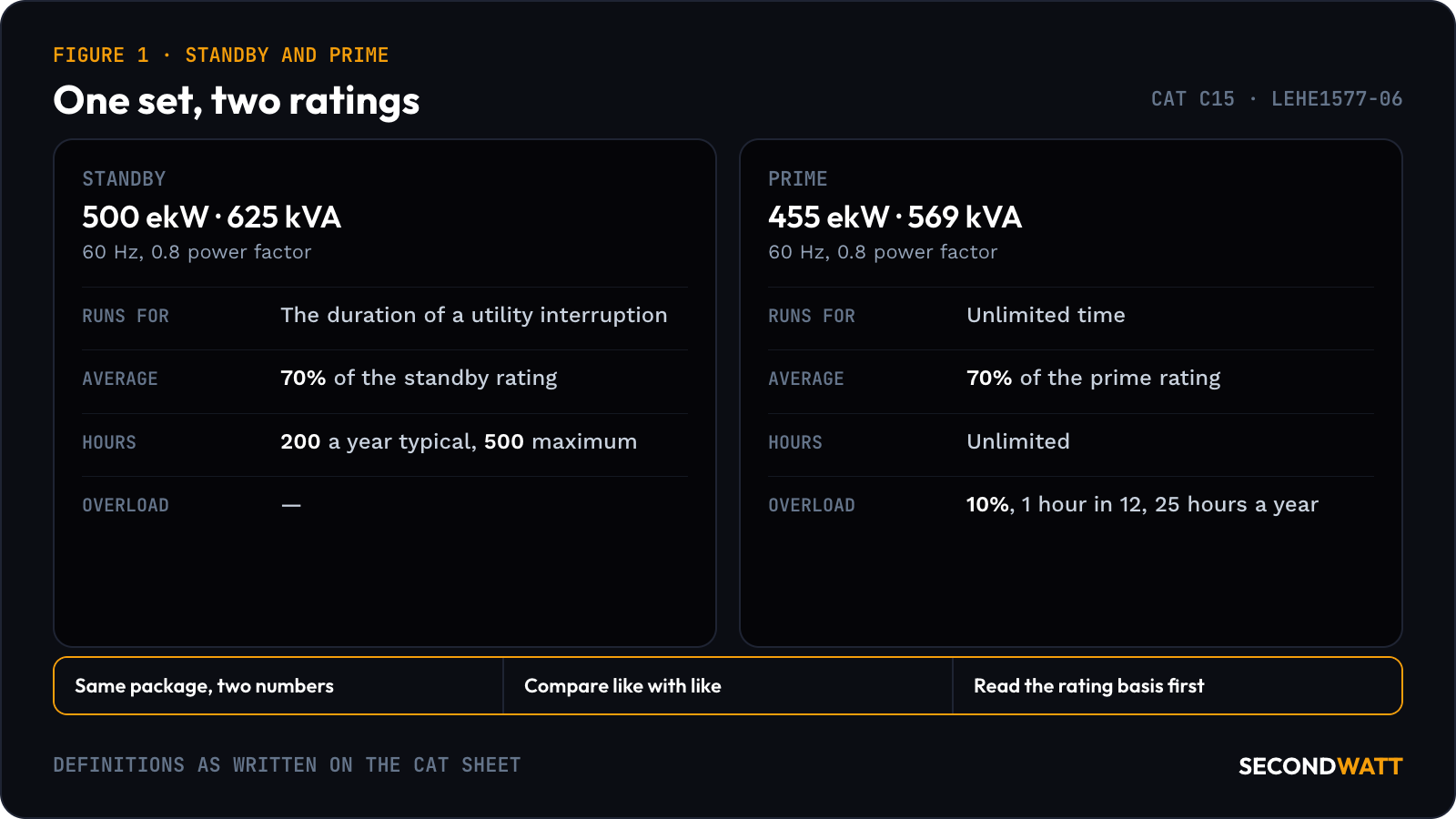
Standby, prime and base load (continuous) are duty definitions, and each puts a different number on the nameplate. Cat's data sheet LEHE1577-06, dated 12/25, rates one C15 package at 500 ekW (625 kVA) standby and 455 ekW (569 kVA) prime, both at 60 Hz and 0.8 power factor.
In Cat's definition, standby output lasts for the duration of an interruption of the normal source. Average output is 70% of the rating; typical use is 200 hours a year, with 500 the maximum expected. Prime output runs for unlimited time at the same 70% average, with a 10% overload for emergency use up to 1 hour in 12 and 25 hours a year.
Base load is lower again. On the Cummins QSX15-G9 engine sheet, dated 07/11, typical 60 Hz set outputs were 500 kWe standby, 450 kWe prime and 303 kWe base load. Base load ran at about 61% of standby (calculated). For the DFEK set on that engine, the current Cummins DFEK page lists 455 kW prime and a Data Center Continuous line, also 455 kW at 60 Hz, without defining it. The two prime figures sit in documents 15 years apart; quote the current page.
85% — the average load factor the mtu 6R0269 DS500 sheet (231301, 2026-05) allows on its standby rating, against the 70% average in Cat's C15 definition.
On a 500 kW standby set, 85% is 425 kW of average load and 70% is 350 kW (calculated). Neither the mtu sheet nor Rehlko's G5-394 sheet, dated 2/26, gives its standby rating any overload capability. Both give ISO 8528-1 as the rating basis. The prime power rating explainer covers the definitions in depth.
The 500 kW diesel generator sets you will meet#
Seven sets from five OEMs sit at a 500 kW standby rating, 60 Hz, and differ in engine, prime figure and emissions certification. The generator category holds dossiers for the wider range.
500 kW-class diesel generator sets: standby and prime ratings at 60 Hz, engine, displacement and emissions certification (OEM datasheets, revision noted)#
| Model (OEM document, revision) | Standby, 60 Hz | Prime, 60 Hz | Engine and displacement | Engine output on the sheet | EPA certification on the sheet |
|---|---|---|---|---|---|
| Cat C15 (LEHE1577-06, 12/25) | 500 ekW / 625 kVA | 455 ekW / 569 kVA | Cat C15, in-line 6, 15.2 L | Not listed | Tier II non-road (the C15 product page says Tier 3 for the 350–500 ekW range) |
| Cat D500 GC (LEHE2011-10, 04/24) | 500 ekW / 625 kVA | Standby-only sheet | Cat C15, in-line 6, 15.2 L | Not listed | Stationary emergency, Tier 2 |
| Cummins DFEK (product page rating; engine sheet 07/11) | 500 kW / 625 kVA | 455 kW / 569 kVA | Cummins QSX15-G9, in-line 6, 15 L | 563 kWm gross standby (engine sheet) | Page lists stationary emergency and non-emergency options; engine sheet: emergency, Tier 2 |
| Generac SD500 (A0001404640 revision E, 18 Sep 2026) | 500 kW / 625 kVA | 450 kW / 563 kVA (EPA-certified prime not offered in the US) | Perkins, in-line 6, 15.2 L | 755 hp at rated kW | Stationary emergency |
| Generac SD500-T4 (A0004270738 revision G, 4 Apr 2025) | 500 kW / 625 kVA | 456 kW / 570 kVA | Perkins 2806F-E18TAG1, 18.1 L | 744 hp at rated kW | Tier 4 Final, stationary |
| Rehlko 500REOZVC (G5-394, 2/26) | 400–515 kW across alternator, voltage and temperature rise | 400–460 kW | Volvo TAD1641GE-B, in-line 6, 16.12 L | 565 kWm maximum at rated rpm | Stationary emergency, Tier 2 |
| mtu 6R0269 DS500 (231301, 2026-05) | 500 kWe / 625 kVA | Standby-only sheet | Volvo TAD1641GE-B, in-line 6, 16.12 L | 565 kWm maximum | Tier 2; SCAQMD |
At 277/480 V, 60 Hz and 0.8 power factor, the Rehlko 5M4024 alternator reads 505 kW (631 kVA) standby at 150 °C rise and 475 kW (594 kVA) at 130 °C. Rehlko's G5-394 sheet lists that alternator for IBC or OSHPD orders only; the 5M4027 reads 505 kW standby at both rises.
Generac builds the 500 kW standby rating twice. Revision E of the SD500 sheet describes an emergency set on a 15.2 L Perkins engine. Revision G of the SD500-T4 sheet describes a Tier 4 Final set on an 18.1 L Perkins 2806F-E18TAG1. For the next sizes up, the Caterpillar C27 dossier covers a 750–800 ekW standby set and the Cummins QST30 dossier a 1,000 kW standby set, both at 60 Hz. The 1.5 MW diesel specification page applies the same reading to larger sets.
What to ask a bidder for on a 500 kW standby set#
| Ask for | Why it matters |
|---|---|
| The rating line for the quoted alternator, voltage and temperature rise | Standby kW changes with each on the Rehlko sheet |
| A written definition of any rating beyond standby and prime | Cummins lists Data Center Continuous without defining it |
| Fuel consumption on a stated fuel basis | Tables compare only on a common basis |
| Maximum engine power from the emissions data sheet | It places a non-emergency engine in a Tier 4 row |
| The transient test report for the quoted alternator and voltage | It gives the voltage dip during a load step |
| The sound level for the quoted enclosure at a stated distance | Enclosure and distance both change the reading |
| Lead time against the full configuration | Engine, alternator, enclosure and tank each change the build |
kVA, amps and voltage for a 500 kW rating#
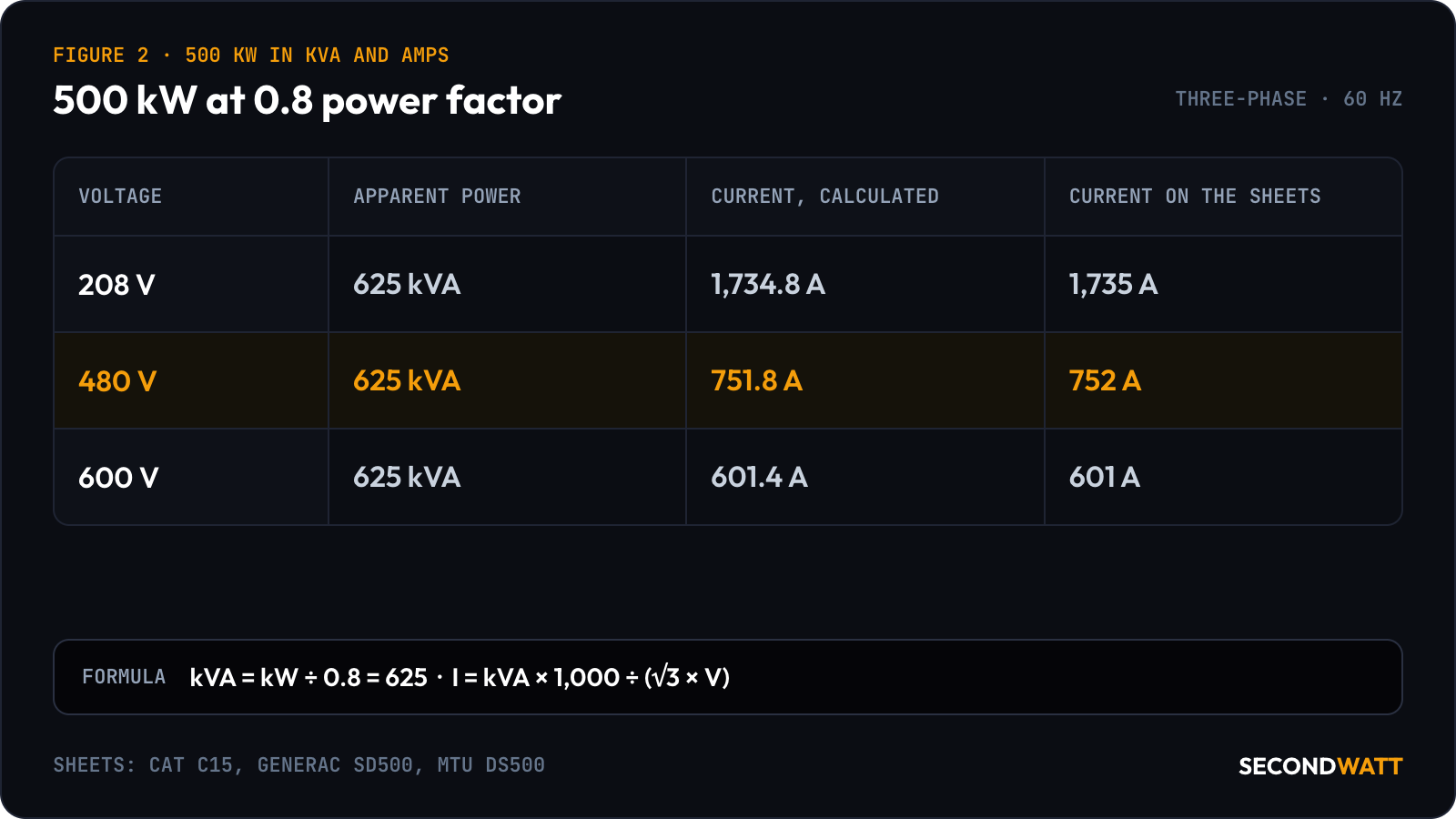
The alternator and every breaker downstream carry apparent power, so convert the standby kW to kVA first. At 0.8 power factor, 500 kW ÷ 0.8 = 625 kVA. Line current then follows from I = kVA × 1,000 ÷ (√3 × V).
500 kW standby at 0.8 power factor: apparent power and line current at three voltages (calculated; datasheet values beside them)#
| Voltage, three-phase, 60 Hz | Apparent power | Current, calculated | Current printed on the Cat C15, Generac SD500 and mtu DS500 sheets |
|---|---|---|---|
| 208 V | 625 kVA | 1,734.8 A | 1,735 A |
| 480 V | 625 kVA | 751.8 A | 752 A |
| 600 V | 625 kVA | 601.4 A | 601 A |
At 208 V the current is about 2.9 times the 600 V figure (1,734.8 ÷ 601.4, calculated). The transfer switch is sized from that current, and the transfer switch sizing guide sets out the method.
Fuel consumption and tank hours#
Fuel burn comes from the OEM table for the exact model and rating. Of the three sheets below, only Cat's states a fuel basis: 35° API gravity with a lower heating value of 18,390 Btu/lb at 85 °F.
Fuel consumption of three 500 kW standby sets at 60 Hz, gal/h (OEM datasheets, revision noted)#
| Load | Cat C15, with fan (LEHE1577-06) | Generac SD500 (revision E) | mtu 6R0269 DS500 (231301) |
|---|---|---|---|
| 25% | 10.8 | 9.6 | Not listed |
| 50% | 18.4 | 18.45 | 18.1 |
| 75% | 28.5 | 24.9 | 27.3 |
| 100% | 35.3 | 31.1 | 36.6 |
At half load the three sheets agree within 0.35 gal/h. At light, three-quarter and full load the highest figure runs 12.5–17.7% above the lowest (calculated). The Tier 4 Final SD500-T4 lists 36.5 gal/h at full standby load, about 17% above the emergency SD500 (36.5 ÷ 31.1, calculated).
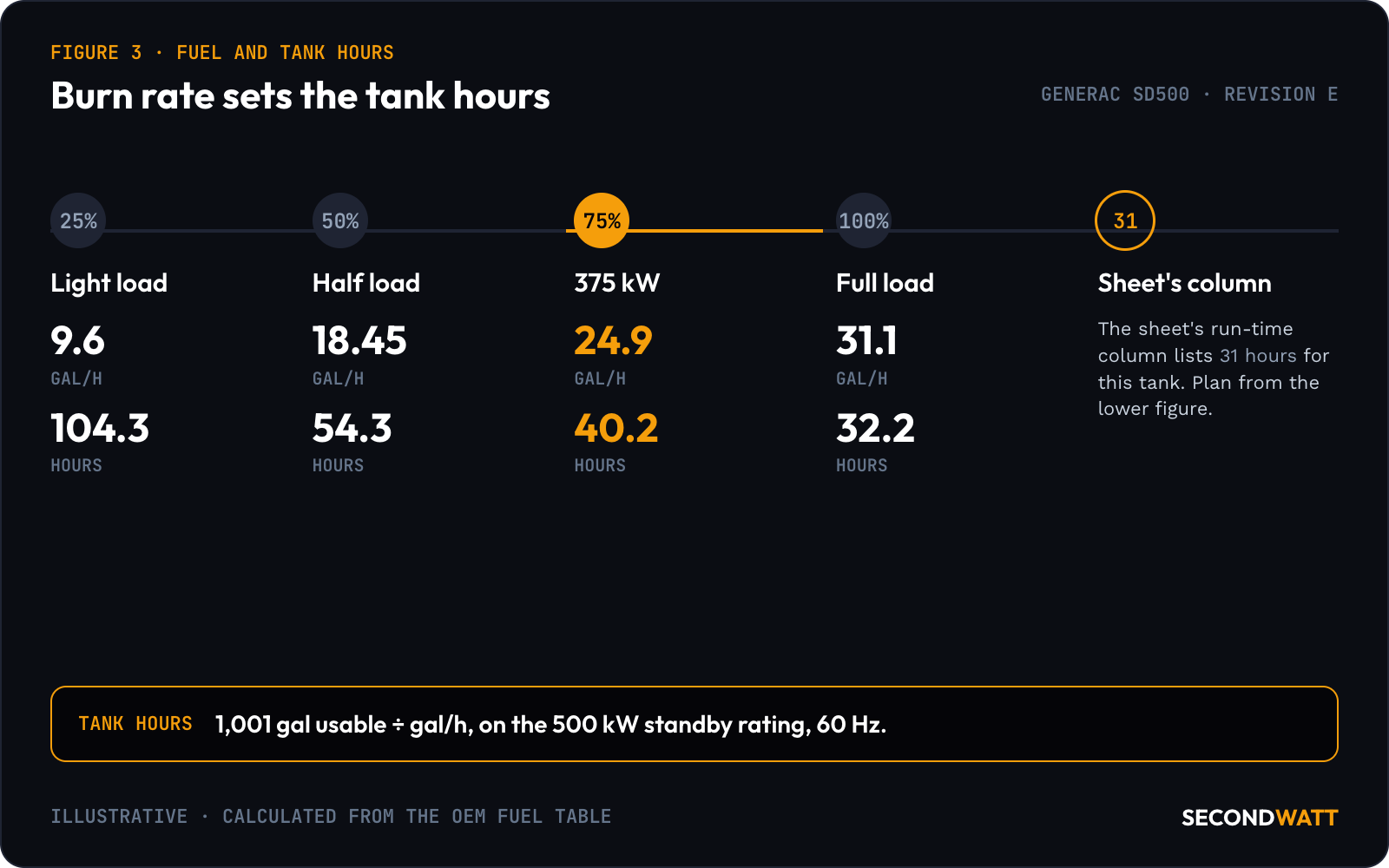
Worked example: run hours from a 1,001-gal usable tank on the Generac SD500 (illustrative; calculated from the revision E fuel table)#
| Load on the 500 kW standby rating | Fuel, gal/h | Hours = 1,001 ÷ gal/h |
|---|---|---|
| 25% | 9.6 | 104.3 |
| 50% | 18.45 | 54.3 |
| 75% (375 kW) | 24.9 | 40.2 |
| 100% | 31.1 | 32.2 |
At full load the arithmetic gives 32.2 hours, while the sheet's own run-time column lists 31 hours for that sub-base tank. Plan from the lower figure.
Emissions: emergency or non-emergency use#
In the US, 40 CFR part 60 subpart IIII covers stationary compression-ignition (diesel) engines whose construction commenced after 11 July 2005. Under 40 CFR 60.4200, it applies to engines made after 1 April 2006, fire pump engines aside, and construction commences when the owner orders the engine. State and local air permits can add conditions.
As defined in § 60.4219, an emergency engine supplies power when the utility or normal source is interrupted.
100 hours — the calendar-year cap on maintenance checks and readiness testing for an emergency engine under US federal rule 40 CFR 60.4211(f)(2).
More hours need an EPA petition, or records showing that a federal, state or local standard requires them. Under § 60.4211(f), up to 50 of the 100 hours may be non-emergency use.
Those 50 hours cannot go to peak shaving, non-emergency demand response or supplying power under a financial arrangement. Paragraph (f)(3)(i) allows the last only under local grid-operator dispatch, with further conditions. An engine run outside these limits "must meet all requirements for non-emergency engines".
That use test decides the standard. The routes below, from § 60.4201(a) and § 60.4202(a), cover engines rated up to 2,237 kW and under 10 liters per cylinder, which includes these 15–18 L six-cylinder engines.
Under § 60.4205(b), which points to § 60.4202(a)(2), owners of 2007 and later emergency engines meet the Tier 2 or Tier 3 nonroad standards for the same rated power. Appendix I to part 1039 lists Tier 3 standards only up to 560 kW rated power; above 560 kW it lists Tier 2 alone.
Under § 60.4204(b), which points to § 60.4201(a), owners of 2007 and later non-emergency engines meet the part 1039 standards for model year and maximum engine power. For model year 2014 and earlier, § 1039.102 applies; after model year 2014 the limits are the Tier 4 standards of § 1039.101.
Tier 4 exhaust standards after model year 2014 by maximum engine power, g/kW-hr (40 CFR 1039.101 Table 1, US federal rule)#
| Pollutant | Engines rated 130–560 kW maximum engine power, all applications | Generator-set engines rated above 560 kW maximum engine power |
|---|---|---|
| PM | 0.02 | 0.03 |
| NOx | 0.40 | 0.67 |
| NMHC | 0.19 | 0.19 |
| CO | 3.5 | 3.5 |
For a non-emergency set, the 560 kW line is a maximum engine power rating: under § 1039.140, the maximum brake power on the engine's nominal power curve, a certification value. The generator's ekW rating is a smaller number.
Listed engine outputs in this class sit on both sides of that line. The QSX15-G9 lists 563 kWm gross at standby and the Volvo TAD1641GE-B 565 kWm maximum. The Generac sheets list 755 hp (about 563 kWm) and 744 hp (about 555 kWm) at rated kW (calculated), and both send permitting users to the emissions data sheet for maximum bhp.
The engine's EPA label shows which use it was certified for. Under § 60.4210(f) and Table 5, new emergency engines rated 130 kW and above that meet only the emergency standards carry a permanent label from model year 2011. It states that the engine is for stationary emergency use only.
A Tier 4 Final set also burns diesel exhaust fluid: 1.3 gal/h at full standby load on the SD500-T4. The Tier 4 Final guide covers the aftertreatment.
What a 500 kW generator can carry#
Three OEMs state one-step acceptance of full rated load. The Rehlko 500REOZVC lists 100% of rating, and the mtu DS500 accepts rated load in one step per NFPA 110 and is tested to ISO 8528-5 for transient response. The C15 accepts 100% block load in one step, in Cat's own description on its C15 product page.
An acceptance statement gives no voltage dip, and Cat's LEHE1577-06 sheet refers configuration- and site-specific transient classification to its dealers.
Motor-starting capability is the starting kVA (skVA) a set can supply while voltage dips by a stated amount. Rehlko publishes its figures at a 35% dip, so the table compares the three sheets that use 30%; the Cat figure is from the D500 GC sheet, LEHE2011-10.
Motor-starting capability of 500 kW standby sets at 480 V, 60 Hz (skVA at a 30% voltage dip; OEM datasheets)#
| Set and document | Alternator | skVA at 30% dip |
|---|---|---|
| Generac SD500 (revision E) | K0500124Y23 (standard) | 1,050 |
| Cat D500 GC (LEHE2011-10) | M3154L41 | 1,160 |
| Generac SD500 (revision E) | K0600124Y23 | 1,560 |
| mtu 6R0269 DS500 (231301) | 572RSL6427 | 1,890 |
| Generac SD500 (revision E) | K0832124Y23 | 2,800 |
On one Generac sheet, alternator choice moves motor-starting capability about 2.7 times (2,800 ÷ 1,050, calculated).
Illustrative running load for one 500 kW standby set, 60 Hz (assumed loads; arithmetic shown)#
| Load | Running kW (assumed) |
|---|---|
| IT load through the UPS | 250 |
| Cooling | 90 |
| Lighting, controls and life safety | 20 |
| Total | 360 kW running load, or 450 kVA at 0.8 power factor |
That 360 kW is 72% of the 500 kW standby rating (calculated): above the 70% average in Cat's standby definition and inside the 85% mtu allows. Check it against the average-load term of the chosen set. If the cooling plant starts as one block, compare its starting kVA with the skVA table above.
Footprint, enclosure and sound#
Open-set lengths run from 3,476 mm (Cat C15) to 4,815 mm (Cat D500 GC on its wide skid or integral tank base) on these sheets. On the Generac SD500 sheet, a Level 2 sound-attenuated enclosure adds 1,243 mm of length and 1,190 mm of height to the open set on the same 1,001-gallon tank (5,268 × 3,813 mm against 4,025 × 2,623 mm, calculated).
Dimensions and weights of 500 kW standby sets at 60 Hz as listed (OEM datasheets; not for installation)#
| Set and document | Configuration | Length × width × height | Weight as listed |
|---|---|---|---|
| Cat C15 (LEHE1577-06) | Open set | 3,476 × 1,628 × 2,128 mm | 4,365 kg dry |
| Cat D500 GC (LEHE2011-10) | Open set on integral tank base, 877.8 gal usable | 4,815 × 1,630 × 2,584 mm | 4,693 kg, basis unstated |
| Generac SD500 (revision E) | Open set, no tank | 3,923 × 1,803 × 1,709 mm | 3,807–4,799 kg, basis unstated |
| Rehlko 500REOZVC (G5-394) | Radiator model | 4,229 × 1,829 × 1,942 mm | 4,082 kg wet, maximum |
| mtu 6R0269 DS500 (231301) | Open power unit | 3,875 × 1,346 × 2,048 mm | 3,824–4,916 kg, estimate |
The mtu DS500 open power unit measures 92.9 dB(A) at 7 m (23 ft) at full standby load, tested to ISO 8528-10 with infinite exhaust.
New, rental or used#
A new set is built to its options. The Generac SD500 sheet lists alternator upsizing, a weather-protected enclosure, three sound-attenuated enclosure levels and, where a tank is selected, a UL 142 double-wall sub-base tank.
Rental bridges the build or an inspection period. Under § 60.4200(e), a rental acting as a temporary replacement unit, on site under a year and certified to the applicable nonroad standards, need not meet subpart IIII's other provisions. The bridge power guide covers temporary supply, and the docking station explainer covers the connection point a rental unit uses.
A used set is judged on its records: the EPA label, model year, emissions data sheet, alternator model, and hour-meter and service history. The install deadlines in § 60.4208 do not apply to an engine removed from one location and reinstalled at another; that exemption covers the section's own requirements only. The used 2 MW standby checklist sets out the inspection steps for the larger class.
FAQ: 500 kW standby generators#
Is a 500 kVA generator the same as a 500 kW generator?#
No. A kVA rating is apparent power, so at 0.8 power factor 500 kVA × 0.8 = 400 kW (calculated). A 500 kVA set is a 400 kW set on that basis.
Can two 250 kW standby generators replace one 500 kW standby set?#
They can, if paralleling controls synchronize the two sets and share kW and kVAR between them. Check the largest load step against what the pair accepts together. The paralleling switchgear guide covers the gear that does this.
Can a 500 kW standby set run on renewable diesel?#
Rehlko and mtu approve it for the sets above. The Rehlko 500REOZVC takes hydrotreated vegetable oil and renewable diesel to EN15940 or ASTM D975, with volumetric fuel use up to 4% higher than #2 ultra-low-sulfur diesel. The mtu DS500 runs on HVO and gas-to-liquid fuels meeting EN15940.
How much is a 500 kW generator?#
Price follows the build: rating, emissions version, alternator, enclosure and tank each change the quote. Compare quotes only on the same configuration. Generator benchmark ranges by condition tier are on the pricing page.
Choosing the set#
SecondWatt publishes equipment research and helps buyers source power equipment; it earns a fee when a sale it arranges closes. If you are sourcing a 500 kW set, send the rating type, voltage, emissions use and largest load step through a request for quote. Owners with a set to place can start from the generator seller page.